Time is flying; it’s already been a week since Thanksgiving. I hope you all had time to enjoy the day.
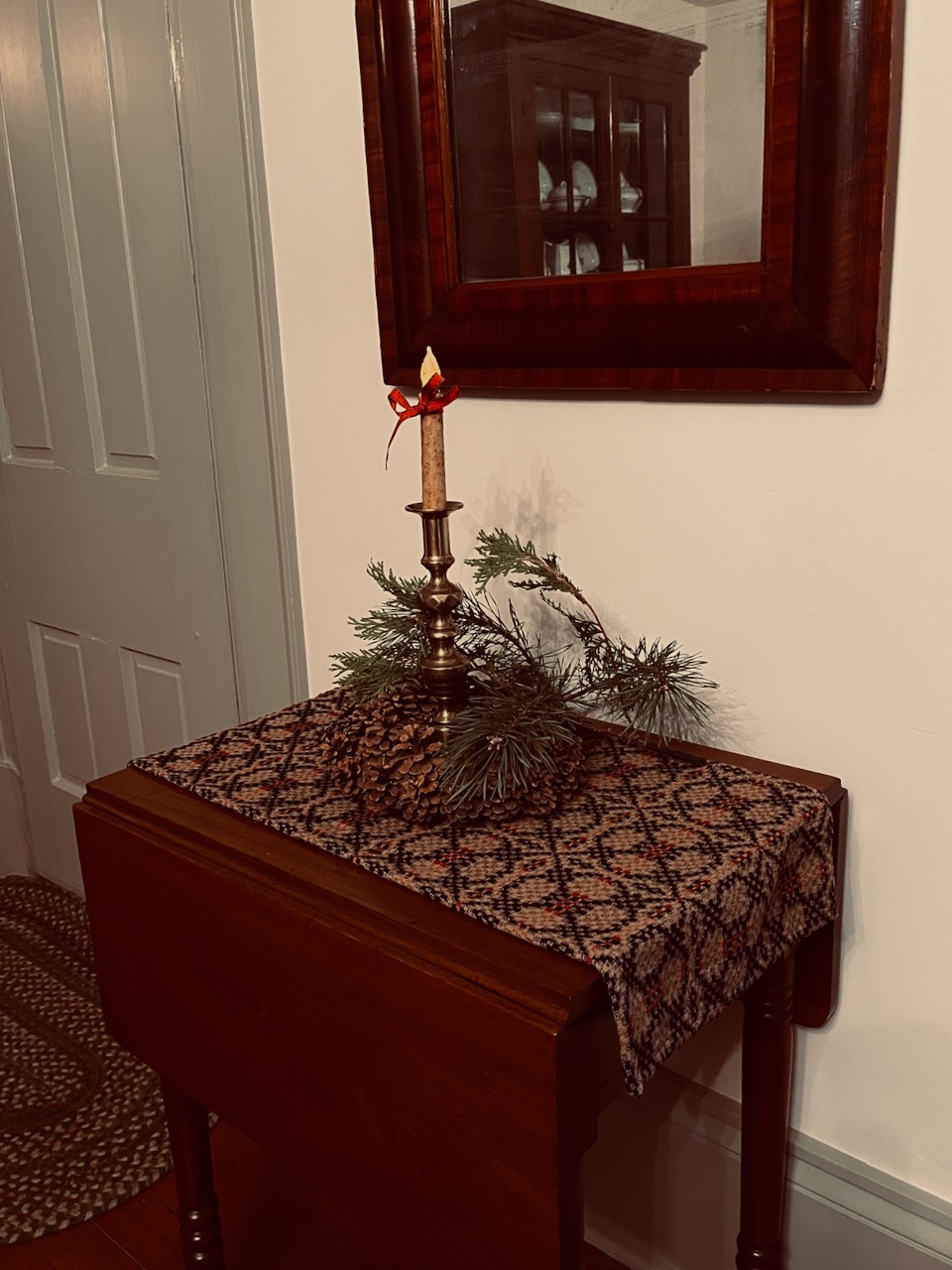
I’m in the middle of preparing several Clark House Historian posts and the writing is going slowly. But! December is here and I’m starting to feel the holiday spirit. So until I finish my current research and writing project (we’ve got to bring the Bonniwells back from the California gold rush!), how about a seasonal photo from my most recent visit to the Clark House?
Clark House front parlor with holiday candle, 2022. Photo credit: Reed Perkins.
Provenance is an important concept for historians, collectors and museums. It refers to the chain of ownership of any collectible item, including manuscripts, artworks, official documents or, in our case, a family Bible. Establishing the provenance of an item—such as the Bonniwell Bible—from its creation to the present day is important for several reasons:
By studying this Bible as an artifact, a book published on paper, we are establishing its history and authenticity as a Bible, published in London, England, by Christopher Barker, in the Geneva translation, including copious notes, helps and other additions, probably during the reign of Queen Elizabeth I and, more specifically, circa 1580-1603.
By studying the inscriptions in this Bible, we can also try and establish who owned the book, and when they owned it. The more we know about this, the more confident we can be about the historical and genealogical information found in the Bible’s many inscriptions.
Who owned it first?
That’s still a bit of a mystery. On the one hand, we do have a solid—though perhaps not unbroken—history of Bonniwell family inscriptions in this Bible, beginning in 1697 and continuing through the early 1900s. First-person family recollections record the Bible’s direct descent from that time until the present day. And we know that this Bible was first in the possession of a related branch of the Bonniwell family and then owned by “our” Bonniwells no later than 1795:
Bonniwell Bible, detail, showing inscription by William Bonniwell, 1798, and ligature WBonniwell, 1795. photo credit: Kendalyne Gentile, 2022.
I hope you liked our recent re-post of Back to School, 1839! And since I’m still working on a number of new but not-yet-ready projects, I thought you might also enjoy a revised and expanded version of a related post that was first published September 2, 2020.
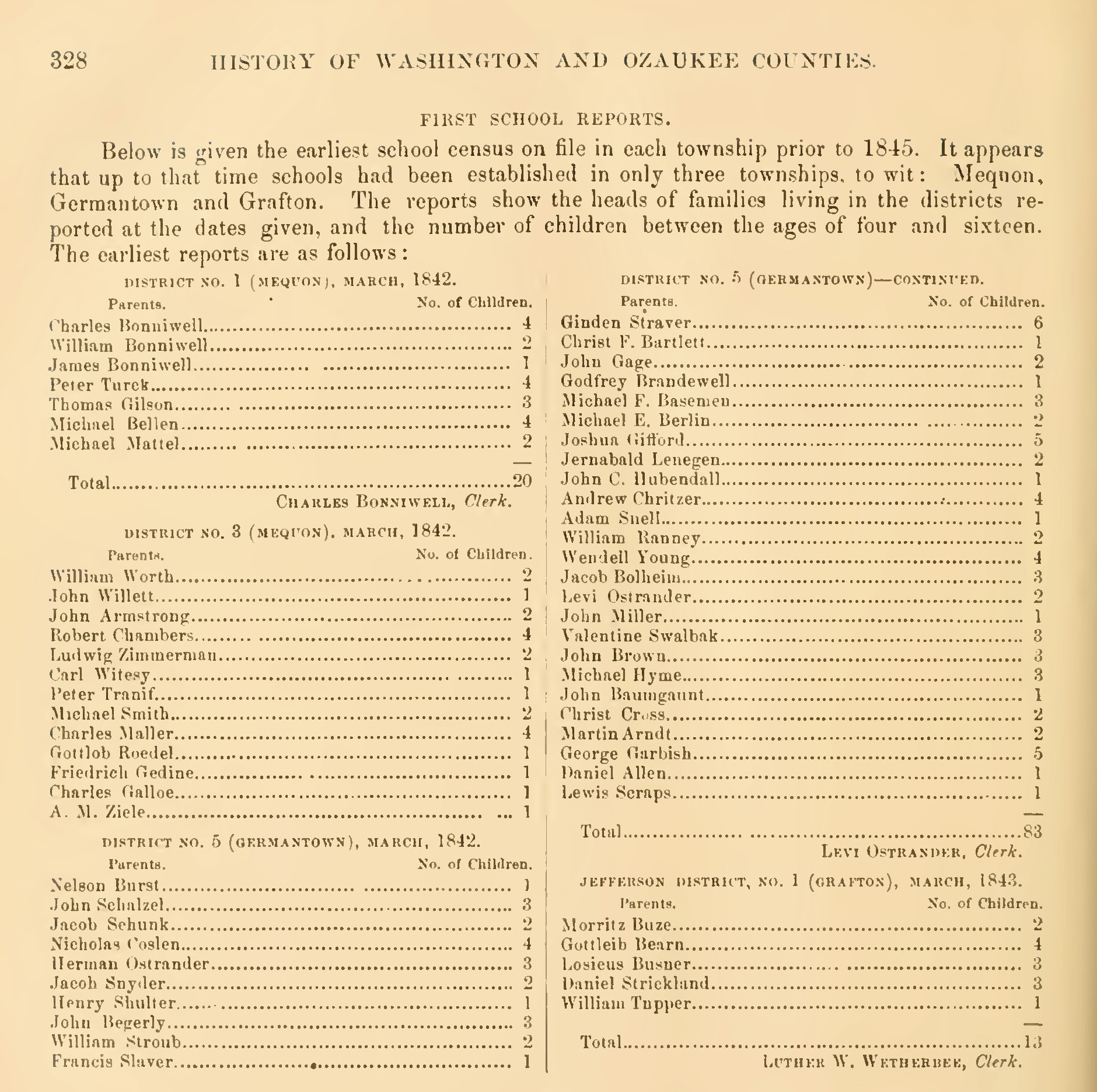
It’s “Back to School” time for many of us, so I thought you might be interested in this transcription of the earliest known school records of old Washington/Ozaukee county prior to 1845, published on page 328 of the History of Washington and Ozaukee Counties, Wisconsin […] Illustrated. Western Historical Co., Chicago, 1881:
Click to open a larger image in a new window, and see which of the early settler families had school age children, that is, children between the ages of 4 and 16, in 1842 and 1843. (Current Washington and Ozaukee county readers: do you have any kin listed in this summary of early school censuses? Let us hear from you via the Leave a Reply box, below.)
I’m still busy annotating maps for upcoming Bonniwell-related blog posts. So instead of my planned Gold Rush themed Monday: Map Day! essay, I hope you enjoy this Clark-era image of a common visitor to much of North and South America—including Wisconsin—the Great Horned Owl.
Havell, Robert, jr., engraver, after John James Audubon, Great Horned Owl, 1829, plate 62 from The Birds of America (1828-1838), hand-colored engraving and aquatint on Whatman wove paper. National Gallery of Art, Gift of Mrs. Walter B. James. Public domain. Click to open larger image in new window.
UPDATE, Nov. 30, 2022: The discussion of the William Bonniwell signatures and dates, below, is not correct. I have lined-through the incorrect paragraph and added the correct info in two new paragraphs below the original misinformation.
It may not look like much on the outside. It’s old. Not very big. Whole pages are missing, others are damaged. The binding is worn.
Bonniwell Bible, front cover. Photo credit: Kendalyne Gentile, 2022
But this modest book was—for over 300 years—the family Bible for Mequon’s pioneer Bonniwell family, their ancestors and descendants. And last month, the Bible’s most recent owner, Bonniwell descendant Kendalyne Gentile, generously gave the Bible and other Bonniwell family documents to the Jonathan Clark House Museum where they will form an important part of our permanent collection.
Summer has finally settled in here in Wisconsin, and the Jonathan Clark House is ready to host you once again on Saturday, July 16, 12pm – 3pm to enjoy all the old fashioned fun in the very spirit of the season for the second installment of our summer series event Heritage Days!
In addition to our favorite features, our special attractions for July include:
Jonathan Clark House Museum, pantry area, June 29, 2022. Photo by Reed Perkins.
Yesterday was the annual “Pie on the Patio” fundraising event for the Jonathan Clark House Museum. I made the drive up to Mequon and had a great time visiting and talking history with many old—and new—Clark House friends.
We have new partnership project with the Mequon Nature Preserve and MATC’s Kate Erickson, the Brown Bag Series: Mother Earth is Where We All Meet. Today is the second installment in the series, and our executive director Dana Hansen will be speaking on “European Settlement and the Shift of Mindset About the Earth.”
Old World Wisconsin, July, 2016. Photo credit: Anna Perkins. Click to open larger image in new window.
Guess what I did instead of writing a new Clark House Historian post! Here’s a clue, from about this time last year (revised and expanded for 2022)…
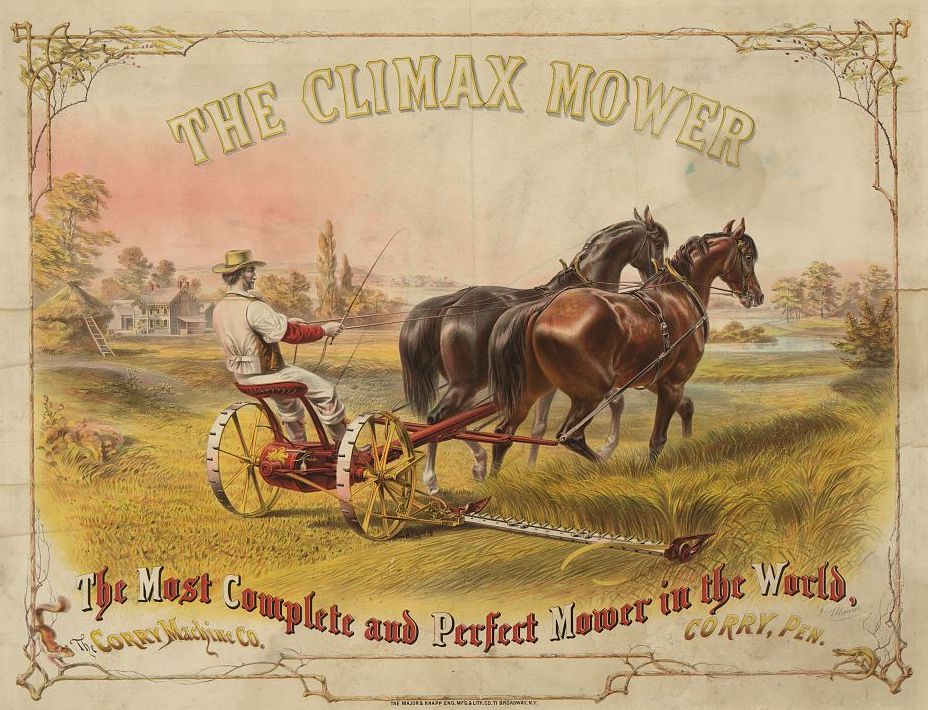
Spring weather in southeastern Wisconsin is pretty hard to predict these days. Spring 2021 was awfully dry. This year, spring has been wetter overall—I think—but the days have zigzagged rapidly and unpredictably between chill and damp or hot and humid. It’s almost like we haven’t had a proper Midwestern spring at all. And yet, the grass around the Historian’s house has already gotten pretty tall and scruffy. So it was time to get out the mower and tidy up (some of) the yard.
Maurer, Louis, Artist. The climax mower, most complete and perfect mower in the world, the Corry Machine Co., Corry, Pen. / L. Maurer. United States, None. [NY: the Major & Knapp Eng., Mfg. & Lith. Co., between 1869 and 1872] Photograph. Library of Congress.




 Clark House Historian