At the end of last month, while working on some longer posts about the Turcks and Clarks, I had some fun creating the first Clark House Historian Reader Challenge: where you get to be the historian!, and today we have the results. The original challenge went something like this:
Here’s an excerpt of a document that will be part of an upcoming post. Can you read and transcribe it? (Ignore the squiggles in the top right corner, they belong to another record on the same page.)
The original CHH Reader Challenge #1. Click to open larger image in new window.
And I gave y’all a hint, the full page from which this record was excerpted. And as a second hint, I suggested that a look at my discussion of Kurrenthandwriting might be helpful.
So what is this a record of, and what does it say?
Clark House Historian blog is approaching its fifth anniversary, so I’m making some updates to the layout and content of the site. To find the new info click the highlighted links in this post, or the new permanent links in the main menu, under the blog header. Here are the details:
The ABOUT page has been lightly updated, and I’ve added a page of DISCLAIMERS, too.
The big news is that the blog now has an INDEX. With almost five years of research and writing, the blog now has over 140 posts comprising more than 125,000 words. So I’ve begun indexing the blog’s contents. Indexing will take a while—especially once I get to 2020—so please be patient. As of this morning, the index is complete for all of the posts from 2016, and most of 2017.
Today we celebrate the inauguration of the forty-sixth president of the United States. The inauguration of a president is traditionally a time to take stock and ponder the direction of the republic. I expect that President Biden—like many of his predecessors—will try and make the best of his opportunity. (I’m writing this before the ceremony; I don’t know if he succeeded.) For a little inspiration—for us all—let’s look back at one of the great American speeches—perhaps the most moving and inspired of all the inaugural addresses—delivered at one of the most difficult and dangerous moments in our history.
A second term, and Union victory, were not certain…
For much of 1864, president Abraham Lincoln’s prospects for reelection looked dim. Union forces had suffered notable defeats and horrifying casualties in early 1864, and many in the North were tired of the cost of the war, both in dollars and human suffering. If not for Gen. William Tecumseh Sherman’s timely capture of Atlanta on September 2, 1864, Lincoln might have lost the election to Gen. George B. McClellan. McClellan sought to end the war by negotiating an armistice with the South. Such an armistice would have ended the fighting, but would not have solved the cause of the war: the continued existence of chattel slavery in the South and in the new U.S. territories and states forming in the West. But Lincoln’s popularity soared after Sherman’s decisive victories during the Atlanta campaign—especially after the fall of Atlanta—and the incumbent president won a decisive popular and electoral college victory on November 8, 1865.
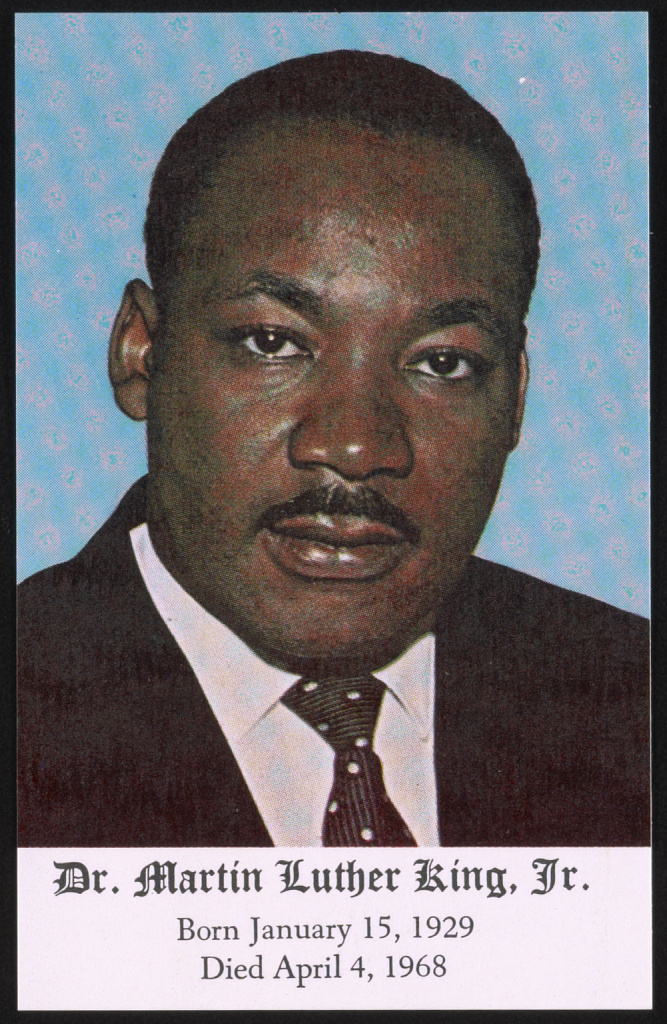
Today is the day set aside to commemorate the life and work of Dr. Martin Luther King, Jr. (1929-1968), one of the first and foremost proponents of Gandhi-style non-violent protest in the West, and one of the most inspirational and influential civil-rights, labor-rights and anti-war advocates in American history.
Unknown photographer. “Dr. Martin Luther King, Jr. Born January 15, 1929, died April 4, 1968.” From the Rosa Parks Collection, Library of Congress, https://www.loc.gov/item/2015651821/. Used here under Free Use provisions of U.S copyright law.
Among many honors, Dr. King was awarded the Nobel Peace Prize in 1964. The Norwegian Nobel Committee has a good biography here and additional information including a series of school lessons with lesson plans, videos, photos and other materials here. These are excellent resources for all of us. While Dr. King is—justly—remembered for his “Letter from a Birmingham Jail” and his 1963 “I have a dream” speech, it’s important that we remember the full depth and breadth of his life and work, and not just a few often-repeated quotes and sound bites.
In spite of the stresses and disruptions the ongoing Covid-19 pandemic has brought to all of our lives, 2020 was a busy and productive year for the Jonathan Clark House Museum, and the many Clark House friends and volunteers that support its mission to collect, preserve and share the history of the Jonathan Clark House and the early settlers of Mequon-Thiensville.
As is her custom, Clark House Museum executive director Nina Look has put together an excellent—and generously illustrated—document summarizing our 2020 activities. To catch up with all that’s gone on in the past year with the museum and the Friends, and to enjoy all 12 pages of the report, either click this link, or click the photo of the report’s first page (below). Either should open the complete 2020 Annual Report in a new window for reading or downloading:
Before we come to the end of 2020, I’d like to share a little seasonal cheer with this pictorial look back at previous holidays at the Jonathan Clark House Museum. Many thanks to Nina Look, the JCH board, the community, and all the Clark House volunteers and young historians who give so much of their time and resources to keep the house alive.
If you’d like to support the Clark House and its mission to collect, preserve and share the history of the house and the early settlers of Mequon and Thiensville, please click here to make a donation. Thanks for reading, thank you for your support, and best wishes for a Happy and Healthy New Year!
Original photo pages by Nina Look. Click each page to open larger image in a new window:
In spite of several unusually summer-like days, fall has definitely arrived in our corner of Wisconsin.
I’m working on several Clark House history projects at once and, as the saying goes, “there are a lot of moving parts,” and I need more time to get organized.
So no essay today, but here’s a lovely seasonal photo for your enjoyment:
It’s been “one of those weeks” here at the Clark House Historian’s actual house. Nothing unfortunate, but assorted “real life” tasks have kept me from finishing several more substantial posts. (Yes, there will be another photo analysis post or two featuring Cyrus Clark. And tintypes, too.)
News from Clark House Museum director Nina Look
Fortunately, Jonathan Clark House museum director Nina Look has just written and distributed the September, 2020, newsletter for the Friends of the Jonathan Clark House, and I can share it with you today. It’s filled with news and photos about the Clark House and some of our current and future projects.
If you’d like to open and/or download the complete, five-page PDF, click here. Or, if you want to catch up with your Jonathan Clark House news here on the blog, click “Continue reading” (below) and enjoy.
Recently, I’ve made a few corrections and comments on previous posts, and I’ve gathered some here for your convenience, followed by a few suggestions so that you may get more out of Clark House Historian.
Lesen Sie Kurrent?
I’m not sure how I forgot this, but if you are really interested in reading or writing Kurrent, I highly recommend the 28-page A Guide to Writing the old German “Kurrent” Script, by Margarete Mücke, available in English as a free download at her website Ms. Mücke’s explanations of the Hows and Whys of the letters and their use in Kurrent are clear and thorough. If you read German and are interested in the old writing styles, you may find the rest of her website fascinating.
Spelling in the 19th-century: surnames
Something worth remembering when reading 19th-century (and earlier) documents, is that early spelling varied widely, even (or especially) for family names. One example, from the post on a “new” Jonathan M. Clark document, is Barnet Clow’s surname. It is found on other Wisconsin documents variously as CLOW or CLOUGH, and back in his Dutch- speaking home of Greene Co., New York, as CLOW, CLOUGH, CLAW, KLAUW, and KLAW. But it’s all the same family and surname.
(And if you think that’s confusing, I also have ancestors who migrated to the southern states and territories in the late 18th- and early 19th-centuries. And holy cow!, no one on those southern censuses spells given names or surnames the same way twice. And some of the name spellings are amazingly…creative, to say the least.)
Spelling in the 19th-century: long-S
In the recent post on a historic German cursive style and its relevance for American researchers, we discussed the various 19th-century forms of the letter S, including the long-S, as also found the U.S. Constitution:



 Clark House Historian