This blog, Clark House Historian, published its first post 10 years ago today! (And just to be clear, the Clark House Historian blog is ten years old today. Reed Perkins, the Jonathan M. Clark House historian and author of the blog is, alas, a good deal older…)
Time to celebrate!
Our first post was a modest, two-paragraph “welcome” post, reproduced—in its entirety—below:
Happy New Year to all, and best wishes for an excellent 2025. I thought we’d start the year with a lightly edited re-post of an earlier CHH essay about a cheerful, festive song, one that may have been familiar to our Mequon settlers in the 1840s.1
A spot of Spofforth to ring in the New Year…
Our New Year’s sing-along number is “Hail Smiling morn” by the English composer Reginald Spofforth (1769-1827), a vocal quartet featured in the second part of the Milwaukee Beethoven Society’s March 23rd, 1843, premiere concert:
Milwaukee Weekly Sentinel March 15 1843, page 2. Click to open larger image in new window.
Spofforth was a man of many talents, but was particularly known for his glees. A glee is a kind of convivial part-song, typically for three or more voices and usually—but not always—sung without accompaniment. I’ll have more to say about this particular composer and piece later, but for now, it’s well enough to know that “Hail Smiling morn” is—according to musicologist Nicholas Temperly—”possibly the most popular glee in the entire repertory,” and that’s saying something!
Guess what I did instead of writing a new Clark House Historian post! Here’s a clue, from about this time last year (revised and expanded for 2022)…
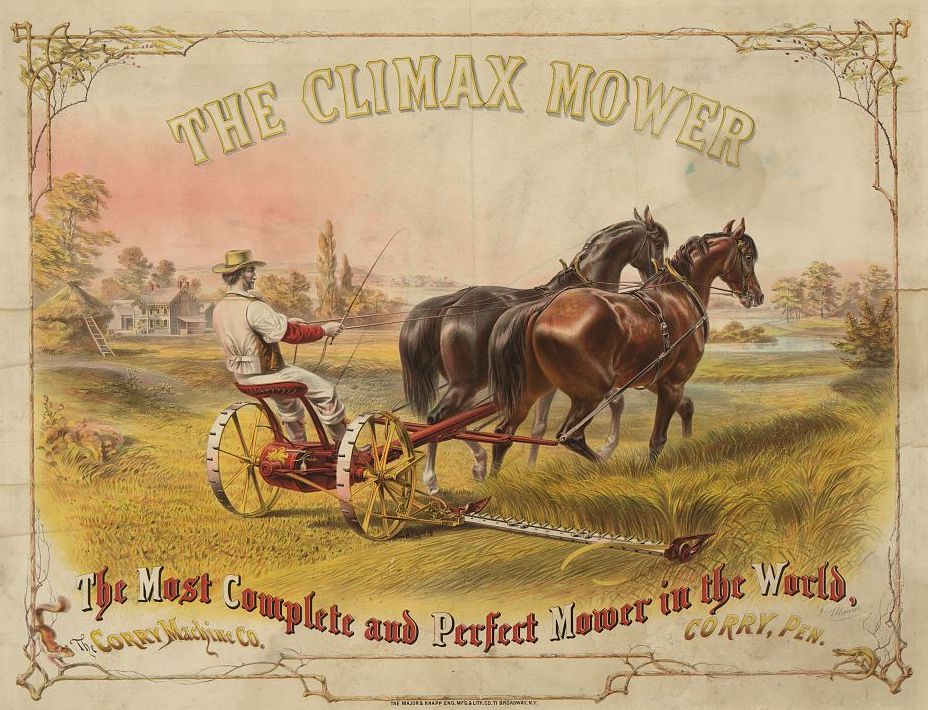
Spring weather in southeastern Wisconsin is pretty hard to predict these days. Spring 2021 was awfully dry. This year, spring has been wetter overall—I think—but the days have zigzagged rapidly and unpredictably between chill and damp or hot and humid. It’s almost like we haven’t had a proper Midwestern spring at all. And yet, the grass around the Historian’s house has already gotten pretty tall and scruffy. So it was time to get out the mower and tidy up (some of) the yard.
Maurer, Louis, Artist. The climax mower, most complete and perfect mower in the world, the Corry Machine Co., Corry, Pen. / L. Maurer. United States, None. [NY: the Major & Knapp Eng., Mfg. & Lith. Co., between 1869 and 1872] Photograph. Library of Congress.
UPDATED, April 9, 2022 to fix a minor typo and two unclear phrases.
I haven’t published much here in the last month or so. My apologies. There were some unavoidable but relatively harmless distractions involved, the sort of things that we all deal with from time to time. But the ongoing slaughter in Ukraine, unprovoked, inhuman and inexcusable, made writing and blogging…impossible.
But now it seems even more impossible to not write about the largest conflict in Europe since the end of the Second World War. So today’s “Monday: Map Day” will be devoted to some basic information about Ukraine: its location in Europe, its main cities and geographic features, and a few facts about the country, at least as it was prior to the Russian invasion.1
Maps
This map2 was downloaded on April 3, 2022, and shows the borders of Ukraine as understood by the United States and most of nations of the world, and includes all the portions of Crimea, Donbass and Luhansk that Russia seized at the start of the Russo-Ukrainian War in 2014.
Not quite sure where we are? Here’s a map showing Ukraine’s location in eastern Europe:
Happy New Year to all, and best wishes that 2022 will be an improvement on the past year. (A low bar, I know.) Anyway, when I first published this post, on January 1, 2021, I wrote: I’m almost done with my research on the second half of the 1843 concert by the Milwaukie Beethoven Society. (If you missed our earlier posts on that concert, links are here and here.) But it’s New Year’s Day, and I’m not quite done writing about “Part Second.”
Well, it turns out that “not quite done” was an optimistic estimate, as I became distracted by so many other research topics and posts and never got around to discussing the second part of the Milwaukee Beethoven Society’s concert. New Year’s Day is here again, and I’m still not done, alas, but I have not forgotten and—with luck—I will finish that post some time this winter.
A spot of Spofforth to ring in the New Year…
Meanwhile, let’s start the New Year on a cheerful note by reprising last year’s festive musical selection, drawn from that second part of the Milwaukee Beethoven Society’s 1843 premiere concert:
Milwaukee Weekly Sentinel March 15 1843, page 2. Click to open larger image in new window.
It’s been an awfully dry spring in southeastern Wisconsin. Even so, the grass around the Historian’s house has gotten pretty tall and scruffy. Time to get out the mower and tidy up the yard.
I’ve recently returned to my job behind the counter at the local mercantile. This is good—for all sorts of practical reasons—but requires an adjustment to my research and writing schedule that I’ve not quite figured out. Yet.
Main counter and clerk, 1880s General Store at Old World Wisconsin, July, 2016. Photo by Reed Perkins. Click to open larger image in new window.
I should be back with the conclusion of Infrastructure Week! next week. Meanwhile, here are a few more photos of the General Store at Old World Wisconsin — “big box” retail at its finest, circa 1880.
Jonathan Clark House, Mequon, Wisconsin, July, 2015. Photograph by Reed Perkins. Click to open larger image in new window.
Our very first post, announcing the new blog, went live on March 29, 2016. The information in that post has now been revised and expanded into the About and Disclaimers sections of the blog.
The first posts with historical content followed in April, 2016. I still link to one of those posts—Where are we?—when I need to explain the evolving place names and political geography of the Mequon area.
Since the first Clark House Historian posts in 2016 we have learned a lot more about the Clark house, its occupants and their families, friends and neighbors. If you’re new to the blog—or the Jonathan M. Clark House—here are some good places to begin reading (and be sure to click the links in each article):
Happy New Year to all, and best wishes that 2021 will be an improvement on the past year. I’m almost done with my research on the second half of the 1843 concert by the Milwaukie Beethoven Society. (If you missed our earlier posts on that concert, links are here and here.) But it’s New Year’s Day, and I’m not quite done writing about “Part Second.” So let’s have another festive musical selection, this one drawn from that second part of the Beethoven Society’s premiere concert:
Milwaukee Weekly Sentinel March 15 1843, page 2. Click to open larger image in new window.
We’ll start the year with “Hail Smiling morn” by the English composer Reginald Spofforth (1769-1827). Spofforth was a man of many talents, but was particularly known for his glees. A glee is a kind of convivial part-song, typically for three or more voices and usually—but not always—sung without accompaniment. I’ll have more to say about this particular composer and piece later, but for now, it’s well enough to know that “Hail Smiling morn” is—according to musicologist Nicholas Temperly—”possibly the most popular glee in the entire repertory,” and that’s saying something!
“Hail Smiling morn” remains a popular pub song in parts of England and—as you’ll soon see—in many other venues around the world, both secular and sacred. “Hail Smiling morn” is frequently sung by church choirs as a Christmas or Easter carol. I think it works wonderfully for New Year’s Day, too. Below are three spirited modern performances of the piece. Just click the image to open a new YouTube window for each video. (The piece is only about 3 minutes long; enjoy all three performances!)
The first video is from a Sunday pub sing at The Royal, in Dungworth—near Sheffield—England. In many ways this is the modern equivalent of the friendly and well-lubricated singing at the glee and catch clubs of 18th-century England:
Click image or this YouTube link to open video in new window. Photo: screenshot of performance.
Before we come to the end of 2020, I’d like to share a little seasonal cheer with this pictorial look back at previous holidays at the Jonathan Clark House Museum. Many thanks to Nina Look, the JCH board, the community, and all the Clark House volunteers and young historians who give so much of their time and resources to keep the house alive.
If you’d like to support the Clark House and its mission to collect, preserve and share the history of the house and the early settlers of Mequon and Thiensville, please click here to make a donation. Thanks for reading, thank you for your support, and best wishes for a Happy and Healthy New Year!
Original photo pages by Nina Look. Click each page to open larger image in a new window:



 Clark House Historian