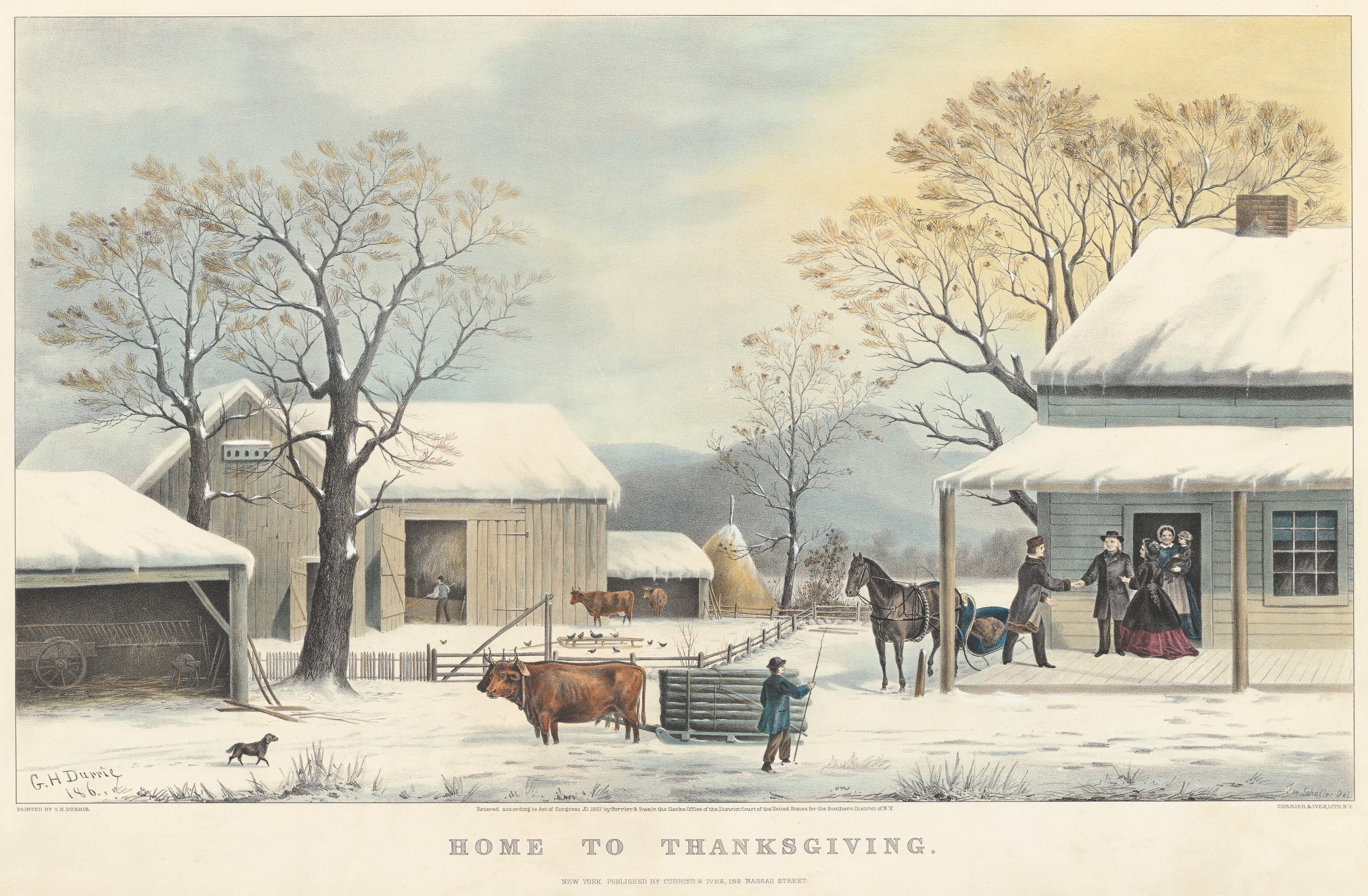
It’s Thanksgiving today, and I’m taking the day off to spend time with family. But in the spirit of the holiday, I thought I’d reprint a lightly revised version of last year’s Thanksgiving post, to share with you a few vintage recipes and a nice Currier & Ives lithograph from the period.1
Thanksgiving, 1867
Durrie, George H. and John Schutler, Home to Thanksgiving, ca. 1867, New York, Currier & Ives. National Gallery of Art, Collection of Mr. and Mrs. Paul Mellon. Public Domain. Click to to open larger image in a new window.
Inman, Henry. Rip Van Winkle Awakening from his Long Sleep, 1823. National Gallery of Art, gift of William and Abigail Gerdts. Public Domain.
A long “nap”
Unlike Rip van Winkle, I haven’t been asleep the whole time since our previous post. But we are well overdue for new blog material. I’ve got a big backlog of documents and images to share with you; all I need to do is get writing. But first…
Be sure to vote today!
It’s election day today, and your vote counts. If you haven’t already done so, get out of the house, over to your polling place, and vote. Voting is your right and responsibility as a citizen, and an indispensable element of our nation since the earliest days of the Republic.
Not surprisingly, voting and public service were an important part of life in the Clark House era. From 1840 onward, Jonathan M. Clark, Peter Turck, William T. Bonniwell and many other relatives and neighbors sought, and won, appointment or election to a wide variety of local, territorial and state offices. Voting—then limited to white males only—was a priority for Mequon’s early settlers, and they never failed to turn out in large numbers for each election. Their passion for civic engagement and electoral politics was, in turn, passed to the next generation.
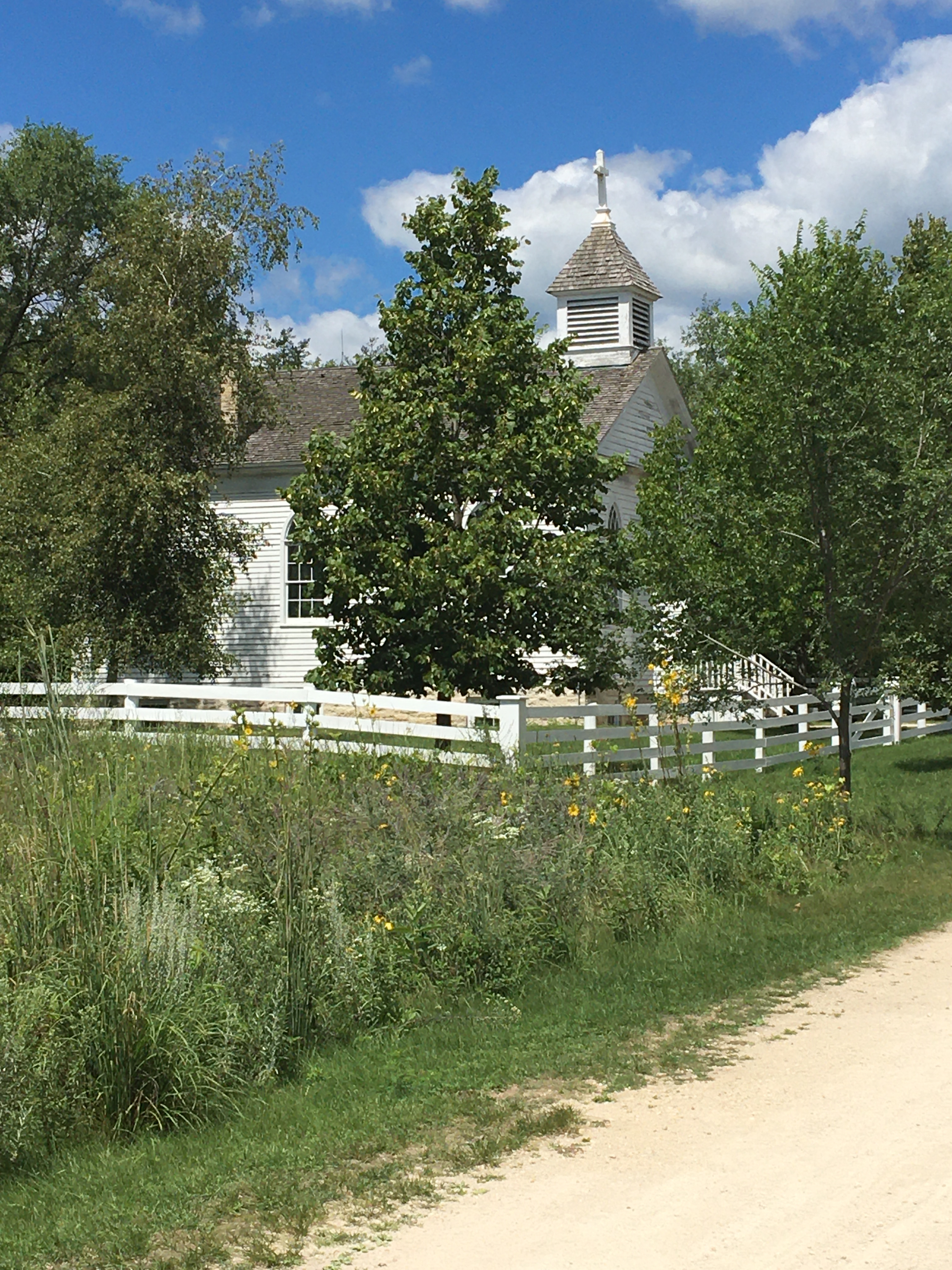
I had a fine day last month walking through our state’s wonderful outdoor living history museum, Old World Wisconsin, where I enjoyed this familiar view:
Photo credit: Reed Perkins, 2022.
There among the trees stood Milwaukee’s old St. Peter’s Roman Catholic Church, a building that was certainly well-known—at least on the exterior—to our Clark and Turck families.
The church was built in 1839, two years after young Mary Turck arrived in Wisconsin Territory with her parents, Peter and Rachael (Gay) Turck and her six siblings, and the same year that Jonathan M. Clark and the Bonniwell family first appeared in the Milwaukee-Mequon area.
I’m still busy annotating maps for upcoming Bonniwell-related blog posts. So instead of my planned Gold Rush themed Monday: Map Day! essay, I hope you enjoy this Clark-era image of a common visitor to much of North and South America—including Wisconsin—the Great Horned Owl.
Havell, Robert, jr., engraver, after John James Audubon, Great Horned Owl, 1829, plate 62 from The Birds of America (1828-1838), hand-colored engraving and aquatint on Whatman wove paper. National Gallery of Art, Gift of Mrs. Walter B. James. Public domain. Click to open larger image in new window.
UPDATE, Nov. 30, 2022: The discussion of the William Bonniwell signatures and dates, below, is not correct. I have lined-through the incorrect paragraph and added the correct info in two new paragraphs below the original misinformation.
It may not look like much on the outside. It’s old. Not very big. Whole pages are missing, others are damaged. The binding is worn.
Bonniwell Bible, front cover. Photo credit: Kendalyne Gentile, 2022
But this modest book was—for over 300 years—the family Bible for Mequon’s pioneer Bonniwell family, their ancestors and descendants. And last month, the Bible’s most recent owner, Bonniwell descendant Kendalyne Gentile, generously gave the Bible and other Bonniwell family documents to the Jonathan Clark House Museum where they will form an important part of our permanent collection.
Hello, readers! Sorry for the long blog silence. I hope you are well.
It’s been a busy summer at my house, filled with the usual demands of job, summer garden chores, lots of behind-the-scenes history research and, alas, an unexpectedly large number of mundane but unavoidable tasks, most of which are now behind me.
I have a backlog of half-written posts to finish and share with you. In the meanwhile, I hope you enjoy this photo.
Cedar Creek, looking north from the Columbia Road bridge, Cedarburg, Wisconsin. Photo credit: Reed Perkins, July, 2022.
The view looks north along Cedar Creek from near the historic Cedarburg Mill, about two miles north of the Jonathan Clark House. Turn off the electric lights, and this is a view that the Clark family would have known well.
Summer has finally settled in here in Wisconsin, and the Jonathan Clark House is ready to host you once again on Saturday, July 16, 12pm – 3pm to enjoy all the old fashioned fun in the very spirit of the season for the second installment of our summer series event Heritage Days!
In addition to our favorite features, our special attractions for July include:
I’m taking a bit of a break and have nothing new for you today. I have been doing a good bit of garden work around the house, and that reminded me of this post from April, 2021. Now we’re just finishing the first week of June, 2022, and it’s almost summertime. In southeastern Wisconsin the first spring flowers are done, and the next round of blossoms have been blooming for weeks. The tomato, bean and pepper seedlings are in the ground and doing nicely (although the rabbits have been nibbling on far too many green bean sprouts), and the roses are beginning to unfold. So even though this was originally an early-spring essay, I hope you enjoy this garden-themed repost from last year.
Planning the garden
It’s early April, and the growing season is not far off. For a farmer like Jonathan M. Clark, it’s a little early yet for plowing and sowing, but not too early to make plans and sharpen the tools. For a farmer’s wife, like Mary (Turck) Clark, it’s not too soon to think about the farm garden, its crops and layout.
I don’t know if Mary and Jonathan were regular readers of the popular and affordable farmers’ almanacs of their era; I wouldn’t be surprised if they were. There were many to chose from. Perhaps they had a copy of something like:
The Cultivator […], New Series, Vol. VII, Albany, 1850, title page. Click to open larger image in new window.
Our annual Memorial Day post, first published in 2020. This revised edition, originaly published in 2022, was inadvertently updated for the further-revised 2023 edition, making a few minor edits and adding new information about Evander B. Bonniwell’s service. So the original 2022 post is “gone” and I’m going to leave this revised-revised version of that post here for reference, in case it is bookmarked elsewhere on the blog or in a readers’ notes.
Graves of Unknown Union Soldiers, Memphis National Cemetery, photo by Clayton B. Fraser, (Library of Congress), public domain. Memphis National Cemetery is the final resting place of Mequon’s Watson Peter Woodworth, and almost 14,000 of his Union Army comrades.
Today is the day our nation officially observes Memorial Day. For many Americans, Memorial Day represents “the first day of summer,” and is traditionally celebrated with trips to the lake, picnics, parades, and sales on cars, appliances, and other consumer goods.
But for many of us, Memorial Day remains rooted in its origins as Decoration Day. The first national observance was in 1868, when retired general John A. Logan, commander and chief of the Grand Army of the Republic—the Union veterans’ organization—issued his General Order Number 11, designating May 30 as a memorial day “for the purpose of strewing with flowers or otherwise decorating the graves of comrades who died in defense of their country during the late rebellion, and whose bodies now lie in almost every city, village, and hamlet churchyard in the land.”
On this Memorial Day, let’s take a moment to remember what this day truly represents.
I’m feeling a bit under the weather today, so Clark House research will have to wait. Fortunately, I’ve had my shots, so it looks like the usual advice of bed rest, fluids, and such should be all I need. If not, perhaps a swig of a potion like Dr. C. V. Girard’s Ginger Brandy will do the trick.
Dr. C.Y. Girard’s ginger brandy, for sale here / lith. of Robertson, Seibert & Shearman, 93 Fulton St. New York. , ca. 1860. New York: Robertson, Seibert & Shearman, 93 Fulton St. Library of Congress. Click to open larger image in new window.
After all, it’s “A Certain Cure for Cholera Colic Cramps Dysentery, Chills & Fever” and “is a delightful and healthy beverage.” Ya can’t beat that!
Of course, if Dr. Girard’s Ginger Brandy doesn’t help, there were so many other elixirs to choose from during the pre-Pure Food and Drug Act era, such as…



 Clark House Historian