Our “How’d they get here?” transportation series will continue shortly, starting with lots of info on Great Lakes steamboats. Here’s a teaser:
Catlin, George, Artist, and St. Louis Mercantile Library Association. St. Louis in 1832. From an original painting by Geo. Catlin in possession of the Mercantile Library Association.Library of Congress. Click to open larger image new window.
UPDATED, February 11, 2024, to include a revised version of the annotated detail map of Ouisconsin, 1836. But for the full update—with additional notes and corrections—please see the most recent version of our discussion the Ouisconsin map of 1836 on our post of February 12, 2024. UPDATED, July 6, 2021, to answer a reader’s question: “Where was Jonathan Clark just before he went to Fort Howard?” Scroll down to Comments for the answer.
How the early settlers came to Mequon, c. 1835-1850 (part 1)
Clark House education director Margaret Bussone and our education team are putting together a project centered on how our Mequon pioneers traveled to southeast Wisconsin in the early days of white settlement, between roughly 1835 and 1850. I thought I’d help out by gathering some relevant materials and sharing them with the education team—and you—here on the blog.1
So this week we’re going to look at how the settlers found their way here, and how they traveled on land, lake, or river. Rather than writing lots of words about each map or image, I’d like to gather a whole bunch of useful items in each post and put them out there as resources for all to use. Later in the week, we’ll look at various modes of travel on land and on water. Today we’ll look at some maps.2 Some of these maps were readily available to our would-be immigrants, others might have been one-of-a-kind or otherwise hard to obtain.
An overview, The U.S. in 1834
When the following map was published in 1834, Jonathan M. Clark was finishing the first year of his three-year enlistment in the U.S. army. He was stationed at Ft. Howard, on the Green Bay of Lake Michigan, in what was then the civil District of Huron, a soon-to-be-outdated term for the western portion of the Michigan Territory.3
Mequon’s earliest settlers would be coming to lands that were poorly mapped and little understood by most European-Americans. The most this map could show—in a very general way—is where the “open” areas were for future migration and settlement.
Norris, William, and Daniel K Minor. Map of the railroads and canals, finished, unfinished, and in contemplation, in the United States. New York: Railroad Journal, 1834. Map. Library of Congress. Click to open larger map in new window.
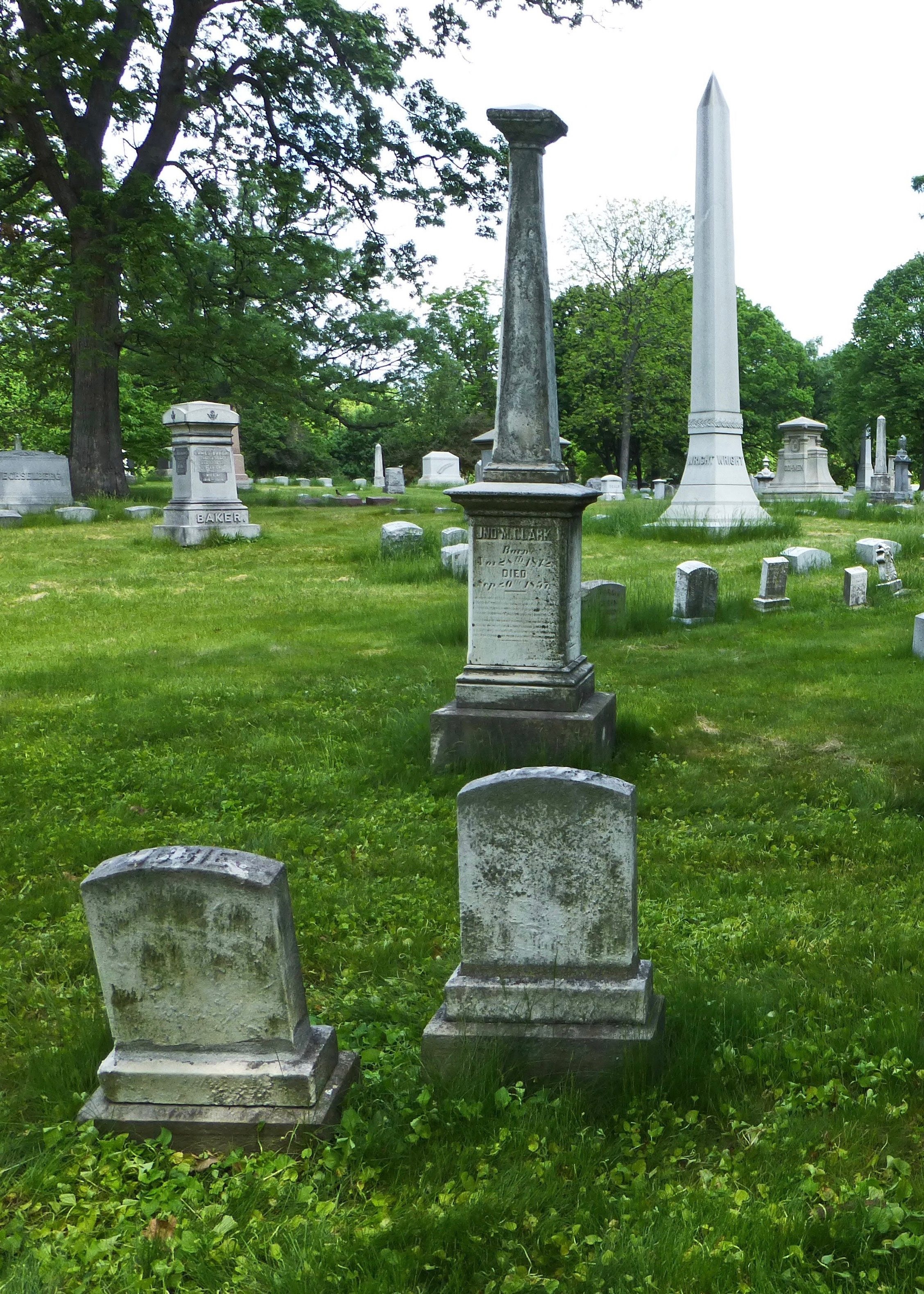
As we learned in our previous post, Henry Clark—only son of Jonathan M. and Mary (Turck) Clark—was buried “in Cedarburg” on Monday, April 23, 1866. But if you seek Henry’s final resting place, you’ll find him next to his father, mother, and sister Josie in the Clark family lot at historic Forest Home Cemetery in Milwaukee. How this came to be, and what this tells us about Clark family history, is the subject of today’s post.
Clark family graves, lot 3, block 44, section 10, Forest Home Cemetery, Milwaukee, Wisconsin. Photo courtesy Liz Hickman, 2016. Click to open new image in larger window.
In our previous post, we discovered that Henry M. Clark was drafted for Civil War military service on November 10, 1863. Today we will look at the existing evidence recording Henry’s death and burial in April, 1866, aged 23. So far, we lack reliable documentation for Henry’s life during the 28 months between those dates; we’ll continue the search for Henry’s possible Civil War service in a series of upcoming posts.
The question remains: why did Henry Clark, only son of Jonathan M. and Mary (Turck) Clark, die so young? Milwaukee death records for the 1860s are uneven and incomplete; it’s not surprising that no death certificate exists. I have not been able to find a death notice in the Milwaukee newspapers. But we do have two contemporary sources that can shed some light onto the mystery of this Clark family loss.
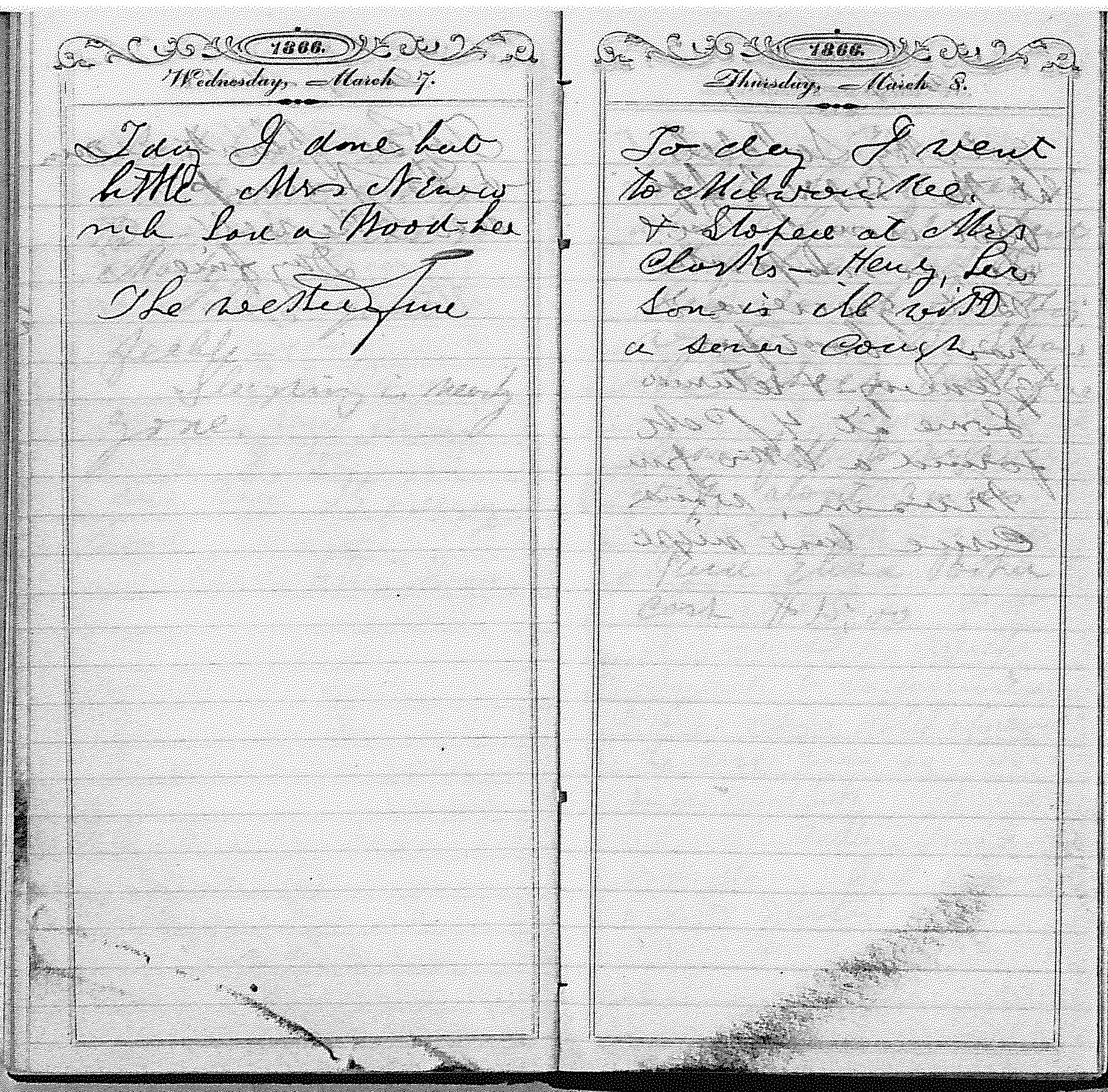
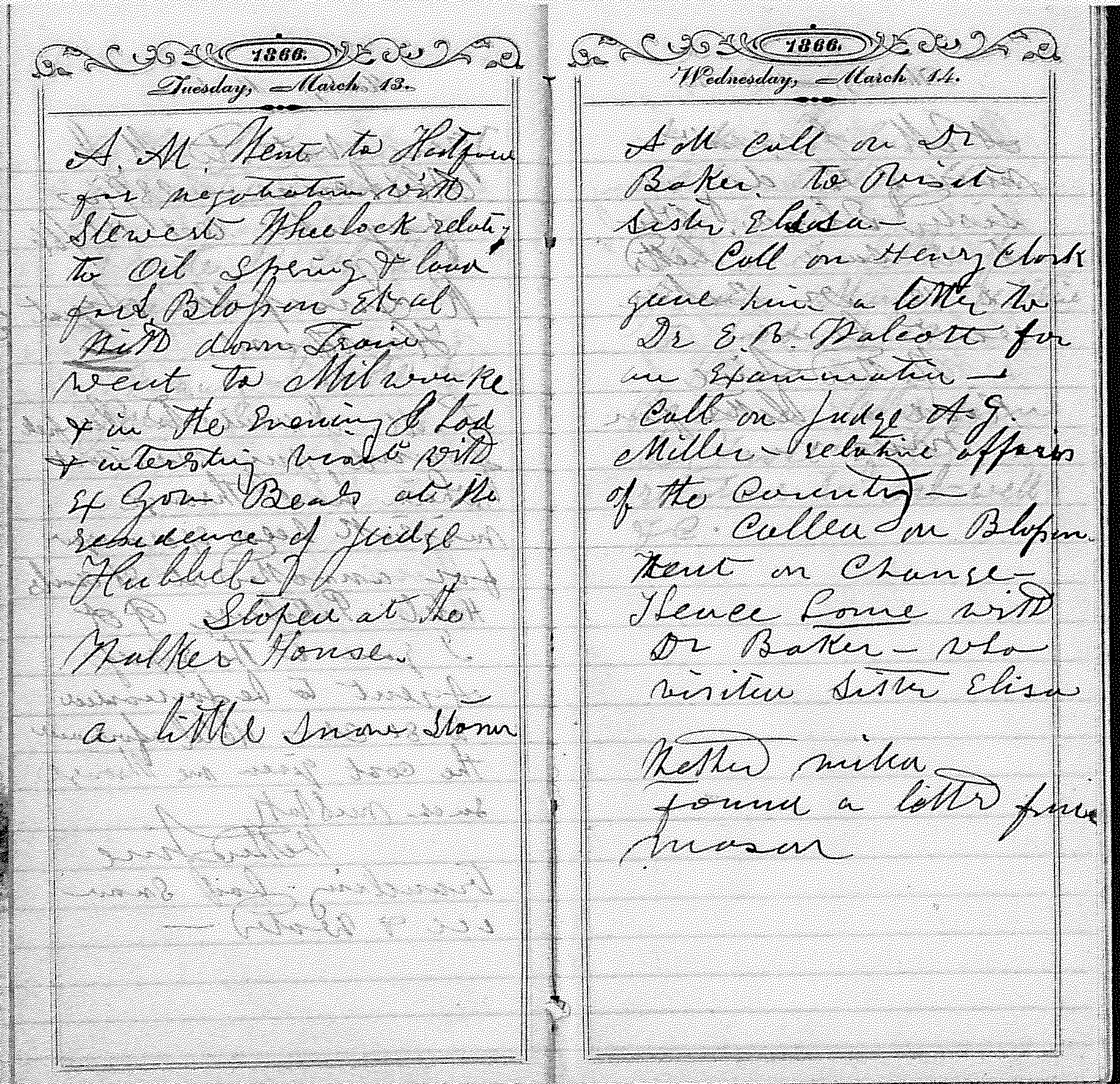
Densmore W. Maxon’s 1866 diary
On April 2, 1846, Mary Turck Clark’s younger sister Elizabeth Turck (1828-1913) married an ambitious young settler, Densmore W. Maxon (1820-1887). Maxon began his Wisconsin years as a surveyor, and eventually rose to prominence as a businessman and politician. He laid out the village of Cedar Creek, Town of Polk, Washington county, about 18 miles north and west of the Jonathan Clark house in Mequon. Densmore and Elizabeth Maxon lived in Cedar Creek for the next 41 years.
The lives of the Maxons, Clarks and Turcks are deeply intertwined from the 1840s onwards. For at least one year, 1866, Densmore Maxon kept a pocket diary. These pages contain his notes on the final days of nephew, Henry Clark:
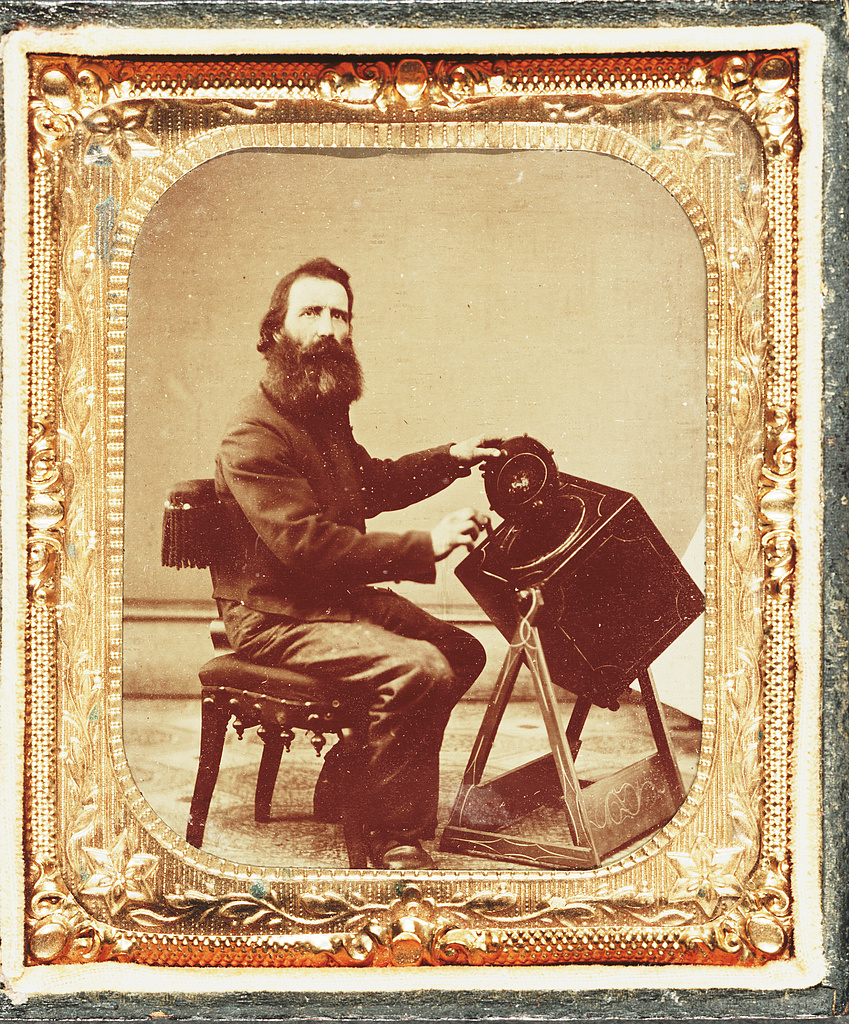
[Civil War induction officer with lottery box.] United States, ca. 1863. Photograph. Library of Congress. Click to open larger image in new window. The draft officials in Milwaukee used a similar box or wheel to draw names in the 1863 draft. (The Wisconsin Historical Society has a wheel-shaped draft drum, circa 1863-1865, in its collections. It’s possible that the WHS lottery wheel may be the exact wheel used during Henry Clark’s November, 1863, draft event. Click here for a photo and accompanying information.)
Our previous post included an image of Henry Clark’s June, 1863, registration for the upcoming military draft. The Milwaukee draft of November, 1863, lasted for several days. The names of draftees from each Milwaukee city ward or county town were written on paper slips and placed in a round wooden “wheel.” The container was spun about to mix the names, and then the draft official would reach in, pull out one slip of paper, read the name aloud, and the clerk (and the press) would record the names as drawn. Once each ward, town, or village reached its quota of draftees, the box would be emptied and a new set of names from another location would be placed in the drum, and the process repeated.
Heritage Days, a Clark House summer favorite, returns on Saturday, July 17, 2021, from 12:00 noon to 3:00 pm. No admission charge, but donations gladly accepted. Come enjoy some 1848-style family fun!
It was an eventful weekend. Congress—acting with a speed and unanimity1 unusual these days—declared a new federal holiday to celebrate June 19th as Juneteenth National Independence Day, formerly known and variously celebrated as Juneteenth, Emancipation Day, or Black Independence Day. It has roots in the issues and events of the Civil War years that I’m currently blogging about, and I’ll have more to share about the history of our newest federal holiday in a future post.
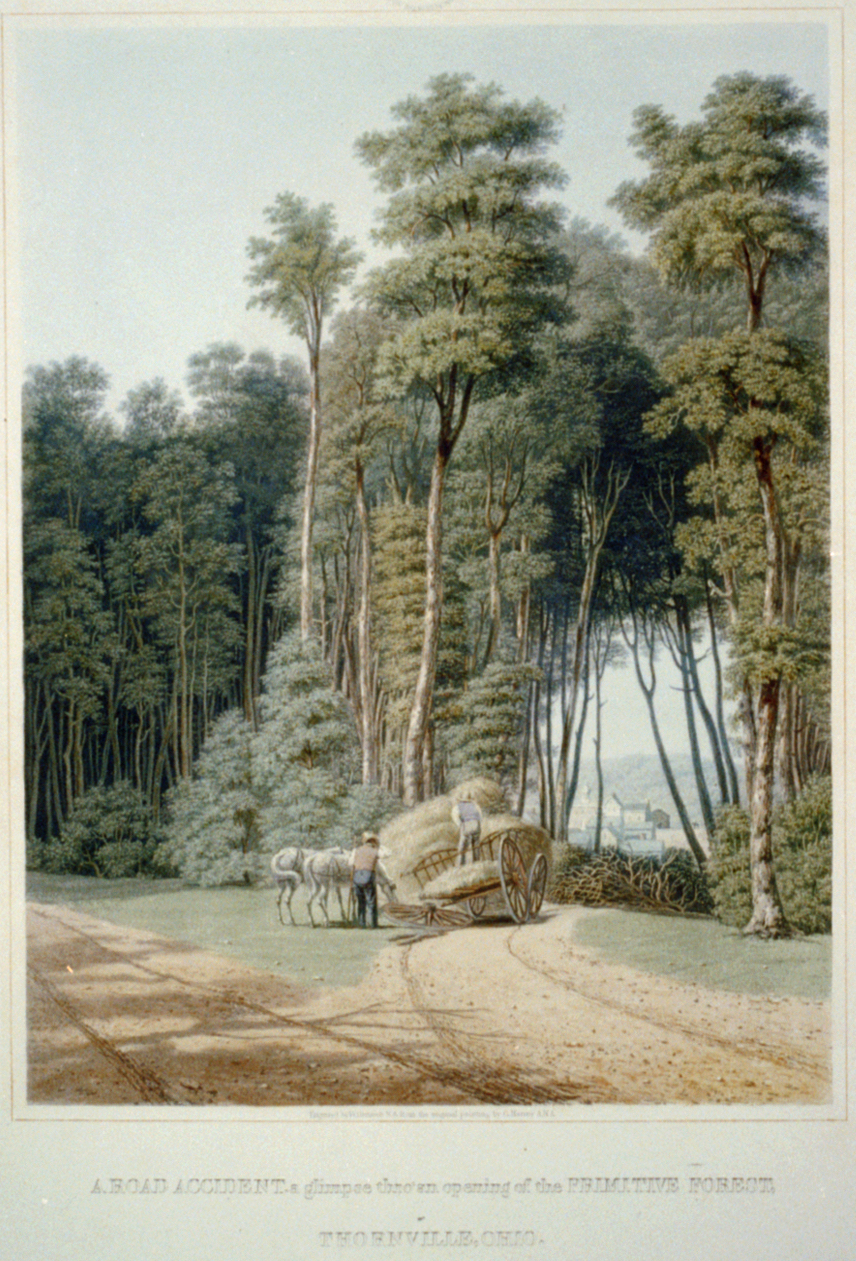
Sunday June 20 heralded the arrival of summer, and the observance of Fathers’ Day. In honor of both, I took the day off from writing and spent some time with my family. Wishing you all the best for summer, 2021, here’s an evocative seasonal print from Jonathan and Mary Clark’s era…
What we do — and don’t — know about the Clarks’ only son (part 2)
This is the second in a series of posts examining what we do — and don’t — know about Henry Clark, his life, and his possible military service. If you missed it, you might want to start with part 1: Meet the Children: Henry M. Clark
Reading, Mass. Selectmen. The union must be preserved! The citizens of Reading are hereby invited to meet at Lyceum Hall to-morrow, Thursday, at 6 o’clock. P.M., to make such arrangements as may seem necessary to raise our proportion of volunteers … Selectmen of Reading. Boston, 1862. Library of Congress Meetings such as this were held all over the North—including Wisconsin—before and after the passage of the Militia Act of 1862. Click to open larger image in a new window.
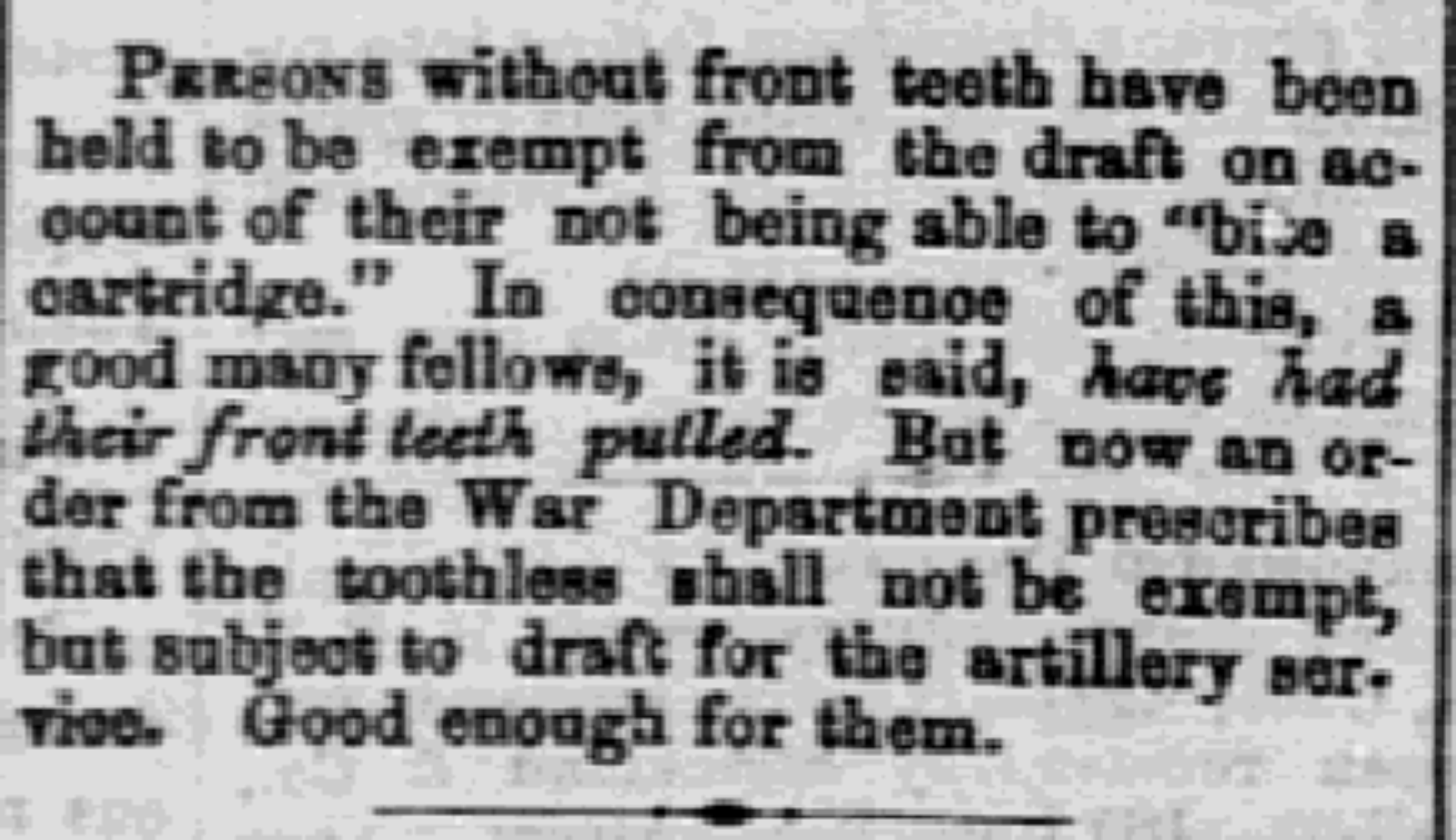
Here’s another Random Bit o’ History. I found this while researching an upcoming post on Henry Clark and the Civil War draft. It was too good (?) to sit idly by, so here ya go:
UPDATED with correction, June 18, 2021: The Peter Turck house at 474 Jefferson was (and is?) in Milwaukee’s seventh ward. Why I said “second ward” when the map clearly shows “VII” or seventh ward is a mystery. So please note the correction to the headline and content of the relevant paragraph “The Seventh Ward,” below.
What we do — and don’t — know about the Clarks’ only son (part 1)
Jonathan M. and Mary (Turck) Clark had eight children: seven daughters and one son, Henry M. Clark (1843-1866). The Clark children were born between 1840 and 1857. All lived to adulthood, some longer than others. For a general overview of the Clark children, including birth and death dates, start with our earlier posts Meet the Children (part 1) and History Mystery! No. 2 – The Clark “Family Record.”
Although we know quite a bit about most of the Clark children, our recent Memorial Day 2021 post reminds us that we know very little about several important aspects of Henry Clark’s life, in particular: did he serve in the Civil War? I’ve been working on this question, off and on, for a number of years, and I think it’s time to pull the sources together and see what really we do — and don’t — know about Henry Clark, his life, and his possible military service.
There is a lot of information to sort through and interpret, so this post will be the first of several about Henry and the events of his life. Today we focus on what we know of Henry’s life before the Civil War.
——— 1840s ———
1843(?)
The first documentary mention of Henry Clark may possibly be this report of his birth on February, 21, 1843, written at an unknown date in the Clark “Family Record”:







 Clark House Historian