Our series of “How’d they get here?” posts is written to illustrate the nuts and bolts of how our early Mequon pioneers travelled from their original homes or ports of arrival in North America to the newly opened federal lands in Wisconsin Territory, circa 1830-1850. Today’s post continues our westward journey from Buffalo; see Note 1 (below) for links to earlier posts in the series.
The ships at Detroit, 1837
We closed our previous post with a brief look at a colorful aquatint of the ships and small craft on the Detroit River, a major port on the Great Lakes route between Buffalo and Chicago in the 1830s and ’40s. The print was published in 1837, and is an excellent illustration of almost all of the important types of ships in use during the years of Wisconsin Territory settlement:
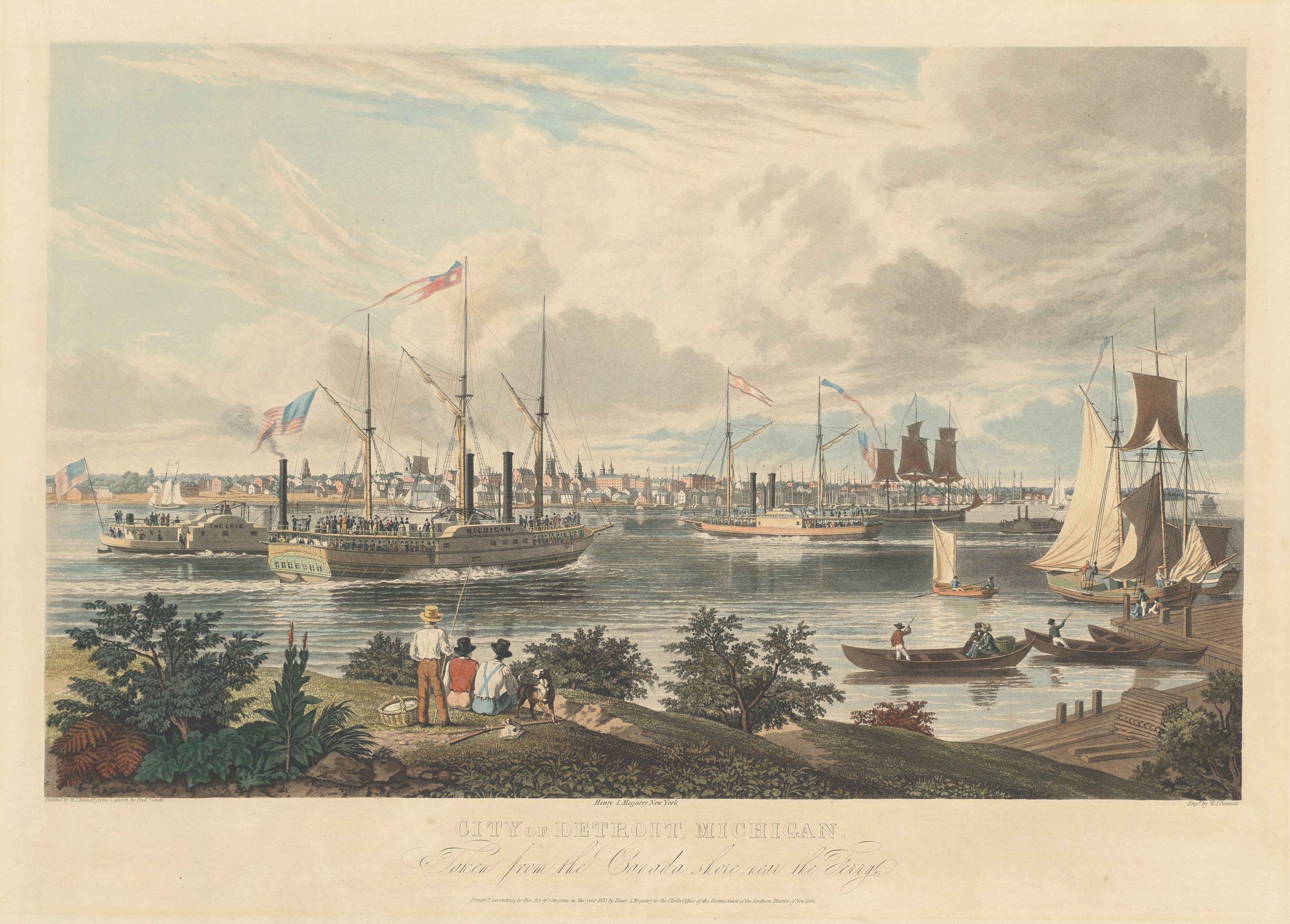
Bennett, William J., after a sketch by Frederick K. Grain, City of Detroit, Michigan. Taken from the Canada shore near the Ferry., hand-colored aquatint on engraving, ca. 1837. National Gallery of Art, Collection of Mr. and Mrs. Paul Mellon. Public Domain. Click to open larger image in new window.
If you’re not clear on your Michigan and Upper Canada (now Ontario) geography, the artist was standing on the Canadian shore, looking west across the river to the city of Detroit. The two steamboats at the left center of the picture are headed north, upstream on the Detroit River that connects Lake Erie to Lake St. Clair and, via the St. Clair River, to Lakes Huron, Michigan and Superior.
Given that the picture shows leafy green foliage and men in shirt-sleeves, it was probably drawn in the spring or summer of 1837 (or a perhaps a year or two earlier?). In August, 1837, the Peter Turck family—including eldest daughter Mary Turck—migrated from Wayne county, New York, to Milwaukee via this exact route and, perhaps, on one of the ships shown in this picture. Other Mequon immigrants, including the Bigelow, Bonniwell, Loomer, Strickland and Woodworth families (and many others), would have seen similar views as they travelled from the eastern seaboard to Wisconsin Territory in the ’30s and ’40s.
There is a lot to see here. Let’s take a closer look…
Continue reading


 Clark House Historian