Monday: Map Day! – To the gold fields, 1849 & ’50

I love a great map, and today’s example is particularly fine in several respects: as a detailed view of our hemisphere at a particularly dynamic moment in U.S. history, as an excellent example of mid-19th-century cartography, and—as we’ll see in our next post—as a clear illustration of how members of Mequon’s Bonniwell family made their way to and from the California gold fields in the heady days of the early Gold Rush of 1849 and 1850.1

Gold! where it is and how to get there, 1849

Atwood, John M., Map of the United States, the British provinces, Mexico &c.: showing the routes of the U.S. mail steam packets to California, and a plan of the Gold Region. New York: J. H. Colton, 1849. From the collection of Millard Fillmore. Library of Congress.

I’ve published some great old maps on Clark House Historian, and this is one of my favorites. In our next post, I’ll annotate a copy of this map to illustrate the Bonniwell’s Gold Rush travels in 1849 and the early 1850s. But today I’d like to show the map as it was in 1849, with all its “extra features.” I recommend you begin by clicking the map image, above, which opens a much higher-resolution copy of the map in a new window (FYI, this may take a few seconds; it’s a big, detailed image).

Continue reading

The Bonniwells & Co. in California, 1849 & 1850

Our last two posts focused on the evidence we have that documents the Bonniwell family’s two-part trip west to the gold fields of California: by the Panama shortcut in 1849 and by the overland route in 1850. Today I’d like to focus on the members of Bonniwell company after the end of their westward voyage(s), and give you a sense of their experiences as newly-arrived prospectors in the California gold diggings through period drawings, lithographs, photographs, and a substantial excerpt from the Bonniwell Gold Rush diary.1

Currier & Ives. Gold mining in California. California, ca. 1871. New York: Published by Currier & Ives. Library of Congress. As always, click the images to open larger versions in new window.

This colorful Currier & Ives lithograph presents a somewhat idyllic view of “Gold Mining in California” as imagined in 1871 by a New York artist who, most likely, had never been west of the Alleghenies. On the one hand, the lithograph does give us an hint of the splendors of the Sierra Nevada, and some idea of the typical activities of California miners. But as we’ll see, life in gold country when the Bonniwell party arrived—in the early, frenzied days of 1849 and 1850—was much less bucolic.

“Working the bar”

Much of early California gold prospecting involved looking for smaller and larger bits of gold found within the loose alluvial soils and sediments of the rivers and dry riverbeds of the Sierra Nevada. In particular, the miners spent a lot of time “working the bar.” And no, my fellow Wisconsinites, this does not mean they were strenuously pub-crawling in El Dorado county, circa 1849-1850.

Continue reading

Brown Bag Series, part 2, is today!

We have new partnership project with the Mequon Nature Preserve and MATC’s Kate Erickson, the Brown Bag Series: Mother Earth is Where We All Meet. Today is the second installment in the series, and our executive director Dana Hansen will be speaking on “European Settlement and the Shift of Mindset About the Earth.”

Old World Wisconsin, July, 2016. Photo credit: Anna Perkins. Click to open larger image in new window.

Continue reading

Time to mow…

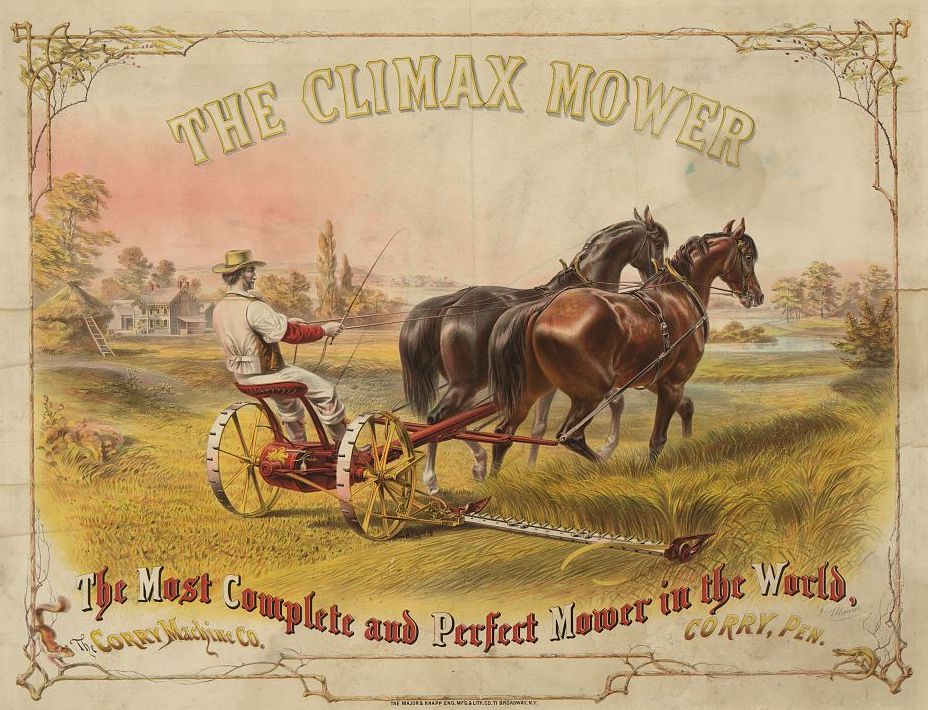
Guess what I did instead of writing a new Clark House Historian post! Here’s a clue, from about this time last year (revised and expanded for 2022)…

Spring weather in southeastern Wisconsin is pretty hard to predict these days. Spring 2021 was awfully dry. This year, spring has been wetter overall—I think—but the days have zigzagged rapidly and unpredictably between chill and damp or hot and humid. It’s almost like we haven’t had a proper Midwestern spring at all. And yet, the grass around the Historian’s house has already gotten pretty tall and scruffy. So it was time to get out the mower and tidy up (some of) the yard.

Maurer, Louis, Artist. The climax mower, most complete and perfect mower in the world, the Corry Machine Co., Corry, Pen. / L. Maurer. United States, None. [NY: the Major & Knapp Eng., Mfg. & Lith. Co., between 1869 and 1872] Photograph. Library of Congress.

Continue reading

Preparing for planting

I’m still tied up with other projects, so I thought you might enjoy a repeat of this seasonal post from last May. I’ll be back soon with new Clark House history.

It’s mid-May in southeastern Wisconsin, and with luck the last frost is behind us. For the past weeks and months farmers and gardeners have been tending to the soil and preparing for planting. At this time of year in the 1840s and ’50s, Jonathan M. Clark would have done much the same, hitching up his team of oxen to a steel-bladed plow to cut and turn over the tough prairie grasses and break up the soil of his newly-cleared lands.

Continue reading

Big Bird

I’ve been happily busy doing some special, behind-the-scenes research and event organizing for the Jonathan Clark House museum, and I don’t have a new post ready for our ongoing Alfred T. Bonniwell documents series. So how about a short historical nature break, instead?

It’s spring in southeast Wisconsin, and the birds are returning to the banks of the little creek in our backyard. (Okay, our “creek” is really a man-made storm water drainage ditch, but it’s filled with native plants and grasses and we like to think of it as a creek.) Anyway, the birds love it, and every now and then a really big bird will drop by for a snack. Like this guy, who paid us a visit last week:

Havell, Robert, engraver, after John James Audubon, Snowy Egret or White Heron, 1835, plate 242 from The Birds of America (1828-1838), hand-colored engraving and aquatint on Whatman wove paper. National Gallery of Art, Gift of Mrs. Walter B. James. Public domain. Click to open larger image in new window.

Continue reading

View on the Catskill – Early Autumn (1836-1837)

I’m still catching my breath after writing Thursday’s big post on the life of Caroline Clark’s mentor, John G. McKindley. We’ll return to Caroline (Clark) Woodward, and see how her time with McKindley influenced her adult life and work, in just a bit.

In the meantime, here’s a lovely fall scene that would have looked very familiar to Mary (Turck) Clark’s mother Rachael (Gay) Turck, and to Rachael’s Gay and Van Loon / Van Loan parents and ancestors:

Cole, Thomas, View on the Catskill—Early Autumn, 1836-1837. The Metropolitan Museum of Art, New York, gift in memory of Jonathan Sturges by his children, 1895. Public domain. Click to open larger image in new window.

Continue reading