I’m still taking some time to relax and catch up on my reading. Meanwhile, I hope you enjoy this Revised! and Enhanced! holiday post that first appeared last December. UPDATED: 28 Dec.2022 to correct a minor error about the “Bower of Beauty” illustrations.
It’s the week after Christmas. Perhaps you have family or friends visiting from out of town. If you have children, they’re home from school. How to keep them entertained? If you lived near New York City in 1864, you were in luck. Barnum’s American Museum was ready with spectacular and unique holiday exhibits for the whole family, all for the low, low, price of 25 cents for adults, 15 cents for children under age ten!
The Holidays are upon us, and I’m taking time to celebrate and enjoy some time with family, That means I won’t have much new for you for the next week or so. (Don’t worry, we will wrap up the Alfred T. Bonniwell story in the very near future. I promise!) But in case you need a little Clark House history for fireside reading this week, I’m going to re-post several seasonal CHH favorites from past years. And since much of the Midwest is currently under a blizzard warning, I thought we should begin with this essay, which originally appeared in early 2021, was revised last February, and has been updated with an additional Currier & Ives lithograph for today’s post.
Snow, and often lots of it, was a feature of Jonathan and Mary Clark’s life in Wisconsin. And if you wanted to go to town or church or visit your neighbors during the snowy Wisconsin winter—or just enjoy a pleasant winter ride in the country—you’d need a sleigh.
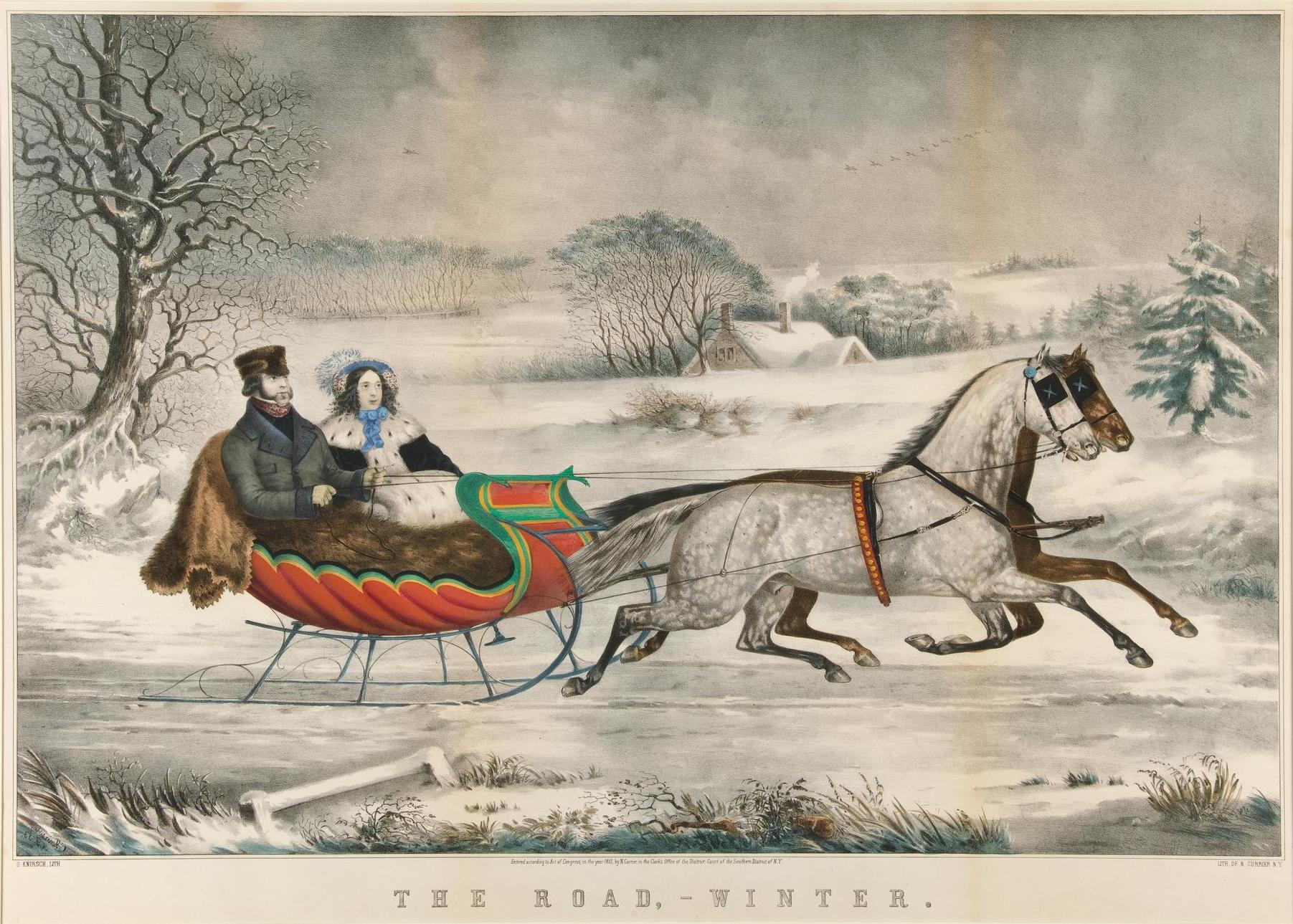
Currier, Nathaniel (1813-1888), The road, winter / O. Knirsch, lith., 1853. New York: Published by Currier & Ives. Yale University Art Museum, Whitney Collections of Sporting Art, given in memory of Harry Payne Whitney (B.A. 1894) and Payne Whitney (B.A. 1898) by Francis P. Garvan (B.A. 1897) June 2, 1932. Public domain. Click to open larger image in new window.1
We don’t know if the Clarks owned a sleigh while they lived in Mequon. I suspect they did, though their sleigh—and their clothing—may not have been quite as posh as those in this Currier & Ives lithograph from 1853.
It’s been a hectic few days here at Clark House Historian. Some of our essential technology was getting to the end of its useful life, so we’ve spent the last few days upgrading and updating some critical—but now outdated—hardware and software.
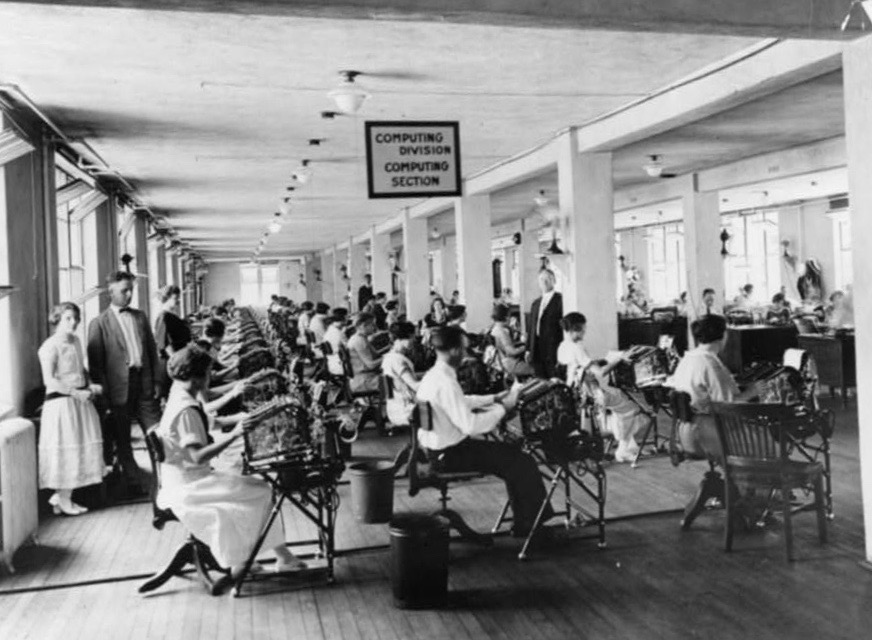
The Bonus division where the many clerks figure the amount of the bonus each veteran is entitled to / [Between 1909 and 1932] Photograph. Library of Congress.
Which reminds me, that not too long ago the word computer was a job description, and not a device.
Lately, I’ve been spending a lot of time looking through digitized historical newspapers, trying to fill in some of the missing pieces of the Clark House story. In the process, I’ve managed to discover some unique and important information about the Clarks, Turcks, Bonniwells and their neighbors. And I’ve also run into a lot of off-topic but fascinating tidbits about daily life in Wisconsin during the Clarks’ era, such as this random bit of history:
Summer has finally settled in here in Wisconsin, and the Jonathan Clark House is ready to host you once again on Saturday, July 16, 12pm – 3pm to enjoy all the old fashioned fun in the very spirit of the season for the second installment of our summer series event Heritage Days!
In addition to our favorite features, our special attractions for July include:
I just got some fun news from Jonathan Clark House executive director Dana Hansen:
While the weather doesn’t feel like it at the moment, our fundraiser game with the Chinooks is coming up very soon! Make sure to purchase your packages asap for the game on June 3rd as they will be opening up general ticket sales May 2nd, and expect to sell out. See the poster below for more information, and hope to see you out at the ball game!
______________________________________
Click to open larger image in a new window.
Batter up! for history.
So if you’d like to support the Clark House—andenjoy an fun evening at the ballpark—call and reserve your game package for Friday, June 3rd, 2022, and don’t forget promo code JCH.
And even though the Chinooks and the Rafters will play by modern rules, I’m sure Old Abe would approve…
Updated Feb. 14, 2022 to add the qualifier “English-speaking” to the second paragraph.
Did you watch the Big Game? Go out to eat? Maybe you had to put in a shift at work? Or did you just take a break and relax at home, gearing up for another week on the job? Perhaps you went to church on Sunday.
In Jonathan and Mary Clark’s era, many of their Mequon neighbors would honor the Sabbath by refraining from all work and worshiping privately at home with their families, or gathering with small groups of neighbors to pray and hear the Word. Beginning in the early-1840s, the English-speaking Protestant Christians living near the Clark House—including many members of the Clark, Bonniwell and Turck families—gathered at the new, one-room, Bonniwell School to worship together at Sunday services; these were often led by their neighbor, the farmer and evangelical Methodist preacher Rev. James W. Woodworth.
Rev. Woodworth has concerns…
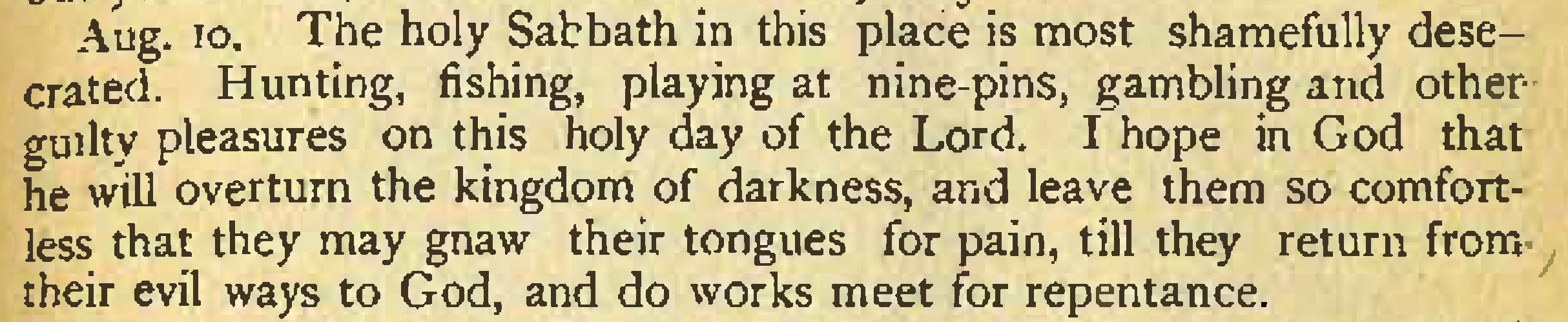
We have talked about Rev. Woodworth previously and, as we have seen before, he was constantly concerned about the state of his neighbors’ souls. It seems that even though the nation was still riding the wave of several decades of the religious revival now known as the Second Great Awakening, the settlers of the young Wisconsin territory and state were not always very good at “keeping the Sabbath holy.” In his diary entry for August 10, 1855, the reverend lamented:
Aug. 10. The holy Sabbath in this place is most shamefully desecrated. Hunting, fishing, playing at nine-pins, gambling and other guilty pleasures on this holy day of the Lord. I hope in God that he will overturn the kingdom of darkness, and leave them so comfortless that they may gnaw their tongues for pain, till they return from- their evil ways to God, and do works meet for repentance.
Woodworth, James W., My path and the way the Lord led me, Milwaukee, 1878, p. 79.
Updated Feb. 11, 2022, with information about Milwaukee’s “original Ice Bear,” Henry Kroeger (see comments, below).
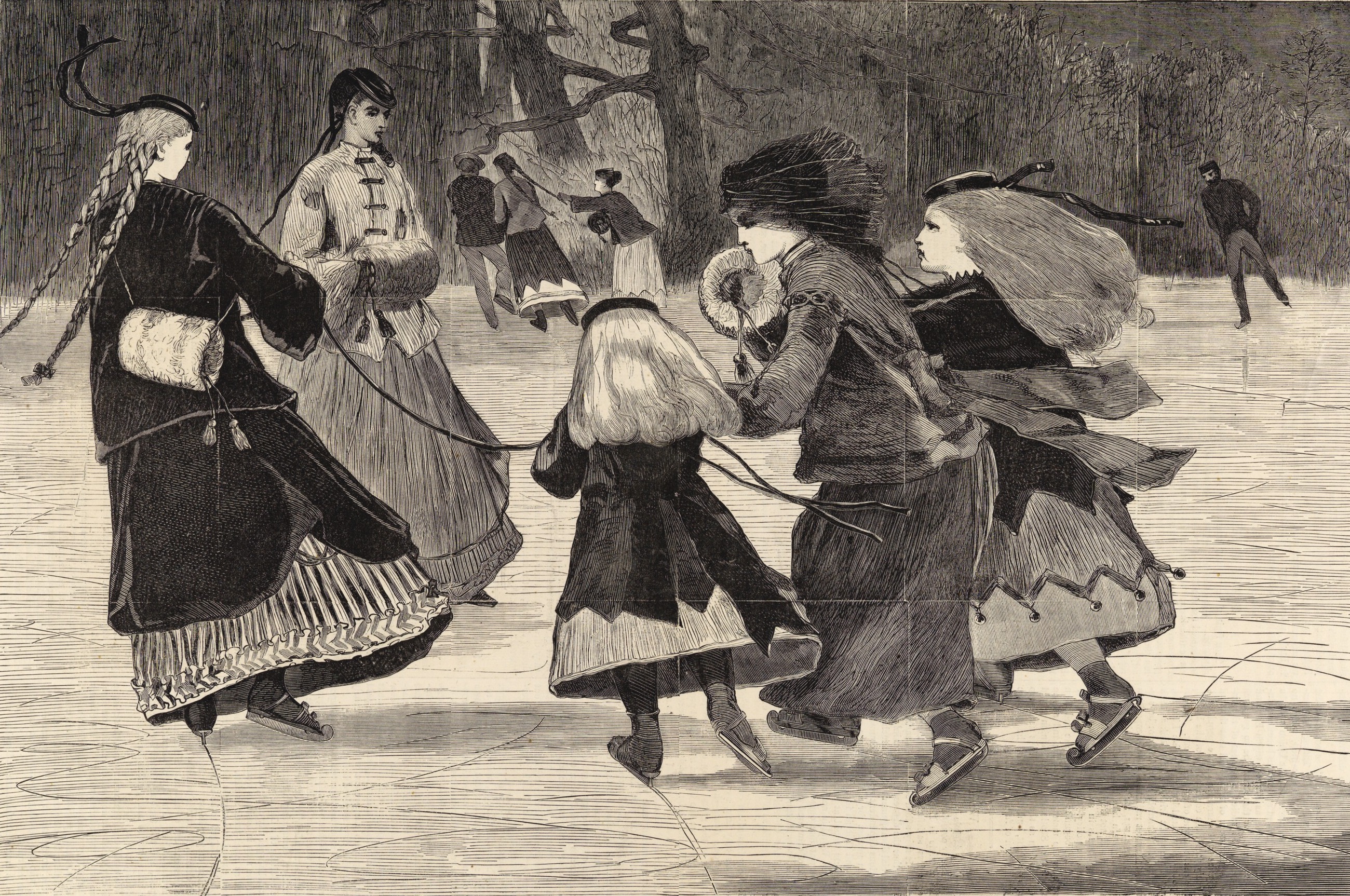
The 24th Winter Olympic Games are now under way in Beijing, with a dizzying profusion of modern sliding and gliding winter sports. Of course, outdoor winter games and sports pre-date the modern Olympics by hundreds, if not thousands, of years. Among the oldest and most popular of these is ice skating.
Homer, Winslow, “Winter” — A Skating Scene, from Harper’s Weekly, January 25, 1868. Smithsonian American Art Museum, The Ray Austrian Collection, gift of Beatrice L. Austrian, Caryl A. Austrian and James A. Austrian. Public domain, CC0. Click to open larger image in new window
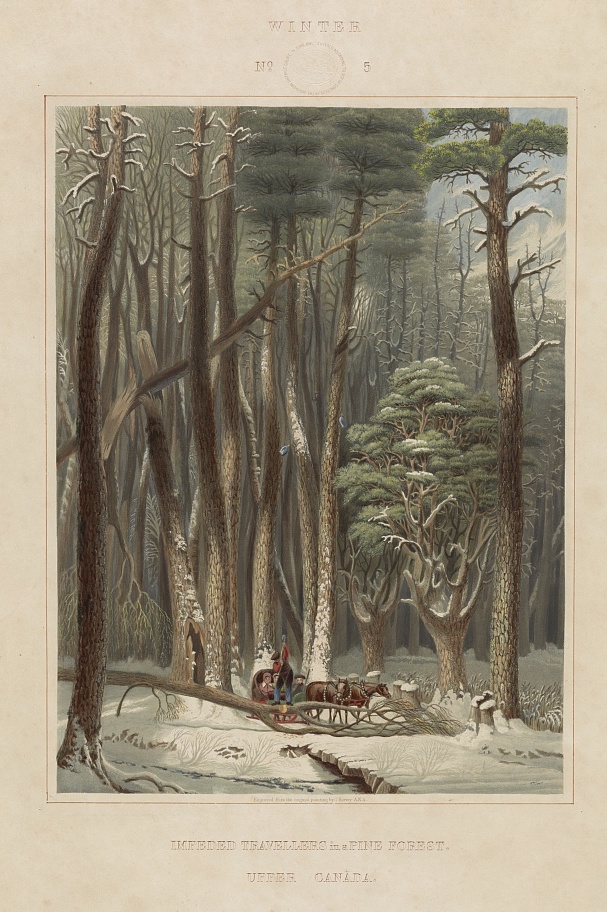
In Jonathan and Mary Clark’s era, if you needed to get somewhere during the winter—for business or for pleasure—you probably rode in a a horse-drawn sleigh. Travel in a sleigh could be fun, even exhilarating, but was not without its perils, most of which came from inadequately maintained roads and trails:
Bennett, W. J. , Engraver, and George Harvey. Winter. No. 5., Impeded Travelers in a Pine Forest, Upper Canada / engraved from the original painting by G. Harvey A.N.A., New York, 1841. Color aquatint. Library of Congress. Click to open larger image in new window.
Much of this post appeared last year, but since we—finally!— got some snow in southeast Wisconsin last night, I thought I’d share it again, with a few additions and revisions, and a new, hand-colored, version of the artwork.
Snow, and often lots of it, was a feature of Jonathan and Mary Clark’s life in Wisconsin. So if you wanted to go to town or church or visit your neighbors during the snowy Wisconsin winter—or just enjoy a pleasant winter ride in the country—you’d need a sleigh.
Currier, Nathaniel (1813-1888), The road, winter / O. Knirsch, lith., 1853. New York: Published by Currier & Ives. Yale University Art Museum, Whitney Collections of Sporting Art, given in memory of Harry Payne Whitney (B.A. 1894) and Payne Whitney (B.A. 1898) by Francis P. Garvan (B.A. 1897) June 2, 1932. Public domain. Click to open larger image in new window.1
We don’t know if the Clarks owned a sleigh while they lived in Mequon. I suspect they did, though their sleigh—and their clothing—may not have been quite as posh as those in this Currier & Ives lithograph from 1853.




 Clark House Historian