I’m still investigating the cabinet card and tintype photos of Cyrus Clark. More on those coming soon. Meanwhile, it’s Back to School time for many of us, so here’s a page with a transcription of the earliest known school records in old Washington county prior to 1845:
Continue readingEducation
1861/1862: Moving Time
Mary Clark and the children move to Milwaukee
On July 20, 1860, the eighth federal decennial census recorded Mary Clark and her family living together on their Mequon farm. Less than a year later, on May 15, 1861, eldest daughter Caroline Clark married William W. Woodward and, presumably, left the Clark house to start their new life together. By the next federal census—June 1, 1870—Mary Clark, her six youngest daughters, one son-in-law, one grandchild, and one future-son-in-law, would be enumerated together in Mary’s home in Milwaukee.
What happened to the Clarks between July, 1860, and June, 1870? Ozaukee County land records show that Mary and her children did not finally sell the Mequon land, stone house, barn, and other structures until April, 1872. Catherine Doyle, matriarch of Mequon’s Doyle family was the buyer. Two years earlier, the 1870 federal census shows that Catherine Doyle, her husband John, and their family were already farming on the old Jonathan M. Clark farm. It appears that Mary Clark had rented or leased the Clark farm to the Doyles and, presumably, used the income to support her family.
So when did the Clarks move to Milwaukee? Did they buy a house, rent, or move in with Mary’s father, Peter Turck? To find out, we need to consult a mundane but very useful resource, the City Directory.
Continue readingMonday: Map Day! – 1854 Panoramic Map of Milwaukee
The first white settlers to old Washington County, Wisconsin—later divided into Washington and Ozaukee counties—arrived in the late-1830s and early-1840s. Many of these settlers were so-called “Yankees,” namely New England and New York state residents. Other early immigrants to old Washington county came from places such as Lower Canada (i.e., Quebec), Nova Scotia, and the many German-speaking lands.
Why did they come?
For many families, the chance to buy inexpensive land, clear the forest, build a house, and work their own farm was a dream come true. Many of the Yankee immigrants had realized that the farms of New England were too small to continue dividing generation after generation and still make a profit. (Sometimes—as the old joke goes—it seemed like the only guaranteed “crop” each year was the annual spring “harvest” of rocks in the field.) For European immigrants, land ownership was often unaffordable or simply not allowed for the average family back in “the old country.” Other European immigrants fled mid-century famine, as in Ireland, or mandatory military service or political unrest in various places, including the German lands. It’s no surprise that many Wisconsin immigrants of the ’30s, ’40s and ’50s made their homes in Washington/Ozaukee county and then farmed there for decades, often passing the house and farm to the next generation and beyond.
For other early arrivals, the opening of government land in Wisconsin Territory represented a chance to make money. More than a few of the Yankee settlers came to the territory early, bought land at $1.25 per acre, farmed for a decade or so, and then sold out to the next wave of immigrants, often making a considerable profit. Some of these men—such as Solomon Juneau, Byron Kilbourn, and William A. Prentiss—were land speculators that made (and sometimes lost) fortunes in the process, and became important figures in nineteenth-century Milwaukee and Wisconsin business and government. Other, smaller, investors were simply savvy farmer-capitalists that bought government land cheaply, held it for a while, and then sold at a profit. Some of these repeated the process several times throughout their lives, buying and selling, moving westward as the government opened new tracts of cheap—or even free—land in the new territories of the frontier.
Stay or go?
By the mid-1850s, a number of early Washington/Ozaukee county settlers decided that rural life was no longer for them. Mary Clark’s father, Peter Turck, was one of the first Mequon settlers to relocate. A self-made polymath, from his earliest days in the territory Turck had been—often simultaneously—a farmer, Baptist preacher, sawmill owner, justice of the peace, coroner, territorial and state legislator, and lawyer. In the 1840s he survived the death of his first wife Rachael Gay, remarried, and had another child. By the early 1850s—like a number of his early Mequon neighbors—he decided to leave his farm and relocate to nearby Milwaukee. There he could focus on his work as a lawyer and real estate dealer and, perhaps, seek better educational opportunities for his youngest children.
Milwaukee
In 1836,—a year before the Turck family arrived there from New York—Milwaukee had been a small, random collection of roughly made homes and businesses along the east and west banks of the Milwaukee River where it flowed into Lake Michigan. By the time Peter Turck moved to Milwaukee from Mequon, the city looked like this:
Continue readingWorking at Home
I’ve been busy with Jonathan Clark House research for the last few days. Many questions answered, but others still need work, and none of the blog post drafts are ready for publishing. So how about another Jonathan Clark House Museum photo?
Continue readingThe Clark Family in 1850 – part 4
Beyond Names, Dates & Birthplaces
Previously—and, yes, it’s been a while—we looked at the Jonathan Clark family as enumerated on the population schedule of the 1850 U. S. Federal Census. If you missed those posts, here are the links for Part 1, Part 2 and Part 3. Take a look at those, and you’ll learn some key facts about the Clarks: the names and ages of each person in the household, and where each was born. That’s important information, but not all. In 1850, the census bureau wanted to know more, and if we look carefully we can discover some interesting things about the family:
Think Like a Historian…
To all my blog readers, I hope this finds you well and staying safe at home.
I just received a message from Jonathan Clark House director Nina Look and I thought I’d share it with you:
Dear Friends-
As you might imagine, the Clark House is closed at this time, but we continue to think about the history of our early settlers and how important it is to share that history with our children. I prepared the attached guide with the help of JCH Education Coordinator Margaret Bussone and JCH Curator Fred Derr.
Feel free to pass it on to a young person who may want to “Think like a historian.”
Nina Look, Director

Click this link to open the CLARK HOUSE Guide for Young Visitors
February History Fun!
While the blog has been quiet for a while, behind the scenes I’ve been pursuing some hot leads as we try and solve the mysteries of Jonathan M. Clark’s parents, siblings and birthplace. More on that in the near future. Meanwhile, here are a few upcoming events that may be of interest:
On Saturday, February 1, 2020, from 10:00-4:00, Jonathan Clark House museum volunteers will have an indoor exhibit with family-friendly activities at the Mequon Nature Reserve Winter Frolic. For more information and parking directions, see their Facebook page.
Still Here! Watch This Space!
Well the third anniversary of the Clark House Historian blog has come and gone without new posts in, er, quite a while. Sorry about that!
Although I haven’t posted new blog content lately, I have been busy behind the scenes, collaborating offline with Jonathan Clark House Museum staff and friends as we try and solve a number of vexing Clark house, Clark family history, and Mequon area history questions and mysteries. I hope to be posting regularly again with lots of new documents and information for Jonathan Clark House Museum friends in the coming months.
Meanwhile, if you are new to the blog, please see our second anniversary post for background on the blog, the Jonathan Clark House Museum, and links to all kinds of interesting Mequon area historical information.
And be sure to visit and support the Jonathan Clark House Museum! Come to the house and do your 19th-century farm chores at the final Heritage Days event on August 17th: Continue reading
Mary Turck Clark
UPDATE, January 30, 2021: this post was the second-ever post on Clark House Historian. It represented what we knew at the time about Mary Turck, the daughter of Peter Turck and Rachael Gay, wife of Jonathan M. Clark, and mother of the eight Clark family children. This original post was pretty accurate, and I’m leaving it here for reference. But we have learned a lot more about Mary and her Turck and Clark families in the intervening almost-5 years. For the most up-to-date info on Mary Turck Clark, please go the the revised version of this biographical sketch. Thanks for reading!
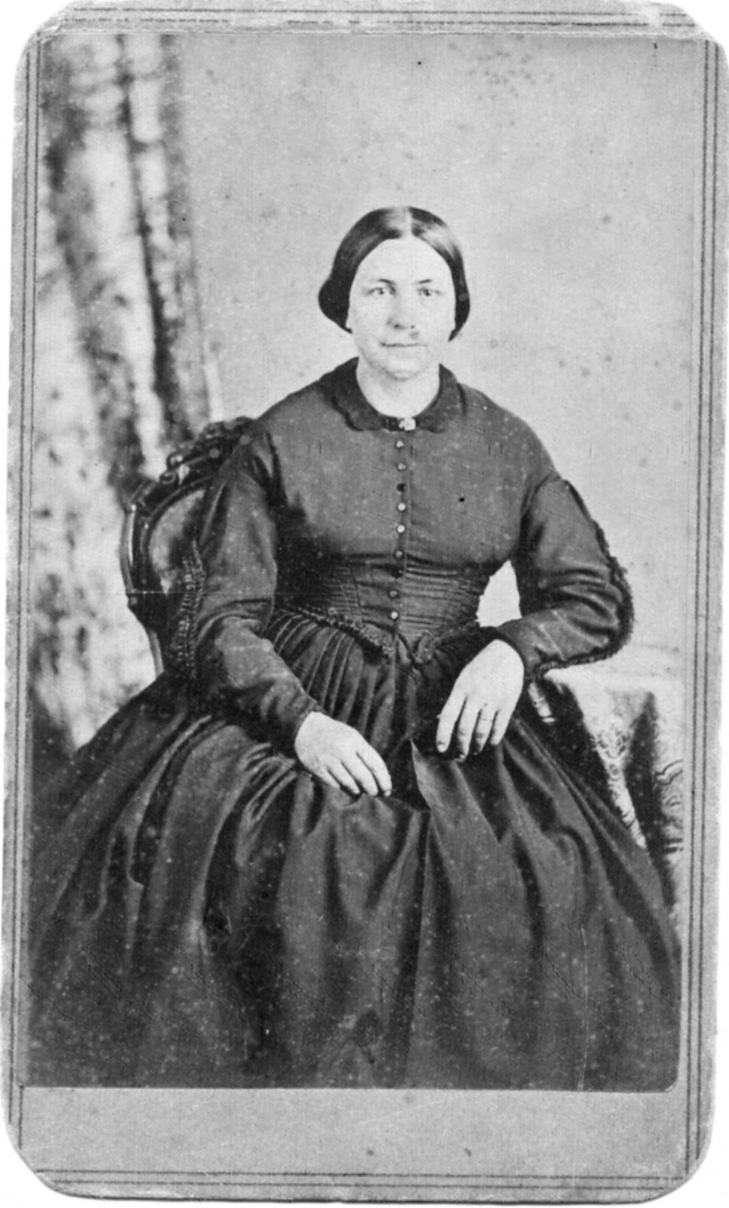
Mary Turck Clark. Photograph courtesy Liz Hickman.
It is a commonplace of genealogical and historical research that women and their stories are the “forgotten fifty percent.” In most North American societies it was, and in many places remains, the custom that upon marriage the woman took her husband’s surname. Some documents that recorded marriages, births and deaths might include a place for the woman’s surname, and sometimes the names of her parents, but this information was often left blank. After a generation or two, the woman’s name and those of her parents and grandparents would be completely forgotten, even by her closest descendants.
 Clark House Historian