Our series of “How’d they get here?” posts is written to illustrate the nuts and bolts of how our early Mequon pioneers travelled from their original homes or ports of arrival in North America, to the newly opened federal lands in Wisconsin Territory, circa 1830-1850. See Note 1, below, for links to other posts in the series.
Village of Buffalo, 1825
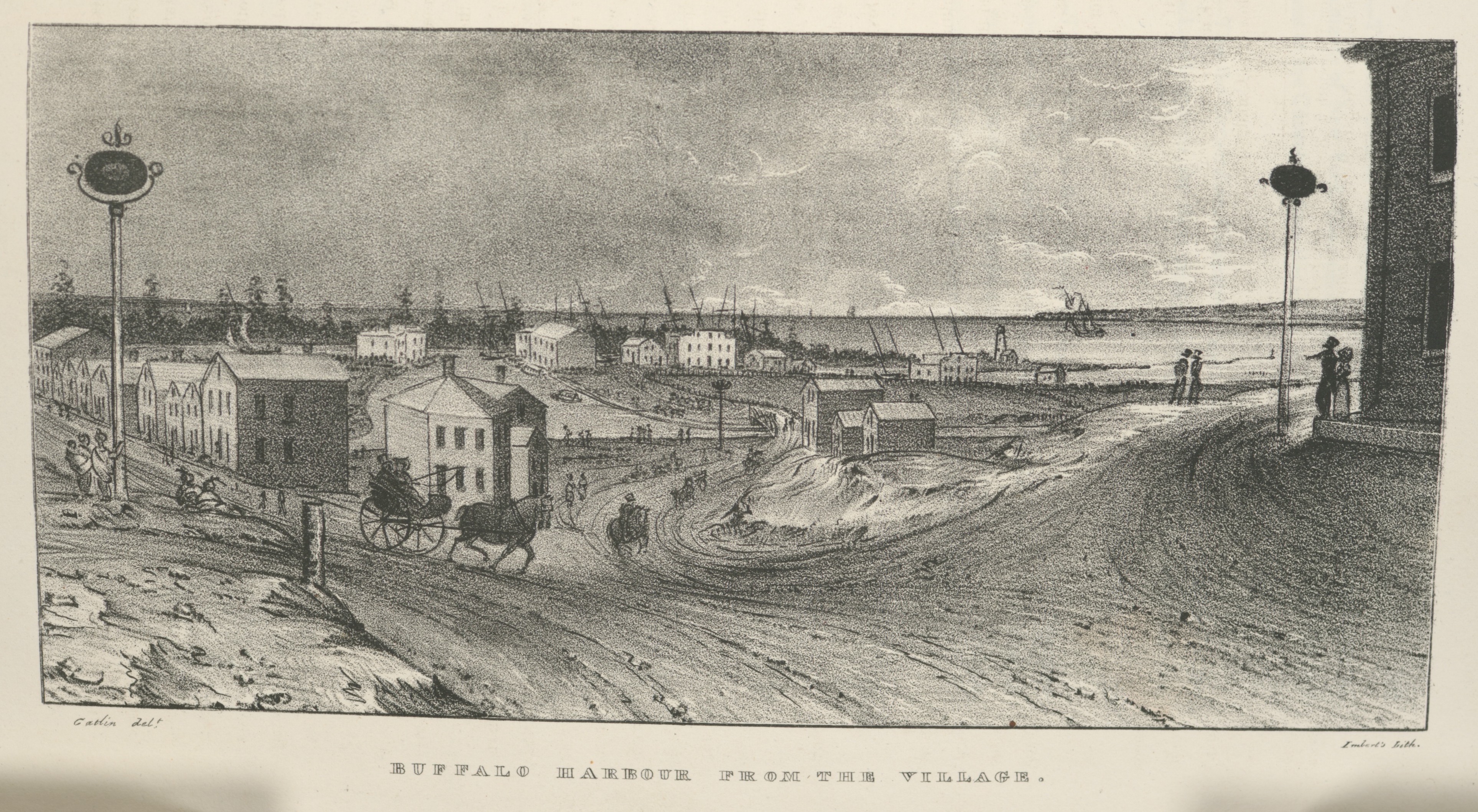
In a previous post, we followed the newly-opened route for westward migrants from the New York City docks, up the Hudson River to Albany, and then along the new Erie Canal towards its terminus at the village of of Buffalo, New York, at the eastern end of Lake Erie. After seven days of travel on canal boats, the westbound traveler of 1825 would have looked up and seen this, the muddy streets and modest harbor of Buffalo:
Buffalo Harbour from the Village, in Cadwallader Colden, et. al., Memoir…at the Completion of the New York Canals, New York, 1825. Image from “extra-illustrated” edition in New York Public Library Digital Collections, scanned copy of standard edition of book via GoogleBooks. Public domain. Click to open larger image in new window.
After leaving the Deep Cut above Lockport, the last part of the Erie Canal merges with Tonawanda Creek, seen here flowing into the village from far left to center, in front of the line of distant trees, and then curving toward the viewer before exiting into the harbor, to the right. The original Buffalo lighthouse of 1818 can be see on a small peninsula, right of center, just above where Tonawanda Creek meets the lake.
Earlier this summer, while putting together the post How’d they get here? – early Erie Canal images, I came across a tidily-drawn print that helps illustrate the story of the Peter and Rachael (Gay) Turck family’s life before coming to Mequon. It’s downtown Palmyra, Wayne county, New York, in 1825:
Unknown artist, Eastern view in Main-street, Palmyra., in Cadwallader Colden, et. al., Memoir…at the Completion of the New York Canals, New York, 1825. Image from “extra-illustrated” edition in New York Public Library Digital Collections, scanned copy of standard edition of book available via GoogleBooks. Click to open larger image in new window.
One of the really neat aspects of researching and writing about Clark House history on this site is the feedback I receive from blog readers. I love hearing from you, whether you have a comment or a question about the topic at hand, or perhaps there is something else that you want to know more about.
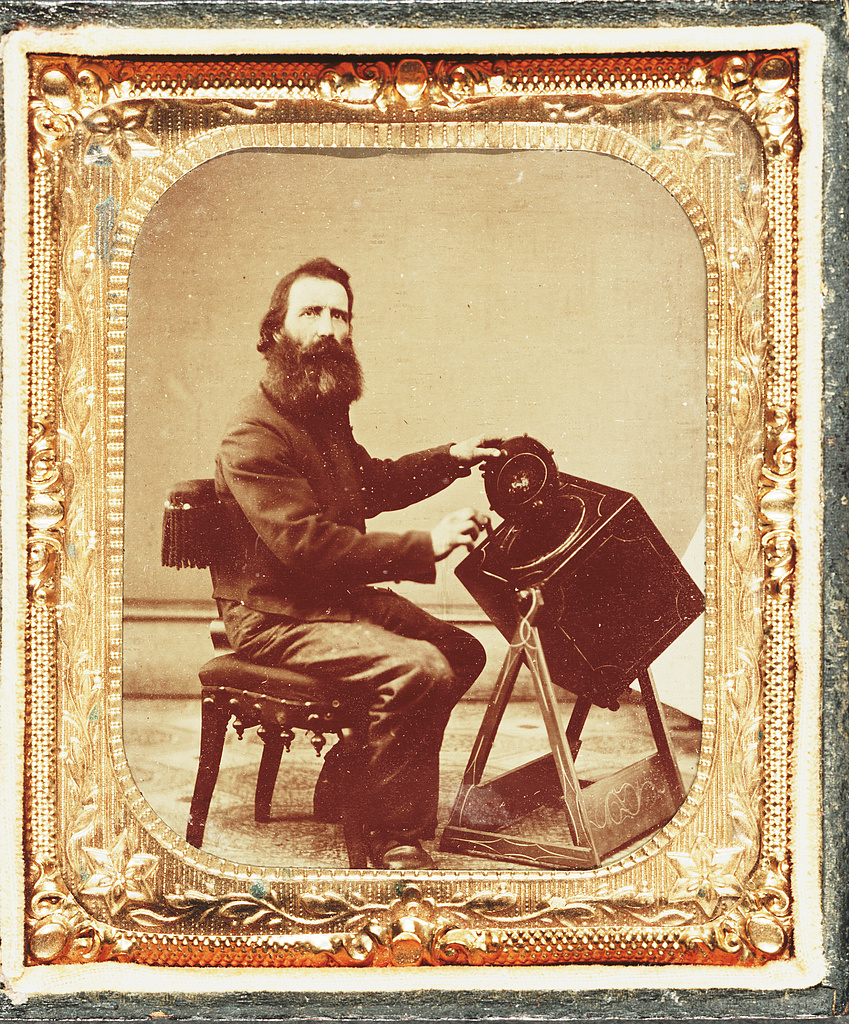
[Occupational Portrait of a Salesman], Three-Quarter Length, Seated, Displaying His Wares. Daguerreotype, between 1850 and 1860, cropped and lightly color-adjusted. Library of Congress. Click to open larger image in new window.
“UPDATED…”
History is never “done.” No one can know it all. There are always new sources with fresh information, and new ways to look at well-known material. A question or a new bit of information from a reader will often prompt additional research or a correction to previous statements. The result is that this blog—and our knowledge of the Clark family, their neighbors, and their era—is constantly evolving.
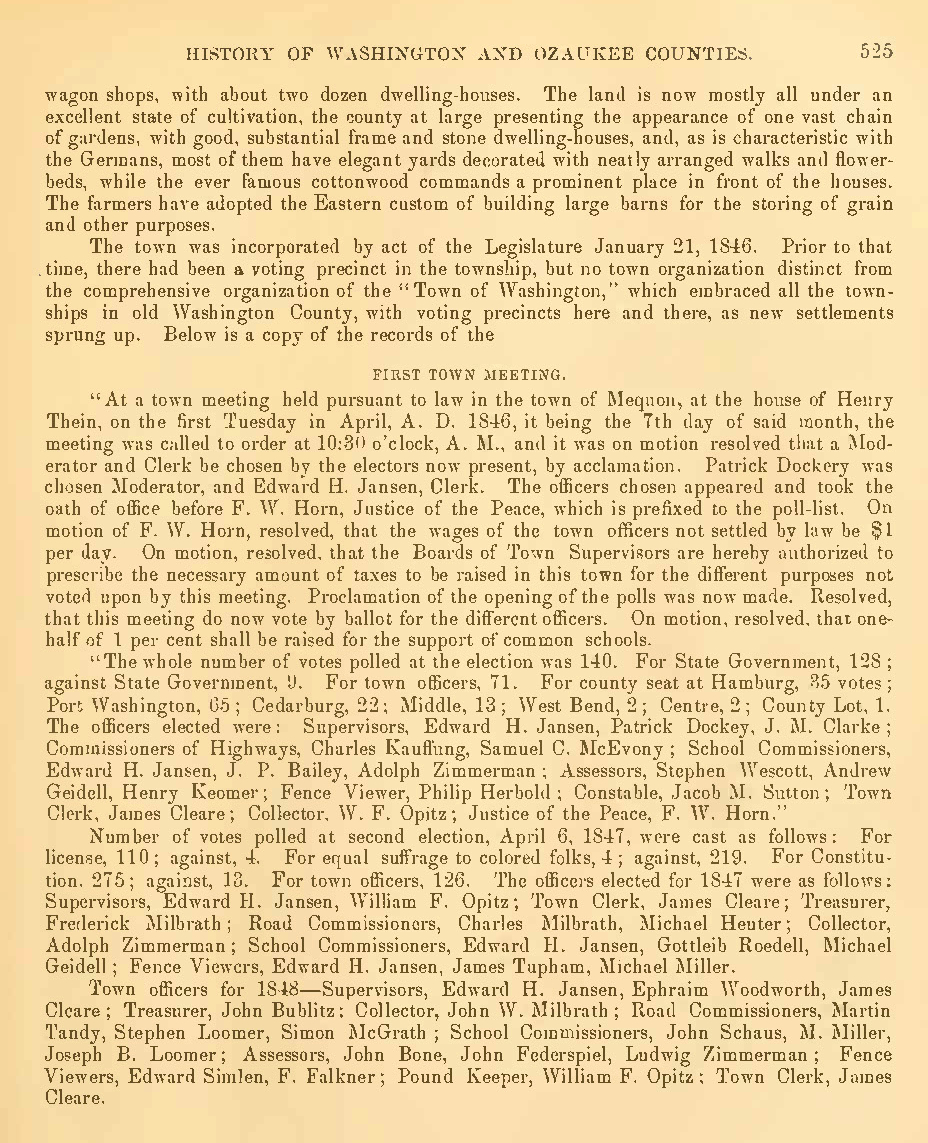
Every now and then it pays to take a fresh look at familiar sources. One of the key sources for the early history of Mequon and its parent counties is The History of Washington and Ozaukee Counties, Wisconsin […] Illustrated, published in Chicago in 1881. And even though I’ve been using this book for Clark House research for over a decade, I still discover (or, in this case, re-discover) facts about Mequon—and, specifically, Jonathan M. Clark—that I had either not known before, or had noticed, “filed for future reference,” and forgotten to write about. Today’s post fixes one such omission.1
The first meeting of the Town of Mequon, April 7, 1846
Page 525 of The History… contains a load of information about the beginnings of town government in Spring, 1846. Unfortunately, it’s the sort of densely worded, 19th-century “history” writing that makes the reader want to skip ahead to something less dry. Here, take a look; start with the first full paragraph, beginning “The town was incorporated”…
The History of Washington and Ozaukee Counties, Wisconsin […] Illustrated, Western Historical Co., Chicago, 1881, page 525, pdf of full book via GoogleBooks. Additional online, pdf copies can be found at Hathi Trust, the Wisconsin Historical Society and Archive.org. Click to open larger image in new window.
That’s a lot of info: names, dates, job titles. Let’s break things up a bit and take a closer look at what’s going on as old Washington county transitioned from the original county-wide system of government to the new system, in which each town will be responsible for much of its own governance.
UPDATED August 12, 2021 (twice), with more information on Orange Dibble’s derrick, illustrated below. See my reply to the question from reader Chester T. Hartwell in Comments, below.
UPDATED July 29, 2021, to include some new general information and details about several of the images sent by reader Robert Randall, second vice-president of the Camillus Canal Society. For Mr. Randall’s full message, see Comments, below. For more on the society’s Camillus Erie Canal Park, click here.
How the early settlers came to Mequon, c. 1835-1850 (part 3)
Our series of “How’d they get here?” posts is written—in part—to help our education team put together a Clark House Museum educational activity. The idea is to illustrate the nuts and bolts of how our early Mequon pioneers travelled from their original homes or ports of arrival in North America, to the newly opened federal lands in Wisconsin Territory, circa 1835-1850. (If you missed ’em, the previous parts are here and here, with a bonus image, here.)
Erie Canal images – 1825!
Finally!! For years, I’ve been searching for images of the unique, low-draft, narrow-sided, low-height, lock-length boats designed for and used in the earliest years of the Erie and Champlain canals (c. 1825-1840). And year after year, I had no luck finding such images…until this week.
You might be thinking, “hasn’t Clark House Historian already spent quite a bit of time on the Erie Canal?,” and you’d be correct. But it’s hard to overstate the national and international importance of the Erie Canal on world trade and American westward expansion in the decades after its opening in 1825. And while we have used maps to illustrate the migration routes of some Mequon settlers (such as the Turck, Gay, Bonniwell, and Woodworthfamilies), I wasn’t able to adequately illustrate the details of how they travelled in the early days of the canal era. Until now.
Today’s treasure trove of early canal images is from Cadwalleder Colden, et. al., Memoir…at the Completion of the New York Canals, New York, 1825. Many of these images are from the “extra-illustrated” edition in New York Public Library Digital Collections; you can download and enjoy a scanned copy of the standard edition of the book via GoogleBooks. Yes, these images are a bit early for our generally 1835-1850 “How’d they get there?” timeframe. But these are, by far, the best visual representations of early New York canal travel that I have seen. Even though Jonathan M. Clark, and the Woodworth and Bonniwell families and other Mequon settlers did not travel on the canals until the 1830s, these images depict scenes they would have experienced along the Champlain and Erie canals.
Please take a close look at each image for the “big picture,” then click on each and zoom in on the details. All the images can be clicked on to open as a larger, downloadable, image in a new window. All images are believed to be in the public domain, and I encourage you to enjoy, download, save, share and use them as you see fit.
Canal Boats
Here is an excellent view of a group of the new canal boats, loading freight and soliciting business at the North [i.e., Hudson] River docks, New York City, before heading up the Hudson to Albany and the canals:
Canal boats on the north river, New York, in Cadwallader Colden, et. al., Memoir…at the Completion of the New York Canals, New York, 1825. Image from “extra-illustrated” edition in New York Public Library Digital Collections, scanned copy of standard edition of book via GoogleBooks.
How the early settlers came to Mequon, c. 1835-1850 (part 2)
This is part 2 of a series focused on how our Mequon pioneers traveled to southeast Wisconsin in the early days of white settlement, between roughly 1835 and 1850. If you missed part 1, it’s here at Monday: Map Day! – How’d they get here?, plus a short post with bonus image at Steamboat’s coming!
From the late 1820s until about 1850, if you wanted to get from the settled American northeast to the open frontiers of the West, the fastest, safest, and cheapest way to get there was by water. Thousands of New Yorkers, New Englanders, Canadians, and overseas immigrants that had come from Europe to America’s eastern ports, found the Great Lakes route—west on the Erie Canal to Buffalo, and then by water through the Lakes to Chicago and Milwaukee—was their preferred route to new homes on the western frontier. And many of those settlers traveled on the newest, fastest craft afloat: the steamboat.
View of Detroit…1837
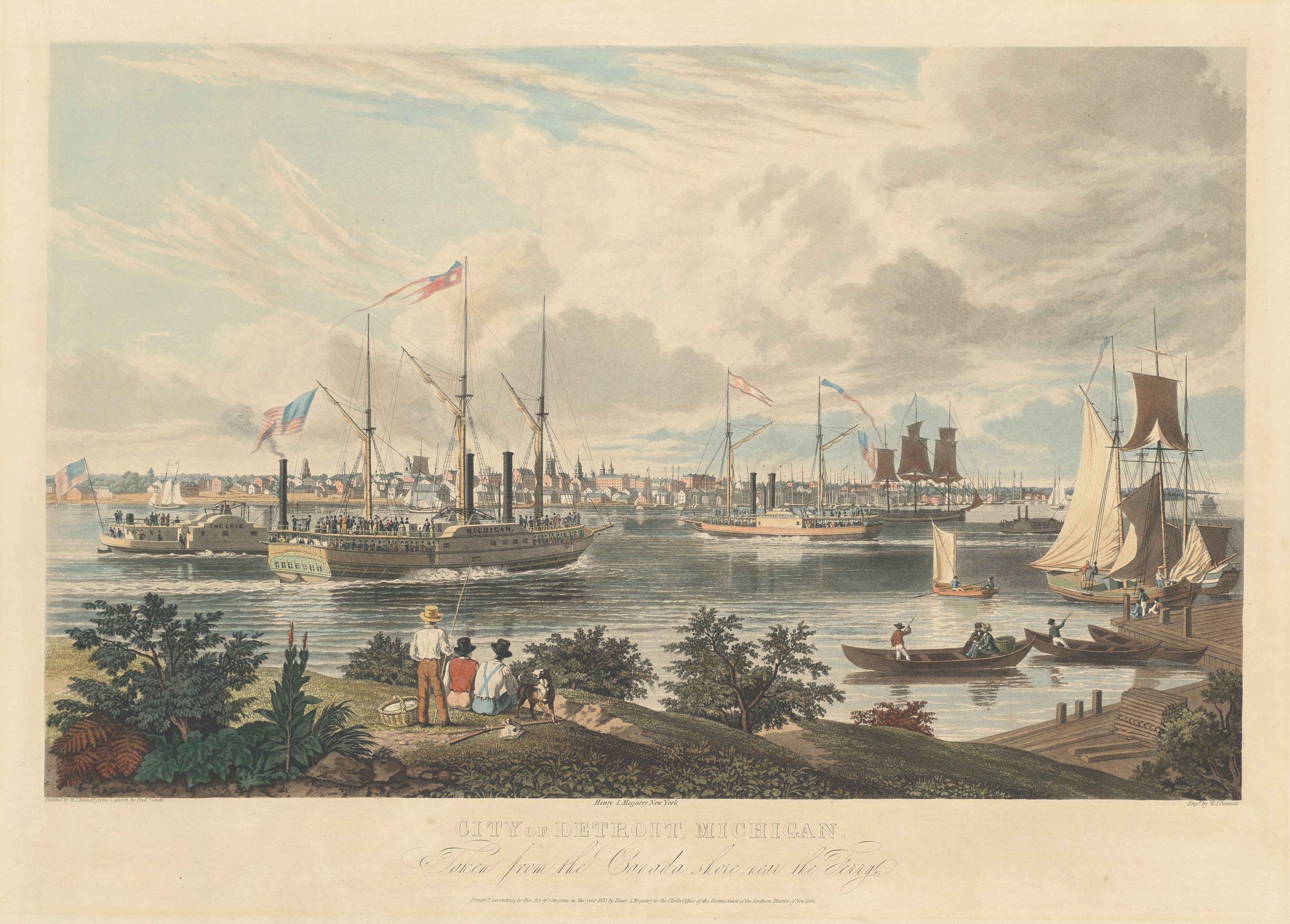
Here’s something really special for Clark House history lovers, a detailed drawing of the various kinds of sailing ships and steamboats as they passed by Detroit, Michigan on a sunny day in 1837, as seen from the Canadian side of the Detroit River. Take a close look; this is the view Peter Turck and his family—including daughter Mary, the future spouse of Jonathan M. Clark—would have seen as they traveled to Milwaukee in August of the same year1:
Bennett, William J., after a sketch by Frederick K. Grain, City of Detroit, Michigan. Taken from the Canada shore near the Ferry., hand-colored aquatint on engraving, ca. 1837. National Gallery of Art, Collection of Mr. and Mrs. Paul Mellon. Public Domain. Click to open larger image in new window.
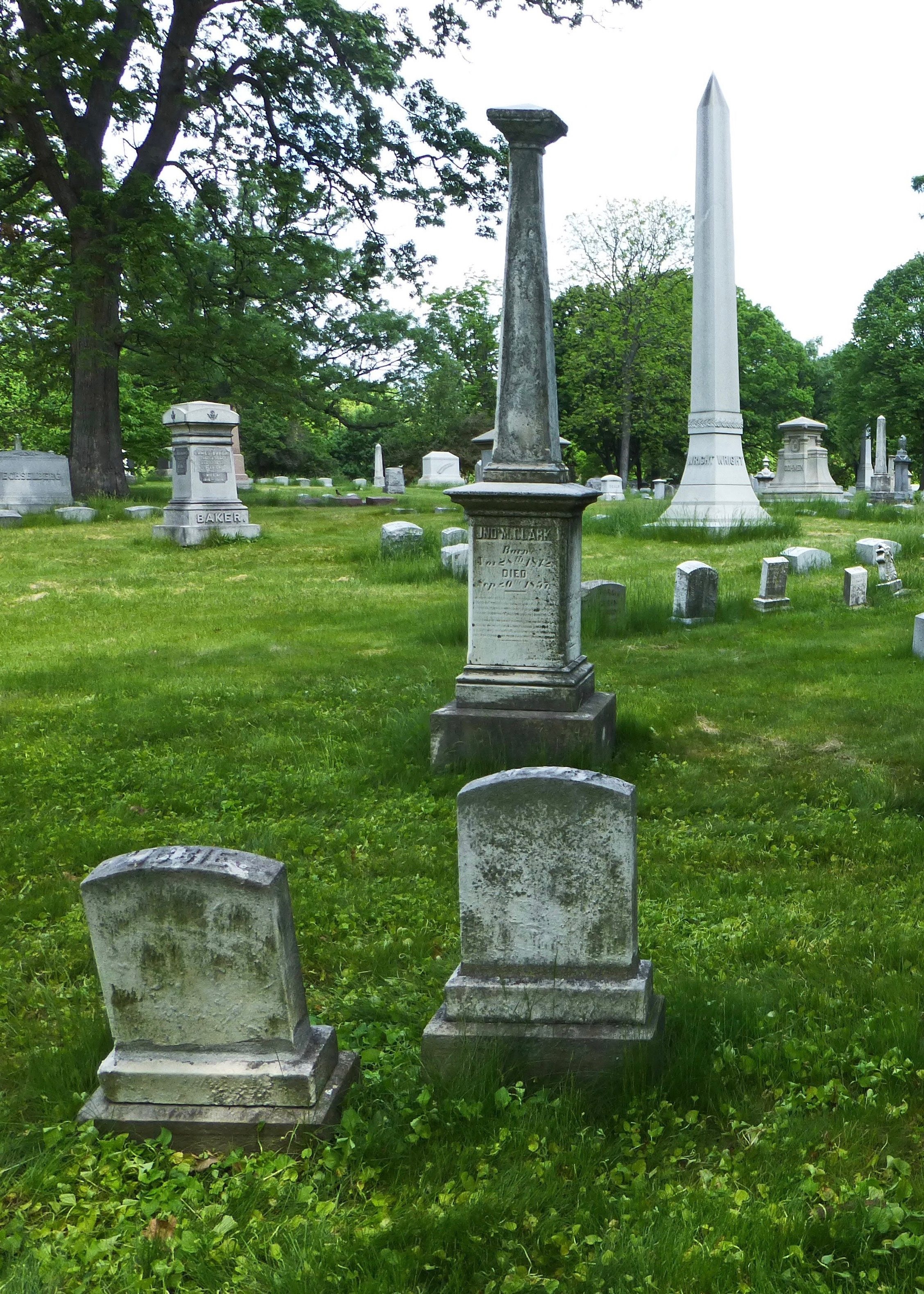
As we learned in our previous post, Henry Clark—only son of Jonathan M. and Mary (Turck) Clark—was buried “in Cedarburg” on Monday, April 23, 1866. But if you seek Henry’s final resting place, you’ll find him next to his father, mother, and sister Josie in the Clark family lot at historic Forest Home Cemetery in Milwaukee. How this came to be, and what this tells us about Clark family history, is the subject of today’s post.
Clark family graves, lot 3, block 44, section 10, Forest Home Cemetery, Milwaukee, Wisconsin. Photo courtesy Liz Hickman, 2016. Click to open new image in larger window.
In our previous post, we discovered that Henry M. Clark was drafted for Civil War military service on November 10, 1863. Today we will look at the existing evidence recording Henry’s death and burial in April, 1866, aged 23. So far, we lack reliable documentation for Henry’s life during the 28 months between those dates; we’ll continue the search for Henry’s possible Civil War service in a series of upcoming posts.
The question remains: why did Henry Clark, only son of Jonathan M. and Mary (Turck) Clark, die so young? Milwaukee death records for the 1860s are uneven and incomplete; it’s not surprising that no death certificate exists. I have not been able to find a death notice in the Milwaukee newspapers. But we do have two contemporary sources that can shed some light onto the mystery of this Clark family loss.
Densmore W. Maxon’s 1866 diary
On April 2, 1846, Mary Turck Clark’s younger sister Elizabeth Turck (1828-1913) married an ambitious young settler, Densmore W. Maxon (1820-1887). Maxon began his Wisconsin years as a surveyor, and eventually rose to prominence as a businessman and politician. He laid out the village of Cedar Creek, Town of Polk, Washington county, about 18 miles north and west of the Jonathan Clark house in Mequon. Densmore and Elizabeth Maxon lived in Cedar Creek for the next 41 years.
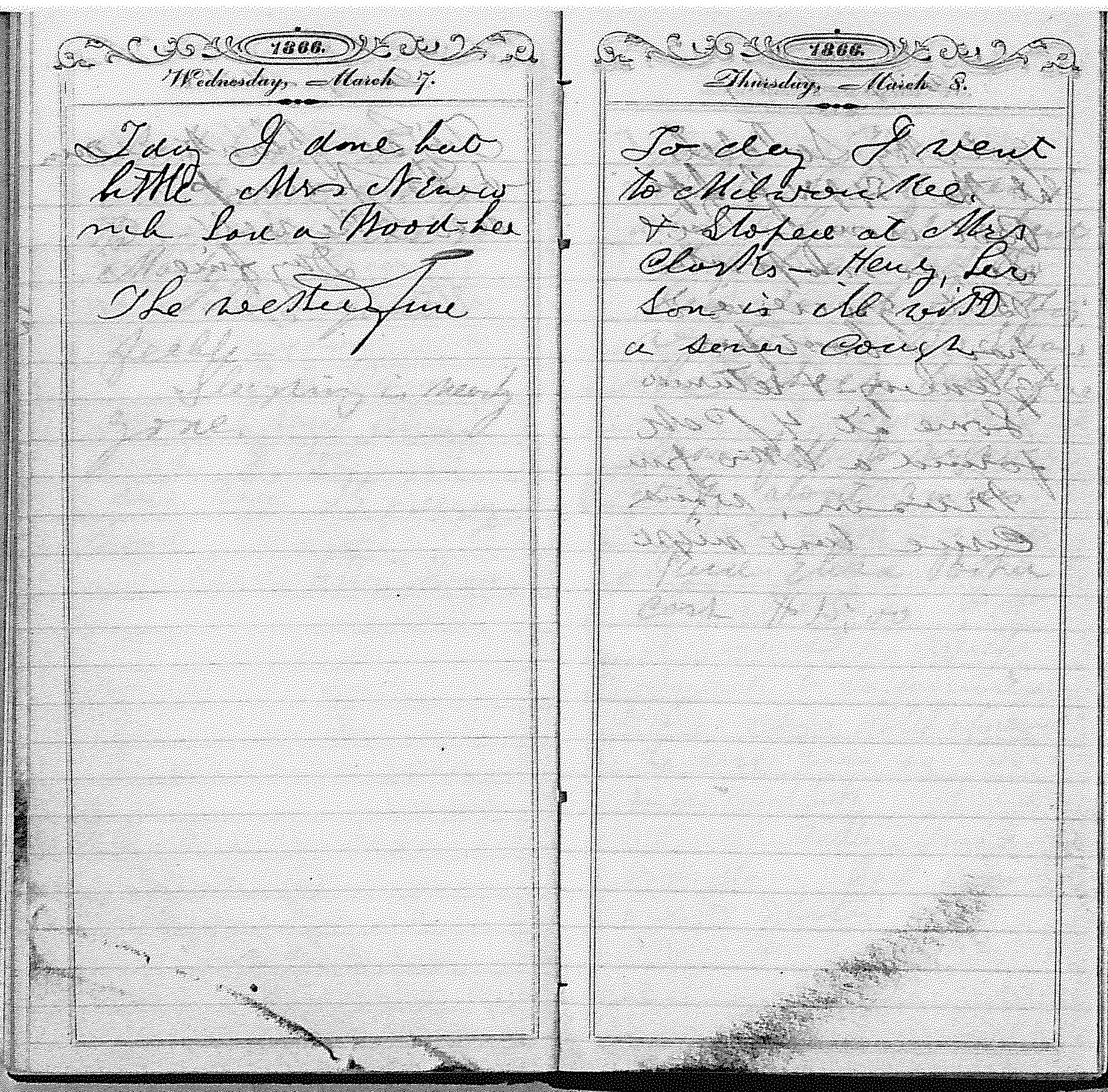
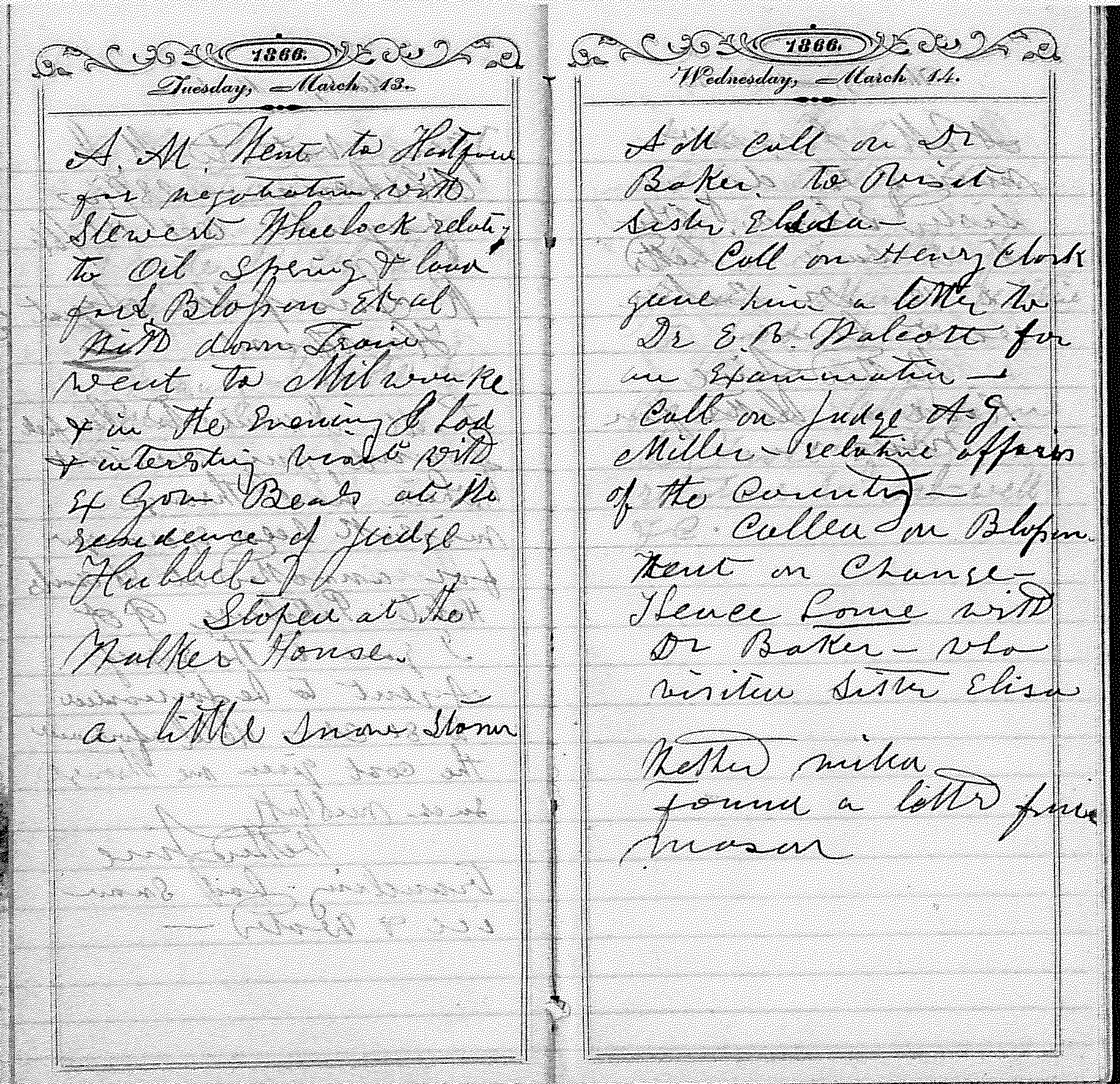
The lives of the Maxons, Clarks and Turcks are deeply intertwined from the 1840s onwards. For at least one year, 1866, Densmore Maxon kept a pocket diary. These pages contain his notes on the final days of nephew, Henry Clark:
[Civil War induction officer with lottery box.] United States, ca. 1863. Photograph. Library of Congress. Click to open larger image in new window. The draft officials in Milwaukee used a similar box or wheel to draw names in the 1863 draft. (The Wisconsin Historical Society has a wheel-shaped draft drum, circa 1863-1865, in its collections. It’s possible that the WHS lottery wheel may be the exact wheel used during Henry Clark’s November, 1863, draft event. Click here for a photo and accompanying information.)
Our previous post included an image of Henry Clark’s June, 1863, registration for the upcoming military draft. The Milwaukee draft of November, 1863, lasted for several days. The names of draftees from each Milwaukee city ward or county town were written on paper slips and placed in a round wooden “wheel.” The container was spun about to mix the names, and then the draft official would reach in, pull out one slip of paper, read the name aloud, and the clerk (and the press) would record the names as drawn. Once each ward, town, or village reached its quota of draftees, the box would be emptied and a new set of names from another location would be placed in the drum, and the process repeated.
It was an eventful weekend. Congress—acting with a speed and unanimity1 unusual these days—declared a new federal holiday to celebrate June 19th as Juneteenth National Independence Day, formerly known and variously celebrated as Juneteenth, Emancipation Day, or Black Independence Day. It has roots in the issues and events of the Civil War years that I’m currently blogging about, and I’ll have more to share about the history of our newest federal holiday in a future post.
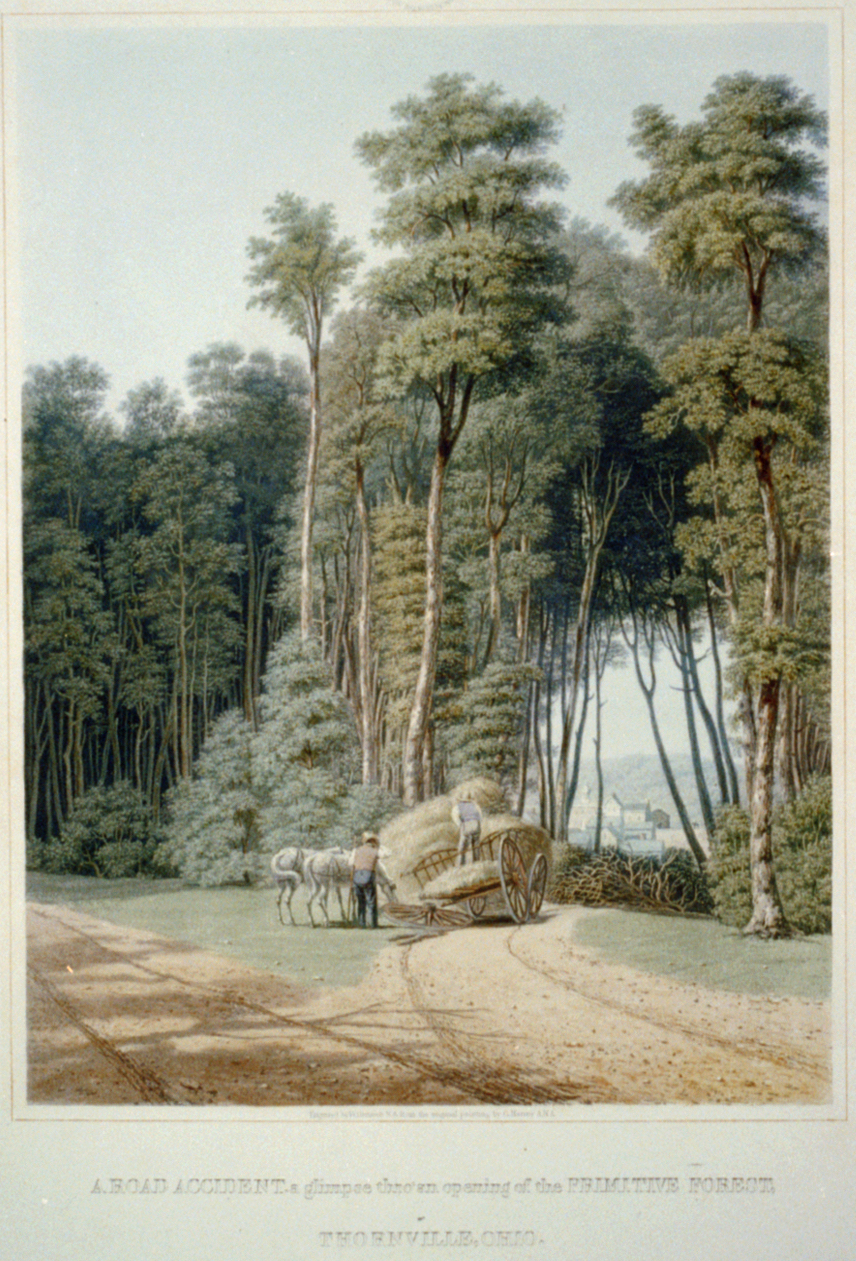
Sunday June 20 heralded the arrival of summer, and the observance of Fathers’ Day. In honor of both, I took the day off from writing and spent some time with my family. Wishing you all the best for summer, 2021, here’s an evocative seasonal print from Jonathan and Mary Clark’s era…





 Clark House Historian