Veterans Day is today. For a perspective on the day—and our early Mequon veterans—here’s a post originally published at Clark House Historian on November 11, 2016, and revised, expanded and republished several times since.
Armistice Day
One hundred and three years ago, on the eleventh day, of the eleventh month, at the eleventh hour—Paris time—the Armistice of Compiègne took effect, officially ending the fighting on the Western Front and marking the end of World War I, the optimistically named “War to End All Wars.”
In the United States, the commemoration of the war dead and the Allied victory began in 1919 as Armistice Day, by proclamation of President Woodrow Wilson. Congress created Armistice Day as a legal holiday in 1938. Starting in 1945, a World War II veteran named Raymond Weeks proposed that the commemorations of November 11 be expanded to celebrate all veterans, living and dead. In 1954 Congress and President Eisenhower made that idea official, and this is what we commemorate today. There are many veterans with a connection to the Jonathan Clark house. We honor a few of them in this post.
Jonathan Clark, Henry Clark, and the U.S. Army
Jonathan M. Clark (1812-1857) enlisted as a Private in Company K, Fifth Regiment of the U. S. Army, and served at Ft. Howard, Michigan (later Wisconsin) Territory, from 1833 until mustering out, as Sargent Jonathan M. Clark, in 1836. In the 1830s, Fort Howard was on the nation’s northwestern frontier. Jonathan’s Co. K spent much of the summers of 1835 and 1836 cutting the military road across Wisconsin, from Ft. Howard toward Ft. Winnebago, near modern Portage, Wisconsin.
Fort Howard, Wisconsin Territory, circa 1855, from Marryat, Frederick, and State Historical Society Of Wisconsin. “An English officer’s description of Wisconsin in 1837.” Madison: Democrat Printing Company, State Printers, 1898. Library of Congress. Click to open larger image in new window.
Inman, Henry. Rip Van Winkle Awakening from his Long Sleep, 1823. National Gallery of Art, gift of William and Abigail Gerdts. Public Domain.
A long “nap”
Unlike Rip van Winkle, I haven’t been asleep the whole time since our previous post. But we are well overdue for new blog material. I’ve got a big backlog of documents and images to share with you; all I need to do is get writing. But first…
Be sure to vote today!
It’s election day today, and your vote counts. If you haven’t already done so, get out of the house, over to your polling place, and vote. Voting is your right and responsibility as a citizen, and an indispensable element of our nation since the earliest days of the Republic.
Not surprisingly, voting and public service were an important part of life in the Clark House era. From 1840 onward, Jonathan M. Clark, Peter Turck, William T. Bonniwell and many other relatives and neighbors sought, and won, appointment or election to a wide variety of local, territorial and state offices. Voting—then limited to white males only—was a priority for Mequon’s early settlers, and they never failed to turn out in large numbers for each election. Their passion for civic engagement and electoral politics was, in turn, passed to the next generation.
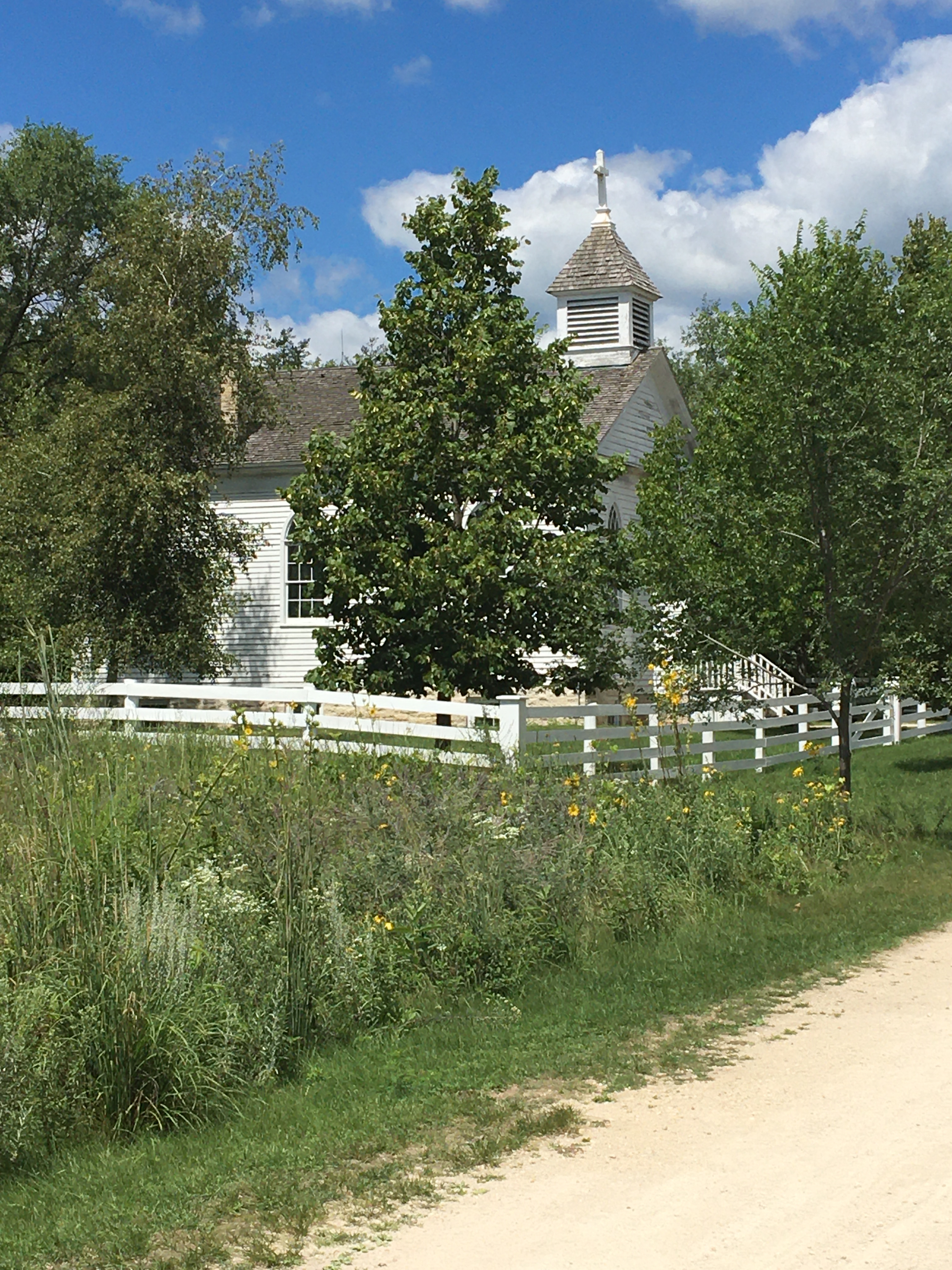
I had a fine day last month walking through our state’s wonderful outdoor living history museum, Old World Wisconsin, where I enjoyed this familiar view:
Photo credit: Reed Perkins, 2022.
There among the trees stood Milwaukee’s old St. Peter’s Roman Catholic Church, a building that was certainly well-known—at least on the exterior—to our Clark and Turck families.
The church was built in 1839, two years after young Mary Turck arrived in Wisconsin Territory with her parents, Peter and Rachael (Gay) Turck and her six siblings, and the same year that Jonathan M. Clark and the Bonniwell family first appeared in the Milwaukee-Mequon area.
In an earlier post I wrote: I’m still on the hunt for the elusive parents and kin of Jonathan M. Clark. Based on what we know so far, we are looking in the area of Derby, Orleans County, Vermont and its northern neighbor Stanstead Township, Lower Canada, circa 1800-1830 or so.
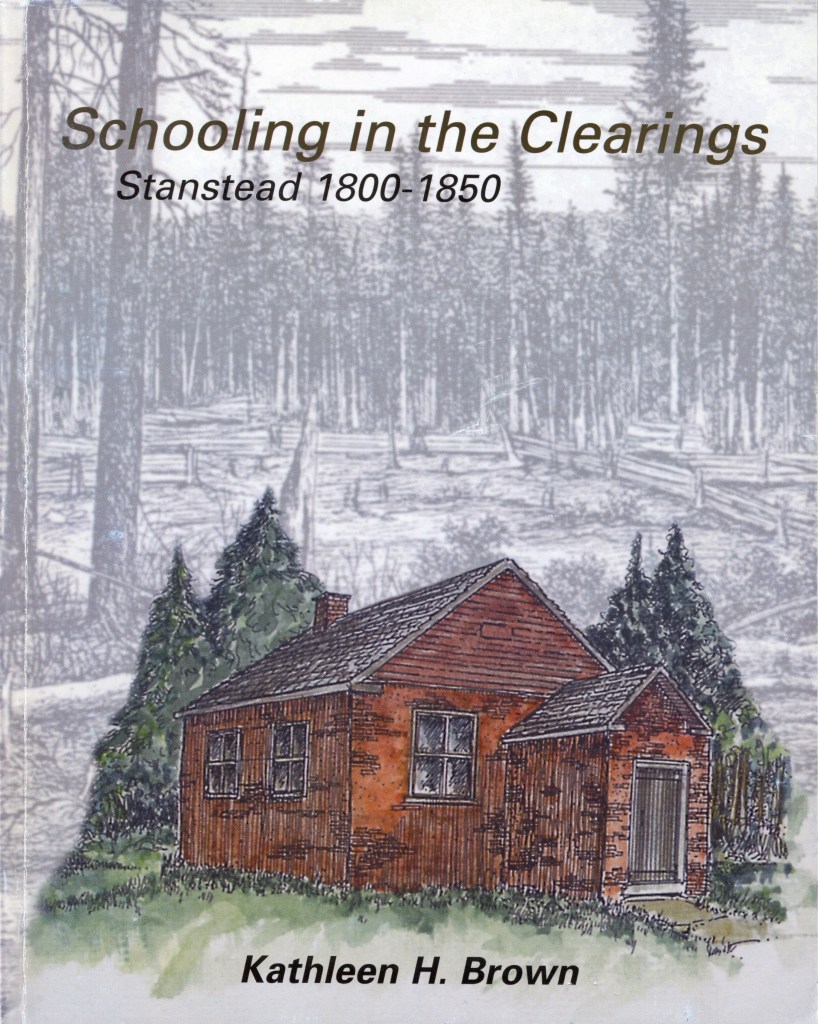
Well, the hunt continues, and today I thought I’d share with you another Back to School tidbit, a “hot tip” that I’ve been meaning to write about for a while. The tip—and its source—comes from Clark-Turck family descendant and Clark House Museum supporter Liz Hickman1, who kindly gave me a copy of this fascinating book:
Kathleen H. Brown’s comprehensively researched and encyclopedic Schooling in the Clearings: Stanstead 1800-1850 is devoted to the early history of public and private education in Quebec’s Eastern Townships and, in particular, Stanstead Township. That might seem like a highly specialized corner of North American history on which to focus, and I suppose it is. But Ms. Brown’s heroic labors in the archives are now a readable and invaluable resource for those of us trying to learn more about the early settlers in the Eastern Townships and their children including, possibly, the earliest record of Jonathan M. Clark known to date.2
I hope you liked our recent re-post of Back to School, 1839! And since I’m still working on a number of new but not-yet-ready projects, I thought you might also enjoy a revised and expanded version of a related post that was first published September 2, 2020.
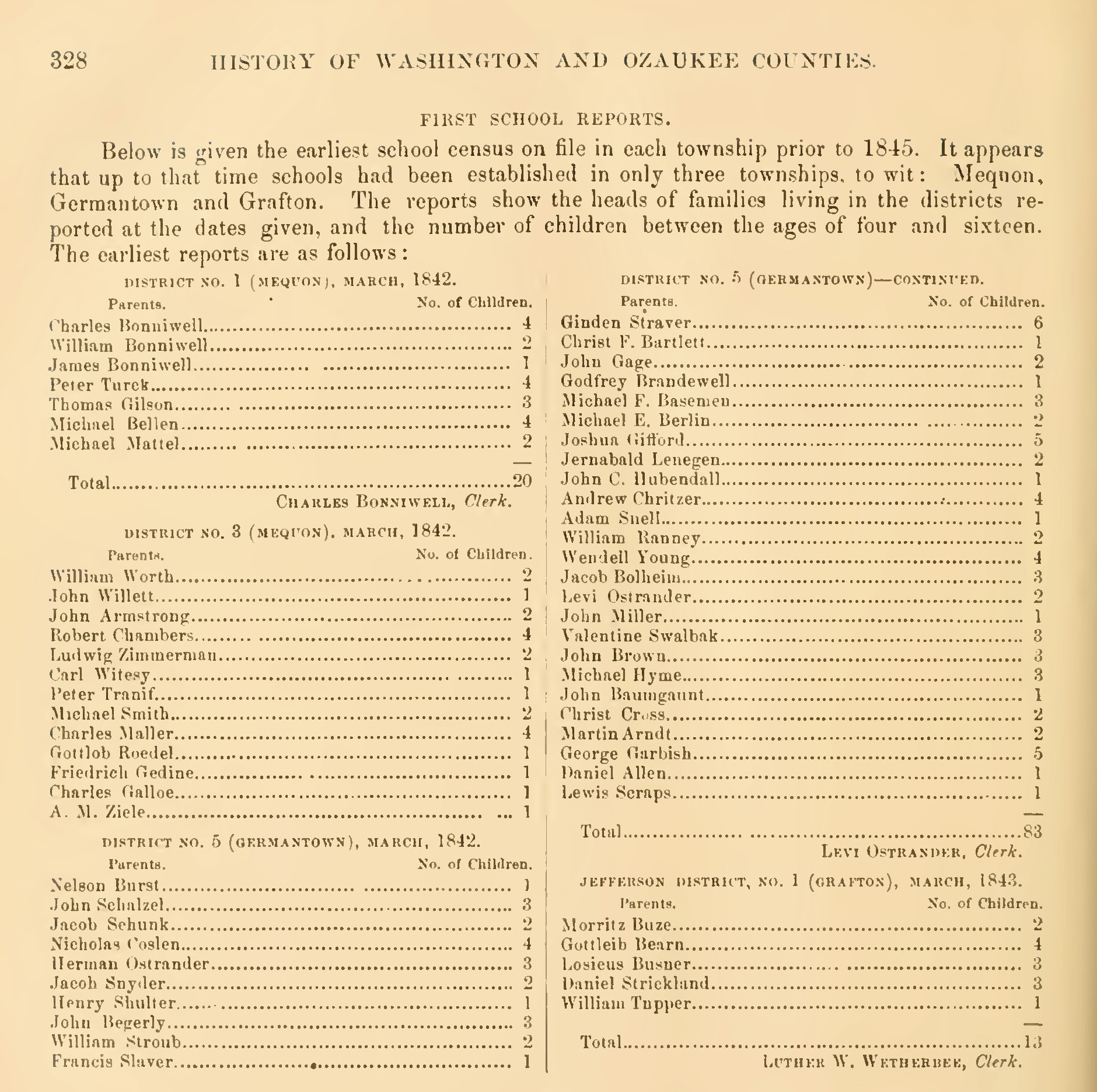
It’s “Back to School” time for many of us, so I thought you might be interested in this transcription of the earliest known school records of old Washington/Ozaukee county prior to 1845, published on page 328 of the History of Washington and Ozaukee Counties, Wisconsin […] Illustrated. Western Historical Co., Chicago, 1881:
Click to open a larger image in a new window, and see which of the early settler families had school age children, that is, children between the ages of 4 and 16, in 1842 and 1843. (Current Washington and Ozaukee county readers: do you have any kin listed in this summary of early school censuses? Let us hear from you via the Leave a Reply box, below.)
It’s that time of year again! And since I’m still working on a number of new but not-yet-ready projects, I thought you might enjoy this lightly-revised “Back to School” post from September 9, 2020.
There are a number of conflicting claims to the title of “first teacher” in Mequon. One of the first was Mary Turck Clark. She led classes for her siblings and four neighbor children in the loft of her father’s cabin in the summer of 1839.
The History of Washington and Ozaukee Counties, relates a number of other “firsts” for area schools and teachers. Among them is this story of how the school committee,1 led by Daniel Strickland (father of Sarah A. Strickland Clark), hired its first teacher.
I’m still busy annotating maps for upcoming Bonniwell-related blog posts. So instead of my planned Gold Rush themed Monday: Map Day! essay, I hope you enjoy this Clark-era image of a common visitor to much of North and South America—including Wisconsin—the Great Horned Owl.
Havell, Robert, jr., engraver, after John James Audubon, Great Horned Owl, 1829, plate 62 from The Birds of America (1828-1838), hand-colored engraving and aquatint on Whatman wove paper. National Gallery of Art, Gift of Mrs. Walter B. James. Public domain. Click to open larger image in new window.
Summer has finally settled in here in Wisconsin, and the Jonathan Clark House is ready to host you once again on Saturday, July 16, 12pm – 3pm to enjoy all the old fashioned fun in the very spirit of the season for the second installment of our summer series event Heritage Days!
In addition to our favorite features, our special attractions for July include:
I’m taking a bit of a break and have nothing new for you today. I have been doing a good bit of garden work around the house, and that reminded me of this post from April, 2021. Now we’re just finishing the first week of June, 2022, and it’s almost summertime. In southeastern Wisconsin the first spring flowers are done, and the next round of blossoms have been blooming for weeks. The tomato, bean and pepper seedlings are in the ground and doing nicely (although the rabbits have been nibbling on far too many green bean sprouts), and the roses are beginning to unfold. So even though this was originally an early-spring essay, I hope you enjoy this garden-themed repost from last year.
Planning the garden
It’s early April, and the growing season is not far off. For a farmer like Jonathan M. Clark, it’s a little early yet for plowing and sowing, but not too early to make plans and sharpen the tools. For a farmer’s wife, like Mary (Turck) Clark, it’s not too soon to think about the farm garden, its crops and layout.
I don’t know if Mary and Jonathan were regular readers of the popular and affordable farmers’ almanacs of their era; I wouldn’t be surprised if they were. There were many to chose from. Perhaps they had a copy of something like:
The Cultivator […], New Series, Vol. VII, Albany, 1850, title page. Click to open larger image in new window.




 Clark House Historian