On the northern frontier: (resuming) the search for JMC’s roots

The scene above is A settler’s hut on the frontier, by W. H.Bartlett and R. Sands, published in London in 1841.1 Based on the known locations of some of Bartlett’s other, similar images, published at about the same time, it is almost certain that the scene depicted was drawn from life in Lower Canada (modern day Québec), and possibly in or near Stanstead, or one of the neighboring Eastern Townships of Lower Canada.

The landscape, dwelling, and people in this scene would have been very familiar to young Jonathan M. Clark. They are the physical and human landscape of his first three decades of life—from about 1812 to 1831—in the vast and sparsely settled north woods of Stanstead, Lower Canada, and nearby Derby, northern Vermont.

I have been searching Vermont and Lower Canada for Jonathan M. Clark’s parents, possible siblings, or other kin for over seven years, and have not yet been able to identify any. As it’s been a while since the blog focused on JMC’s roots, I thought it was time to organize our previous research, publish new sources and findings, and see if we can get closer to locating the family of the builder and first occupant of Mequon’s 1848 Jonathan Clark House.

Continue reading
Ironing out a few wrinkles…

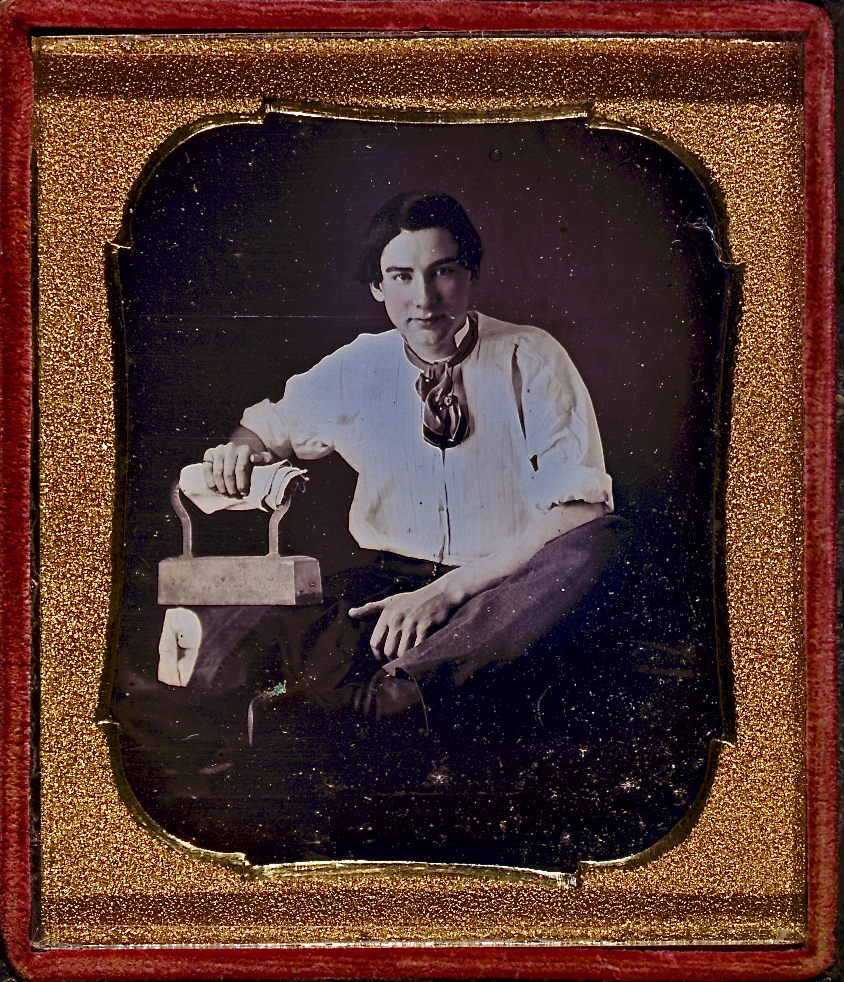
I was hoping to have a Monday: Map Day! post up for you yesterday as the opening item in a series of posts focused on new—or reevaluated—evidence from our continuing search for Jonathan M. Clark’s still-mysterious roots in northern Vermont and/or southern Québec. As you can tell, that didn’t happen. Instead, I spent some time ironing out a few wrinkles on the blog…

Continue reading

Nope. Not our…Henry Clark in the Civil War

Today we introduce a new category on Clark House Historian, one that I’m calling “Nope. Not our…”

What’s “Nope. Not our…” all about? Well, it’s about keeping track of some of the most important dead ends and disambiguation efforts that are—in fact—a huge “behind the scenes” part of the research that goes into this blog.

“Nope. Not our…” An all-too typical day in the Clark House Historian’s office.1

The fact is, I spend a lot of time chasing down “hot tips” for various unsolved Clark House history mysteries and, sadly, many of those promising clues turn out to be duds. From time to time I have written blog posts discussing specific erroneous or misleading bits of information, and then adding clarifying or corrected information and documents for the record.

But some ambiguous or promising Clark House Historian research paths are so complicated—and have taken so much time to research and document before being proven incorrect—that I need to create a more organized record of which research approaches were tried, and how each succeeded or failed. And since this blog is where I “show my work” as we uncover new chapters of Clark House history, I thought it was time for a CHH category dedicated to eliminating confusion and error in our search for a more complete and accurate history of the Clark House and its pioneering residents and neighbors.

And so we present our new category: “Nope. Not our…” And the honor of the first “Nope” post goes to:

Continue reading

Memorial Day, 2023

Lest We Forget

Our annual Memorial Day post, first published in 2020. Updated for 2023 with new information about Evander B. Bonniwell’s service.

Graves of Unknown Union Soldiers, Memphis National Cemetery, photo by Clayton B. Fraser, (Library of Congress), public domain. Memphis National Cemetery is the final resting place of Mequon’s Watson Peter Woodworth, and almost 14,000 of his Union Army comrades.

Today is the day our nation officially observes Memorial Day. For many Americans, Memorial Day represents “the first day of summer,” and is traditionally celebrated with trips to the lake, picnics, parades, and sales on cars, appliances, and other consumer goods.

But for many of us, Memorial Day remains rooted in its origins as Decoration Day. The first national observance was in 1868, when retired general John A. Logan, commander and chief of the Grand Army of the Republic—the Union veterans’ organization—issued his General Order Number 11, designating May 30 as a memorial day “for the purpose of strewing with flowers or otherwise decorating the graves of comrades who died in defense of their country during the late rebellion, and whose bodies now lie in almost every city, village, and hamlet churchyard in the land.”

On this Memorial Day, let’s take a moment to remember what this day truly represents.

Continue reading

Rabbits!

Audubon, John James, artist, and John T. Bowen, printer, Lepus Sylvaticus, Bachman, circa 1845-1848, Smithsonian Institution, Peters Prints Collection, Creative Commons CC0 license.1

There they are: Mr. & Mrs. Cottontail and one of their many offspring. The Eastern Cottontail and its relatives were a common sight in Jonathan and Mary Clark’s world, just as they are today.

We seem to have a bumper crop of rabbits in our suburban Wisconsin yard this year and, no doubt about it, the bunnies are cute and entertaining. But for the gardener, rabbits mean trouble. If you are trying to raise vegetables and fruits to feed your pioneer family, these amusing little fur balls are the enemy. They can consume huge amounts of seedlings and sprouts in just a day or two. What’s a gardener to do?

Last year—after they ate through the plastic fence around our vegetable garden and then devoured our entire crop of green been sprouts—I went to the local big box store and got a roll of metal wire rabbit fencing and some steel posts to hold it up. That worked great for us, but it made me wonder: what did Jonathan and Mary Clark use to keep the ravenous rabbits at bay? Well, I don’t have any documentation from the Clarks’ farm, but during my researches, I have noticed some popular 19th-century methods of rabbit control.

Continue reading

The farm garden

It’s already the third week of May, 2023, and summertime will soon be here. At our southeastern Wisconsin home the first spring flowers are done, and the next round of blossoms have been blooming for a week or two. The peas are in the ground and already about 8 inches high, the rhubarb is big enough to cut and make one or two pies, and we harvested the first half-dozen radishes today. We still have to put in the tomato and pepper seedlings and start the big patch of green beans. So with gardening on my mind, I thought you might enjoy a slightly-belated repost of this annual favorite, which first appeared here in April, 2021. Cheers!

Planning the garden

It’s early April, and the growing season is not far off. For a farmer like Jonathan M. Clark, it’s a little early yet for plowing and sowing, but not too early to make plans and sharpen the tools. For a farmer’s wife, like Mary (Turck) Clark, it’s not too soon to think about the farm garden, its crops and layout.

I don’t know if Mary and Jonathan were regular readers of the popular and affordable farmers’ almanacs of their era; I wouldn’t be surprised if they were. There were many to chose from. Perhaps they had a copy of something like:

The Cultivator […], New Series, Vol. VII, Albany, 1850, title page. Click to open larger image in new window.

Continue reading

Time flies!

[Editor], daguerreotype with added color highlights c.1855 (slightly cropped, and color adjusted), Smithsonian American Art Museum, Gift of Charles Isaacs, (link), Creative Commons CC0 license. Click to open larger image in new window.

Hey! It’s almost been a month since my last post. Sorry about that. I haven’t gone this long between posts in several years, I think, and now I’ve got (the digital equivalent of) a towering pile of half-written posts to finish and topics to discuss. That said, I have been busy…

Continue reading

JMC & the neighbors petition Congress, 1849

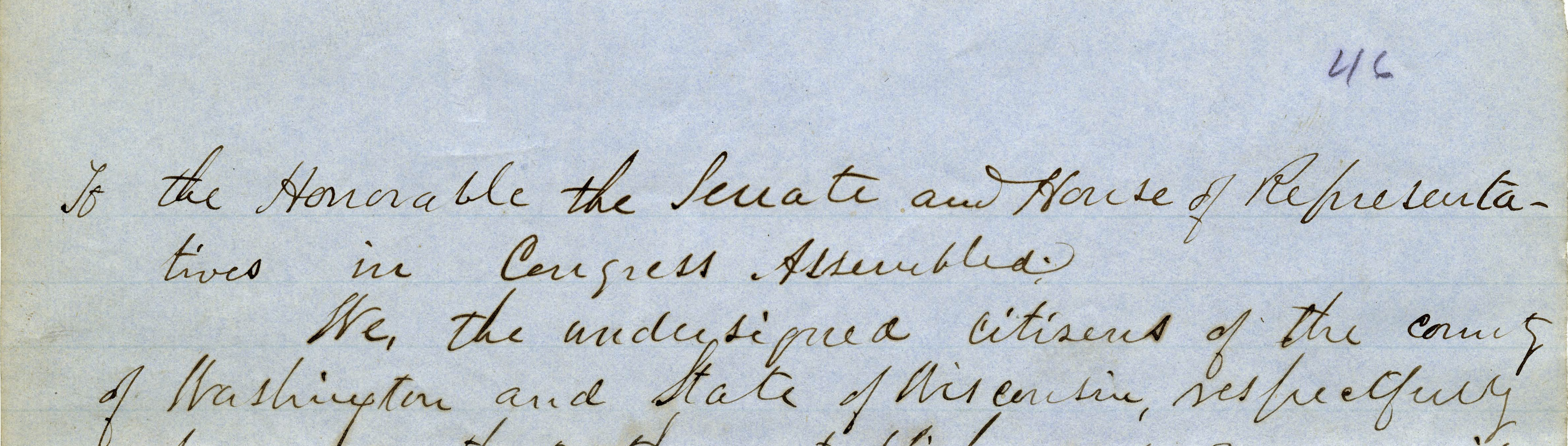
Today we have a surprise addition to our survey of Alfred T. Bonniwell documents. It’s a recent discovery, a very cool 1849 petition to Congress asking for a new postal road from Grafton to Waukesha, via Mequon. It’s signed by many of old Washington county’s most civic-minded men, including Grafton postmaster P.M. Johnson, Jonathan M. Clark, Peter Turck, and almost all of the Bonniwell men. It’s of interest to us, in part as an example of the citizen petition process in the early days of Wisconsin statehood, and more specifically as a record of “who was here?” in Washington county in a non-census year.

A growing county needs a new mail route

Petition of Phineas M. Johnson and others to U.S. Congress. [1849-02-06]. /documents/D275080, page 1, detail, salutation, The Papers of Abraham Lincoln Digital Library. Public domain.1, 5

Citizen petitions have been a part of American governance since early days. Check out our 2021 RBOH: Wisconsin Citizen Petitions for more information on a newly digitized collection of early Wisconsin territorial and state petitions, including a searchable database of petition images. Citizens could also petition the federal government for assistance; our petition is addressed To the Honorable the Senate and House of Representatives in Congress Assembled, and looks like this:

Continue reading

Snow!

The Holidays are upon us, and I’m taking time to celebrate and enjoy some time with family, That means I won’t have much new for you for the next week or so. (Don’t worry, we will wrap up the Alfred T. Bonniwell story in the very near future. I promise!) But in case you need a little Clark House history for fireside reading this week, I’m going to re-post several seasonal CHH favorites from past years. And since much of the Midwest is currently under a blizzard warning, I thought we should begin with this essay, which originally appeared in early 2021, was revised last February, and has been updated with an additional Currier & Ives lithograph for today’s post.

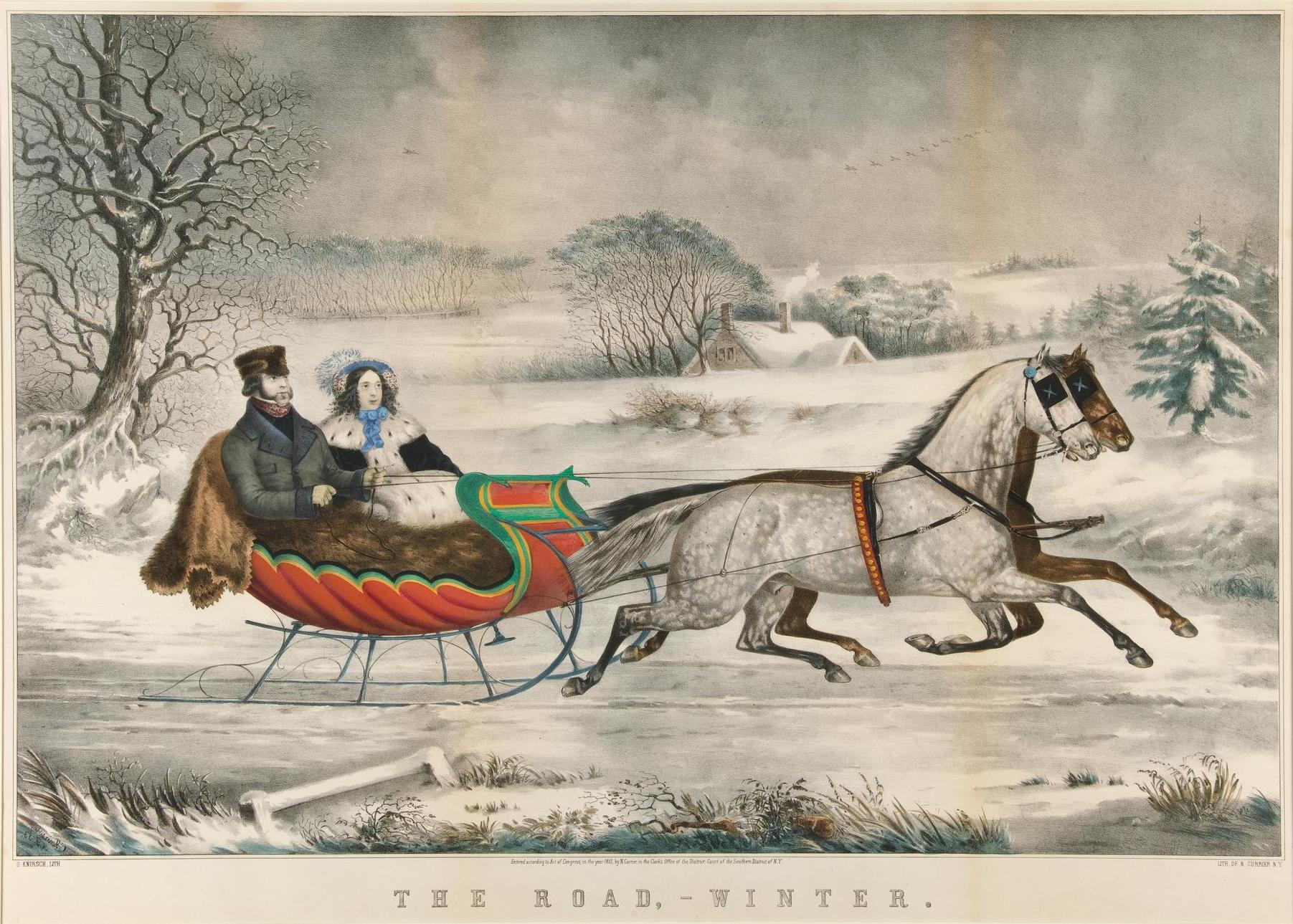
Snow, and often lots of it, was a feature of Jonathan and Mary Clark’s life in Wisconsin. And if you wanted to go to town or church or visit your neighbors during the snowy Wisconsin winter—or just enjoy a pleasant winter ride in the country—you’d need a sleigh.

Currier, Nathaniel (1813-1888), The road, winter / O. Knirsch, lith., 1853. New York: Published by Currier & Ives. Yale University Art Museum, Whitney Collections of Sporting Art, given in memory of Harry Payne Whitney (B.A. 1894) and Payne Whitney (B.A. 1898) by Francis P. Garvan (B.A. 1897) June 2, 1932. Public domain. Click to open larger image in new window.1

We don’t know if the Clarks owned a sleigh while they lived in Mequon. I suspect they did, though their sleigh—and their clothing—may not have been quite as posh as those in this Currier & Ives lithograph from 1853.

Continue reading