As I write this, southeastern Wisconsin is in the midst of our first substantial snowfall of Winter, 2025-2026. In Jonathan and Mary Clark’s lifetime, the day after a storm like this meant it was time to hitch up the sleigh and have some fun “dashing through the snow.” Here’s a lightly-revised and expanded repeat of a post that celebrates Clark-era “sleighing time” and “jingle bells.” (And be sure to click the highlighted links for more vintage wintertime images and info.)
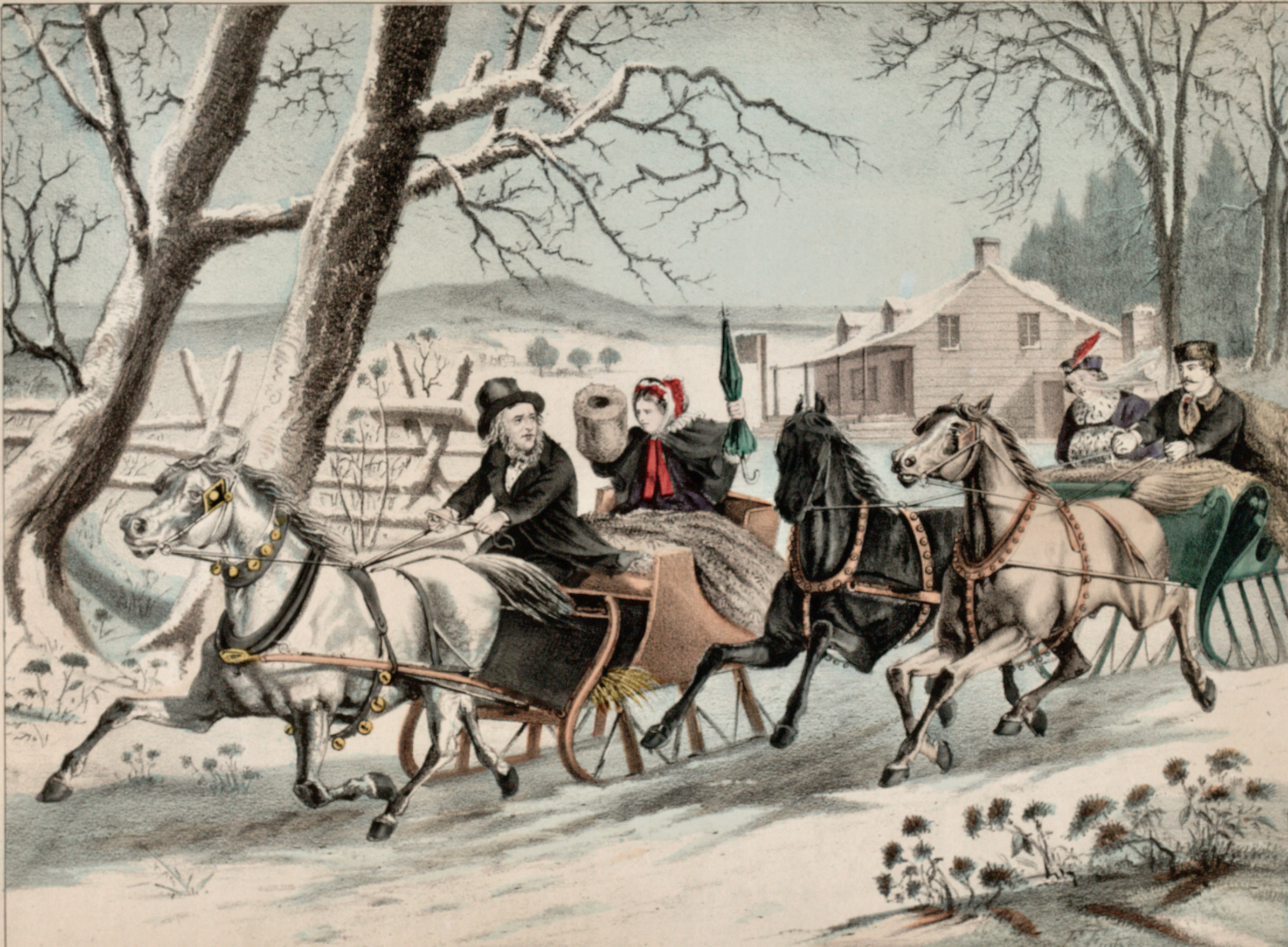
Kimmel and Forster, publishers, “Winter Pleasure in the Country,” circa 1865. National Museum of American History, Peters Prints Collection, Smithsonian Institution.1 Note the modest straps of jingle bells on the one-horse sleigh and the much more ostentatious—and louder—straps of bells on the two-horse sleigh.
Last winter, our earlier CHH posts Snow!, Shoveling out -and other winter chores and Stuff Happens – on a sleigh ride, got me wondering again about winter travel in old Washington/Ozaukee county during the Clarks’ era of the mid-1830s through the 1860s or so. Assuming most of the more successful farmers—such as the Clarks, Bonniwells and Turcks—owned a one- or two-horse sleigh, how easy was it to navigate that sleigh on the early county roads? Could you sleigh ride all the way to Milwaukee? And if you could, how long might that take?
Winter news from Cedarburg neighbors
It turns out that there’s an excellent source for answers to those questions, found in a group of letters exchanged between members of the notable Cedarburg immigrant Hilgen, Schroeder and Boerner families. They were written between 1845 and 1849, and published as “Documents: German Pioneer Letters,” in the The Wisconsin Magazine of History, vol. 16, no. 4 (June, 1934), pages 428-448.2 In the introduction to these family letters, Arthur R. Boerner, grandson of correspondent Friedrich Boerner, gives this outline of the authors of the letters.
Friederich Hilgen, 1805-78, and William Schröder (Schroeder), 1812-82, came to Milwaukee in 1844 from Charleston, South Carolina, and immediately set out on foot to find a suitable location for a settlement. They walked north along the Green Bay Road to New Dublin (now Hamilton), thence to the present site of Cedarburg, where Cedar Creek flowing through a deep rock channel offered potential power for a mill.
Their first undertaking was to cut a road through the virgin forest from the Green Bay Road to the site they had chosen.3 They then erected a mill, a store, and some dwellings, in what is now the heart of Cedarburg, In 1855 they built the five-story grist mill which is still in use. […]
Friederich Börner (Boerner), 1812-78, was born in Kirch Hatten, Duchy of Oldenburg,4 and emigrated to Charleston, South Carolina, in 1837. In 1846 he traveled to Wisconsin territory to visit his brother-in-law Hilgen and his friend Schröder. That he liked the country is evidenced by his selection of a farm, purchased the same year, and by the financial assistance which he lent to the Hilgen and Schröder enterprises. Before the year 1846 was ended, he had decided to move to Cedarburg. In 1848 he journeyed to Oldenburg to visit his old home and win recruits for the new settlement. The following spring he moved to Cedarburg, where as a merchant and farmer he became an active member of the community.
Regular CHH readers will recognize that Hilgen and Schroeder’s immigrant path, from Germany to Milwaukee, then up the Green Bay Road (such as it was at that time) to the little mill community at Hamilton, and then cutting the road from Hamilton to Cedarburg, parallels the path taken by Jonathan Clark house tenant and farmer, Friedrich “Fred” Beckmann some two decades later.
Sleighing and local roads, 1847
Here are the sleigh-related excerpts from the Hilgen-Schroeder-Boerner letters. I have added a bit of explanatory information where needed, but the excerpts pretty much speak for themselves. Our first letter mentions sleighing as a recreational activity shared by couples.
Schröder to Börner, in Charleston, S.C.
Dated: Milwaukee, W. T., Jan 4, 1847.
Dear friend Friedrich Börner:
[…] We had a snow storm on Jan. 1 and now have good sleighing. Yesterday we went sleighing with our wives for the first time this year. Our business establishments are going well. We have as much [grain] to grind as we can possibly do, but the wheat is very cheap. A bushel costs 50 to 53 cents, and rye 35 to 38, corn 28 to 31, oats 18 to 20, flour is $3.00 to $3.38 a barrel.
It’s worth remembering that winter—once the roads froze hard—was the season of heavy-duty hauling and transportation. While dry summer roads may have been hard enough for heavy loads, the local farmers were usually too busy farming to attend to logging and milling. And in the spring and fall, the roads were often too wet and soft for transporting heavy loads. So winter was the season when logs would be sledged to the sawmill, lumber transported from the mill to the job site, grain would be ground and returned to the farmer, and so forth.

Durrie, George H., Winter in the Country: The Old Grist Mill, Currier & Ives, New York, 1864. Mabel Brady Garvan Collection, Yale University Art Gallery. On the left, crossing the bridge, is a single horse sleigh, probably returning home with a load of just-milled and bagged flour. On the right, a pair of oxen are hitched to a heavy-duty sledge, ready to haul other large bags of grain to or from the mill.
Winter social life
Our next letter goes into more detail regarding sleighing, socializing, and the condition of the local roads in winter.
Hilgen to Böerner, in Charliston [sic], S.C.
Dated: Cederburg [sic], February 8, 1847.
Dear Brother-in-law:
[…] Until January our weather was always warm, then it snowed and cold weather began. I have never experienced such cold weather in this country. We were invited to attend the military ball at Milwaukee on January 8. Our wives said we must go to the ball even if it were cold. Schröder and I, our wives, and several others from Cederburg went. We used our large sleigh with the two white horses. The highways here are now like a railroad, and it [sleighing] is a pleasure—one drives from Cederburg to Milwaukee in 2-1/4 hours, that is 20 miles. Two weeks ago 20 men, 6 of whom were musicians, came from Milwaukee in large sleighs with 4 horses. They ate at our house and after that they played. They departed at four o’clock in the afternoon. Now we have good winter weather, neither too cold nor too warm. The sleighing to Milwaukee is always good.[…]5
Twenty miles from Cedarburg to Milwaukee in two-and-a-quarter hours was a fine, quick time, indeed. And who knows, if they took the Cedarburg Road route, they would have passed the Jonathan Clark farm along the way.
Other Wisconsin Territory winter travel stories
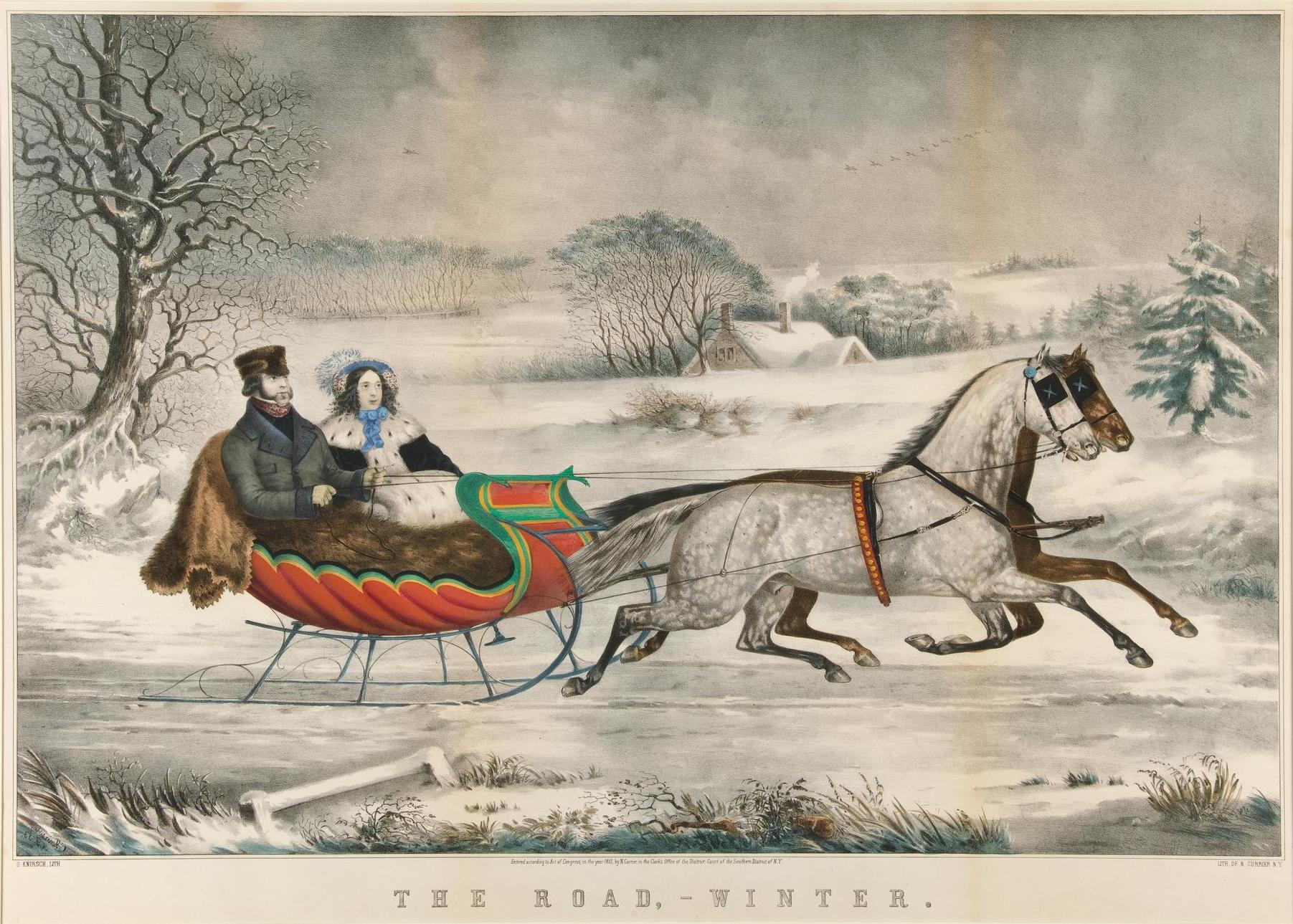
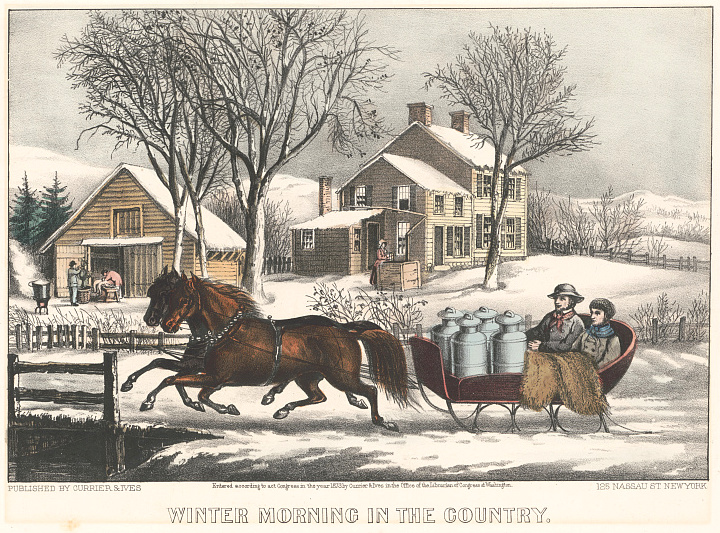
It turns out that a quite a few Wisconsin Territory settlers wrote about sleighing—and other modes of winter travel—during their pioneer days. Among the sources that I’ve previously mentioned here at CHH, you might be interested in:
• Baird, Elizabeth T. [Therese], and State Historical Society Of Wisconsin. “Reminiscences of life in territorial Wisconsin.” Madison: Democrat Printing Company, State Printers, 1900, available online via the Library of Congress. See p 252-254 in particular (also quoted in our earlier post Stuff Happens – on a sleigh ride).
• Kinzie, [Juliet Magill] John H., Mrs, Wau-bun, the early day in the Northwest. Philadelphia, J. B. Lippincott & Co, 1873. Originally published in 1856, this citation is to a pdf of the 1873 edtion, via the Library of Congress. If you’re interested in this book—and it is a captivating memoir—I recommend the expanded and annotated “Historic Preservation Edition,” issued in 2021 by the Historic Indian Agency House in Portage, Wisconsin, Juliet McGill Kinzie’s home from 1832-1833. Here’s the link to the HIAH Wau-Bun page, with ordering information.
• Van Cleve, Charlotte Ouisconsin Clark, Three Score Years and Ten, Life-Long Memories of Fort Snelling, Minnesota, and Other Parts of the West, originally published 1888, available for free via GoogleBooks. For more on Charlotte, and her pioneering military family, see our post Nope, not our Clark family – Ft. Winnebago edition.
By the way, these memoirs, written by three remarkable women of the Old Northwest, are important documents of the earliest days of white settlement. Although their prose style—and attitudes toward Native Americans—are occasionally dated and paternalistic, all three accounts make for fascinating reading and provide unique, first-person insights into the event-filled lives of the authors and of some of the other indomitable women of their day. Well worth your time.
__________________________________________
NOTES:
- I have only been able to locate a handful of useful drawings, lithographs or other images of mid-19th-century sleighs in use, especially the larger sleighs. There are some, but it’s hard to find images relevant to our Clark House era of circa 1840-1860 (it’s much easier to find images of sleighing in the post-Civil War era, usually in places like New York City).
Somewhat surprisingly, today’s lithograph of one-horse and two-horse sleighs sharing the road, or perhaps racing each other, is not a unique subject in these 19th-century prints. This print also repeats related tropes of the day, mainly the more “sedate” one-horse sleigh—often driven by an older man—being passed by the “sports car” of its day, the two-horse sleigh. - The complete group of transcribed letters exchanged between members of the Hilgen, Schroeder and Boerner families is available from the Wisconsin Historical Society’s online collection of the complete Wisconsin Magazine of History. The letters, from Vol. 16, No. 4 (June, 1934), can be found at this link.
I recommend you read them all. They provide fascinating insights into the early days of Cedarburg settlement, German-American immigration, and the lives and work of several important business families. These are people, and businesses, that were located only a mile or two from the Jonathan Clark house and farm, and the Clarks are believed to have known and done business with Hilgen & Schroeder and their Cedarburg immigrant neighbors from their earliest days in the county. - For more on the history of Mequon’s first roads, and Jonathan M. Clark’s role as a road commissioner, see these posts:
• County Government – Early Records
• Marking out the roads
• Roads into the Woods, 1841
• Another Road into the Woods, 1841
• “J. M. Clarke” – Town Supervisor, 1846 - The modern spelling for Boerner’s birthplace is Kirchhatten. In Meyers Orts- und Verkehrs-Lexikon des Deutschen Reichs. 5th edition. Uetrecht, E. (Erich) Leipzig and Wien: Bibliographisches Institut, 1912, Kirchhatten is a “homestead” in the district of Oldenburg, Schleswig, German Empire; as of 2025, Kirchhatten and Oldenburg are within the German state of Lower Saxony. (For all the info—as of 1912—and a detailed map, see the entry for Kirchhatten at Meyers Orts- online.
- This letter mentions the arrival of several four-horse sleighs, carrying a large party of riders. These big sleighs, the “mini vans” of the period, were usually found in larger cities, such as Milwaukee, and for some reason, are rarely shown in illustrations from that time.
 Clark House Historian
Love this!
LikeLike
Pingback: Bitter cold? Sounds like fun! | Clark House Historian
Pingback: Indexing. Again! | Clark House Historian