This is the second part of a multi-part look at local (Mequon and Washington/Ozaukee County) history sources. If you missed Part 2, I recommend you click this link and read that first.
In today’s post, I’d like to guide you to and through another one of the local histories that I’ve bumped into over the last decade or so. As in Part 1, I’ll include a link to a PDF copy of the source, make comments on the range and quality of the information in the book, and sum it up with an overall grade for accuracy, style, and usefulness.
“All sources lie.” — Lawrence of Arabia (supposedly)
That provocative quote begins the forward of Elizabeth Shown Mills’s monumental Evidence Explained (third edition, revised, 2017), the “Bible” of genealogical research, source evaluation, and modern citation practices. It makes an arresting opening for her almost 900-page book, devoted to historical and genealogical sources and how to cite them.1 But what does the author mean by beginning her book with Lawrence’s (supposed) quote? Here is part of her explanation:
This hyperbole, often attributed to T. E. Lawrence, is understood by all who seek to reconstruct history. Sources err. Sources quibble. Sources exaggerate. Sources mis-remember. Sources are biased. Sources have egos and ideologies. Sources jostle for a toehold in the marketplace of ideas.
So why do we invest so much of our own energy into the citation of those sources? Because all sources are not created equal.
History is not a collection of raw facts we simply look up and copy down. The past is still a little known world that we explore with curiosity and confusion. As we probe its reaches, we appreciate resources that save us time. We crave materials we can confidently trust. Yet historical truths are rarely rooted in either shortcuts or comfort.2
These observations ring true for all responsible historians, both amateur and professional, whether they explore the Big Issues of national and international history, or simply try to reconstruct the history and lives of the early settlers in a small community, such as our Clark House family and their neighbors. Indeed, all history lovers “appreciate resources that save us time. We crave materials we can confidently trust.” Unfortunately, not all local history materials—such as the subject of today’s post—”save us time” or are “materials we can confidently trust.”
Mequon updates and memoirs
The post-World War II era saw the creation of several “new” local histories and collections of historical essays. Some of these are available online via the Digital Library of America and/or the University of Wisconsin’s online digital collections. Some of these are typescripts of interviews with local elders, recording their memories of Mequon, Thiensville and Ozaukee County as far back as the end of the 19th-century.
Some of these interviews and first-person memoirs record wonderful slices of real life, as lived in Ozaukee County, and are valuable as such. Some of these interviews and historical essays probably originated as school or civic organization projects. Not surprisingly, most of these small-scale publications often incorporate, and simplify, material from earlier published histories, especially the 1881 History of Washington and Ozaukee Counties […] Illustrated. And sadly, they rarely include supporting notes or lists of references, so all dates and details in these histories need to be checked before being repeated as fact.
The History of the Town of Mequon…to about 1870
To the best of my knowledge, there were no attempts to bring the history of Mequon, or Ozaukee County, up to date between the 1881 publication of the History of Washington and Ozaukee Counties […] Illustrated and the mid-20th-century. Then, in 1950, the Mequon Club sponsored the publication of this work:

Corrigan, Walter D., Sr. History of the town of Mequon, Ozaukee County, Wisconsin, brought down to about 1870. [Mequon, Wisconsin?]: Mequon Club, [1950] available as a free PDF download from the University of Wisconsin Libraries.
By 1950, the big, rambling, repetitive, sometimes erroneous but frequently fact-packed History of 1881 had been out of print for almost 70 years and copies were probably hard to find and becoming too fragile to read easily. So the publication of this new booklet—only 21 pages of text plus one photograph—was designed to fill the need for an accessible, short overview of the history of Mequon from its origins until 1870.
Perhaps because it is shorter, and newer, than other local histories, Corrigan’s History of 1950 still seems to be read and referred to when someone wants to get a quick overview of Mequon history. And this is too bad, because this little book has a lot of problems.
Scope and balance
If I have one complaint about all of our published area histories, new or old, long or short, even the 1881 History, it’s that the author or compiler gives excessive and repetitive attention (and column inches) to a select group of “hit” stories from the area’s past. In almost all of these works, you will find undue emphasis—and sometimes mind-numbing detail—given to the telling and re-telling of such notable local events as:
• the original 1830s and ’40s settlement, abandonment, and re-settlement of Port Washington
• the 1840s fight over the county seat/court house location
• the 1862 “Indian Scare”
• the 1862 Ozaukee county draft riot
These stories are, indeed, important to the history of the county. But oh!, how our historians like to go on and on about these particular tales. That said, I am willing to forgive the 1881 History for its excessive and repetitive coverage. As a compiled work, presenting in print for the first time the contents of many original, contemporary sources (and more than a few “well, it happened this way…” Old Settler anecdotes), the 1881 History can hardly avoid suffering from excess and repetition. But let’s give the 1881 book it’s due: it provides us, and future historians, with much of the raw information on these (and other) topics, and can thus be excused for not having the sort of editorial concision and historical perspective that comes with additional research and the passage of time.
Anyway, a close reading of these “hit” stories, and others, demonstrates that the 1881 History must be the original source for all further re-tellings of these incidents, including Corrigan’s 1950 booklet. In fact, one of my main problems with Mr. Corrigan’s work is that by 1950, almost 70 years after the 1881 History was published, his little book still lacks “the sort of editorial concision and historical perspective that comes with additional research and the passage of time,” and is dominated by the repetition of these same old tales, to the exclusion of many other incidents and aspects of early Mequon history.
Corrigan’s contents
Including his one-page introduction, Corrigan has a grand total of 21 pages of text in his short book, and the “hit” stories take up a disproportionate amount of that limited space. For example, after beginning with two pages [sic!] devoted to the origins and proper pronunciation of the name “Mequon,” Corrigan proceeds to devote considerable space to these well-worn local subjects:
• the county seat/court house location discussion occupies, in total, substantial parts of pages 13 & 14, and most of pages 15 and 16
• the 1862 Ozaukee county draft riot is incorporated into a long series of anecdotes (mostly focused on Mequon’s early German settlers) excerpted from Judge Timlin’s autobiography. These Timlin extracts begin near the bottom of page 18 and continue onward, covering all of pages 19-20, and half of page 21
• the 1862 “Indian Scare” takes up the remainder of page 21 and about half of page 22
It’s worth noting that the 1881 History covered events up to 1881, and when that book was compiled these “hit” events from the 1840s and ’60s still loomed large in the memories of the “old settlers.” But by 1950, one would hope that a greater sense of balance and perspective might prevail. Instead, of his total available pages, the author chose to devote about half of those pages to these three or four oft-repeated bits of local lore. It is not, then, a surprise that the other important persons and events from the first four decades of Mequon history end up jammed together in the remaining available pages in a disorganized, abbreviated, error-filled hodgepodge of names and facts.
At least there is a bibliography
To give author Corrigan credit, he did include a short bibliography at the end of his little book.
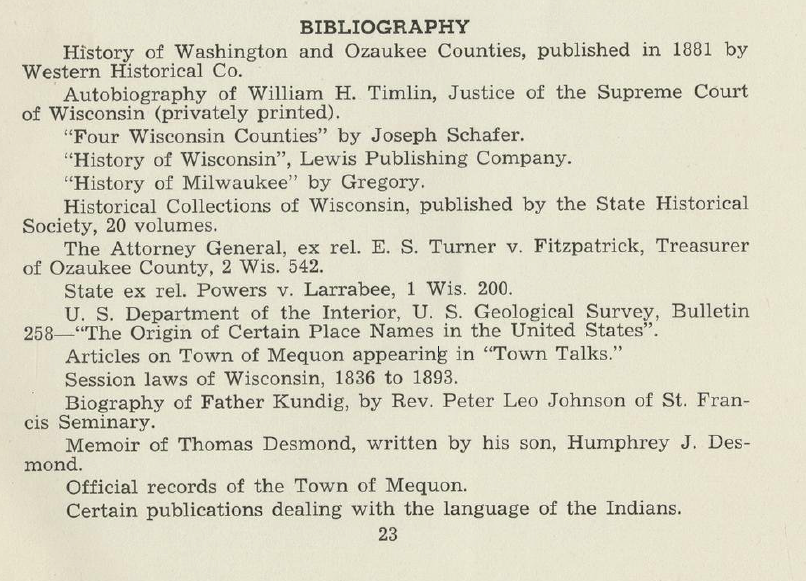
The sources listed in Corrigan’s bibliography include general mentions of many of the “usual suspects” for local history, including the 1881 History, Schafer’s Four Wisconsin Counties, and generic references to useful, book-length histories of Wisconsin and Milwaukee. There are also very general references to important (but very large, multi-subject) series of publications such as the Wisconsin Historical Collections, but these citations are so broad and non-specific that they are pretty useless for readers that want to further investigate the source for a particular fact or anecdote in Corrigan’s book. And vague entries such as ” Certain publications dealing with the language of the Indians” are really not much help at all.
Some wheat among the chaff
There are a few listings in Corrigan’s bibliography of unique, and potentially useful, sources not found elsewhere. For example, the privately printed autobiography of Mequon-born state supreme court justice William Timlin. Timlin was born in Mequon in 1852, so I’m not sure if his autobiography would have much to say about the Clarks or their era, but it’s worth looking into. For more info on Timlin, click here for a short biographical sketch, and click here for info on his 1915 autobiography.3
Another privately printed item that caught my attention—and was completely new to me—was the Memoir of Thomas Desmond, written by his son Henry Desmond. Thomas Desmond and his brother Dennis were pioneer residents of the Town of Mequon and neighbors of the Clarks for several decades. The Thomas and Dennis Desmond farm parcels were located in the NW quarter of Sec. 3, T9N-R21E, Town of Mequon, immediately adjacent to the northwest corner of the farm of Jonathan M. and Mary Clark (which occupied all of the SE quarter of Sec. 3).
A memoir of a Clark neighbor is something I’d like to read. But the Desmond memoir was privately published in an edition of only 50 copies, to be distributed to the immediate family. Worldcat has a citation for the book,4 but does not know of any libraries that have a copy. Might someone have one?
(Spoiler alert: Yes! I have found a transcription, with photographs, and I’ll be blogging about this shortly!)
Assertions of fact without evidence
The presence of a bibliography or other lists of works consulted is always appreciated. But when a reference simply cites a long single work, such as the 1881 History of Washington and Ozaukee Counties, or a series of works, such as all 20 volumes of the invaluable Wisconsin Historical Collections, it’s really not much help for the researcher. For example, the Wisconsin Historical Collections were published 1855-1915, and those 20 volumes contain over 1000 articles originally printed on over 11,000 pages. Which article(s) from which volume(s) of the Collections provided information for which part(s) of Corrigan’s book? There’s no way to know.
In addition to the lack of specific citations to facts found in longer books or in series of publications, this bibliography also disappoints by not recording where one can find these sources. The Collections have always been pretty widely available (and now they can be searched and read, for free, online), but the location of certain rare or unique sources remains unknown. And this is a pity, as Corrigan mentions a few unique sources that might include first-person information from the Clark family’s years in Mequon.
Over-condensed and poorly proofread
Unfortunately, Corrigan’s book suffers from other major defects. The most serious of these—in my opinion—are that the author tried to squeeze too much information into too small a book, that too much of this information was taken from older sources (especially the 1881 History) and greatly abridged and condensed and, in the process, the author omitted or over-simplified whole sequences of town history and often mangled facts and proper names that may have been correctly recorded and discussed in those earlier sources. As an example, on page 8, Corrigan wrote:
In 1833 Joseph Wood and his brother Ephraim Wood, Peter Turck, Reuben Wells, Isham Day, and several Irish families made settlements in the town. Isaac Bigelow and Daniel Strickland settled in 1836. The Town of Mequon was then a dense wilderness.
Only the last sentence is correct. Most of the other information is wrong, in one way or another. How wrong? Let’s see:
• To the best of my knowledge, in 1833,there were no permanent white settlers in all of Mequon, and possibly in all of old Washington/Ozaukee county.
•The Isaac Bigelow and Daniel Strickland families arrived in the U.S. from Nova Scotia in 1835; both families were in Milwaukee County by mid-1836.
• Corrigan’s “Joseph and Ephraim Wood” must refer to brothers James W. and Ephraim Woodworth, also immigrants from Nova Scotia.
• The Woodworth brothers were early settlers, but they first came to Wisconsin in June, 1837.
• Peter Turck and his family arrived in Wisconsin from Wayne County, New York, in August of the same year, 1837.
• Other important early (1830s) settlers, such as John Weston/Western and Isham Day, were important parts of this early settler cohort, but are not even mentioned until later in Corrigan’s narrative.
• While there do appear to have been a few Irish men and/or families in the county as early as the 1838 territorial census, I believe the more substantial Irish immigration to Mequon began around 1839 or the early 1840s.
• As for immigrants from England, the most notable contingent was the large, multi-generational Bonniwell family—including brother-in-law Philip Moss and widowed matriarch Eleanor (neé Hills) Bonniwell, later Mrs. Hyde—and they did not arrive in Wisconsin until mid-1839.
What’s the big deal?
This may seem like nit-picking, but facts matter, especially when we want to develop a clearer understanding of our history, of the real lives of, and events experienced by, our predecessors. Seeing so many errors in just two sentences of one paragraph leads the knowledgeable reader to suspect that the writing has been poorly sourced, hastily done, and inadequately fact-checked and proofread. And for a reader new to the subject, an error-prone text like this only serves to perpetuate those errors and then, over time, the errors begin to assert themselves as established “facts” or “common knowledge.”
The verdict
I don’t want to be harsh when assessing the work of fellow historians, especially amateurs and volunteers. They are my predecessors and colleagues, and did useful work for good reasons and (usually) with very limited funds or access to primary sources. So when Walter Corrigan was asked to compile a short history of Mequon, “brought down to about 1870,” he did his best with the time and resources that he had at his disposal.
And to be fair, Corrigan had a daunting task: reduce the sprawling and repetitive History of 1881 into an abridged, organized, and readable little history booklet, updated and corrected with as many new sources as he could access. One would think this would be an ideal assignment for a prominent, experienced lawyer and history enthusiast such as Walter D. Corrigan, Sr. After all, lawyers are often required to take piles of incomplete and conflicting facts, depositions, physical evidence and case law and refine them into a tightly-edited, to-the-point legal argument, covering all the necessary bases and omitting any distracting or irrelevant information. Unfortunately for this 1950 history booklet, Corrigan’s editing and organizational skills were not really up to the assignment.5
It’s now 75 years since his History of the Town of Mequon, Brought Down to About 1870 was published, and we need to recognize that Corrigan’s booklet is, in many ways, an error-prone and often misleading detour on the path toward a fuller, more accurate understanding of the early decades of Mequon settlement and development. Based on the work done by others in subsequent years, and on my own work on the Jonathan Clark House and Clark family history over the last 15 years or more, we are now able to identify many errors of fact in Corrigan’s History. And those known errors, coupled with the lack of source citations and the probability of additional unknown errors, make it impossible to trust the accuracy of the whole work.
And that’s too bad. Because Corrigan’s History contains the occasional unique story or other bit of information that could add something interesting or valuable to our understanding of early Mequon history if we could independently assess and verify that story or bit of information. But, without additional research, we can’t.
What to do?
So I’d like to make the following recommendations to all Mequon and Old Washington/Ozaukee County history enthusiasts and researchers:
• If you want, go ahead and read Corrigan’s book as part of a comprehensive review of the literature, but…
• Don’t rely on Corrigan’s 1950 History of the Town of Mequon for accurate names, dates or historical facts
• For pre-1881 local information, read the 1881 History of Washington and Ozaukee Counties…Illustrated. It’s not perfect, but the editors have included many first-person recollections, transcribed private and public records (local, state and federal) and keep in mind that…
• Frankly, all of the local histories written after 1881 clearly rely on the History of Washington and Ozaukee Counties…Illustrated for many of their facts and stories, and they don’t always transmit the 1881 book’s information accurately.
Summing up…
Are we due for a readable, more accurate, more comprehensive, more up-to-date history of Mequon and Old Washington/Ozaukee County? Yes we are. But until then, steer clear of Corrigan, treat the other post-1881 works with caution, and start your Mequon history researches with the 1881 History of Washington and Ozaukee Counties…Illustrated.
Grade: Corrigan’s work was sincere and well-meaning, but his 1950 History must get a D, for its uneven coverage of events and, especially, for too many dangerously dubious details.
Postlude
Thanks for reading this far in part two of our series of JCH Sources: a look at local histories. I know that, for most of us, evaluating and citing sources is not the most exciting way to pass the hours. But I’ve spent a lot of time and energy researching our local history, looking for more and better sources, and trying to separate fact from fiction and from that scourge of good history: “common knowledge.” It’s wonderfully interesting work, but it is frustrating to see some of the same old unsubstantiated tales, errors of fact, and misspelled names pop up over and over, year after year, often because folks continue to rely on information from outdated and incorrect sources. And with that said, let’s close with a few memorable words to inspire and guide all history lovers, whether amateur or professional:
• “All sources lie.” — Lawrence of Arabia (supposedly)
• “Trust, but verify” — Ronald Reagan (quoting Russian proverb to Soviet Premier Gorbachov)
• “Chum, if your mother says she loves you, check on it.” — Edward H. Eulenberg, editor, Chicago City News Bureau (advising generations of young reporters)
_________________________
NOTES:
- Or, should I say, was the Bible for genealogical citation. Ms. Mills has recently released a new, 4th edition of Evidence Explained, so it looks like I’ll need to update my reference library…
- Mills, Evidence Explained, 3rd revised edition, 2017, p. 9.
- The UW Library online catalog record for Timlin’s 1915 autobiography lists these topics in its summary:
Autobiography of Timlin, a Wisconsin State Supreme Court associate justice (1907-1916), describing 19th-century rural farm life, labor, and education in Ozaukee County, Wisconsin; an 1861 rebellion of Ozaukee County German Americans against Civil War conscription; an 1862 “Indian panic” in Wisconsin; lumber camps and saw mills of Muskegon, Michigan; the 1875-76 Black Hills gold rush and subsequent Sioux Indian War; and school superintendency and law practice in Kewaunee County, Wisconsin. - WorldCat citation: Desmond, Humphrey J. A Memoir of Thomas Desmond : With a Chapter on the Desmond Genealogy. [publisher not identified], Milwaukee, 1905.
- The irony is not lost on me that my own critique of Corrigan’s book comprises over 3,300 words and is, certainly, “sprawling and repetitive” in its own way. In my defense, I just don’t feel like spending more time editing this piece and—as the saying goes—”hey, it’s just a blog.” My apologies for any and all errors, rambling, or repetition.
 Clark House Historian
As you know, I developed an index to the Corrigan book. I agree that it is not well done. Nina
LikeLike
I had forgotten that you had indexed this book. My sympathies!
—Reed
LikeLike
Pingback: Meet the Neighbors: the Desmond family (part 1) | Clark House Historian
Pingback: Errata | Clark House Historian