If you are interested in the history of the Jonathan Clark House, there are a number of published local histories that you might consult. Many of them are available online, as free, searchable, PDF downloads from Internet Archive, GoogleBooks, the Library of Congress, and other digital repositories. This is pretty cool but, as you might expect, not all sources are equal. Some are more reliable than others. Some contain detailed information about early settlement, settlers, government and politicians, pioneer businesses and other local affairs, often drawing upon old primary sources, some of which have since disappeared. Other histories are more content to paraphrase (and sometimes mangle) earlier volumes. How do you know which to trust?
A guide for the perplexed
In today’s post, I’d like to guide you to and through several of the published histories that I’ve spent a lot of time with. I’ll provide links to PDF copies where available, make a few comments on the range and quality of the information in each book, and give each book an overall grade for accuracy, style, and usefulness.

Whistler, James McNeill, artist, Reading by Lamplight, etching and drypoint, 1859. MetMuseum
The big overview: Wisconsin before 1849
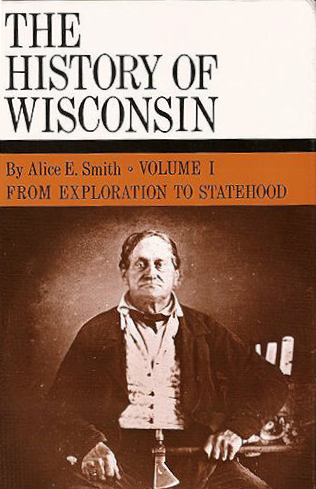
Smith, Alice E., History of Wisconsin Volume I: From Exploration to Statehood, Wisconsin Historical Society Press, 1973.
Even if you don’t read it from cover to cover, this is still the essential one-volume early history of Wisconsin. It’s not available as a PDF, but it’s still in print, and available from many sources, including the Wisconsin Historical Society’s online store. There is also a copy in the Jonathan Clark House Museum reference collection.
As the publisher’s blurb states, “this volume remains today the definitive work on Wisconsin’s beginnings, from the arrival of the French explorer Jean Nicolet in 1634, to the attainment of statehood in 1848. This volume explores how Wisconsin’s Native American inhabitants, early trappers, traders, explorers, and many immigrant groups paved the way for the territory to become a more permanent society. Including nearly two dozen maps as well as illustrations of territorial Wisconsin and portraits of early residents, this volume provides an in-depth history of the beginnings of the state” — and that about sums it up. It’s a long book, densely packed with information, so it doesn’t hurt that Ms. Smith writes well, too. Fully indexed, and Smith’s notes and bibliography are copious and meticulous and lead to many useful, but often obscure, sources (through 1973, of course).
Grade: a well-earned A for scholarship, accuracy and readability
The settlement of southeast Wisconsin, in depth
In the 1920s and ’30s, the Wisconsin Historical Society’s Joseph Schafer led a project that aspired to map and document the early decades of the settlement of the state in great, scholarly, detail. The project, modeled after the great English enumeration of 1086 was called the Wisconsin Domesday Book and, over the course of 10 or 15 years, produced a number of related books and maps (including the Clark House’s recently acquired Mequon Plat Map of 1860). The second volume of the General Studies series of the Wisconsin Domesday Book project is devoted to the study of the four most southerly lakefront counties of the state: Kenosha, Racine, Milwaukee and Ozaukee.

Schafer, Joseph. Four Wisconsin Counties, Prairie and Forest. State Historical Society of Wisconsin, 1927.
This is a detailed, thoughtful, though somewhat dated, scholarly analysis of what these four counties were like before settlement, what they became over time, and how they got that way. A look at the table of contents will give you an idea of the topics covered:
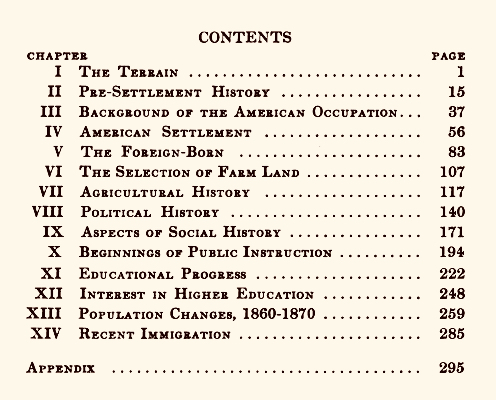
The Appendix runs for dozens of pages and includes maps and charts of population and political statistics, agricultural production, terrain and land use, and much more. The book is not, perhaps, for the casual reader. But if you want to know what the land was like when the Clarks, Turcks and Bonniwells arrived in the late 1830s, and how subsequent waves of immigration effected the politics and economy of the state, you will find answers here.
Grade: a solid A- for vast amounts of well-researched information, but in a very dense, slightly out-of-date package.
The(?) essential source for Jonathan Clark era history…

Western Historical Co., Chicago, pub. History of Washington and Ozaukee counties, Wisconsin … illustrated. Chicago, Western historical company, 1881. Free, downloadable PDF copies available via GoogleBooks, Internet Archive, and the Library of Congress, among others.
It’s not perfect. It only covers Washington and Ozaukee counties from prehistoric times through 1881, it has some of the typical biases of its era (for example, some of the language and attitudes concerning Indians), and the occasionally scatter-shot—and often fawning—coverage of local families and distinguished persons that are common to this and many other sold-by-subscription “county history” books of the later 19th-century.
It lacks proper scholarly notes, bibliography, and index (although the PDF search function is pretty good at filling that last gap). Yet, for all that, the History of Washington and Ozaukee counties…Illustrated (1881) is the essential book for those seeking information about the earliest settlers in our part of Wisconsin.
It appears that the editor(s) of this volume actually visited Washington and Ozaukee counties and made a point to collect and publish the first- and second-hand reminiscences of many of the earliest remaining settlers and their descendants. It also appears that they read—and transcribed with care—the early manuscript minutes of old Washington county government (for more on these minutes, including a link to this indispensable document, be sure to see our post on County Government – Early Records.)
Frankly, a very large portion of what we know about the Clarks, Turcks and Bonniwells and their community of settlers (up to 1881) comes from—or is amplified by—this book. It is not a scholarly tome, it rambles and repeats itself, and is written in a typically wordy, Victorian style. But this is the essential book for anyone interested in early Washington/Ozaukee and Clark House history.
Grade: A-, for Absolutely essential, though dated in many ways.
A pioneer neighbor’s diary
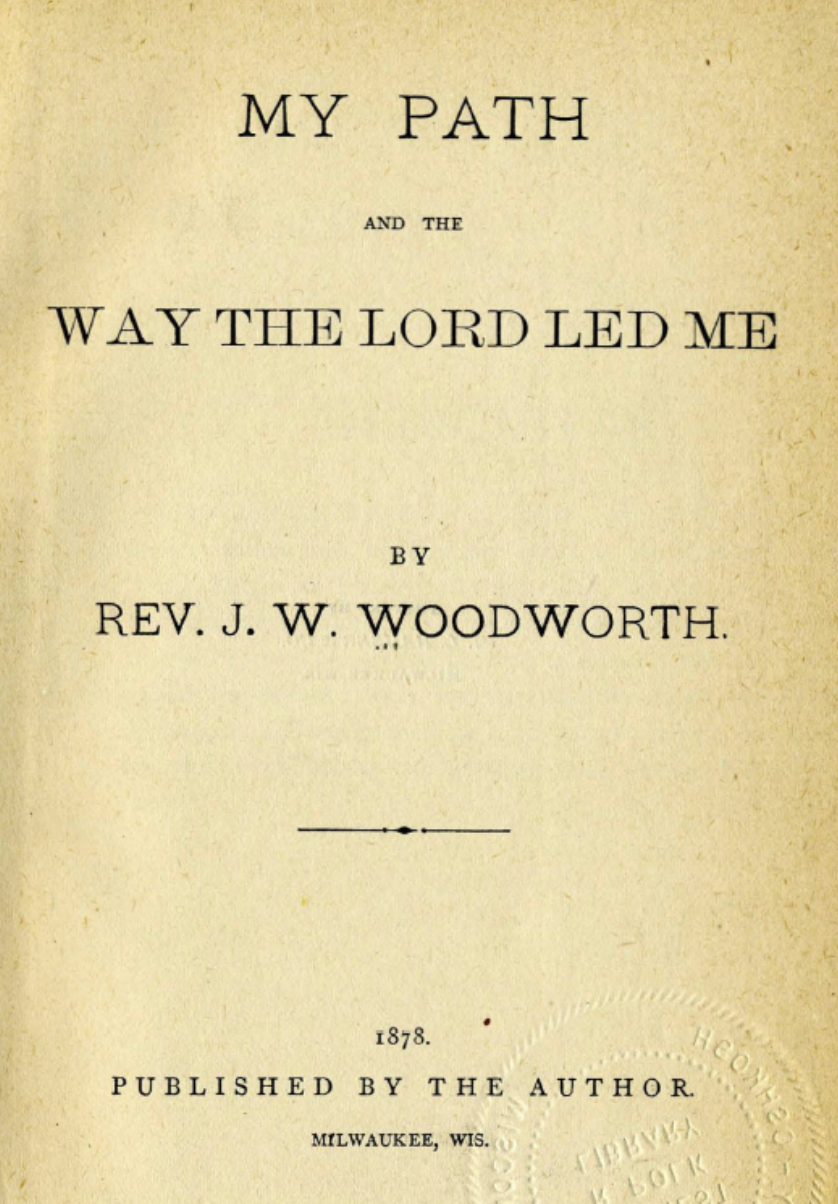
Woodworth, James W., Rev., My path and the way the Lord led me, by the author, Milwaukee, 1878.
James W. Woodworth (1813-1893) and his brother Ephraim were among the earliest white settlers in Mequon. They came from Nova Scotia, as did several other early Mequon settlers and families, including Isaac Bigelow, Daniel Strickland, and Stephen Loomer. On March 1, 1838, J. W. Woodworth married fellow Nova Scotia emigrant and Mequon neighbor Mary Cerena Loomer. The marriage was believed to be the first Christian marriage in old Washington county and was performed by Mary Turck Clark’s father, Peter Turck, “an anabaptist preacher.”
For much of his life Rev. Woodworth kept a diary of both the spiritual and mundane events of his life. He published the diary in Milwaukee in 1878 as My Path and the Way the Lord Led Me. The book is very rare. There is one copy still with the family in the Pacific Northwest, another at the Polk Library at UW-Oshkosh, and a searchable PDF of the book on DVD at the Clark House.
This diary is an example of “spiritual autobiography,” a once-popular literary genre with roots in seventeenth-century English protestant practice. Some modern readers may find the long passages of self-doubt and spiritual searching to be heavy going. But the book also includes page after page of detailed and interesting stories of local events and residents, many of which are not found elsewhere. Anyone with an interest in early Mequon, the Clarks and their neighbors, early Washington, Ozaukee and Milwaukee county history will find the book to be a unique and valuable resource. For more on the author and his book, see our 2017 post Rev. Woodworth’s Autobiography.
Grade: All sorts of unique genealogical and historical info gives this turgid diary a blessed B+
Washington county – the sequel
The History of Washington and Ozaukee counties…Illustrated, recorded events that were still within the living memory of many of the people interviewed for that book sometime around 1881. Not surprisingly, after the passage of a few decades, the next generations of county residents desired a sequel to the 1881 history.

Quickert, Carl, ed. Washington county past and present, Volume 1, Illustrated, Chicago, S.J. Clarke Publishing Company, 1912.
The sequel—for Washington county—came thirty-one years later with editor Carl Quickert’s Washington county past and present, Volume 1, Illustrated. This is a shorter book than the 1881 history, and less densely packed with facts, such as quotations, reports, election results, county budgets and so on, that are a feature of the 1881 book. Clark House Historian readers will be interested in the mentions of Mary (Turck) Clark’s brother-in-law Densmore Maxon, his wife Elizabeth (Turck) Maxon and some of their neighbors and kin in the Cedar Creek area. There is information about the nearby Rix family, immigrants from Stanstead, Lower Canada in the 1840s and possible Canadian friends of JMC in his youth. Elizabeth Maxon’s 1907 (slightly abridged) letter to the Old Settler’s Club is quoted in the book, and is an important source of early Turck family history in the county.
I have spent much less time with this book that with others, so my impressions may need revising if I get around to reading the whole thing. I can say that much of the material covering the earliest years of settlement appears to be based upon—and heavily condensed from—the 1881 history. The newer information, up to 1912, is less directly relevant to the Clark House and family, but may be of interest to local readers, historians and genealogists.
Grade: the early years are covered in more (meandering) detail in the 1881 history, but the 1882-1912 updates here earn this book a respectable B+
und…auf Deutsch!
Quickert’s 1912 Washington county past and present, Volume 1, Illustrated is actually a revised and expanded English language version of this earlier collection of his local history sketches, published in 1907:
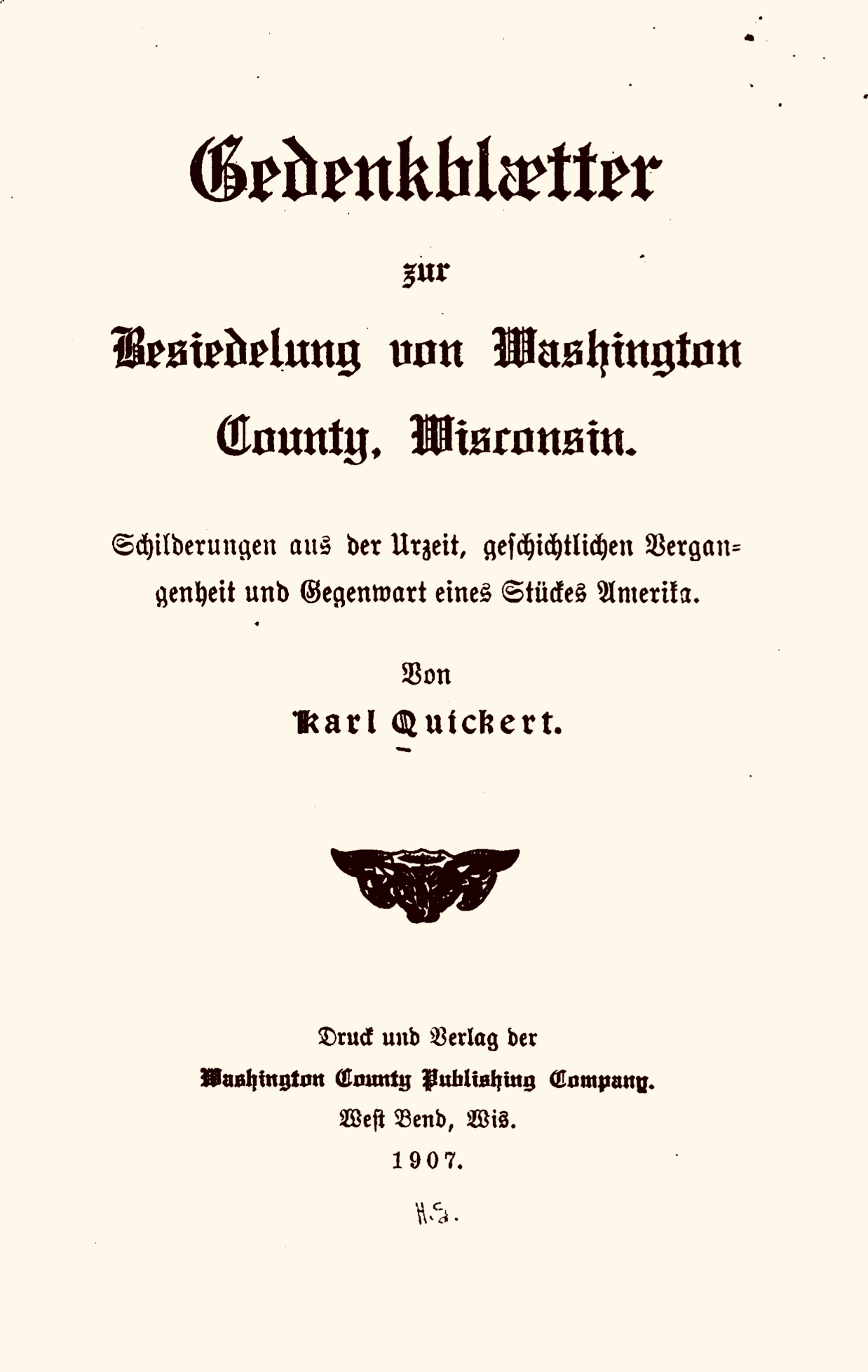
Quickert, Carl. Gedenkblaetter zur Besiedelung von Washington County, Wisconsin. Schilderungen aus der Urzeit, geschichtlichen Vergangenheit und Gegenwart eines Stückes Amerika. Von Carl Quickert. Druck und Verlag der Washington County Publishing Company. West Bend, Wis. 1907.
Translated, the full title page reads: Commemorative Pages on the Settlement of Washington County, Wisconsin. Descriptions of the Prehistoric, Historical, and Present Times of a Part of America. By Carl Quickert. Printed and published by the Washington County Publishing Company. West Bend, Wis. 1907. For convenience’s sake, we’ll just call this the Quickert Gedenkblaetter (1907). You can read and download your own PDF copy of the Gedenkblaeter at this GoogleBooks link. There is also a digital copy of the Gedenkblaeter at the Wisconsin Historical Society’s website.
In the preface to his expanded, English language, Washington County, Past and Present of 1912, Quickert had this to say about its 1907 predecessor, the Gedenkblaetter:
About five years ago I published a little German volume of sketches, mostly of a historical nature, on Washington County, Wisconsin, titled “Gedenkblatter […]” The work found a most hearty welcome among the foremost German scholars of the state. It was much more than I dared to expect for a book that had but a casual origin. […] The collection of sketches first appeared as a serial article in the “Beobachter,” a weekly paper published at West Bend, Wis., the proprietors of which ventured to publish the book.
If you read German (printed in Fraktur type) the 1907 Gedenkblatter are an interesting source of local history, including a German translation of most of Elizabeth (Turck) Maxon’s 1907 reminiscences that had been recently read to the members of the Washington County Old Settler’s Club.
Grade: this one-of-a kind volume receives an energetic E, for Einzigartig! (“unique” in German).
The sequel to the sequel
Carl Quickert’s Washington county past and present, Volume 1, Illustrated of 1912 was never followed by a “Volume 2.” But in 1923, Quickert—unsatisfied with his earlier efforts—published a more comprehensive sequel, The Story of Washington County, Wisconsin.

Copies of the book are hard to locate, but a scan is available online among the Wisconsin Historical Society’s free digital resources. To date, I have not spent much time with The Story of Washington County. As in Quickert’s earlier books, the focus—even in the pre-1853 chapters—is very much on the towns that make up present-day Washington County. There are exceptions, including a reprint of Elizabeth (Turck) Maxon’s 1907 letter to the county’s Old Settlers’ Club. (It’s worth noting that this transcription of Mrs. Maxon’s letter introduces several typos; for example, the date of the letter is given as 1917, and the family surname is spelled Turk.)
To give you a sense of the book’s contents—and the author’s opinion of the 1881 History of Washington and Ozaukee Counties […] Illustrated—here are some excerpts from Quickert’s 1923 preface:
The writer has been collecting material for this work during the past twenty years, on and off, purposely and accidentally. He had access to a rich store-house of local history, the files of the West Bend News reaching down to 1860, and often, when there was a lull in his editorial work, he would delve into those tomes, some as blurred and decrepit as old age at its worst. There also was an old county history in the sanctum, published in 1880 [sic, 1881], with a jumble of information, some quite valuable, some of no import, some misleading, and some made useless by later researches. […}
In the present work I have attempted to advance another step or two to come closer to what a county history should look like. To be frank, my aim was to produce an ideal or model county history, the thing Wisconsin historians have been after for some time. […] Besides the sources mentioned, I have drawn my information from various other sources, from speeches on the olden times, from conversations with old settlers, from correspondence with people who were in possession of desirable material, from publications by the Wisconsin State Historical society, and from bulletins published by the State, as far as they touched upon matters useful to the work. Most of the chapters of my former work, as far as they have been made use of in this history, have been entirely re-written to come up to the results 0£ the latest historical researches and the amplifications which I was able to add to the county’s history
That certainly sounds promising. And the parts of the book that I have read are readable, and a good deal less fusty in style than the 1881 History. That’s not to say that all is up-to-date. For example, while generally sympathetic to his subject, Quickert’s writing about Native Americans is still rather dated in language and content.
Grade: since I have only skimmed this book, I have to give it a tantalizing “T” as a tentatively worthwhile source, especially for researchers focused on Washington County history.
Coming up: Mequon history “brought up to date”
The post-World War II era saw the creation of several Mequon-area histories and historical essays. Some are worth your attention and one… well, not so much. Who’s worth reading and who’s not? Stay tuned for details.
 Clark House Historian
Pingback: The Clarks, a family of readers… | Clark House Historian
Reed, The 1881 History has been reprinted (2022) and is available for purchase on line for $31. regards, Sam
LikeLike
Thanks for the tip, Sam!
—Reed
LikeLike
Nothing like a book instead of looking at your phone or a computer screen. LOL The Weyenberg Library has an original 1881 copy. Sam
LikeLike
Pingback: JCH Sources: a look a local histories, part 2 | Clark House Historian
Pingback: Meet Mary’s sister: Elizabeth Turck Maxon (1828-1913) | Clark House Historian
Pingback: Errata | Clark House Historian