The Clark House Historian’s Christmas Wish List…
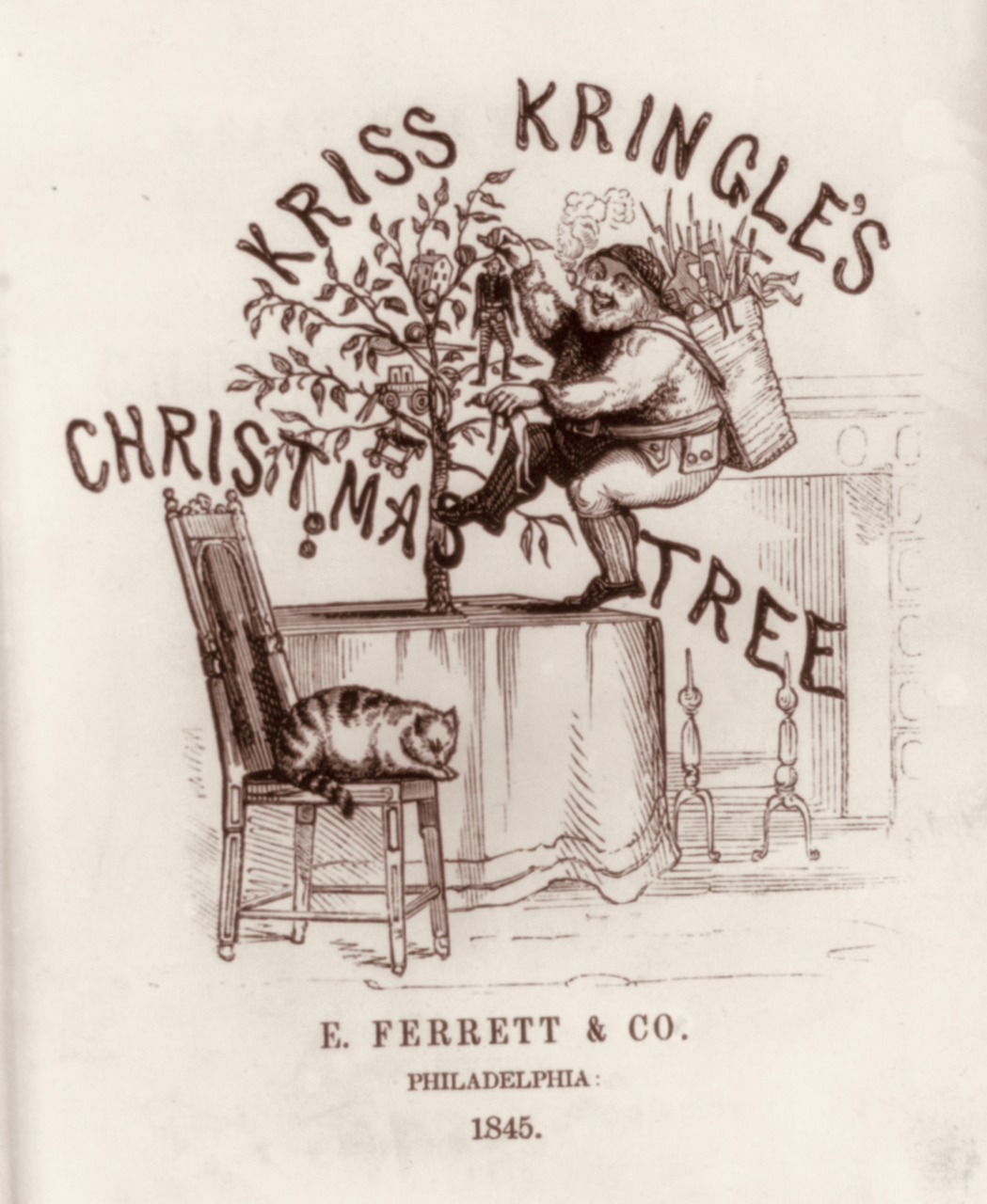
Kriss Kringle’s Christmas Tree [title page], E. Ferrett & Co., Philadelphia, 1845. Library of Congress
I grew up in the Chicago suburbs, and I remember the holiday thrill of riding the Chicago & Northwestern commuter train downtown with my parents, and then walking into the majestic State Street headquarters of Chicago’s grandest department store, Marshall Field & Company. Our mission? A trip up to the “toy floor” at Field’s, where we would wait in line to tell Santa all the wonderful things we would like to receive for Christmas that year.1
It goes without saying that I haven’t been able to fit on Santa’s lap for a very long time. But as the Clark House Historian, I still have holiday dreams and wishes, and today I’d like to share some of them with you. Who knows, perhaps Santa will work his magic once again?
(Official disclaimer: I do not serve on the JCH Board of Directors, or any of its committees. This is my Christmas daydream, a fantasy of what I’d like to see unfold at my favorite museum, given unlimited resources. And besides, as the great Chicago architect and city planner Daniel Burnham famously said: “Make no little plans. They have no magic to stir men’s blood!”)
My list is organized into several parts, the first of these is…
Archaeology
I’d love for Santa’s Elves to arrive at the Clark House one summer, fully equipped to do a full-on archaeological survey, with comprehensive mapping and exploratory digs and test pits on the museum property. I’d like the elves to begin with a geophysical survey—mapping all the “lumps and bumps” of the landscape—using all the modern tools, especially ground-penetrating radar and aerial lidar, While we’re at it, I’d like to get permission to continue this survey across the street, on the east side of Cedarburg road, where the Clark farm barn and other outbuildings once stood.
What’s our goal?
What are we searching for? After all, Cedarburg and Bonniwell roads have been widened and re-contoured several times since the Clark era. The museum property only encompasses a fraction of the Clarks’ original 160 acres of farmland. And a good portion of the museum property has been excavated to install one or more modern septic systems. What could possibly be left to find?
Well… (pun intended), I think there is still a good chance we could find a number of seemingly mundane, but possibly archaeologically-rich features of the old Clark farm, including:
- One or more of the original drinking water wells. Lots of interesting things fall into wells over the years, by accident or on purpose. And when the well no longer provided enough clean water for drinking, they were often transformed into…
- Trash pits. There were no garbage trucks in 19th-century Mequon, and every household had to find a way to dispose of its trash and kitchen waste. Some trash might be burned. But for other waste, an area near the house became a trash pile, or with a little digging, a trash pit. Old wells often became household trash pits when they no longer served their original purpose, as did…
- The privy. Call it what you will, in addition to its primary purpose, the household privy, outhouse, or latrine was a natural spot to discard trash
As you know, besides the 1848 stone house, and copies of the original photos of Jonathan and Mary Clark, we have no tangible goods that actually belonged to the Clark family. If we can locate and excavate the lowest levels of the oldest Clark House wells, trash pits and privies, we might find all sorts of things that the Clark family actually owned, used and eventually discarded. And that can tell us a lot about how the family lived in the 1840s and ’50s. For an earlier example, click this link to see what they found in one original well during the ongoing comprehensive survey of Jamestown, Virginia.
What else might we find, or want to discover?
Jonathan Clark purchased the first 80 acres of the future 160-acre Clark family farm in December, 1839. He married Mary Turck in March, 1840. Their first child, daughter Caroline, was born in November of the same year. There were four children in the family by the time Jonathan carved his name and the year 1848 onto the lintel of the big stone house. Even with the most vigorous efforts of hard working settlers like Jonathan Clark, his father-in-law Peter Turck, and their Bonniwell family neighbors, it must have taken a fair amount of time to dig the house’s full cellar and construct the two-story, Greek Revival, Jonathan Clark House above it. Where did the young Clark family live before the big house was finished? Possibly in a shanty.
Shanties

Forbes, Edwin, artist. Soldiers’ huts in winter camp / E.F., Fredericksburg, Virginia, 12 January 1863. Library of Congress
Historical sources include many mentions of early Mequon settlers—including sawmill owner-operator Peter Turck—arriving in the area in the 1830s and ’40s and quickly constructing a “shanty” to live in. What were these shanties? Sometimes they were more-or-less what we would call a “log cabin.” Sometimes they were much flimsier affairs, made of downed fir trees and tarps or blankets.2
In any case—whether a rude tarp-and-tree-limb shanty, a log cabin, or something else—I’d like the elves to look on both sides of Cedarburg road and try and locate the site, and map the dimensions, of the original Jonathan M. Clark family shelter. (And if we find it, let’s have a proper archeological dig of the shanty floor and surrounding area, too.)
Genealogy
Sorry Santa, I know my list is long already, but I’m just getting warmed up, and I’m thinking about family history. You know, genealogy. Particularly Jonathan M. Clark’s genealogy because, as you know, we don’t know who Jonathan’s parents, siblings or other kin are or where, exactly, they came from. And that’s not the only Clark-Turck genealogy mystery that’s been driving me crazy for the last decade.
Therefore, as part of the Magic of the Season, my wishes are that vexing genealogy mysteries get solved! For example, just off the top of my head:
- someone (Santa’s Elves? professional specialist researchers?) helps us finally uncover JMC’s family tree!
- Clark son Henry’s Civil War activities (or lack thereof) and—possibly—his cause of death, are finally made clear!
- we learn who Arthur Clark (from the family’s 1850 census) was, and what happened to him after 1850!
- we discover what happened to daughter Laura (Clark) Bleyer Wentworth after her scandalous divorce!
- we learn the cause of Josie Clark’s sudden death at the state mental health facility in Oshkosh
- we establish the death date of Mary Clark’s mother, Rachael Gay Turck
- we discover the original Ozaukee county burial location (“the Cedarburg Cemetery”) of Jonathan M. Clark, Henry Clark and Josie Clark (and Rachael Gay Turck? and others?)
- we locate Peter & Rachael Gay Turck’s 1820s (?) New York marriage record or, at least, their date of marriage
- we learn more about Peter Turck’s mysterious third wife, Maria Turck, and their brief marriage, circa 1861
Documents & Maps & more…
Those genealogy mysteries are indeed vexing problems that do need extra time (and money) to solve. But there are other holes in the historical record that can be solved, with the free time and necessary funds needed to travel and request copies of (and publication rights to) various documents filed in a wide-spread assortment of local, state, and federal archives. As long as I’m wishing, I’ll wish for a Historian’s Bottomless Pot o’ Gold to fund endless travel to, and file-retrieval & copying at, archival repositories large and small, near and far! And what else is on this historian’s shopping list?
- Maps. Whether for research or for display at the museum, you can’t have too many historical maps. JCH co-curators Fred Derr and Nina Look have already acquired some handsome and useful period maps for the museum, but there are still many interesting and relevant maps that would make excellent additions to the Clark House collection.
- Military records. Many local men served in the Civil War, and their complete service and pension files might fill in a number of gaps in our research. I”d begin by getting the complete files for Mary Clark’s brother, Benjamin Turck, and perhaps several of the Bonniwell and Woodworth lads that might have served with Henry Clark.
- Newspapers. I need time and inter-library loans to look for relevant early Mequon events, marriages and deaths in the microfilms of the earliest surviving Washington/Ozaukee county newspapers.
- A magical checkbook, to pay for access to, and copies of documents from, historical societies large and small. I know that the Wisconsin Historical Society has many relevant records that I have not yet seen, and I suspect the Milwaukee, Washington, and Ozaukee county historical societies do, too.
Speaking of money
The Jonathan Clark House Museum is an old house, but a young institution. And in just over a decade our Board, staff, volunteers, and visitors have transformed a former dentist’s office into the wonderful museum that it is today. I tip my hat to them all. But if Santa wanted to drop some serious cash on the Clark House, I can think of a number of neat ways to spend it, ways that enhance the mission and long-term durability of the museum.
Infrastructure…
After he made his millions in the rough and tumble of the 19th-century American steel business, Andrew Carnegie rehabilitated his reputation by funding the construction of 1,681 Carnegie libraries, as well as several universities and numerous foundations and other charitable enterprises. He built lasting things to enhance his—and many other—communities. I’m thinking that Santa, if he is agreeable, might want to follow in Carnegie’s footsteps and build some permanent infrastructure for the Clark House. For example, Santa could…
- pay off the museum’s mortgage
- establish a big endowment for the long-term future of the JCH
- build a welcome center with ADA compliant bathrooms and space for tour groups to arrive, eat (if desired), hear docent pre-tour presentations, view permanent and rotating historical JCH exhibits, host JCH meetings and guest speakers, with climate-controlled office space for artifact storage and JCH staff work. And a small gift shop, too.
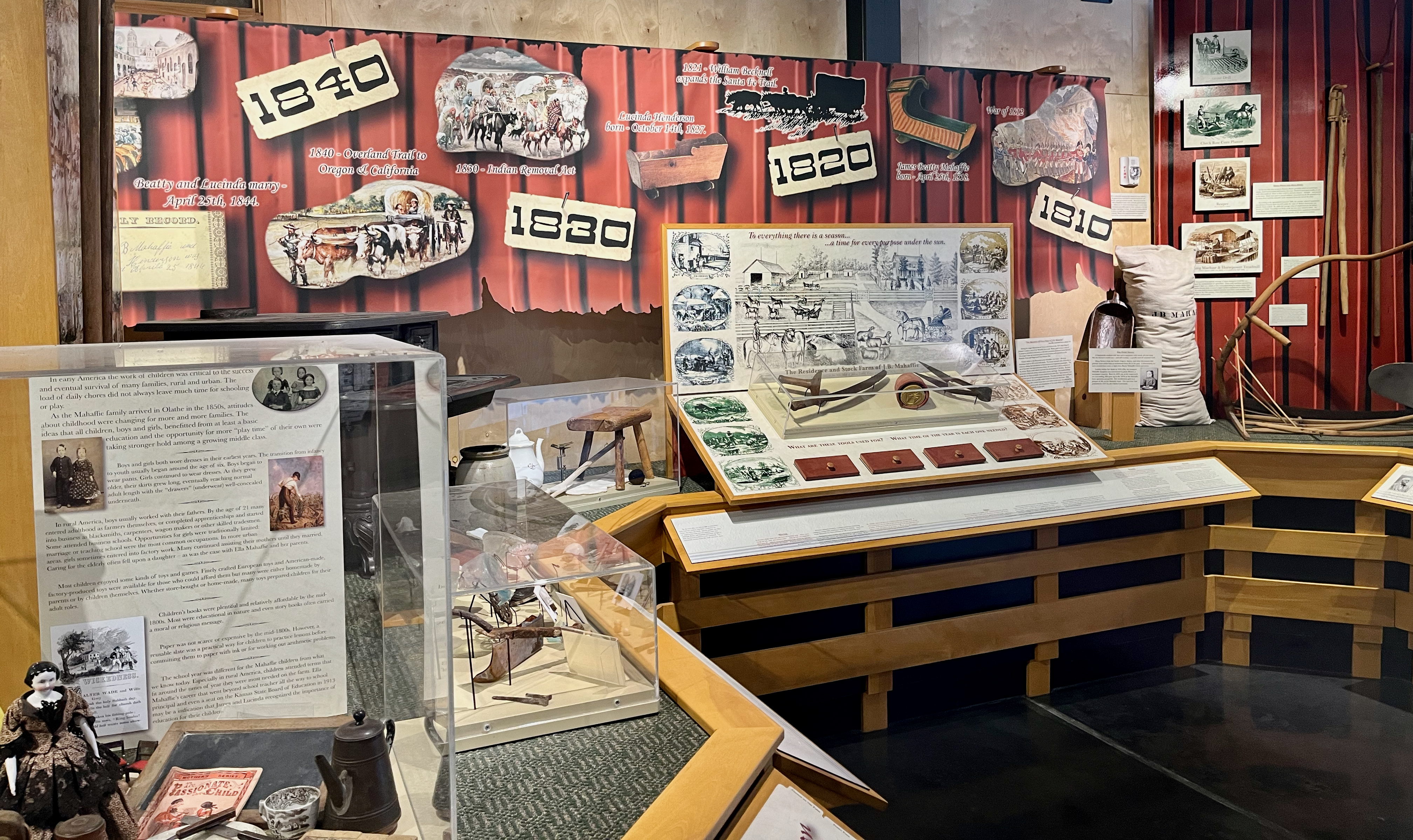
Part of the Visitor’s Center permanent exhibit at the Mahaffie Stagecoach Stop & Farm Historic Site, Olathe, Kansas, 2023. Photo credit: Reed Perkins.
A welcome center would allow more groups to easily access the Clark House, and it would remove all “modern,” non-historical functions and technology from the 1848 house, all of which would reinforce and enhance the museum’s mission and visitor experience. Speaking of which…
Interpretive enhancements
The current museum property is not large, but I have a vision for one particular outdoor interpretive idea that might enhance a visit to the house. I’d love to have a smooth (ADA compliant) path that more or less circles the property where, at various points along the way, the visitor can pause to read illustrated interpretive signs.3 Circling the property clockwise from the current entrance, these signs might explain:
- looking eastward: photos and text about the original Clark barn
- looking southeast, at the corner of Bonniwell & Cedarburg roads: a map of the neighboring farms & families, c. 1840-1850; perhaps a focus on the nearby Nova Scotia immigrants, esp Woodworths, Loomers and Stricklands
- along Bonnniwell road, looking southwesterly: a map showing the locations and images of the Peter Turck sawmill (the county’s first business), and the nearby William T. Bonniwell house (site of early county government)
- looking west down Bonniwell road: a drawing of and text about the 1843 Bonniwell school and it’s role in neighborhood education and worship
- on the west side of the property: info about the adjacent neighbors, the Jesse Hubbard family, longtime friends of the Clarks and supporters of and frequent hosts to traveling preachers and abolitionists
- looking northwest: information about Mary Clark’s sister and brother-in-law, Elizabeth and Densmore Maxon; they moved to Cedar Creek, town of Polk. He ran a sawmill and creamery, remained active in civic and business life, and advocated for progressive, compassionate mental health treatment in Wisconsin.
- Looking north: discussion and illustration of Native American original inhabitants of the area, how the settlers interacted with them (it’s complicated) and what happened to them after the 1830s-’50s.
Ho! Ho! Ho!
Well, Santa, I guess I should wrap this up. My initial thoughts have turned into a long list, and I know parts of it are more practical than others. But a historian can dream, can’t he?
Postscript
If you’d like to help Santa, and support the museum and its educational mission, gifts to the Friends of the Jonathan House may be made online or by mail. Click this link to the JCH website’s DONATE page for all the details.
Thanks for reading, and Happy Holidays to all!
________________________
NOTES:
- After talking to the Marshall Field’s Santa, if we were lucky, we’d get to visit the elegant tea room at Field’s and have a scoop of their velvety, dark-chocolate, “Frango Mint” ice cream. You could only get it at Field’s and the taste and texture remain the high-point of my ice cream eating experience…
- I am in the process of writing an illustrated post on what JMC might have thought of, and built, when he made his own “shanty” in 1839 or ’40.
For the record, I wonder whether JMC lived with Peter Turck and his family in JMC’s early days or years in Mequon. Turck was known to have hosted shelterless Mequon immigrants on several occasions. Perhaps JMC lived with the Turck family while he built his own shanty? And that’s how he became acquainted with eldest Turck daughter Mary? It’s only a theory for now, but it’s plausible. More on all this in a future post. - Another museum of the early days of Wisconsin Territory and State, the Historic Indian Agency House near Portage, has done something like this on their grounds. Click here to take a look at their interpretive trails and other outdoor educational and recreational activities.
 Clark House Historian
I believe in Santa Claus! Nina🌲😊
LikeLike
Pingback: Santa came! | Clark House Historian