Guess what I did instead of writing a new Clark House Historian post! Here’s a clue, from about this time last year (revised and expanded for 2022)…
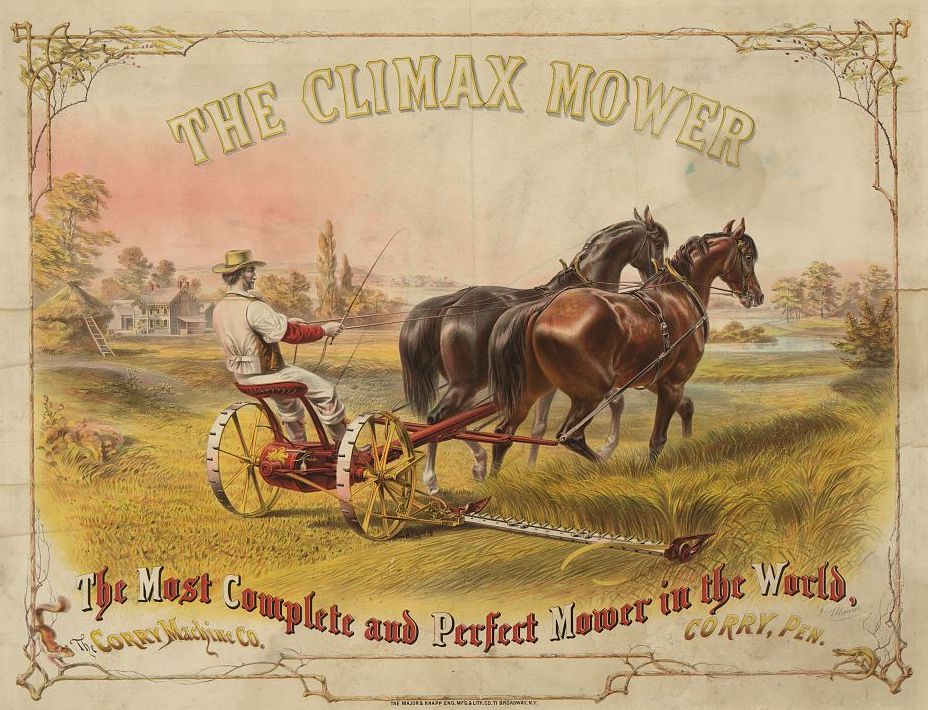
Spring weather in southeastern Wisconsin is pretty hard to predict these days. Spring 2021 was awfully dry. This year, spring has been wetter overall—I think—but the days have zigzagged rapidly and unpredictably between chill and damp or hot and humid. It’s almost like we haven’t had a proper Midwestern spring at all. And yet, the grass around the Historian’s house has already gotten pretty tall and scruffy. So it was time to get out the mower and tidy up (some of) the yard.
Maurer, Louis, Artist. The climax mower, most complete and perfect mower in the world, the Corry Machine Co., Corry, Pen. / L. Maurer. United States, None. [NY: the Major & Knapp Eng., Mfg. & Lith. Co., between 1869 and 1872] Photograph. Library of Congress.
If I read my calendar correctly, that means you can just drop in this Friday, May 6, or next Saturday, May 14, between 11 and 2, and enjoy a tour of the historic home of Mequon’s pioneer Clark family. Other open days will follow on first Fridays and second Saturdays throughout the summer. If you have a group of 6 or more, please call ahead. More info on Clark House tours can be found at this link. Questions? Give us a call at 262-618-2051 or send us an e-mail at jchmuseum@gmail.com.
History Mystery! update…
Did you see our CHH History Mystery! post on Monday? Have you been working on your transcription of our early English manuscript text? Are you stumped? Do you still want to win eternal fame and glory throughout the Clark House Historian readership? Here’s an update to that initial post, with two more clues to help you solve our handwriting puzzle:
I just got some fun news from Jonathan Clark House executive director Dana Hansen:
While the weather doesn’t feel like it at the moment, our fundraiser game with the Chinooks is coming up very soon! Make sure to purchase your packages asap for the game on June 3rd as they will be opening up general ticket sales May 2nd, and expect to sell out. See the poster below for more information, and hope to see you out at the ball game!
______________________________________
Click to open larger image in a new window.
Batter up! for history.
So if you’d like to support the Clark House—andenjoy an fun evening at the ballpark—call and reserve your game package for Friday, June 3rd, 2022, and don’t forget promo code JCH.
And even though the Chinooks and the Rafters will play by modern rules, I’m sure Old Abe would approve…
It’s been a week of constant organizing at my house. A useful and productive week, perhaps, spent sorting, reading, and filing paperwork, and updating the household accounts. But not much writing.
Of course, the need to sort, repair and organize is not limited to our era. I suspect the Clarks, Turcks, Bonniwells—and their neighbors—spent a good bit of time trying to catch up with their 19th-century chores, like this fellow…
Guy, Seymour Joseph (1824–1910), Utilizing a Spare Moment, oil on canvas, c. 1860-1870. Yale UniversityArt Gallery, public domain (CC0 1.0). Click to open larger image in new window.
Unknown photographer, [Occupational Portrait of a Blacksmith, Three-Quarter Length, Working on a Horseshoe at an Anvil, Other Tools to His Side], no place, daguerreotype circa 1840-1860. Library of Congress, public domain, cropped and exposure lightened. Click to open larger image in new window.
I’m at the writer’s “forge,” trying to beat several new blog posts into shape.
Updated February 22, 2022 to fix a few minor typos, and to add a link to a brief history of American samplers, with an illustrated list of 73 of the 137 American samplers in the Textile Collection of the National Museum of American History.
In addition to raising and educating her children, a 19th-century farm wife like Mary Turck Clark had many other responsibilities, including planning and tending a farm garden, preserving its produce, preparing daily meals for the family and hired hands, and keeping the farm house clean and organized. And Mary, like many women of her era, probably made some or all of her own and her family’s clothes.
The sewing arts
Like most girls of her era, Mary Turck (born in New York, 1821) probably learned the craft of needlework from her mother and, perhaps, as part of her school education. When a young girl like Mary mastered some of the many practical and decorative sewing stitches, she might demonstrate her proficiency by making a sampler.
A sampler might feature simple examples of sewn letters, numbers and perhaps a popular saying or Bible verse. But many samplers were more complex and artistic. An accomplished embroiderer might produce an elaborate sampler featuring detailed images and texts, as in this 1829 sampler from Connecticut.
Thompson, Mariette (1817-1851), [Sampler with family register], 1829. Yale Art Gallery, public domain. Click to open larger image in new window.
Updated Feb. 11, 2022, with information about Milwaukee’s “original Ice Bear,” Henry Kroeger (see comments, below).
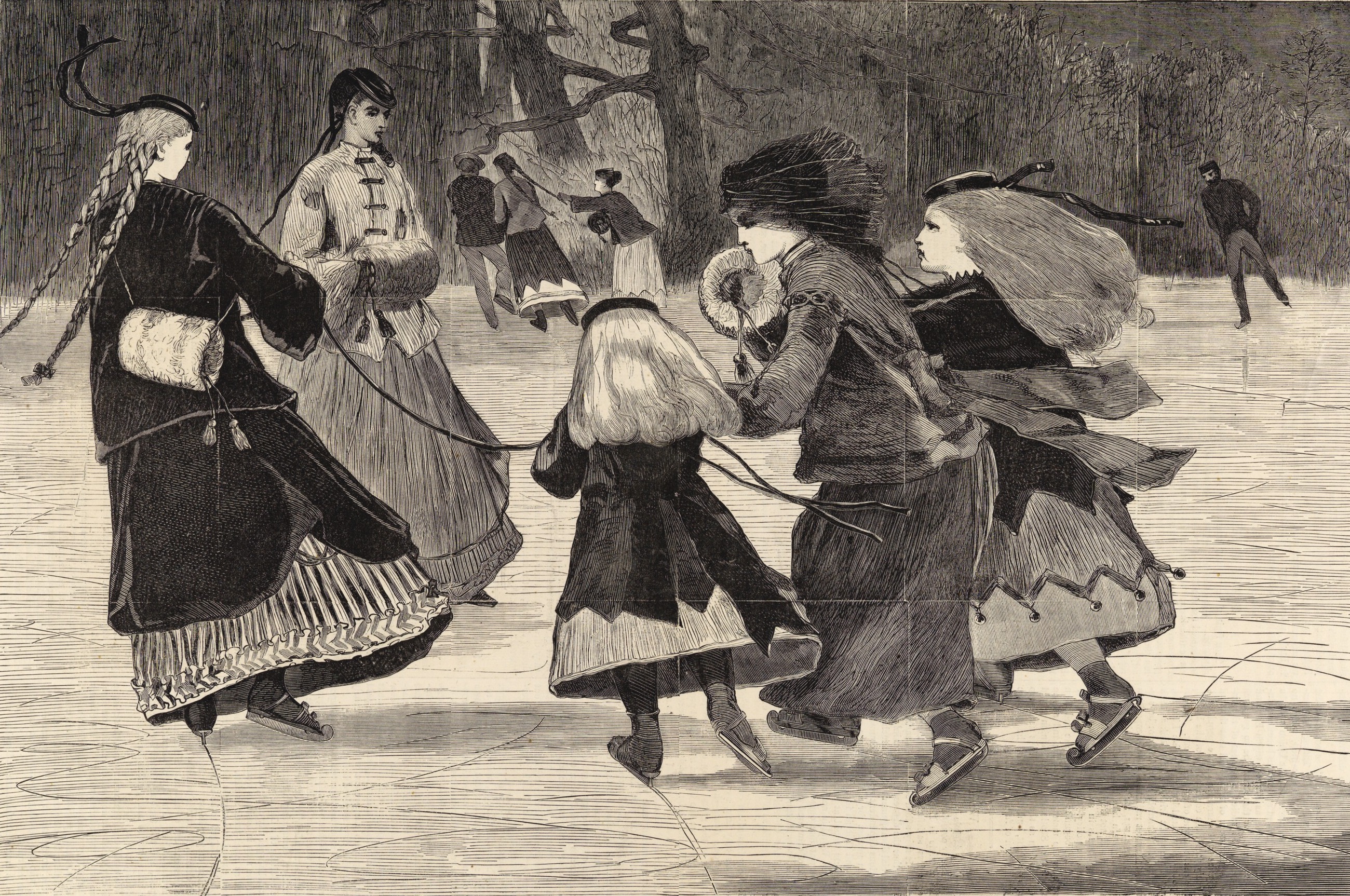
The 24th Winter Olympic Games are now under way in Beijing, with a dizzying profusion of modern sliding and gliding winter sports. Of course, outdoor winter games and sports pre-date the modern Olympics by hundreds, if not thousands, of years. Among the oldest and most popular of these is ice skating.
Homer, Winslow, “Winter” — A Skating Scene, from Harper’s Weekly, January 25, 1868. Smithsonian American Art Museum, The Ray Austrian Collection, gift of Beatrice L. Austrian, Caryl A. Austrian and James A. Austrian. Public domain, CC0. Click to open larger image in new window
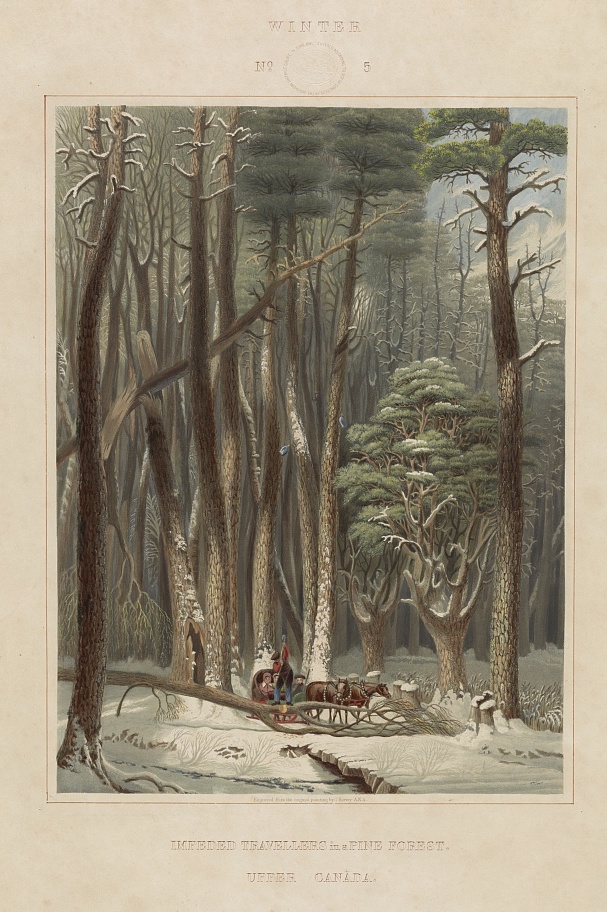
In Jonathan and Mary Clark’s era, if you needed to get somewhere during the winter—for business or for pleasure—you probably rode in a a horse-drawn sleigh. Travel in a sleigh could be fun, even exhilarating, but was not without its perils, most of which came from inadequately maintained roads and trails:
Bennett, W. J. , Engraver, and George Harvey. Winter. No. 5., Impeded Travelers in a Pine Forest, Upper Canada / engraved from the original painting by G. Harvey A.N.A., New York, 1841. Color aquatint. Library of Congress. Click to open larger image in new window.
It’s the week after Christmas. Perhaps you have family or friends visiting from out of town. If you have children, they’re home from school. How to keep them entertained? If you lived near New York City in 1864, you were in luck. Barnum’s American Museum was ready with spectacular and unique holiday exhibits for the whole family, all for the low, low, price of 25 cents for adults, 15 cents for children under age ten!
Barnum’s American Museum. Christmas and New Year holiday bill, 1864. [New York: Wynkoop, Hallenbeck & Thomas, Book and Job Printers, 113 Fulton St. N.Y], Library of Congress. Click to see larger, easier to read, image.
Tonight is Christmas Eve, and I thought you might enjoy an expanded reprise of our 1867 Santa Claus story, originally posted December 25 and 30, 2017. This year I have combined the two original posts and incorporated some new illustrations and a few revisions of the text. Here it is again, for your holiday enjoyment. Ho! Ho! Ho!
Christmas in early America
For many years now, Christmas has been celebrated by Americans as an important religious and (increasingly secular) community holiday. Christians gather to worship and commemorate the birth of Jesus, and they and other Americans enjoy a break from work to gather with family and friends to feast and exchange gifts. But it was not always this way.
In many of the American colonies, Christmas was not observed as a religious or secular holiday. The seventeenth-century Puritan leaders of the Massachusetts Bay Colony considered Christmas to be non-biblical and pagan influenced. In Boston and other parts of New England any observance of Christmas was prohibited and, for a few years, actually illegal:
Penalty for Keeping Christmas, 1659
Records of the Governor and Company of the Massachusetts Bay in New England. Printed by order of the Legislature, edited by Nathaniel B. Shurtleff, M.D., Vol. IV, Part I, 1650-1660, online at mass.gov (accessed 21 Dec. 2021). Click to open larger image in new window.
Transcription: For preventing disorders arising in several places within this jurisdiction, by reason of some still observing such festivals as were superstitiously kept in other countries, to the great dishonor of God and offence of others, it is therefore ordered by this Court and the authority thereof, that whosoever shall be found observing any such day as Christmas or the like, either by forbearing of labor, feasting, or any other way, upon such accounts as aforesaid, every such person so offending shall pay for every such offence five shillings, as a fine to the country.
Christmas was not generally accepted as a holiday in many parts of the United States until after the federal government made December 25 a national holiday in 1870.
On the other hand…
The Massachusetts Puritans may not have approved of “observing any such day as Christmas or the like, either by forbearing of labor, feasting, or any other way,” but Christmas was “kept in other countries” and increasing numbers of immigrants from those countries to the United States—particularly from Victorian England, Catholic Europe, and the German Lands—celebrated the day in their new American homes with many of their accustomed religious observances and national traditions.






 Clark House Historian