Today we celebrate the inauguration of the forty-sixth president of the United States. The inauguration of a president is traditionally a time to take stock and ponder the direction of the republic. I expect that President Biden—like many of his predecessors—will try and make the best of his opportunity. (I’m writing this before the ceremony; I don’t know if he succeeded.) For a little inspiration—for us all—let’s look back at one of the great American speeches—perhaps the most moving and inspired of all the inaugural addresses—delivered at one of the most difficult and dangerous moments in our history.
A second term, and Union victory, were not certain…
For much of 1864, president Abraham Lincoln’s prospects for reelection looked dim. Union forces had suffered notable defeats and horrifying casualties in early 1864, and many in the North were tired of the cost of the war, both in dollars and human suffering. If not for Gen. William Tecumseh Sherman’s timely capture of Atlanta on September 2, 1864, Lincoln might have lost the election to Gen. George B. McClellan. McClellan sought to end the war by negotiating an armistice with the South. Such an armistice would have ended the fighting, but would not have solved the cause of the war: the continued existence of chattel slavery in the South and in the new U.S. territories and states forming in the West. But Lincoln’s popularity soared after Sherman’s decisive victories during the Atlanta campaign—especially after the fall of Atlanta—and the incumbent president won a decisive popular and electoral college victory on November 8, 1865.
A few days ago, Clark House museum director Nina Look asked me a simple question: when, exactly, was Mary Turck Clark born? So I looked in my database and I came up with…two answers: Mary Turck Clark was born on either May 4th, 1820 or May 3, 1821. So I reviewed my dates and sources, and today’s post is about what I (re-)discovered, and what I still have to investigate.
Haven’t we been over this before?
Why, yes, we have. Here are links to earlier posts on essential sources of Mary Turck Clark birth date and birth year information, starting with my second Clark House Historian post, this now-outdated post about Mary from 2016. Other, more recent, posts have gone into detail examining Mary, her family, and their likely birth dates as found on the U.S. federal decennial censuses:
I’ve not yet blogged about Mary’s 1870 or 1880 federal censuses—both enumerated in Milwaukee—but I’ve seen them and used them in my research. More on these in a moment.
Christmas Eve is tomorrow night, so I thought you might enjoy another look at our previous Santa Claus posts, from December 25 and 30, 2017. I have combined the two original posts and incorporated a few revisions and updates to the text. Ho! Ho! Ho!
Christmas in early America
For many years now, Christmas has been celebrated by many Americans as an important religious and community holiday. Christians gather to worship and commemorate the birth of Jesus, and they and other Americans enjoy a break from work and gather with family to feast and exchange gifts. But it was not always this way.
But in many of the American colonies, Christmas was not observed as a religious or secular holiday. The seventeenth-century Puritan leaders of the Massachusetts Bay Colony considered Christmas to be non-biblical and pagan influenced. In Boston and other parts of New England any observance of Christmas was prohibited and, for a few years, actually illegal. The holiday was not generally accepted in many parts of the United States until after the federal government made December 25 a national holiday in 1870.
November 28, 2020, is the 208th anniversary of the birth of Jonathan M. Clark. To celebrate, I’m reposting a revised, expanded and annotated version of one of my first Clark House Historian posts. Since this was first published, on April 20, 2016, we have learned much more about the lives of Jonathan Clark, Mary Turck Clark, their family and their neighbors. Please check out the footnotes and click on the links for some of this newer, more accurate, information.
Happy Birthday, Jonathan! (and thanks to Nina Look for the timely reminder).
JMC: Man of Mystery
Jonathan M. Clark. Photograph courtesy Liz Hickman.
Well, the big day is just a week away. Here at Clark House Historian I try and remain officially non-partisan. But as a researcher and writer, and as an American with long, deep, roots in this country, I have a passionate interest in our nation and its history, and a life-long desire to see us live up to our highest ideals and aspirations. (Of course, human nature being what it is, we have not always lived up to those ideals.)
So with the election approaching, today’s post takes a look at the political leanings of early Washington County and—after its establishment in 1853—Ozaukee County, with an emphasis on presidential elections from 1848 to 1880. Our main source today is the invaluable History of Washington and Ozaukee counties, Wisconsin […], published in Chicago in 1881. Let’s begin with some of the earliest results, following statehood in early 1848:
Today’s and Friday’s posts are inspired by a question about Monday’s Harvest Time post. Reader Laura Rexroth asked: Any records of what they did grow? Animals? How much land did they have? A fine question, and the answer is yes, there are records.
How big was the farm?
We know the size of the Clark farm from information in their land records, including their two federal land patents, a variety of maps from the mid-1800s through the 20th-century, and the Abstract of Title for the Clark property that was prepared by the Ozaukee County Abstract of Title Company, now in the collection of the Jonathan Clark House museum. For most of their time in Mequon, about 1840-1860/61, Jonathan and Mary Clark owned 160 acres of land. Much of this land was originally forested, and I assume that the Clarks cleared and farmed more and more of their 160 acres over time. How much was under cultivation in 1850? For that we need to see:
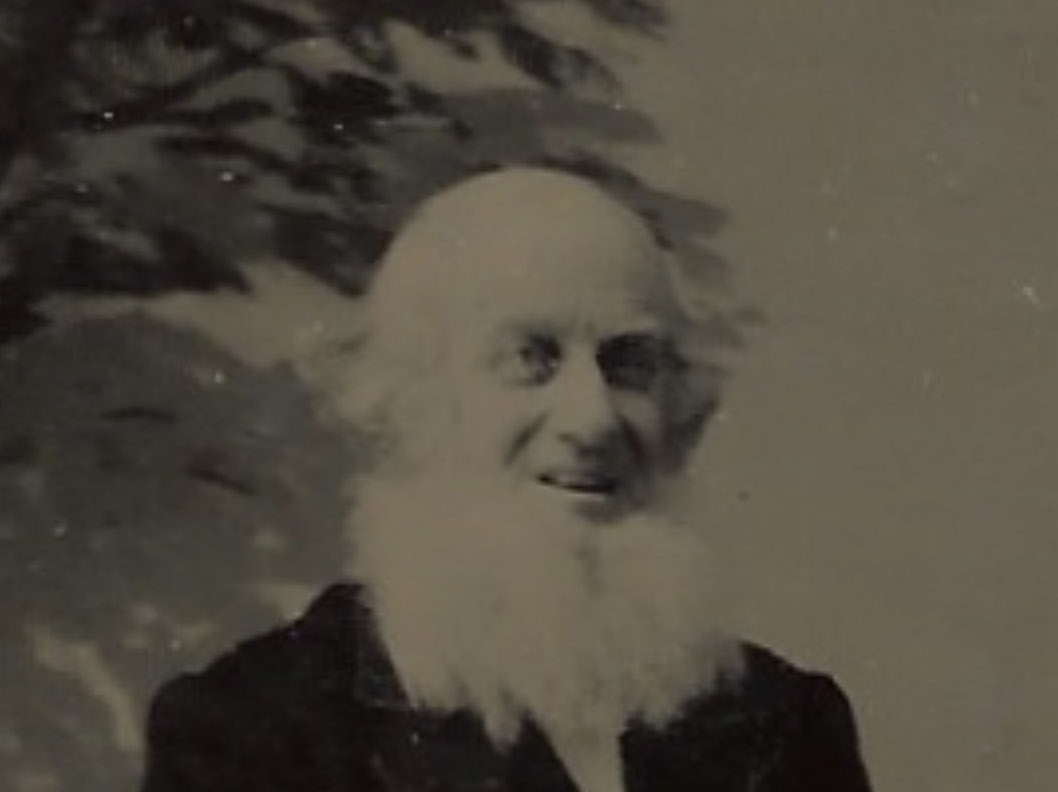
Cyrus Clark (tintype, detail). Photo courtesy Steven Clark Van Slyke. Click to open image in new window.
Dating and interpreting old photographs, part 3 of 4
For our next to last look at photographs from the family of early Mequon settlers Cyrus and Sarah (Strickland) Clark we’ll start to take a closer look at three images made with another popular photographic process from the era, the tintype. We will examine the clothing, props, backgrounds and other aspects of the photographs, learn more about the tintype process, and try and determine when the photos were taken1. Once again, thanks to Clark and Strickland descendants Steven Clark Van Slyke and Lynnette Thompson for the photos and family history assistance.
If you’re new to the discussion, I recommend you read our previous post, Cyrus Clark’s Cabinet Card, and click the links there for additional background on the family and the other Clark portraits. To begin, let’s take a quick look at all three of our Cyrus Clark tintypes:
Today we take another dive into photo research and dating, as part of our look into the lives of Cyrus Clark and Sarah Strickland Clark (here, here, here, here and here). Thanks again to Clark and Strickland descendants Steven Clark Van Slyke and Lynnette Thompson. Without further ado, here is part two of our initial Clark House Historian attempt at analyzing historic photos1.
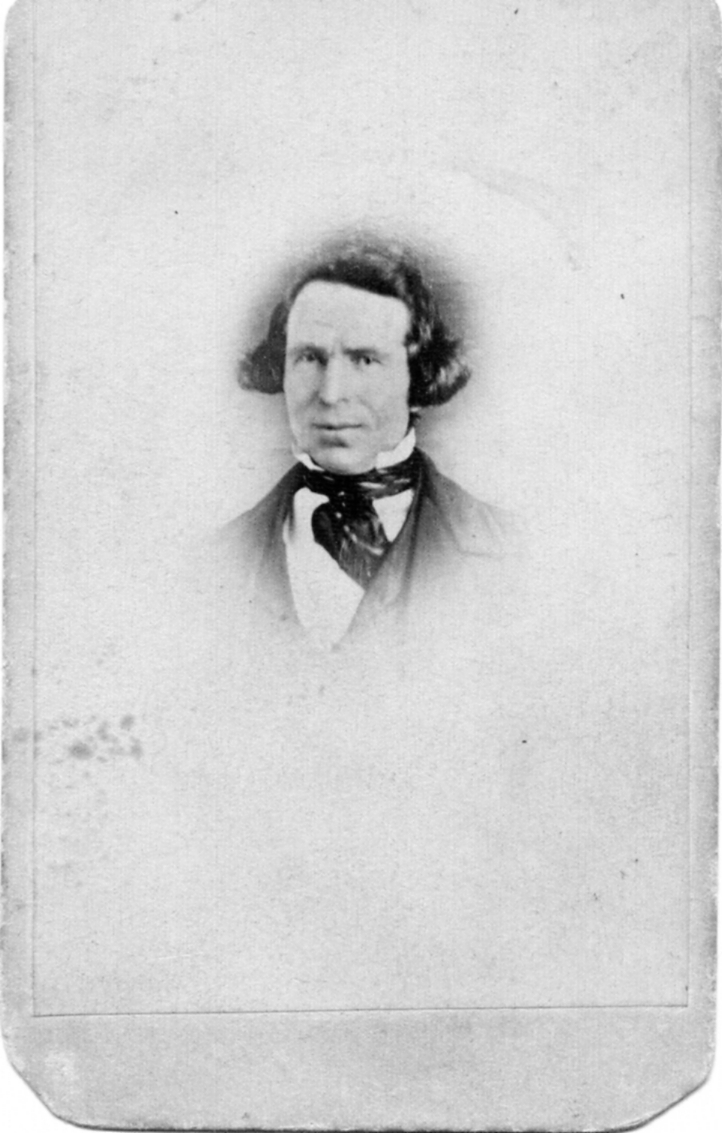
Let’s start with the photo of Cyrus that we’ve used on our previous Cyrus and Sarah posts. Here’s the front:
Here are a few quick odds and ends while I finish working on the last of our Cyrus Clark and Sarah Strickland Clark posts.
Burying the lede: Cyrus Clark edition
For the last week or so we’ve been looking at the lives of early Mequon and Wisconsin Territory settlers Cyrus Clark and Sarah (Strickland) Clark. If you missed those, you can catch up here, here, here, and here. And in one of those longer posts, I pretty much managed to “bury the lede,” of the breaking news of the week, namely: We found the missing documents that answer the question “who were Cyrus Clark’s parents, and was he related to the builder of the Clark House, Jonathan M. Clark?“
Clark and Strickland descendant Lynette Thompson contacted researchers from the New England Historic Genealogical Society via their site, americanancestors.org, and managed to locate the 1866 will and probate file for one Kellogg Clark of Sandisfield, Berkshire County, Massachusetts. He had been cited as a possible father for Cyrus Clark, but without supporting documents.
But his will and probate papers confirm that Kellogg Clark had a son named Cyrus Clark, and that in 1866 son Cyrus was in Wisconsin. Other information in the documents list siblings of Cyrus Clark, including a brother, Alexander Clark, who was previously known. We are now convinced that Kellogg Clark and wife Charity of Sandisfield, Berkshire County, Massachusetts were the parents of Mequon settler Cyrus Clark.
And, since every clue we have about Jonathan M. Clark indicates that his family lived in either Derby, Orleans County, Vermont or nearby Stanstead, Lower Canada (later Province of Quebec), I am quite convinced that Cyrus Clark is not (closely) related to Jonathan M. Clark. (For now, I will hedge my bets with that “closely” modifier—there are, after all, a whole lot of Clark families in New England and they moved around a lot in the 1800s and who can tell who is related to whom—but I don’t believe Cyrus and Jonathan are related, or knew each other before coming to Wisconsin.)
“Follow Blog Via Email” issues…
According to reliable reports, the “Follow Blog Via Email” widget in the right-hand column of this blog is not working properly. I think my old widget may not be 100% compatible with the current WordPress blogging software. I will look into that and see what I can do.
In the meanwhile, if you’d like to follow the blog, skip the widget and just send me a note via the CONTACT link in the top menu. I’ll be glad to issue an emailed “invitation” to follow the blog and then you will get an email each time new material appears here at Clark House Historian (typically each Monday, Wednesday and Friday morning).
A photo for Wednesday…
As a salute to Cyrus Clark’s roots in Berkshire County, Massachusetts, here’s a photo I took there a few years ago. It’s the Housatonic River near the old town of Stockbridge. Not too far from Cyrus Clark’s boyhood home in Sandisfield.
Photo by Reed Perkins, October, 2010. Click to open larger image in new window.
And by the way, “The Housatonic at Stockbridge“…
is also the title of the last movement of Three Places in New England, one of the masterworks of the great American composer Charles Ives (1874-1954). Standing on a small bridge over the river reminded me of the composer’s own description of the piece: … River mists, leaves in slight breeze river bed–all notes and phrases in upper accompaniment…should interweave in uneven way, riverside colors, leaves & sounds–not come down on main beat…”
Here’s a link to a video of a fine performance by the New England Conservatory’s Philharmonia orchestra, Hugh Wolff, conductor. Enjoy.
This is the second in what was originally planned to be a three-part1 series on early Mequon settlers Cyrus Clark and Sarah A. Strickland Clark. If you missed it, click here for part one.Also, I suggest you read this post to view maps that will prove useful in following today’s discussion.
The Jonathan Clark House Museum, and my work as Clark House Historian, is not just about Jonathan M. Clark, Mary Turck Clark and their family. The mission of the museum—and this blog—is to:
Collect, preserve and share the history of the Jonathan Clark House and the early settlers of Mequon and Thiensville.
So with that in mind, I like to explore the stories of the Clark’s friends and neighbors in order to develop a more comprehensive picture of early Washington/Ozaukee county and it’s settlers. This week—thanks to an unexpected contact from blog reader Lynette Thompson—we will be focusing on not one, but two of Mequon and old Washington/Ozaukee county’s earliest settlers, Sarah Allise Strickland and her husband, Cyrus Clark. Why them? Just look at what I got in my inbox:

 Clark House Historian