I’m chipping away at my sources, trying to carve out a coherent post or two.

Infrastructure Week Fortnight Month continues…
It’s been a busy few weeks here at the Historian’s (actual) house, and I’m (very) slowly transcribing handwritten documents and making maps to illustrate the work of Jonathan M. Clark and his fellow road supervisors as they mapped and built old Washington County’s first roads in early 1841. While you’re waiting for those posts, check out our previous installments in this series — County Government – Early Records and Monday: Map Day! — for some interesting background, maps, and first-hand records.
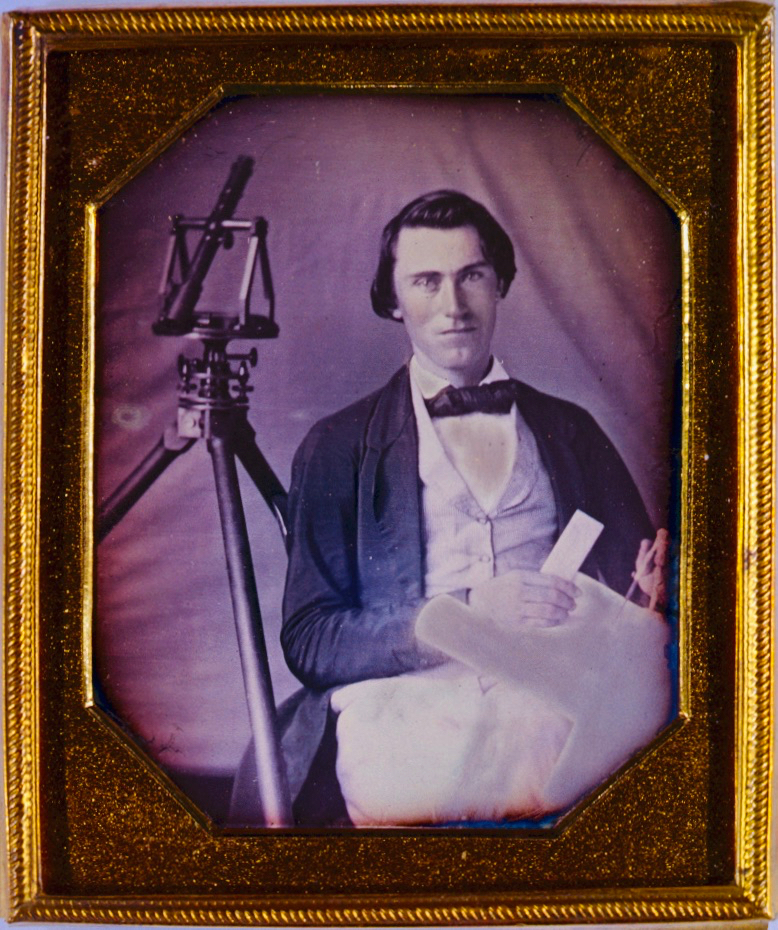
Jonathan Clark – surveyor?
What did Jonathan Clark know about surveying and road building? Probably quite a bit. Like most farmers—then and now—Jonathan would not have been successful without a good understanding of maps, distances, land boundaries and how to best use and navigate the fields, forests and wetlands of his property.
If you recall our earlier posts detailing JMC’s military service (starting with Fort Howard, October 1833 (part 1) and including Ouisconsin Territory, 1836), you’ll remember that his unit, the U.S. Army’s 5th infantry regiment, was responsible for laying out and cutting the new military road that would ultimately connect Ft. Howard in Green Bay, Ft. Winnebago near Portage, and Ft. Crawford at Prairie du Chien. Jonathan’s Co. K was involved in this work for the better part of his final two years of service (1835-1836). This assignment would give him hands-on experience in surveying, map-making, grubbing out roads and building serviceable bridges with the materials at hand. By the time he arrived in Mequon, in late 1839, it’s possible that Jonathan Clark was the most experienced road builder (and one of the better surveyors) in early Washington/Ozaukee county.
A surveyor and his tools…
UPDATED, April 20, 2021 to include another historic misspelling of “Mequon,” this one from the 1837 first official map of Wisconsin.
____________________________
Mequon is the home of the Jonathan M. Clark House. Mequon is a unique name, and its source, pronunciation, spelling—and, occasionally, location—are the source of a fair amount of confusion and error. So I thought I would gather a few pertinent facts about the name that might help readers avoid some of the pitfalls in Mequon research.
As a reminder:
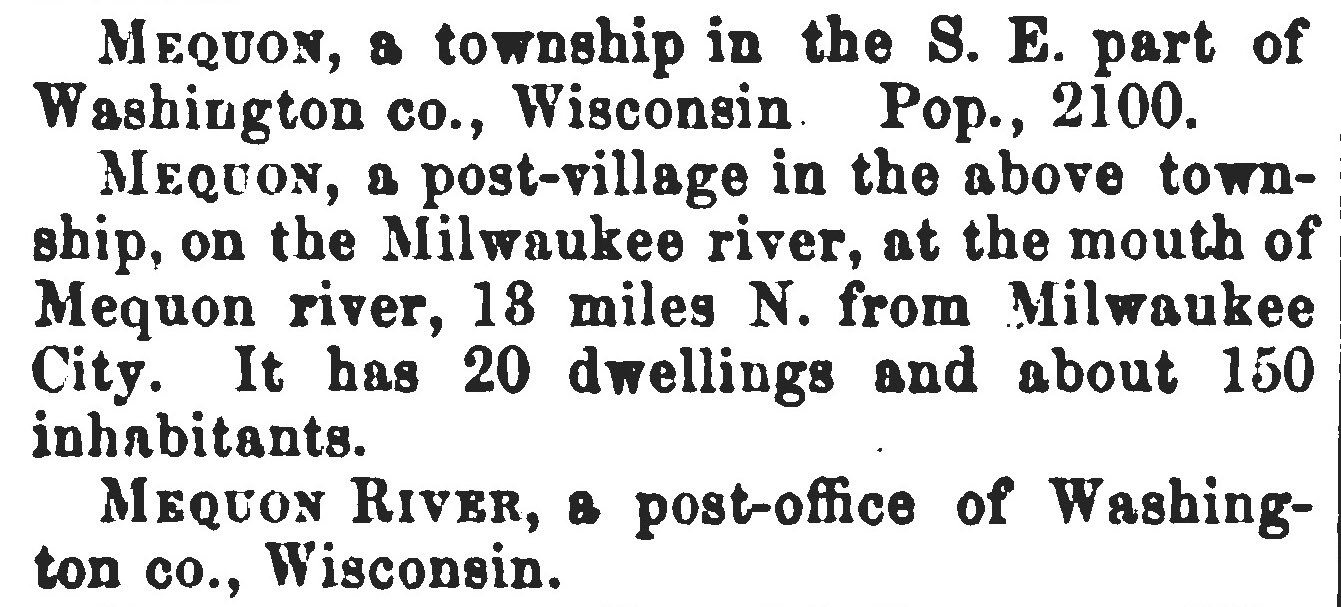
Baldwin, Thomas and J. Thomas, M.D., A New and Complete Gazetteer of the United States […], Philadelphia, 1854, p. 687. Via GoogleBooks.
That’s a pretty accurate, “just the facts,” description of Mequon in 1854. (Although it looks like Gazetteer editors Baldwin and Thomas didn’t get the news that on March 7, 1853, the east part of Washington county—including the Town of Mequon—had split from its parent county to form the new Ozaukee county. And the town vs. township distinction could be more precise, too.)
Continue readingToday’s map is another unique and wonderful map from the University of Wisconsin–Milwaukee, American Geographical Society Digital Map Collection. It is map of Washington and Ozaukee Counties from 1874, and it is packed with information and unique details.

Map of Washington and Ozaukee Counties, Wisconsin 1873-4 / drawn, compiled and published by G.V. Nash & M.G. Tucker ; engraved & printed by J. Knauber & Co. ; colored and mounted by E.M. Harney. University of Wisconsin-Milwaukee, American Geographical Society Digital Map Collection. Full copyright notice here, presented in this post as a public domain item and/or under fair use provisions of U.S. copyright law. Click map to go to the UWM collection and open larger image in new window.
Continue readingIt’s early April, and the growing season is not far off. For a farmer like Jonathan M. Clark, it’s a little early yet for plowing and sowing, but not too early to make plans and sharpen the tools. For a farmer’s wife, like Mary (Turck) Clark, it’s not too soon to think about the farm garden, its crops and layout.
I don’t know if Mary and Jonathan were regular readers of the popular and affordable farmers’ almanacs of their era; I wouldn’t be surprised if they were. There were many to chose from. Perhaps they had a copy of something like:

The Cultivator […], New Series, Vol. VII, Albany, 1850, title page. Click to open larger image in new window.
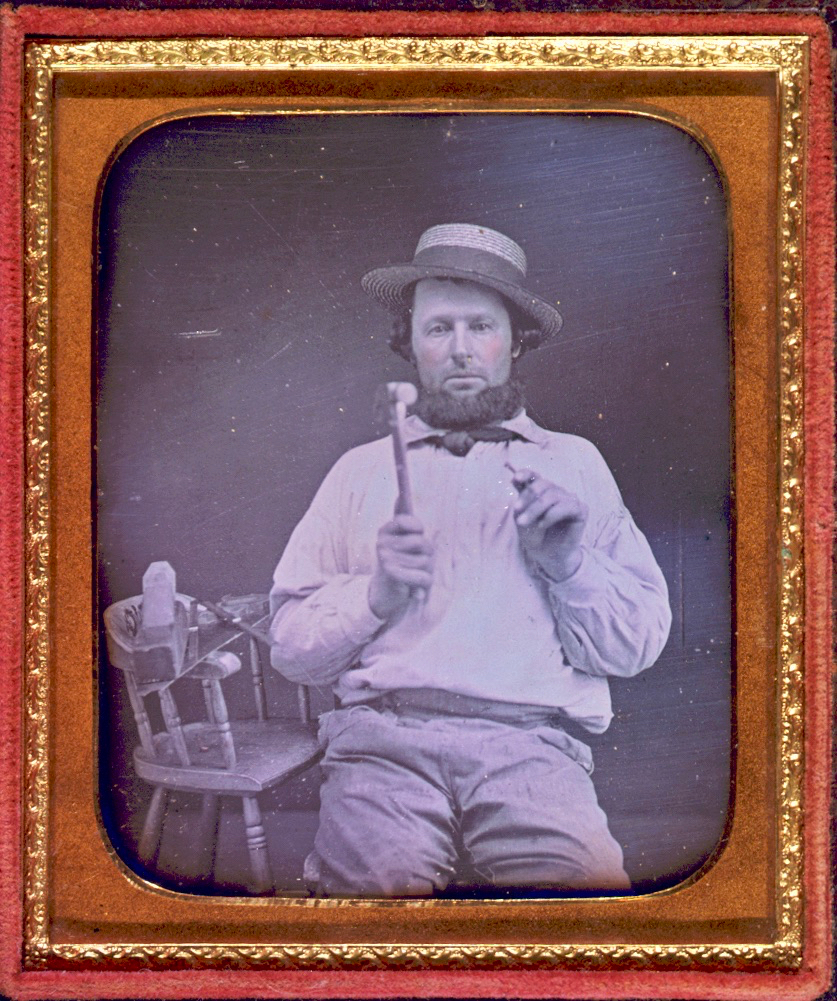
Continue readingAnother in our occasional series of Random Bits of History, illustrating life as experienced by the early Mequon settlers and their contemporaries. Today we examine a photograph that may—or may not—depict an early Mequon settler or their kin.
Is this a photo of young Sarah (Strickland) Clark?
Reader Eric Pearman is a descendant of early Mequon settlers Cyrus Clark and Sarah Strickland. For a while last year Clark House Historian spent some time tracing Cyrus and Sarah’s lives, and analyzing some old photographs of those Mequon pioneers here, here, here, here and here (and a few more places, too; just use the blog’s Search function and keyword “Cyrus” or “tintype”).
Eric recently sent me this, unidentified, photo that belonged to a Cyrus and Sarah Clark descendent, and wondered if it might be of a previously un-photographed member of the Cyrus Clark or Sarah Strickland families. Even if this is not a Cyrus Clark or Sarah Strickland family member, the photo has a unique feature that you may want to know about as you examine other old photos. Let’s take a look…

Spelling variations in old records

Durk, Peter [Turck], baptismal record, 1798, detail. “Peter” starts the left column, father “Jacob A. Durk” is at the top of the center column (source). Click to open larger image in new window.
In a previous post, reader Laura Rexroth asked: Why did they spell Peter Turck’s name incorrectly [i.e., Durk] when he was baptized? That’s a great question, and super relevant to successful historical and genealogical research. So let’s talk about the Turck family surname and, by extension, the whole issue of spelling in earlier times and documents.
There are two main issues to keep in mind:
• variations in spelling that existed at the time the source material was created, and
• subsequent misreadings, including incorrect transcription or indexing of sources

 Clark House Historian