The Clark Family in 1850 – part 4

Beyond Names, Dates & Birthplaces

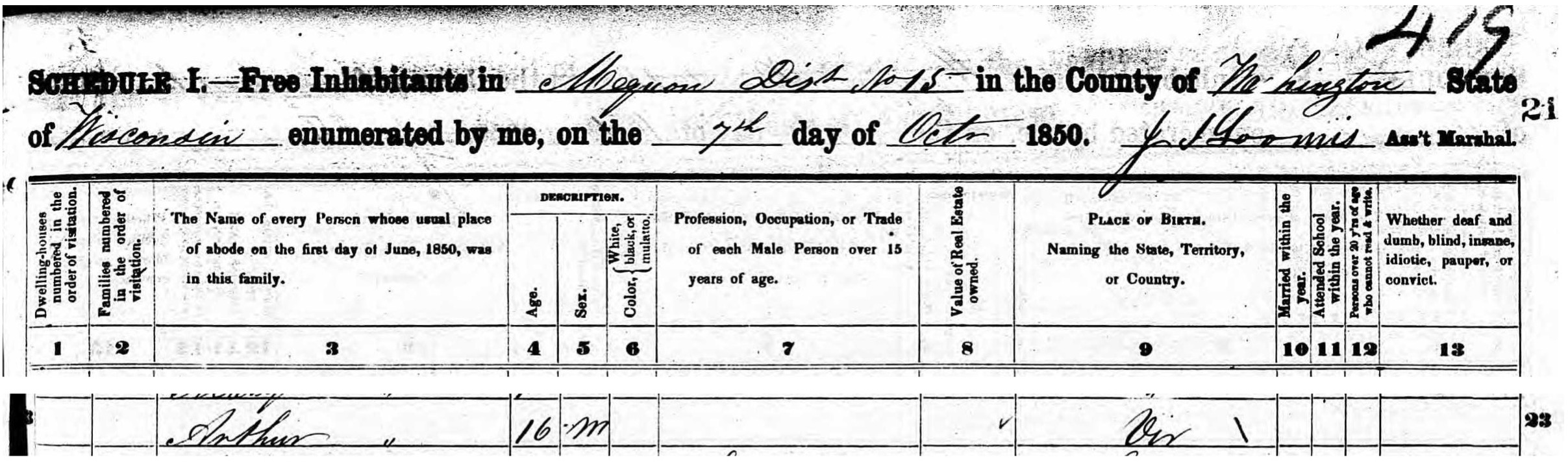
Previously—and, yes, it’s been a while—we looked at the Jonathan Clark family as enumerated on the population schedule of the 1850 U. S. Federal Census. If you missed those posts, here are the links for Part 1, Part 2 and Part 3. Take a look at those, and you’ll learn some key facts about the Clarks: the names and ages of each person in the household, and where each was born. That’s important information, but not all. In 1850, the census bureau wanted to know more, and if we look carefully we can discover some interesting things about the family:

Continue reading

Lesen Sie Kurrent?

“Lesen Sie Kurrent?” —Do you read Kurrent?—generated at
http://www.deutsche-handschrift.de/adsschreiben.php#schrifftfeld

Do you have ancestors from the German-speaking world? No? Then perhaps you have genealogy or local history interests in southeastern Wisconsin or other German-settled areas of the USA? Or you’ve bumped into handwritten census images, family correspondence, or other historical documents that seem to be almost written in “normal,” readable cursive, but some—or a lot—of the letters just don’t make sense? Would you like to be able to decipher these records? Then whether your name is Smith or Schmidt, you need to learn a bit about Kurrent, the standard handwriting style of the German-speaking world from around the seventeenth- until the early twentieth-century.

And to make things more confusing, writers of German didn’t always use the Kurrent script. Sometimes they employed “English cursive,” also known as “Latin script,” similar to some of the well-known American and English writing styles of the time, and it’s not unusual to see documents created in both the USA and “the old country” that employ a mix of Kurrent and English cursive styles in the same document.

Here’s a practical example. Take a look at the following list of names, recorded in elegant cursive on page 1 of the 1855 Wisconsin State Census for Mequon, Ozaukee County:

Continue reading

Think Like a Historian…

To all my blog readers, I hope this finds you well and staying safe at home.

I just received a message from Jonathan Clark House director Nina Look and I thought I’d share it with you:

Dear Friends-

As you might imagine, the Clark House is closed at this time, but we continue to think about the history of our early settlers and how important it is to share that history with our children. I prepared the attached guide with the help of JCH Education Coordinator Margaret Bussone and JCH Curator Fred Derr.

Feel free to pass it on to a young person who may want to “Think like a historian.”

Nina Look, Director

CLARK HOUSE Think Like a Historian image

Click this link to open the CLARK HOUSE Guide for Young Visitors

Continue reading

O!…Canada? History Mystery! No. 3

Jonathan M. Clark was born…where?

Perhaps this should really be the Number One Clark House History Mystery! — was Jonathan M. Clark born in the United States or not? All of our previous evidence indicates that Jonathan M. Clark was born in Vermont in 1811 or 1812, namely: 

• Jonathan’s army enlistment papers from September 19, 1833, state that he was “…born in Derby, in the State of Vermont.”

• His 1850 Federal Census population schedule declares he was born in “Vir,” which we are quite certain indicates the State of Vermont.

• In later years, JMC’s children would almost always declare on subsequent Federal Censuses that their father was born in Vermont. (There were a few exceptions; “Ohio” was given by one daughter almost a half-century after her father’s death. We’ll have more on those census responses in later posts.) For example, the second sentence of daughter Caroline Clark Woodward’s biography in American Women: Fifteen Hundred Biographies With Over 1,400 Portraits… (New York: Mast, Crowell & Kirkpatrick, 1897, page 799) reads: Her father, Jonathan M. Clark, was a Vermonter of English descent, who, born in 1812 , of Revolutionary parentage, inherited an intense American patriotism.

So it seems clear that Jonathan M. Clark was born in Vermont. If that’s the case why, on March 19, 1848, did JMC travel to the District Court of the United States in Milwaukee County, Wisconsin Territory and file this document?:

Continue reading

The Clark Family in 1850, part 3

Where y’all from? 

If you missed them, you might want to begin with Part 1 and Part 2 of our look at Jonathan and Mary Clark and their growing family on the 1850 federal decennial census. Those earlier posts focused in some detail on the names and ages of the various family members and how that information correlates with the manuscript Clark Family Record. In this post we’ll try and answer the question of where Jonathan, Mary, and the children were born, a simple question, right? Let’s start by taking another look at the census page: Continue reading

The Clark Family in 1850, part 2

A Closer Look at the 1850 Census: Ages and Dates

How well does the information on the 1850 census schedule agree with the Clark Family Record and other Clark family documents and known facts?

First, examine the census page header. It was enumerated by J. I. Loomis (a resident of Polk township, Washington county) and covered the “Free Inhabitants in Mequon Dist. No 15 in the County of Washington State of Wisconsin enumerated by me, on the 7th day of Oct. 1850.” Continue reading

The Clark Family in 1850, part 1

Looking at the 1850 Census: A Growing Family

Continuing our look at important sources for Clark family history, let’s return to the decennial U.S. federal census. If you missed it, be sure to read our earlier post on Jonathan, Mary, and ? on the 1840 Census. The 1850 census was the seventh United States federal —and first “all name”— decennial census; every free person—man, woman or child—living on June 1, 1850, was to be counted and named on a separate line on the census form. It was also the first federal census to ask for certain additional information, such as each individual’s place of birth and occupation. (Enslaved African-Americans were enumerated on a separate form and not by name, but by sex, age, and owner. Click here for more information on the 1850 and 1860 so-called Slave Schedules.)

Based on what we know from the Clark Family Record and other sources, as of the official enumeration day, June 1, 1850, if the census enumerator and his Clark family “informant” were both accurate in providing and recording the data, we should expect to find the following living family members listed on the 1850 census: parents Jonathan and Mary Clark and their children Caroline, Henry, Elizabeth, Persis, and new baby Teresa. Let’s look at the census page and see what the enumerator recorded: Continue reading

History Mystery! No. 2

The Clark Family Record: What is it? Who created it?

Welcome to our second installment of the Clark House Historian’s History Mystery! in which you, the reader, are invited to Help the Historian and solve one of the many persistent mysteries surrounding Jonathan M. Clark, his family, and related unknowns of local history. In a previous post, we got to Meet the Children of the Clark family. One of the sources for that post is an image that I received from Clark descendant Liz Hickman (thanks, Liz!) of what looks like a single page removed from an old family bible. The page lists birth dates for Jonathan M. Clark, Mary Turck Clark, and their children, and death dates for Jonathan and his only son, Henry. It’s a key document for Clark family research and yet there is much we don’t know about it.  History Mystery! No. 2 seeks to answer: What is the Clark “Family Record,” who created it, and how accurate is it?

Here’s a copy of the image from our files: Continue reading

Where are we?

CLARK, Jonathan house square crop  July,  2015

Jonathan Clark House, Mequon, Wisconsin, July, 2015. Photograph by Reed Perkins

Where are we? Well, if you’re looking at this handsome stone house in real life, you’re standing by the front door of the Jonathan Clark House Museum, looking northward. On a modern map you can find it at 13615 N. Cedarburg Road—on the intersection with Bonniwell Road—Mequon, Wisconsin. If you’d like to visit the museum, click here for more info.

But “Where are we?” is never a simple question when it comes to historic places, because the answer often changes over time. Along with “Where are we?” we need to ask “When are we?” The answer to “Where are we?” is surprisingly varied—and useful for further research—throughout the lives of Jonathan and Mary Clark.

Continue reading