Busy researching…

I’m in the middle researching and writing several multi-part Clark House Historian posts, so no essay today. How about a sunny photo of the Clark House parlour, instead?
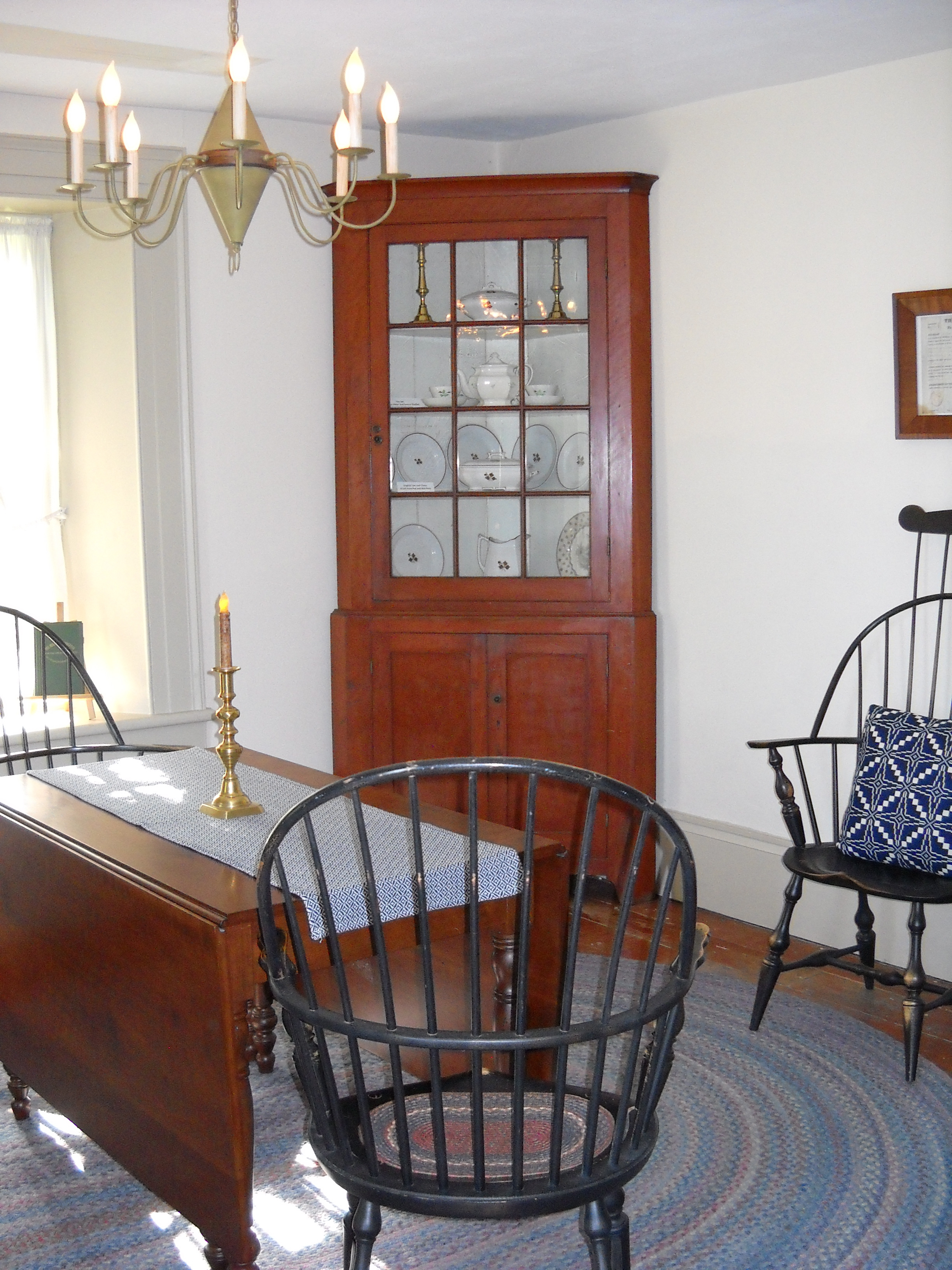
Photo by Reed Perkins, 2015. Click to open larger image in new window.

The cherry gate-leg drop leaf table dates from about 1850, and is used at Jonathan Clark House Museum board meetings. The bow backed Windsor chairs are based on 1840s originals. These reproductions date from around the 1940s or so.

The cherry corner cupboard is from about 1840. The finish and most of the glass are original. The tea leaf pattern china and twig pattern tea set in the parlour cupboards were donated by local antiques collectors. And the period reproduction light fixture was made in a small shop in Vermont.

Hope you have a fine day and a lovely weekend.

Back soon with surprises!
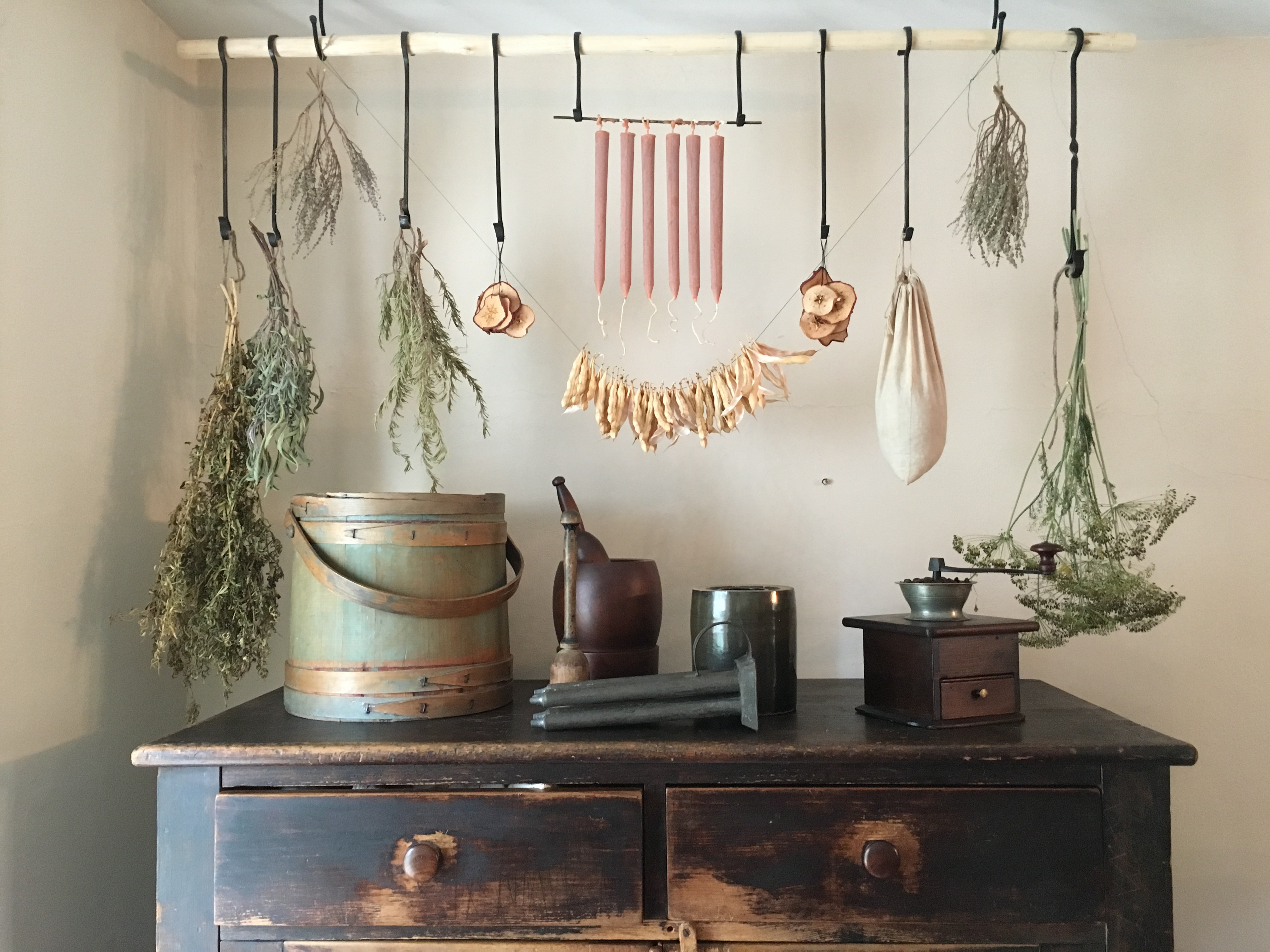
Summer in the Kitchen

I’m working on a number of longer posts, none of which are ready yet. So how about a Jonathan Clark House Museum photo instead?

Part of the kitchen at the Jonathan Clark House museum, Mequon, Wisconsin, July, 2016. Photo by Anna Perkins, used by permission. Click to open larger image in new window.

Mary Turck Clark—and the Clark children—probably spent part of each spring, summer and early fall day tending a sizable herb and vegetable garden. Herbs added flavor to food and were also valued for their medicinal properties. But herbs often grow faster than you can use them. What to do? Hang them up to dry, and enjoy their scents, flavors and healing qualities throughout the coming year.

In early July, if the weather had been good—lots of sun and perhaps an inch or two of rain each week—the Clark family might have enjoyed the first fresh green beans of the summer. That would have been a real treat after months and months of dried produce and the last, tired, potatoes, turnips, onions, carrots and such from the root-cellar1.

By the time autumn arrived, the last beans on the bush would have been big and kind of stringy. Not as tasty as the mid-summer beans, they would be hung up to dry so that the beans could be saved, ready for planting the next spring.

Continue reading

Census Records for the In-Between Years: 1842

Don’t Forget the (Free!) Territorial and State Censuses

Although they are not as informative as the decennial federal censuses, Wisconsin’s territorial and state census returns can offer useful information about the growth and development of places—such as Mequon—and can add to what we know about a family—like the Clarks—and their neighbors at various times between the once-a-decade federal census population schedules. For a nice explanation and overview of federal, territorial and state census history in Wisconsin, please go to the Wisconsin census FamilySearch.org wiki page. This is an invaluable first stop for locating these records. Be sure to peruse the lists of which records have been preserved for which counties; not all census records have survived. And the Wisconsin Historical Society has a similar page of useful Census Research Tips

The FamilySearch.org Wiki page is kept pretty current, but there have been a few changes that may not be reflected there yet. In one positive development (especially for the safer-at-home researcher), it appears that all of the microfilmed state and territorial censuses are now viewable—at no cost—via the FamilySearch.org portal. (Note that you will have to use a free account to be able to view the digitized images online. So create an account if you don’t already have one, and login before you search the indexes and click the links for the multitude of digitized microfilms.)

Here are some links and tips to speed your search. For the FamilySearch.org index, click here: United States, Wisconsin online census collections. You should land on a page that looks like this:

Continue reading

The “E” is silent – as in “Clarke”

A “New” Jonathan M. Clark Document, a New Line of Inquiry, and a Friendly Reminder…

Take a look at the following name as written by a professional U.S. land office clerk in three different places on land patent no. 19687, from 1848:

Patent No. 19687, Jonathan M. Clark(e)? #1
Patent No. 19687, Jonathan M. Clark(e)? #2
Patent No. 19687, Jonathan M. Clark(e)? #3

What to you think? Jonathan M. Clark or Clarke? Is that a silent “e” at the end of “Clark,” or just a looping flourish? Whoever indexed this document at the Bureau of Land Management’s General Land Office website1 thought it was Clarke. Is it a big deal? No. Given that the GLO has been digitizing and indexing hundreds of thousands of pages of maps, survey notes and patent documents for the last decade or two, we can’t expect that the indexers can cross-reference each name on each patent and check for consistent spelling. And besides, 19th-century spelling is notoriously capricious anyway.

On the other hand, maybe the indexer could have looked at the end of the document and compared the “K” in “Clark” to the “K” at the end of this signature, representing our eleventh President:

Continue reading

Think Like a Historian…

To all my blog readers, I hope this finds you well and staying safe at home.

I just received a message from Jonathan Clark House director Nina Look and I thought I’d share it with you:

Dear Friends-

As you might imagine, the Clark House is closed at this time, but we continue to think about the history of our early settlers and how important it is to share that history with our children. I prepared the attached guide with the help of JCH Education Coordinator Margaret Bussone and JCH Curator Fred Derr.

Feel free to pass it on to a young person who may want to “Think like a historian.”

Nina Look, Director

CLARK HOUSE Think Like a Historian image

Click this link to open the CLARK HOUSE Guide for Young Visitors

Continue reading

O!…Canada? History Mystery! No. 3

Jonathan M. Clark was born…where?

Perhaps this should really be the Number One Clark House History Mystery! — was Jonathan M. Clark born in the United States or not? All of our previous evidence indicates that Jonathan M. Clark was born in Vermont in 1811 or 1812, namely: 

• Jonathan’s army enlistment papers from September 19, 1833, state that he was “…born in Derby, in the State of Vermont.”

• His 1850 Federal Census population schedule declares he was born in “Vir,” which we are quite certain indicates the State of Vermont.

• In later years, JMC’s children would almost always declare on subsequent Federal Censuses that their father was born in Vermont. (There were a few exceptions; “Ohio” was given by one daughter almost a half-century after her father’s death. We’ll have more on those census responses in later posts.) For example, the second sentence of daughter Caroline Clark Woodward’s biography in American Women: Fifteen Hundred Biographies With Over 1,400 Portraits… (New York: Mast, Crowell & Kirkpatrick, 1897, page 799) reads: Her father, Jonathan M. Clark, was a Vermonter of English descent, who, born in 1812 , of Revolutionary parentage, inherited an intense American patriotism.

So it seems clear that Jonathan M. Clark was born in Vermont. If that’s the case why, on March 19, 1848, did JMC travel to the District Court of the United States in Milwaukee County, Wisconsin Territory and file this document?:

Continue reading

History Mystery! No. 2

The Clark Family Record: What is it? Who created it?

Welcome to our second installment of the Clark House Historian’s History Mystery! in which you, the reader, are invited to Help the Historian and solve one of the many persistent mysteries surrounding Jonathan M. Clark, his family, and related unknowns of local history. In a previous post, we got to Meet the Children of the Clark family. One of the sources for that post is an image that I received from Clark descendant Liz Hickman (thanks, Liz!) of what looks like a single page removed from an old family bible. The page lists birth dates for Jonathan M. Clark, Mary Turck Clark, and their children, and death dates for Jonathan and his only son, Henry. It’s a key document for Clark family research and yet there is much we don’t know about it.  History Mystery! No. 2 seeks to answer: What is the Clark “Family Record,” who created it, and how accurate is it?

Here’s a copy of the image from our files: Continue reading

History Mystery! No. 1 (of many)

Jonathan & Mary & ? on the 1840 Census

Introducing a new feature on the blog: History Mystery! In which you, the reader, are invited to Help the Historian solve one of the many persistent mysteries surrounding Jonathan M. Clark, his family, and related bits of local history.  History Mystery! No. 1 seeks to answer the question: Who was that older guy living with newlyweds Jonathan and Mary Clark in June, 1840? Here are the clues: Continue reading

