In our previous post, I teased a first look at the Town of Milwaukee’s first concert organization, the Milwaukie (sic) Beethoven Society. The first mention of the society that I can locate is this announcement in the February 8, 1843, edition of the local newspaper:
Milwaukee Weekly Sentinel February 8, 1843, page 2. Click to open larger image in new window.
This was an ambitious undertaking in a collection of villages that would not unite and become the city of Milwaukee until another three years had passed. In fact, when the Wisconsin territorial census was enumerated in 1842, the combined population of the “Town of Milwaukee”—comprising the West Ward, East Ward, Walker’s Point and adjacent lands—came to a mere 2,730 men, women and children. How was such a musical society—and concert—possible only one year later?
Today is the 250th anniversary of the birth of composer Ludwig van Beethoven (1770-1827). I’m going to celebrate…and continue work on an upcoming post about Milwaukee’s first musical organization, the Milwaukee Beethoven Society!
Milwaukee Weekly Sentinel February 8, 1843, page 2. Click to open larger image in new window.
Life for early Milwaukee-area settlers was frequently difficult, but often less primitive than we imagine. Among other attributes, Milwaukee has long been a musical place. As early as 1843, the short-lived Milwaukee Beethoven Society brought the first organized concert performances to the neighboring towns that—three years later—would join to become the City of Milwaukee.
1843 was also the year that so many early Mequon immigrants, including Jonathan M. Clark, journeyed to the Milwaukee land office and court house to register and pay for the land they had settled, and obtain their federal land patents. These early Mequon residents knew Milwaukee; it was their center for law, business, shopping, news, and meeting out-of-town visitors. Did Jonathan and Mary Clark make a trip to Milwaukee to hear the Beethoven Society perform? It’s fun to speculate, but we really don’t know.
I’m collecting information on the Beethoven Society’s organizers and their first (and only?) two concerts. In my next post, I aim to gather that information together along with links to online performances of most of the pieces from the first concert so that you can enjoy something like the experience of that debut performance from the comfort of your computer, tablet or phone.
Meanwhile, today is a big day for music lovers. Grab a celebratory beverage (and piece of cake, if you have one1) and enjoy this stirring performance of …
December’s here, and I’m starting to get into the holiday spirit. That means lots of—mostly pleasant—chores and tasks at my home this week. So, no blog essay Wednesday or today.
But how about a holiday view of the Clark House, just to bring a little light to our wintry evenings?
November 28, 2020, is the 208th anniversary of the birth of Jonathan M. Clark. To celebrate, I’m reposting a revised, expanded and annotated version of one of my first Clark House Historian posts. Since this was first published, on April 20, 2016, we have learned much more about the lives of Jonathan Clark, Mary Turck Clark, their family and their neighbors. Please check out the footnotes and click on the links for some of this newer, more accurate, information.
Happy Birthday, Jonathan! (and thanks to Nina Look for the timely reminder).
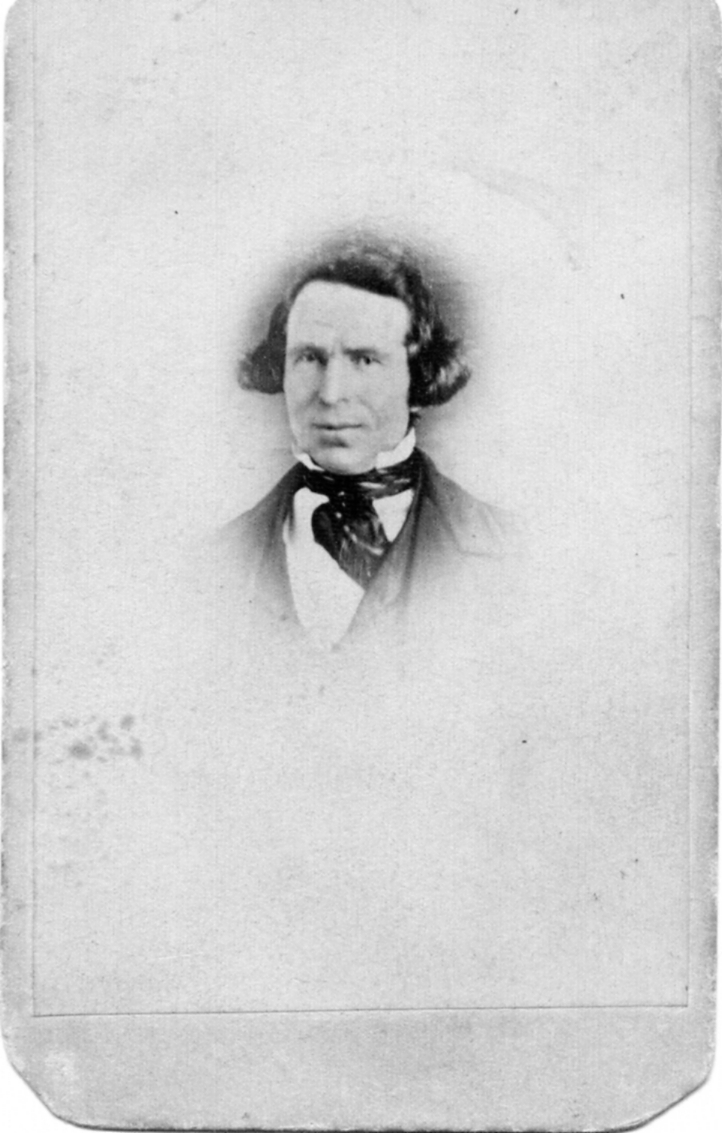
JMC: Man of Mystery
Jonathan M. Clark. Photograph courtesy Liz Hickman.
While we’re all waiting for this year’s votes to be counted, here’s a revised and updated repeat of a post that first appeared here on November 8, 2016.
Really early returns, from Mequon’s—and Washington County’s— first election, 1840.
In an earlier post, I outlined some of the key moments in the settlement and changing political boundaries of early Washington/Ozaukee county. Originally attached to Milwaukee County for all civil and judicial matters, old Washington County got its civil independence by act of the Territorial Legislature on February 19, 1840. And on “the second Monday of October next,” i.e., October 12, 1840, the first election to chose county officers was held at the Mequon home of Taylor Heavilon.1, 2
Well, the big day is just a week away. Here at Clark House Historian I try and remain officially non-partisan. But as a researcher and writer, and as an American with long, deep, roots in this country, I have a passionate interest in our nation and its history, and a life-long desire to see us live up to our highest ideals and aspirations. (Of course, human nature being what it is, we have not always lived up to those ideals.)
So with the election approaching, today’s post takes a look at the political leanings of early Washington County and—after its establishment in 1853—Ozaukee County, with an emphasis on presidential elections from 1848 to 1880. Our main source today is the invaluable History of Washington and Ozaukee counties, Wisconsin […], published in Chicago in 1881. Let’s begin with some of the earliest results, following statehood in early 1848:
As I mentioned in our previous post, Monday: Map Day!, we still have some essential mysteries to solve in the JMC timeline, the most important of which are: who were JMC’s parents and where was he born and raised? As it’s been a while since we last looked at this, I thought it might be useful to repost our original O!…Canada? History Mystery! No. 3, in which I collected and organized images, transcriptions, and links to the various documents that indicate Jonathan M. Clark’s (two!) “official” birth locations: either Derby, Orleans Co., Vermont or Stanstead Co., Lower Canada [now Province of Quebec].
Smith, Jones… Clark
One of the nicer assignments a genealogist or historian can receive is to trace the history and family of someone with a unique or distinctive surname. It is so much easier to trace families with surnames like Turck, Strickland, Rix or Clow, even if there are common variant or erroneous spellings like Turk, Stickland, Ricks and Clough/Claw/Klauw. But our man Jonathan, he who built the fine stone home in Mequon in 1848, carries one of the most ubiquitous surnames in New England and English-speaking Canada: Clark.
Over the past seven years or so, researchers including Nina Look, Liz Hickman, I—and others—have been trying to find the Jonathan M. Clark “needle” in the massive New England and Lower Canada “haystack” of Clark families. I think it’s time to finally collate our results, organize and set aside the “wrong” Clark families from the search, and see if we can discover Jonathan M. Clark’s roots.
This “sorting of the Clarks” may take quite a few posts.1 We will look at many sources, many family trees, and assorted maps and books to try and find Jonathan’s family. Along the way we’ll have diversions to other topics from time to time, I’m sure. But now, let’s get things started by taking another look2 at what we currently know about Jonathan M. Clark’s birth and family:
This is the second in what was originally planned to be a three-part1 series on early Mequon settlers Cyrus Clark and Sarah A. Strickland Clark. If you missed it, click here for part one.Also, I suggest you read this post to view maps that will prove useful in following today’s discussion.
The Jonathan Clark House Museum, and my work as Clark House Historian, is not just about Jonathan M. Clark, Mary Turck Clark and their family. The mission of the museum—and this blog—is to:
Collect, preserve and share the history of the Jonathan Clark House and the early settlers of Mequon and Thiensville.
So with that in mind, I like to explore the stories of the Clark’s friends and neighbors in order to develop a more comprehensive picture of early Washington/Ozaukee county and it’s settlers. This week—thanks to an unexpected contact from blog reader Lynette Thompson—we will be focusing on not one, but two of Mequon and old Washington/Ozaukee county’s earliest settlers, Sarah Allise Strickland and her husband, Cyrus Clark. Why them? Just look at what I got in my inbox:
This week we take a break from our usual focus on the extended Jonathan M. and Mary (Turck) Clark family and begin a week of posts about two remarkable, original Mequon settlers and Clark House neighbors: Sarah Allise Strickland (1823-1891) and her husband, Cyrus Clark (1815-1905).
Sarah A. Strickland was born and raised in Nova Scotia, the eldest child of Daniel and Matilda Strickland. Her family was one of the original white settler families in the area; they were enumerated in Milwaukee County on Wisconsin’s first territorial census in 1836.1
Cyrus Clark was born in western Massachusetts and was in Mequon by about 1839. He married Sarah Strickland in Grafton, Washington (later Ozaukee) County, on March 1, 1841. They lived almost forty years in Wisconsin. First in Mequon and Cedarburg, Washington/Ozaukee) County, and then divided their time between their farm in Moscow, Iowa County, and homes of one or more adult children in Oshkosh, Winnebago County. So how—and why—did they end up in South Dakota at the end of their days?
It’s an interesting story, and one that illustrates a characteristic type of pioneer experience: the continued drive to push westward, on to new frontiers and new challenges. It may seem cliché to us, but it was a real, lived experience for many of Cyrus and Sarah’s generation. This week’s posts will look at a number of key moments in their long lives, especially the decades they spent in Wisconsin. And we have some unique and new sources to share, too.
Beginning at the end…
Click to open larger image in new window.
Gravestones of Cyrus Clark and Sarah A. (Strickland) Clark, Graceland Cemetery, Madison, South Dakota. Photo by Steve Van Slyke, used by permission.
We begin the story of Cyrus and Sarah Clark at the end, in Lake County, South Dakota, their final resting place. And not one, but two maps today, all of which take us far from Mequon and the Jonathan M. Clark house.



 Clark House Historian