It’s our Blog Birthday!

Clark House Historian is 5 years old today!!

Jonathan Clark House, Mequon, Wisconsin, July, 2015. Photograph by Reed Perkins. Click to open larger image in new window.

Our very first post, announcing the new blog, went live on March 29, 2016. The information in that post has now been revised and expanded into the About and Disclaimers sections of the blog.

The first posts with historical content followed in April, 2016. I still link to one of those posts—Where are we?—when I need to explain the evolving place names and political geography of the Mequon area.

Since the first Clark House Historian posts in 2016 we have learned a lot more about the Clark house, its occupants and their families, friends and neighbors. If you’re new to the blog—or the Jonathan M. Clark House—here are some good places to begin reading (and be sure to click the links in each article):

Continue reading

Peter Turck and Irish Relief

Today is St. Patrick’s Day, originally the religious observance of the feast day of the principal patron saint of Eire.1 In honor of the day, let’s take a look at a few aspects of Irish life in early southeast Wisconsin and the involvement of Mary (Turck) Clark’s father Peter Turck in a civic effort to relieve Irish suffering during the Great Famine.

Irish immigrants in early Wisconsin

The first white visitors to Wisconsin were seventeenth-century French-Canadian explorers, priests and fur trappers, at home along Wisconsin’s lakes and rivers. They were followed by a smattering of British and French settlers in the mid- and later-eighteenth century. Cornish lead miners arrived in the southwest corner of the territory around the turn of the nineteenth-century. And in the mid-1830s, when the federal government officially “opened” the southeast corner of Wisconsin for settlement, there was a large influx of New Englanders and New Yorkers.

There were also a substantial number immigrants from across the sea among the Wisconsin pioneers of the 1830s and ’40s, including settlers from Upper and Lower Canada, Nova Scotia, Great Britain, the Netherlands, the German-speaking lands, and Ireland. By the time of the 1850 federal decennial census, Irish men, women, and children comprised the second-largest group of foreign-born immigrants in the state, surpassed in number only by immigrants from the German-speaking lands.

Continue reading

RBOH – Walter Bonniwell’s first marriage

UPDATED: February 25, 2021. See notes, below, for details.

Introducing RBOH – Random Bits of History!

I have so much information to organize and share with fellow Clark House researchers and blog readers, and it doesn’t always fit into a one of our longer, regular blog posts. So today we begin an occasional series where I publish random bits and pieces of Mequon related history. With RBOH, I plan to write shorter posts that present new information or unknown documents, and try to solve mysteries or confirm existing, but undocumented, facts. Let me know if you have any questions, comments, suggestions or requests.

Walter Bonniwell’s first marriage documented!

Regular readers know that I often refer to George B. Bonniwell’s excellent history of Mequon’s early and influential pioneer family—and Clark House neighbors, friends, and in-laws—the Bonniwells. Like any work of history or genealogy, George’s book, The Bonniwells: 1000 Years, printed in 1999, has a few omissions and blank spots. But research has not stopped since his book was printed, and today we present three documents that give information about one of those missing bits of history, the marriage of Walter Bonniwell (1824-1884) and his first wife, Eleanor “Ellen” Bailey (c. 1827 to ????). In the process we’ll run into another key early settler—and man of many trades—Jonathan M. Clark’s father-in-law, Peter Turck.

Marriage License – January 18, 1845

The couple’s handwritten marriage license is image number 1211 in the Milwaukee Public Library’s collection of Milwaukee County Marriage Certificates. It reads:

Territory of Wisconsin }
Washington County }
License is hereby given to

Walter Bonniwell and Ellen
Bailey to Unite in Marriage according
to Law
Given under my hand this 18th day of January. A.D. 1845
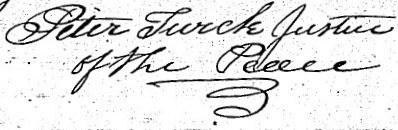
{SL} Peter Turck Justice of the Peace

Source
Continue reading

Turck, Turk…Durk?

Spelling variations in old records

Durk, Peter [Turck], baptismal record, 1798, detail. “Peter” starts the left column, father “Jacob A. Durk” is at the top of the center column (source). Click to open larger image in new window.

In a previous post, reader Laura Rexroth asked: Why did they spell Peter Turck’s name incorrectly [i.e., Durk] when he was baptized? That’s a great question, and super relevant to successful historical and genealogical research. So let’s talk about the Turck family surname and, by extension, the whole issue of spelling in earlier times and documents.

There are two main issues to keep in mind:
• variations in spelling that existed at the time the source material was created, and
• subsequent misreadings, including incorrect transcription or indexing of sources

Continue reading

Mary Turck Clark—updated

The original version of this post was the second-ever post on Clark House Historian. It represented what we knew at the time about Mary Turck, the daughter of Peter Turck and Rachael Gay, wife of Jonathan M. Clark, and mother of the eight Clark family children. The original April, 2016, post was pretty accurate, but we have learned a lot more about Mary and her Turck and Clark families in the meantime. So here is a revised version of that post with errors corrected and ambiguities clarified—where possible.

Please note that there are many more facts about Mary and her Clark and Turck families that I’ve written about in the past almost-5 years that are not linked to in this post. If you are looking for more information about Mary, I highly recommend using the blog’s SEARCH function and our new INDEX. And if you still can’t find the info you want, please ask me! Just use the Leave a Reply box, below, or the CONTACT link, above.

Mary Turck Clark: Mequon Pioneer

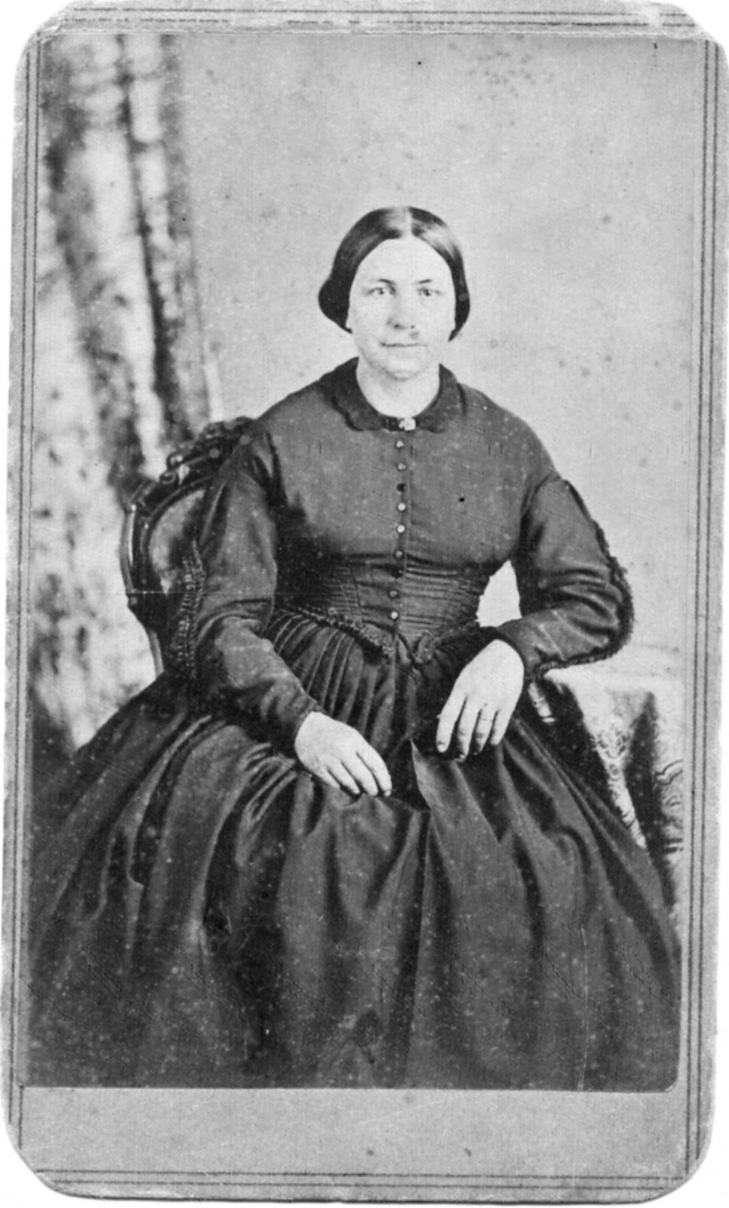
CLARK, Mary TURCK portrait

Mary Turck Clark. Photograph courtesy Liz Hickman. Click to open larger image in new window.

Continue reading

When was Mary Turck born?

Just when you think you know the answer…

A few days ago, Clark House museum director Nina Look asked me a simple question: when, exactly, was Mary Turck Clark born? So I looked in my database and I came up with…two answers: Mary Turck Clark was born on either May 4th, 1820 or May 3, 1821. So I reviewed my dates and sources, and today’s post is about what I (re-)discovered, and what I still have to investigate.

Haven’t we been over this before?

Why, yes, we have. Here are links to earlier posts on essential sources of Mary Turck Clark birth date and birth year information, starting with my second Clark House Historian post, this now-outdated post about Mary from 2016. Other, more recent, posts have gone into detail examining Mary, her family, and their likely birth dates as found on the U.S. federal decennial censuses:

I’ve not yet blogged about Mary’s 1870 or 1880 federal censuses—both enumerated in Milwaukee—but I’ve seen them and used them in my research. More on these in a moment.

Continue reading

Hail, Smiling morn!

A spot of Spofforth to ring in the New Year…

Happy New Year to all, and best wishes that 2021 will be an improvement on the past year. I’m almost done with my research on the second half of the 1843 concert by the Milwaukie Beethoven Society. (If you missed our earlier posts on that concert, links are here and here.) But it’s New Year’s Day, and I’m not quite done writing about “Part Second.” So let’s have another festive musical selection, this one drawn from that second part of the Beethoven Society’s premiere concert:

Milwaukee Weekly Sentinel March 15 1843, page 2. Click to open larger image in new window.

We’ll start the year with “Hail Smiling morn” by the English composer Reginald Spofforth (1769-1827). Spofforth was a man of many talents, but was particularly known for his glees. A glee is a kind of convivial part-song, typically for three or more voices and usually—but not always—sung without accompaniment. I’ll have more to say about this particular composer and piece later, but for now, it’s well enough to know that “Hail Smiling morn” is—according to musicologist Nicholas Temperly—”possibly the most popular glee in the entire repertory,” and that’s saying something!

“Hail Smiling morn” remains a popular pub song in parts of England and—as you’ll soon see—in many other venues around the world, both secular and sacred. “Hail Smiling morn” is frequently sung by church choirs as a Christmas or Easter carol. I think it works wonderfully for New Year’s Day, too. Below are three spirited modern performances of the piece. Just click the image to open a new YouTube window for each video. (The piece is only about 3 minutes long; enjoy all three performances!)

The first video is from a Sunday pub sing at The Royal, in Dungworth—near Sheffield—England. In many ways this is the modern equivalent of the friendly and well-lubricated singing at the glee and catch clubs of 18th-century England:

Click image or this YouTube link to open video in new window. Photo: screenshot of performance.

Continue reading

Haydn’s “The Creation”

Today’s post was originally intended to complete our coverage of the Milwaukie Beethoven Society’s first performance, on March 23, 1843. But I got caught up unscrambling a mixup I made on my post about the first part of that concert, and got behind in new research and writing, so that post is not yet ready. I expect to finish my look at the Beethoven Society concert this coming Wednesday. Sorry for the delay.

Until then, how about listening to some wonderful, joyous music, to drive away the gloom and darkness of Winter, 2020?

Continue reading

Monday Musicale!

The Beethoven Society, part 2

UPDATED, December 27, 2020: I managed to mix together my notes on the two works by Haydn—adapted by William Gardiner as “his” pasticcio oratorio “Judah”—that appeared on this first concert of the Milwaukie Beethoven Society. I have updated this post to correct the information and links about piece no. 2, from “Part First” of the performance, “Now elevate the sign of Judah.” The information about the chorus “Lo he cometh”—the 8th item on “Part Second”—has been moved to its correct place in our upcoming post about the second part of the concert, scheduled for Monday, December 28, 2020. Sorry for the confusion. —R.P.

In Friday’s post we introduced what is commonly believed to be Milwaukee’s first concert society, the Milwaukie Beethoven Society. If you missed it, please take a moment to read that post for background on the group and its place in early Milwaukee’s cultural life. They gave their first performance on Thursday, March 23rd, 1843, at the Milwaukee Court House. The advertised program was:

Milwaukee Weekly Sentinel March 15 1843, page 2. Click to open larger image in new window.

The program for the evening was typical for the era, featuring solo songs (“song,” “air,” “ballad”), vocal duets, trios and quartets, and choruses for the full ensemble. (It’s also possible that the duets, trios and quartets may have been sung one-on-a-part, or with the full chorus divided into two, three or four parts to cover the “solo” lines.) On this initial performance, the Beethoven Society did not play any strictly orchestral works.  This suggests that the the newly-formed ensemble may have understood itself to be more of an “oratorio society”—focused on vocal and choral repertoire with instrumental accompaniment—rather than a “symphony orchestra” with an affiliated chorus.

Oratorio Societies

Even as early as 1843, it’s not surprising that the citizens of Milwaukee could form a performing ensemble of some 35 singers and instrumentalists. Oratorio societies were very popular throughout 19th- and early-20th century America for aesthetic and practical reasons. From a practical point of view—and my own more recent experience—it was probably much easier to assemble a reasonably capable group of men and women to form a decent mixed-voice, SATB, chorus. As we discussed last week, many 19th-century Americans were taught the rudiments of music and singing in school, in church, and at home. In the 19th-century, singing in harmony was a common part of worship, education, and home life.  And you don’t need to invest in expensive instruments and years of regular lessons to become a contributing member of a good amateur chorus. Then as now, the talent pool for a good community chorus is usually deeper than for a full amateur orchestra.

Artistically, choral repertoire fulfilled a need for individual and community music-making and aesthetic and spiritual uplift. In today’s post you’ll see that many of the works on the concert—whether originally sacred or secular—were adapted from their original texts and purposes and fitted out with new, English language, Bible-based or liturgical texts. And if not sacred, the texts of the other pieces—with one or two exceptions—tended to be either somewhat sentimental or deeply maudlin. (It was the Victorian era, after all.)

The orchestra

Continue reading