CHH news and updates: August 28, 2024

I know it’s been a while since my last post, but I’ve been busy! Jonathan Clark House executive director Nina Look and I just finished the latest JCH newsletter, and there’s a lot of Clark House history coming your way this fall, both here on the blog, and “live and in person.” In particular, I’m currently racing to finish not one, but two, illustrated presentations that I’ll be giving in September.

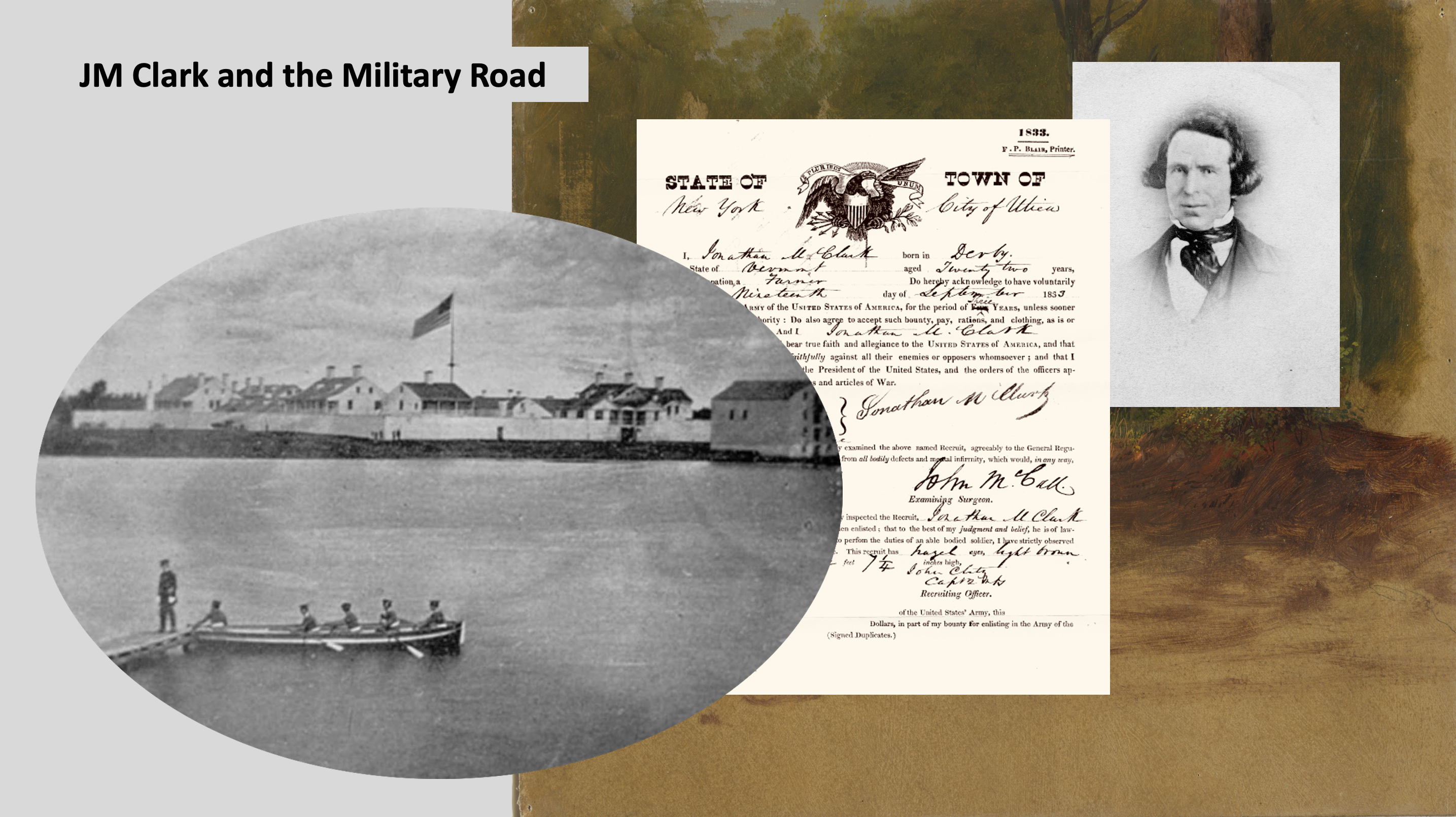
JMC, the Old Military Road, and the DAR

I’ve been asked to speak at the Fall Workshop of the Wisconsin Society, Daughters of the American Revolution. My topic will be “Building the Military Road, Wisconsin Territory’s First Federal Road.” I’ll be incorporating much of the 1830s and ’40s army and road-building information that I’ve blogged about here at CHH, as well as new primary source materials and contemporary illustrations.

The presentation will take place after dinner, Friday, September 13, at the WSDAR Fall Workshop in Oshkosh. The event is limited to registered DAR members and their guests. My thanks to Wisconsin State Regent Sandra Snow and the members of the WSDAR for their kind invitation to speak.

But wait…there’s more!

Continue reading

Not our Jonathan: other “J. M. Clarks” in 1830s & ’40s Wisconsin (part 1)

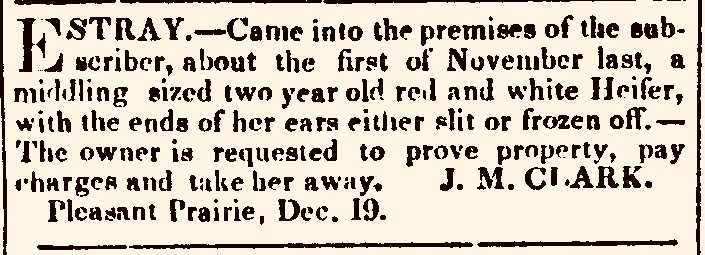
“Estray. […] J. M. Clark” advertisement, Southport [later Kenosha] Telegraph, Dec. 26, 1843, page 4

Hey! How did Mequon’s Jonathan M. Clark end up with a stray red and white heifer on his farm in…Pleasant Prairie, the most southeasterly township in all of Wisconsin, some 56 miles south of the Jonathan Clark House? The short answer is: he didn’t. The man that placed this “stray cow” advertisement in the December 16, 1843, issue of the Southport (later Kenosha) Telegraph was is not “our” J. M. Clark.

So many J. M. Clarks

Throughout the nineteenth century, many men seem to have been referred to, at least in print, by the initial letters of their first and middle names. The builder of Mequon’s Jonathan Clark House was no exception. Many of the documents made during his lifetime refer to him as “J. M. Clark,” and he often signed his name that way as well.1

“J. M. Clark,” signature of Jonathan M. Clark, from his final U.S. naturalization papers, 1853.

Unless the researcher is careful, it’s easy to make assumptions and presume that the “J. M. Clark” that built our historic Mequon home in 1848 is identical with the other “J. M. Clark” men that appear in various Wisconsin Territory documents, land patents, newspapers, and histories. Unfortunately, this is not always the case. To be certain that the “J. M. Clark” referred to in a particular source is “our” Jonathan M. Clark, we need to understand the “who, what, where and when” of each document or event that may—or may not— have involved our Jonathan.

I’m sure my list of suspects is incomplete, but (surprise!) it has turned out to be much longer and more complicated than anticipated. With that in mind, I think I’m going to need several CHH posts to sort out some of the most easily mistaken “J. M. Clark” men that lived and worked in the central and southeastern parts of Wisconsin Territory, yet were definitely not our J. M. Clark, the man born in Lower Canada (or Vermont) in 1812 that went on to build the historic Jonathan Clark House in Mequon in the 1840s.2

Let’s start with earliest and most northerly of these settlers, the first of several Christian ministers surnamed Clark that had links to Wisconsin Territory army posts that were home to our Jonathan M. Clark and his comrades during their service with the U. S. Army’s 5th regiment of infantry, 1833-1836.

Continue reading

Monday: Map Day! – Lower Canada’s Eastern Townships in 1842

The Search for JMC’s roots continues!1 For the last few months, I’ve spent hour after hour reading through hundreds of digitized pages of the various manuscript land petitions and related documents that form the Land Petitions of Lower Canada, 1764-1841 database at Library and Archives of Canada (LAC).2

The good news is that I have found a lot of information about various early Clark (or Clarke) surname immigrants that petitioned for land—and actually settled on it—in Lower Canada during the relevant years of circa 1791-1840. Many of the documents that I’ve found contain information about these Clark immigrants, their families, and from whence they come. This is important, as we need to sort the Patriot, Vermont-related Clark families from other Clark immigrants from New York and New England (including American Loyalists), and the various Anglo-Canadian Clark families that sought land in the Eastern Townships at the same time. So, you know what that means…

We need another map!

Now that we have all this data, we need a way to organize and present it. And since so many of our rejected candidates earn their “Nope, not our Clark family” status because they settled far away from Stanstead, I thought it was time to make a big map of where these various Clark petitioners for Lower Canada land actually ended up. Then, in theory, we can eliminate the Clark families that settled “too far” from Stanstead (and adjacent Derby, Vermont), and focus on the Clarks that settled in or near Stanstead itself.

It’s going to take a while to assemble and present all the data. So we need a big, easy to read map created around the time of Jonathan Clark’s childhood and/or youth, from about 1812 until his arrival in New York state in 1831. (The latter date is flexible, as long as we find a map that predates the reorganization of the townships into larger counties in 1847.) We’ve presented some great Lower Canada maps here at CHH but, as is typical of that era, if they are accurate and detailed, they also tend to be visually “busy” and hard to read. But, dear readers, I finally found just the thing…

Continue reading

JMC: The missing years, 1836-1839

I’m still on the search for Jonathan M. Clark’s parents and other kin somewhere in the early-19th-century wilderness of northern Vermont and southern Québec. I hope to publish more about that here in the near future.

As part of that project, I’ve spent quite a bit of time over the past few months organizing and re-examining the many research materials that I’ve gathered about JMC and his world, and I’ve constructed a whole bunch of genealogies for early Vermont, New Hampshire, and Lower Canada families named Clark that turn out—alas!—not to be related to our Jonathan M. Clark.

More mysteries…

Along with the mystery of JMC’s still-unknown family and childhood, Clark House museum director Nina Look and I have been trying to chase down some rumors that suggest Jonathan Clark may have spent his three years between mustering out of the U.S. Army (in 1836), and purchasing land at the land office in Milwaukee (in late 1839), as a surveyor in or near the area around Fort Winnebago, Columbia County, Wisconsin Territory. At the moment, that story remains a mystery, too. I’ll let you know if we find out more.

Anyway, with all these facts, rumors and mysteries—and many, many others—rolling around in my head, I thought it might be useful to outline JMC’s life in a handy, chronological timeline. Here’s a draft of that timeline, including what we do—and don’t—know about Jonathan M. Clark’s whereabouts and activities during his lifetime, as of July 1, 2024. I’ve included links to some relevant Clark House Historian posts where possible; please click on them for more information.

Childhood & Youth

November 28, 1812, (possibly, 1811) born to unknown parents, in or near Derby, VT, or Stanstead, Lower Canada

• Late-1812 to early-1831: JMC’s childhood whereabouts and activities unknown for 18+ years, with one possible exception:

Continue reading

Nope, not our Clark family – Ft. Winnebago edition

Here’s another addition to our list of various Clark-surnamed people that show up in our search for Jonathan M. Clark’s kin, but we now know (with reasonable certainty) were not JMC’s parents or other relatives.

Today’s “Clark” subjects are connected to the history of the U.S. Army’s Fort Winnebago, and the surrounding area of Columbia County, Wisconsin Territory, during the decade of the 1830s.

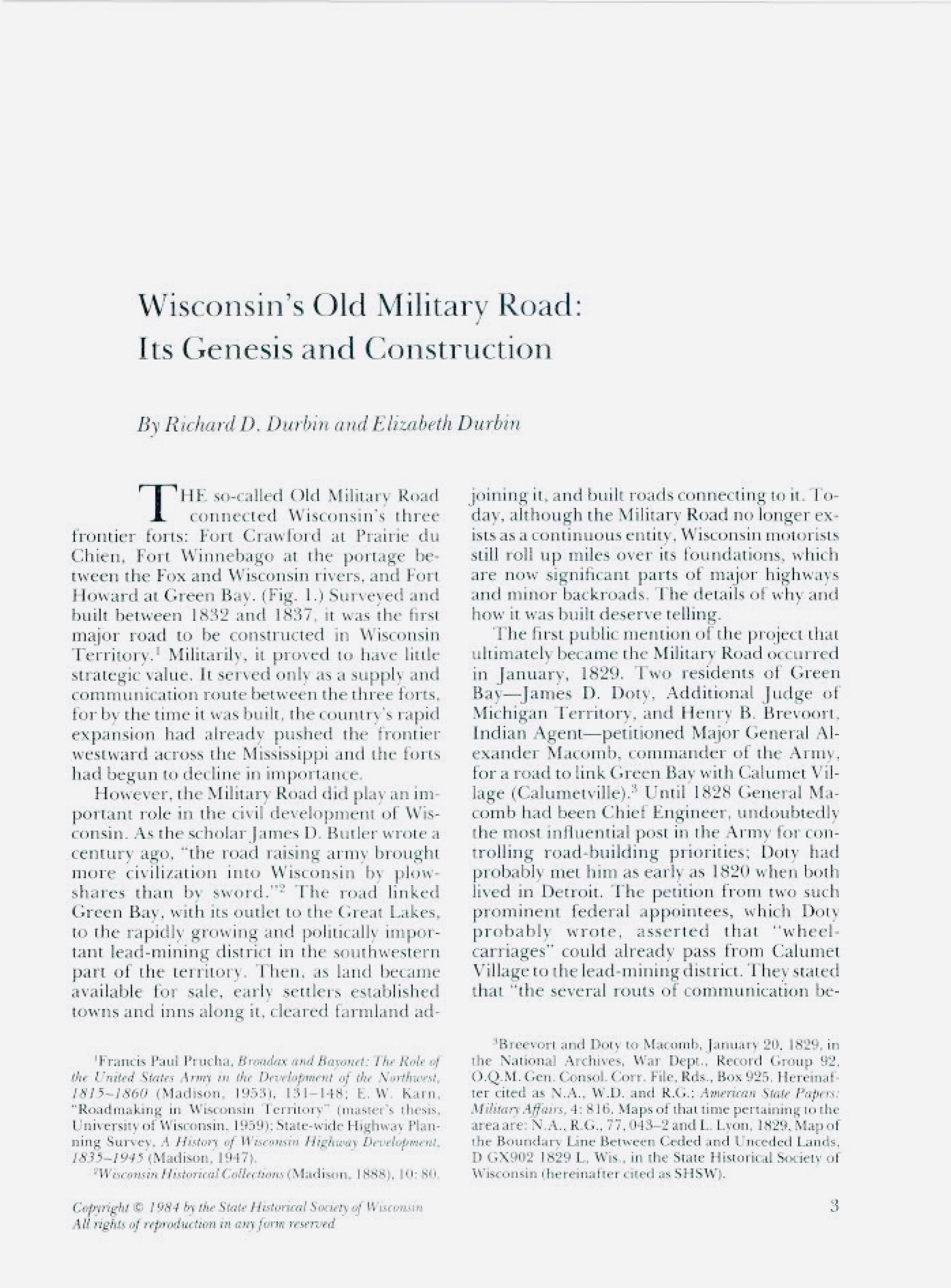
Fort Winnebago was one of several posts in the upper Midwest garrisoned by the army’s Fifth Regiment of Infantry during Jonathan M. Clark’s three-year term in the army at Fort Howard (1833-1836). From about 1835-1836, the soldiers of the 5th regiment were responsible for cutting Wisconsin’s original east-west Military Road from Ft. Howard at Green Bay, to Ft. Winnebago at the portage between the Fox and Wisconsin Rivers, and thence to Ft. Crawford at Prairie du Chien. In the 1830s, in addition to recent recruit Jonathan M. Clark, at least two other men with the Clark surname held positions with the 5th regiment in Wisconsin. Neither of these notable Clark men—it turns out—is related to JMC.

I’m not going into great detail for each subject, but I’ll try and give enough info to make clear whom we are talking about, and why they are being added to the “Nope, not our Clark family…” list. Leading today’s installment is one of the 5th regiment’s senior officers and members of his pioneering family:

Continue reading

How do you…? A Clark-era handbook

Recently, reader and Jonathan Clark House friend Ed Foster mentioned that he wanted to know more about how various JCH tools were used and necessary supplies were made, for example, how were lye soap or candles made? These are excellent questions, as they help us understand the day-to-day world of the Clarks and their neighbors in a more vivid and detailed way.

So, how did Jonathan and Mary Clark make candles or soap or perform many of the other home- and farm-related tasks that occupied so much of their time? Living in their pre-internet, pre-YouTube era, if they did not learn these skills from a parent or other mentor, how did they master such skills on their own? Fortunately for them, the 19th-century was a golden era of what we would call “How To” books.

The “Endless Variety” of books, circa 1837

Jonathan M. Clark mustered out of the U.S. Army at the end of his three-year’s service with Co. K, 5th Regiment Infantry, in September, 1836. While in service, he may have learned or refined a number of useful skills, especially those related to surveying and road construction. The army thought highly enough of his character and aptitude that he rose from private soldier in September, 1833, to Sergeant in 1836. He was, by several accounts, an intelligent and well-read man.

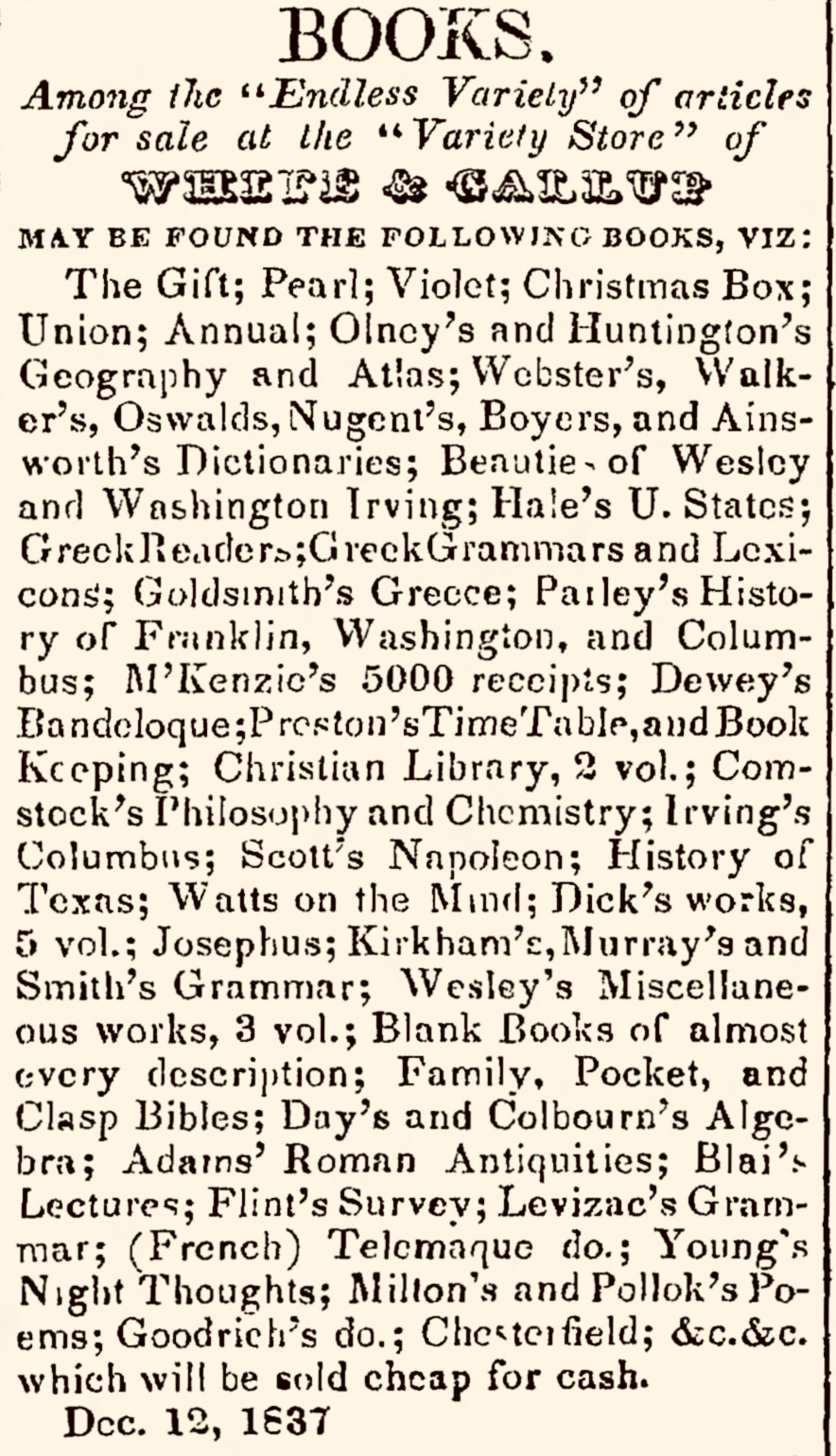
But even an intelligent, experienced man can’t know everything. For that, there were books and stores that sold them. If Jonathan, after he left the army, needed more information on the “practical arts,” he could stop by a shop such as White & Gallup’s “Variety Store” in Green Bay, and probably find the information he needed:

“Books,” advertisement from the [Green Bay] Wisconsin Democrat, 13 Jan 1838, page 1. First published 12 Dec 1837.

One of these advertised volumes caught my eye, just like it may have attracted the eye of Jonathan Clark and many other settlers in the wilds of the Wisconsin Territory in the 1830s…

Continue reading

Memorial Day, 2024

Lest We Forget

Our annual Memorial Day post, first published in 2020. Updated for 2024 with new information about the Civil War service of Isham and Emily (Bigelow) Day’s eldest child, Cpl. James Lemon Day (1834-1863).

Graves of Unknown Union Soldiers, Memphis National Cemetery, photo by Clayton B. Fraser, (Library of Congress), public domain. Memphis National Cemetery is the final resting place of Mequon’s Watson Peter Woodworth, and almost 14,000 of his Union Army comrades.

Today is the day our nation officially observes Memorial Day. For many Americans, Memorial Day represents “the first day of summer,” and is traditionally celebrated with trips to the lake, picnics, parades, and sales on cars, appliances, and other consumer goods.

But for many of us, Memorial Day remains rooted in its origins as Decoration Day. The first national observance was in 1868, when retired general John A. Logan, commander and chief of the Grand Army of the Republic—the Union veterans’ organization—issued his General Order Number 11, designating May 30 as a memorial day “for the purpose of strewing with flowers or otherwise decorating the graves of comrades who died in defense of their country during the late rebellion, and whose bodies now lie in almost every city, village, and hamlet churchyard in the land.”

On this Memorial Day, let’s take a moment to remember what this day truly represents.

Continue reading

Lost in the underbrush…

Advertisement, “Choppers Wanted,” Milwaukee Sentinel, August 27, 1839, page 3.

After years of searching for original reports and drawings or photographs of early Wisconsin road construction, I find myself entangled among piles of information and images on just that topic. Now, the challenge is to organize the best of this material into a few CHH blog posts and wrap up—for now—our most recent excursion along Wisconsin’s earliest roads.1

Like contractor George E. Graves in Sauk Harbor [Port Washington] in 1834 (above), I could probably use the assistance of some (digital) “axe-men” to clear my way forward. Perhaps some hearty fellows such as these…

Continue reading

The Green Bay-to-Chicago and other federal roads, c. 1840

Time for one more follow-up to our recent posts Monday: Map Day! – Wisconsin’s Federal Roads in 1840 and JMC, the Army, and the Military Road, 1835-1840. As I mentioned in that “Monday: Map Day!” post, I recently found some unique maps and related documents in the digitized collections of the National Archives and Records Administration (NARA), in particular a group of maps and drawings created in 1840 by members of the army’s Corps of Topographical Engineers under the supervision of Capt. T. J. Cram.

Before they get lost in my files, I thought I’d share the other documents from Capt. Cram’s 1840 survey that have survived and been digitized by NARA. I’ve already said quite a bit about these 1840 maps and drawings; now I’m most interested in gathering the remaining 1840 documents and their bibliographic citations here for reference. So not much commentary today, but lots of images. And—as always—I recommend clicking on each item to open a larger, higher-resolution image in a new window.

Bridges on the Green Bay Road

The first item is of particular interest for Clark House history fans, as it provides additional details about old Washington/Ozaukee county’s first federal road, the north-south route connecting Fort Dearborn, Chicago, to Fort Howard at Green Bay. The drawing is part of a larger document; this portion is titled “Road from Ft. Howard, by Milwaukee & Racine, to the Northern boundary of Illinois.”

NARA, full citation, below.

The drawing illustrates construction details of the simple wooden bridges that were part of the Green Bay Road, circa 1840. This road, and these bridges, comprised the main north-south transportation route for the U.S. Mail and for immigrants and settlers of the new counties of southeast Wisconsin Territory. The Clarks, Turcks, Bonniwells and other early Mequon pioneers would have crossed bridges like these on their trips to and from Milwaukee, Grafton, Port Washington and beyond on the Green Bay Road.

And that’s not all…

Continue reading

JMC, the Army, and the Military Road, 1835-1840

Today’s post is a follow-up to our recent Monday: Map Day! – Wisconsin’s Federal Roads in 1840. It features another document created by the U.S. Army’s Corps of Topographical Engineers and preserved in the collections of the National Archives and Records Administration. Today’s drawing interests us as it documents—in some detail—the kind of road building work that Pvt. (later Sgt.) Jonathan M. Clark performed as a member of Company K, 5th Regiment, U.S. Infantry.

Webster, Jos. D, et. al., “Military Road from Fort Crawford to Fort Winnebago to Fort Howard (Wisconsin),” NARA, Record Group 77: Records of the Office of the Chief of Engineers, Series: Civil Works Map File, File Unit: United States, accessed here, April 14, 2024.

This document interests us because after JMC left the army he, with many of his early Mequon neighbors, spent a good part of the 1840s surveying, cutting, clearing, and grubbing out some of old Washington/Ozaukee county’s earliest roads. In the process, these pioneers had to bridge streams and rivers of various sizes and depths, and find ways to keep the unpaved roadway dry and firm. How did they do it with the limited supplies and tools at hand?

Today’s document shows how the U.S. Army solved some of those issues a bit farther north, on Wisconsin’s east-west Military Road. The techniques and approaches to road construction use there may have influenced how JMC and our early county road builders solved the problems of building roads in the forests, wetlands, and open prairies of 1840s Washington county.

Continue reading