I’ve been busy…at the Portage! (part 2)

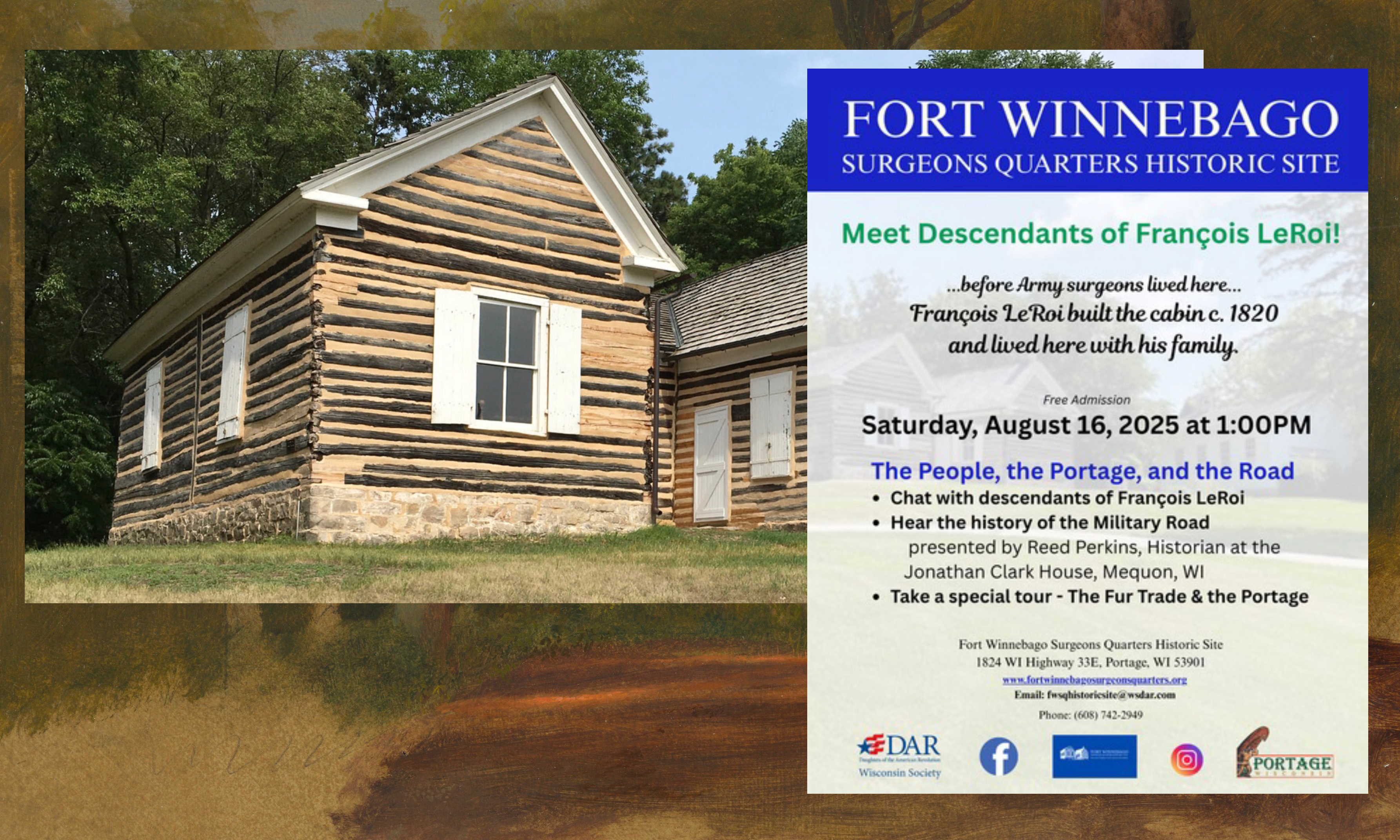
In a recent CHH post I wrote about my Saturday, August 16 visit to, and presentation at, the WSDAR’s excellent Fort Winnebago Surgeons Quarters historic site. That was worth a road trip in itself. But since I was heading up to Portage, I decided to make a history weekend out of the occasion. So on Friday the 15th, I spent a fine few hours touring the nearby Historic Indian Agency House and museum, just a short distance from the Surgeon’s Quarters across the old channel of the Fox River.

Historic Indian Agency House, 2025. Photo credit: Reed Perkins

The Historic Indian Agency House

The Historic Indian Agency House (HIAH) is one of Wisconsin’s oldest museums and a “must see”, for those of you interested in the early days of the Wisconsin Territory and the history of the state’s original Native American inhabitants and their forced removal during white settlement in the 1820s, ’30s and beyond. Like the nearby Fort Winnebago and its remaining Surgeon’s Quarters, the story of the HIAH overlaps and intersects with the story of Jonathan M. Clark and his 1833-1836 military service at Fort Winnebago’s headquarters post, Fort Howard, in Green Bay.

Continue reading
I’ve been busy…at the Portage! (part 1)

It’s been a while, I know! One thing led to another and this summer ended up being a very quiet summer here on the CHH blog, with just a post or two over the past few months. My apologies to you all. However, I have been very busy “behind the scenes,” reading, researching and writing all summer long, and I have lots of new historical information and stories to share with you.

Fort Winnebago Surgeons Quarters—and more

One of the projects that has kept me busy this summer was researching and preparing a presentation that I gave last Saturday, at the historic Fort Winnebago Surgeons Quarters museum as part of their The People, the Portage and the Road event. Originally, my talk was going to be a lightly-revised update of my September, 2024 talk at the Wisconsin Society of the Daughters of the American Revolution’s Fall Workshop in Oshkosh.

That talk, “Building the Military Road,” contained about 45 minutes of detailed information about Wisconsin’s first federal road, and the men that built it—including our own Sgt. Jonathan M. Clark—tightly squeezed into about a half-hour time slot. The presentation was well-received, and I was invited to repeat that talk at this August, 2025, event at the WSDAR’s Fort Winnebago Surgeons Quarters museum in Portage.

However! The August 16th event was also going to be a reunion of the descendants of François LeRoi (aka Francis LeRoy or Roy)—the man that first built and occupied the historic surgeon’s quarters (1816-1829), and it was suggested that I include some Francis LeRoy related information in my talk, a very reasonable request. Since I already knew quite a bit about the Military Road, the Portage, and the life and times at Forts Howard and Winnebago in the 1830s, I thought I would just need to make a few minor cuts to my original talk, find a few, possibly obscure or unknown, LeRoi documents, add them to the presentation and, well, that would be just the thing! Well…

Continue reading

“Dear Santa,”

The Clark House Historian’s Christmas Wish List

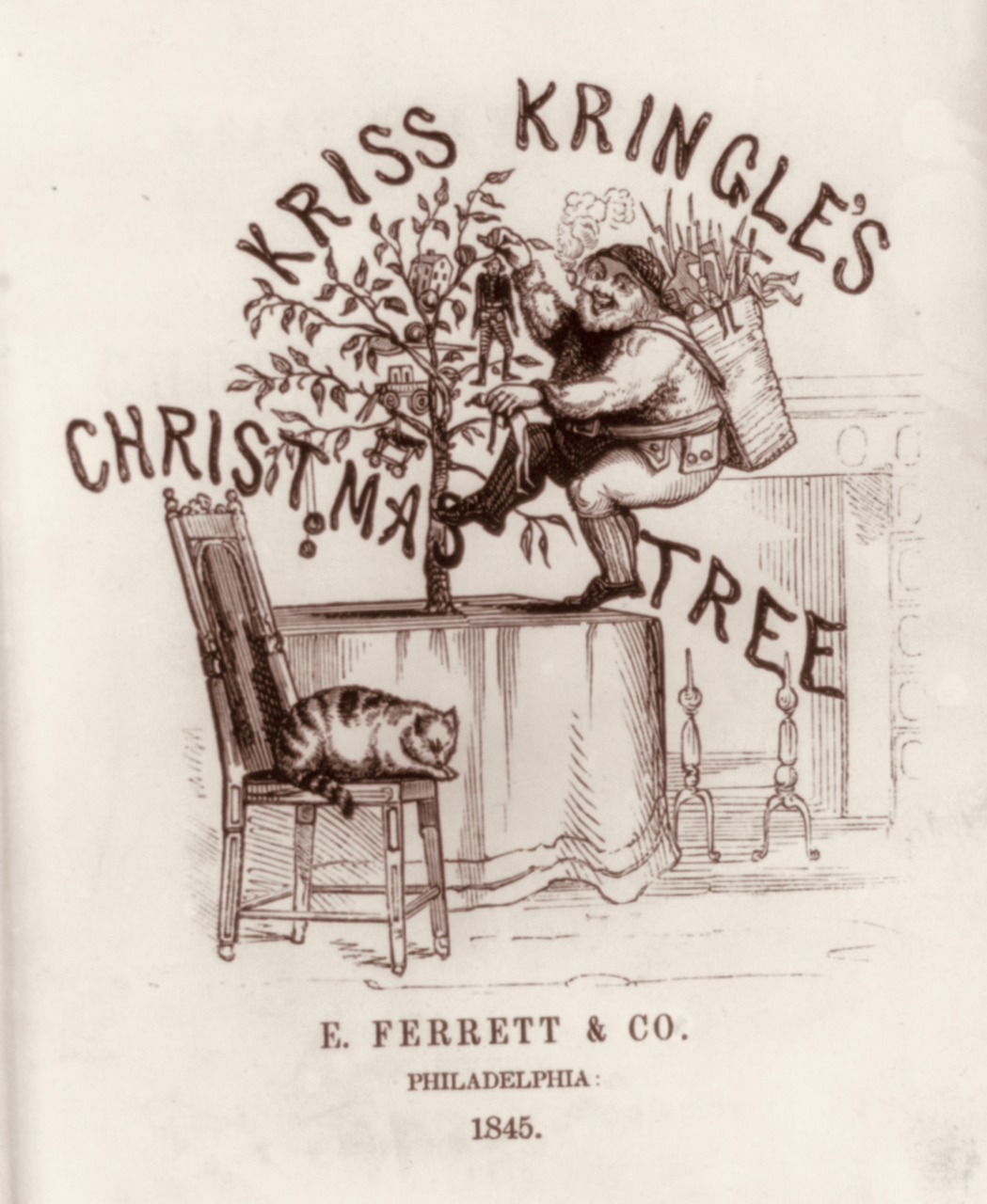
Kriss Kringle’s Christmas Tree [title page], E. Ferrett & Co., Philadelphia, 1845. Library of Congress

I grew up in the Chicago suburbs, and I remember the holiday thrill of riding the Chicago & Northwestern commuter train downtown with my parents, and then walking into the majestic State Street headquarters of Chicago’s grandest department store, Marshall Field & Company. Our mission? A trip up to the “toy floor” at Field’s, where we would wait in line to tell Santa all the wonderful things we would like to receive for Christmas that year.1

It goes without saying that I haven’t been able to fit on Santa’s lap for a very long time. But as the Clark House Historian, I still have holiday dreams and wishes, and today I’d like to share some of them with you. Who knows, perhaps Santa will work his magic once again?

(Official disclaimer: I do not serve on the JCH Board of Directors, or any of its committees. This is my Christmas daydream, a fantasy of what I’d like to see unfold at my favorite museum, given unlimited resources. And besides, as the great Chicago architect and city planner Daniel Burnham famously said: “Make no little plans. They have no magic to stir men’s blood!”)

My list is organized into several parts, the first of these is…

Continue reading

Who’s Who at Forts Howard & Winnebago, 1829-1837

I’m getting back into the blogging groove, and one of my first projects is to continue our series “Not our Jonathan: other “J. M. Clarks” in 1830s & ’40s Wisconsin.” And in my research for that, I’m looking into the identities of one or more men named “J. M. Clark” that served as chaplain at the 5th Regiment’s post at Fort Winnebago.

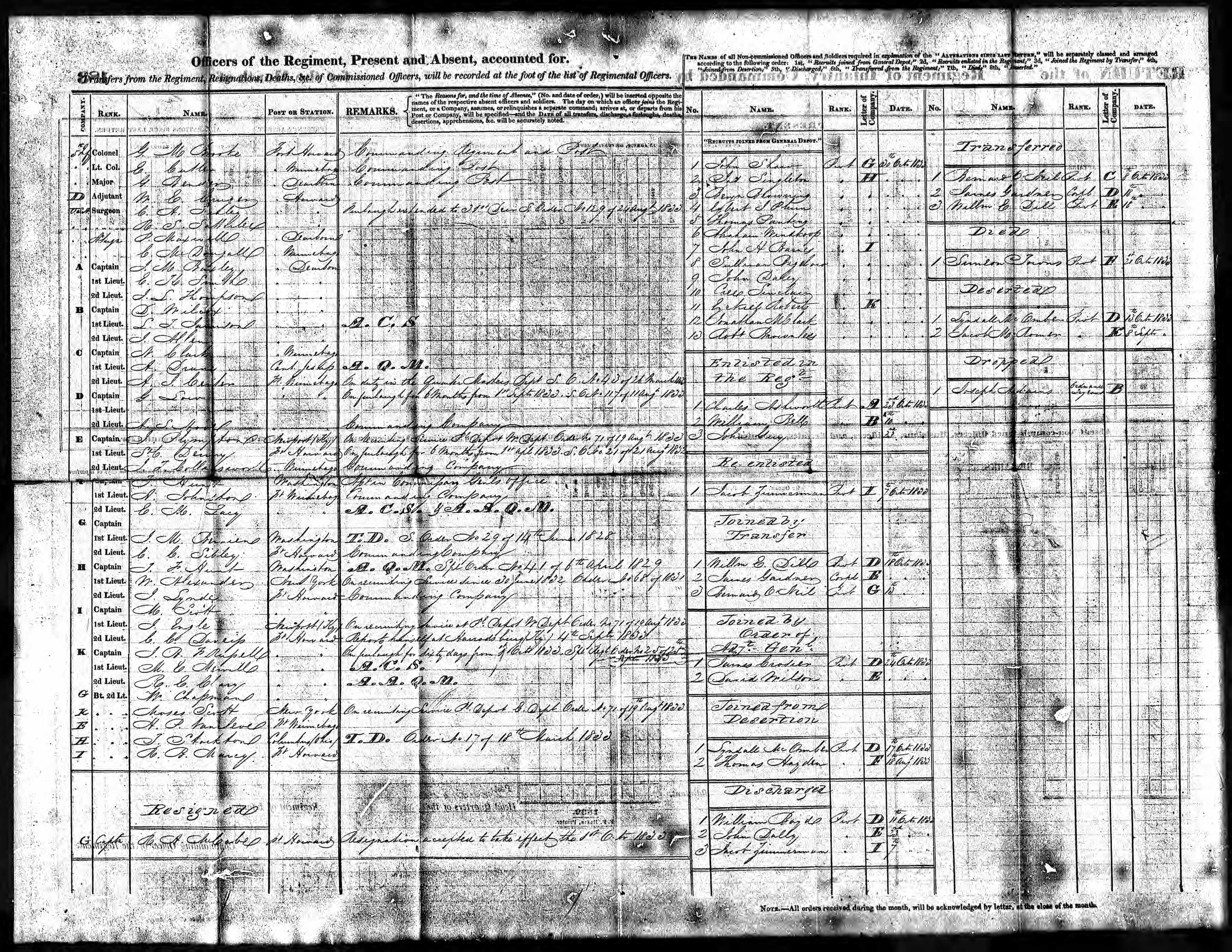
An important primary source for this research are the monthly “Returns” or reports, sent from the 5th Regiment’s posts at Forts Howard and Winnebago back to the army’s chief bureaucrat, the Adjutant General, in Washington, D.C. We’ve examined these Returns several times on Clark House Historian, including this post from 2016 which discussed this October, 1833, bit of U.S. Army record-keeping, the Return of the Regiment [for the 5th Regiment Infantry, at Fort Howard], October, 1833, verso:

NARA, Washington, D.C.; Returns from Regular Army Infantry Regiments, June 1821 – December 1916; Microfilm Serial: M665; Roll: 54 Military Year : 1832-1842. Return of the Regiment [for the 5th Regiment Infantry, at Fort Howard], October, 1833, verso, from Ancestry.com (pay site).

What’s that name???

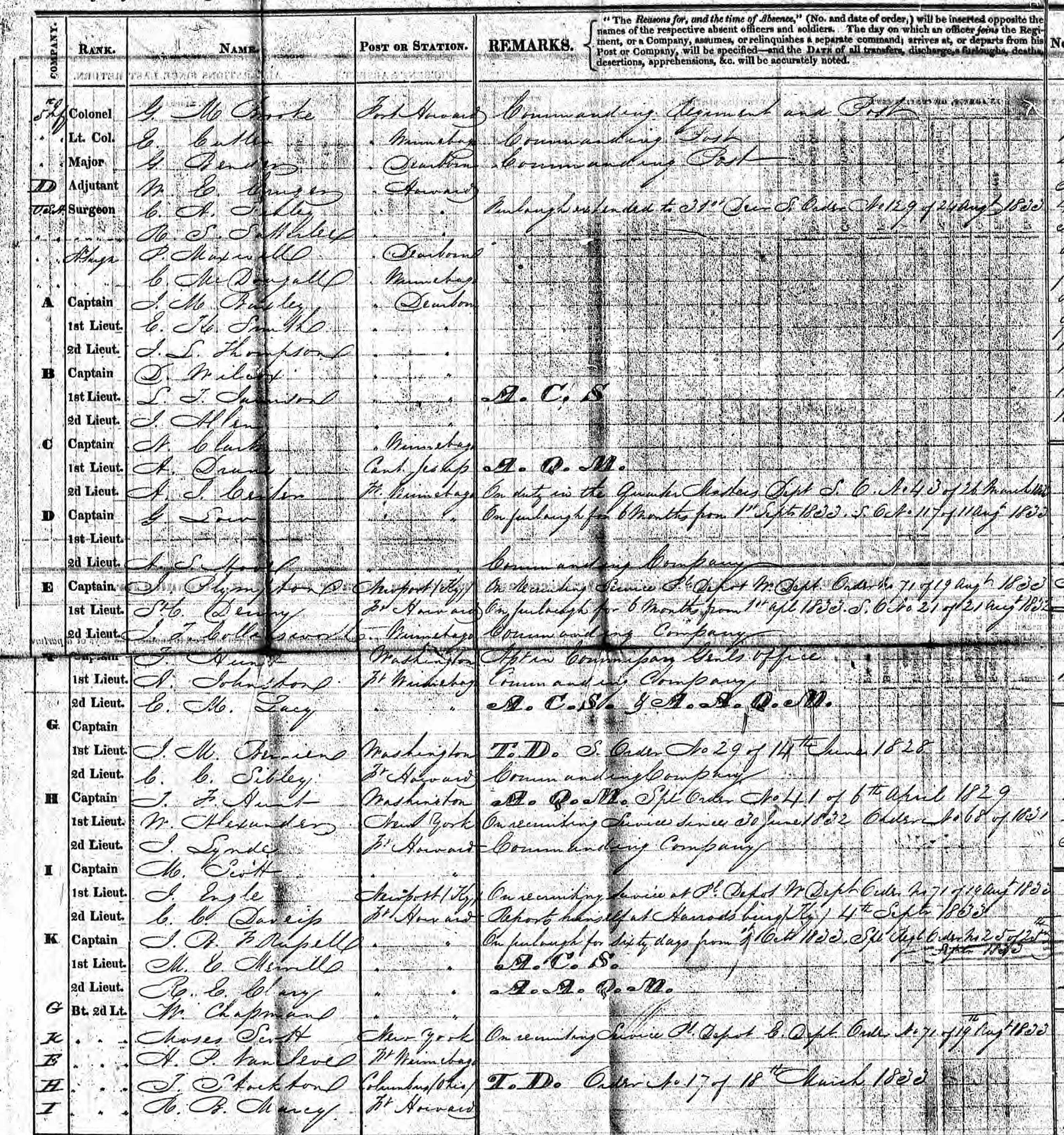
For our purposes, one of the most useful features of these monthly Returns is the top left section of the form, which lists the officers of the regiment by [Company], Rank, Name, Post or Station, and with a space for Remarks about their assignments, temporary duty, leaves of absence, and so on. There’s a lot of useful information here, especially the names of the officers and the companies that they lead. But click the image to open a larger version of this image, and see if you can actually read those names:

On the one hand, the regimental clerk that filled out this October, 1833, form had pretty tidy penmanship, and the digitized microfilm image is not too bad. But even so, some of the names are hard to decipher. And knowing these names can be really useful, for example when looking for correspondence between these regimental officers and the Adjutant General’s office in D.C. (See our post here, for more on this archive.)

So how do we learn “Who’s Who” on the monthly “Returns from Post” and “Returns of the Regiment”? Fortunately, the government put all that info into a series of very useful books, which are now available, for free, online…

Continue reading

Talking about the Old Military Road, the DAR…and JMC

UPDATED October 5, 2024, at 9;30 pm to correct a number of typos and other infelicities.

Phew! What a busy September! I got to talk about some very interesting topics last month, to some very enthusiastic and attentive audiences. Lots of work, but very enjoyable. The first of these events was my September 13, 2024, after-dinner presentation at the Fall Workshop of the Wisconsin Society, Daughters of the American Revolution (WSDAR). My topic was “Building the Military Road, Wisconsin Territory’s First Federal Road.”

Photo credit: Laura Rexroth

I incorporated into the talk some important parts of the 1830s and ’40s army and road-building information that I’ve blogged about here at CHH, as well as new primary source materials and a whole bunch of relevant photographs and illustrations.

The WSDAR and the Military Road

An important, ongoing part of the WSDAR’s mission over the decades is historic preservation and education. The Wisconsin Society DAR’s main historic preservation effort involves the care and presentation of the last bit of Fort Winnebago still standing, the historic Fort Winnebago Surgeon’s Quarters.

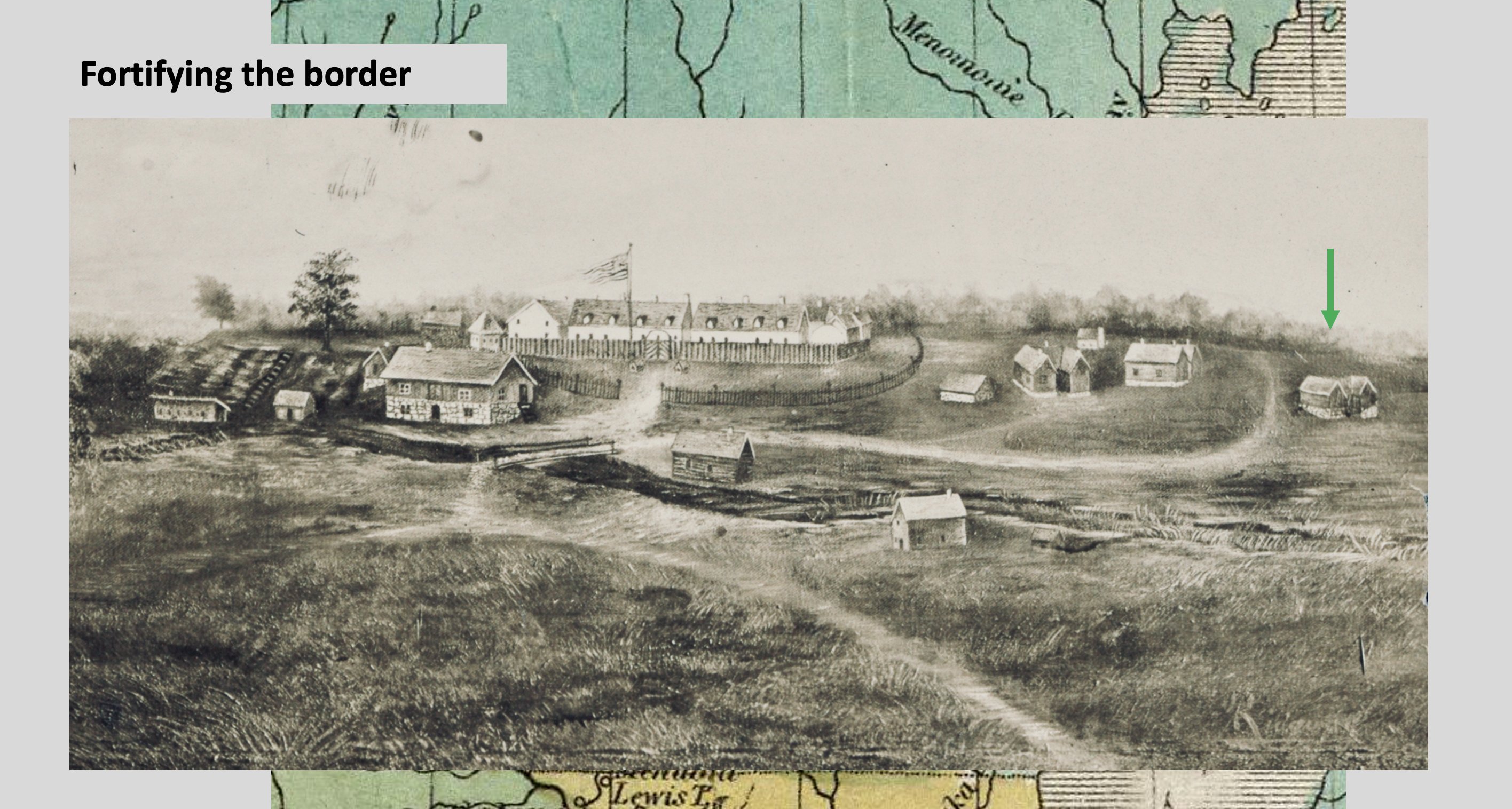
“Fortifying the Border,” slide from my “Old Military Road” presentation.

This image of Fort Winnebago, at the Portage between the Fox and Wisconsin Rivers, was created in the mid-nineteenth century and reproduced on a 1909 postcard. In the detail shown here, the building that is now the WSDAR’s historic Fort Winnebago Surgeon’s Quarters museum is indicated by green arrow. The uncropped full image—including a view of the Historic Indian Agency House—is available from the Library of Congress.

The WSDAR also has an interest in Wisconsin’s Old Military Road that dates back at least to 1930, when Columbia County’s Wau-Bun Chapter, WSDAR placed a series of handsome cast-steel markers along their portion of the route of the Old Military Road. As you might imagine, these have suffered from almost a century of Wisconsin weather and random damage or theft. State regent Sandra Snow has made the restoration and replacement of the 1930 markers one of her signature projects. Here’s a before and after of one of those markers:

Continue reading

Sources: The Old Military Road

I just put the final edits on my upcoming presentation for the Fall Meeting of the Wisconsin Society, Daughters of the American Revolution. I’ll be talking about Wisconsin’s first federal road—the Old Military Road—and the men that built it, including our own Jonathan M. Clark.

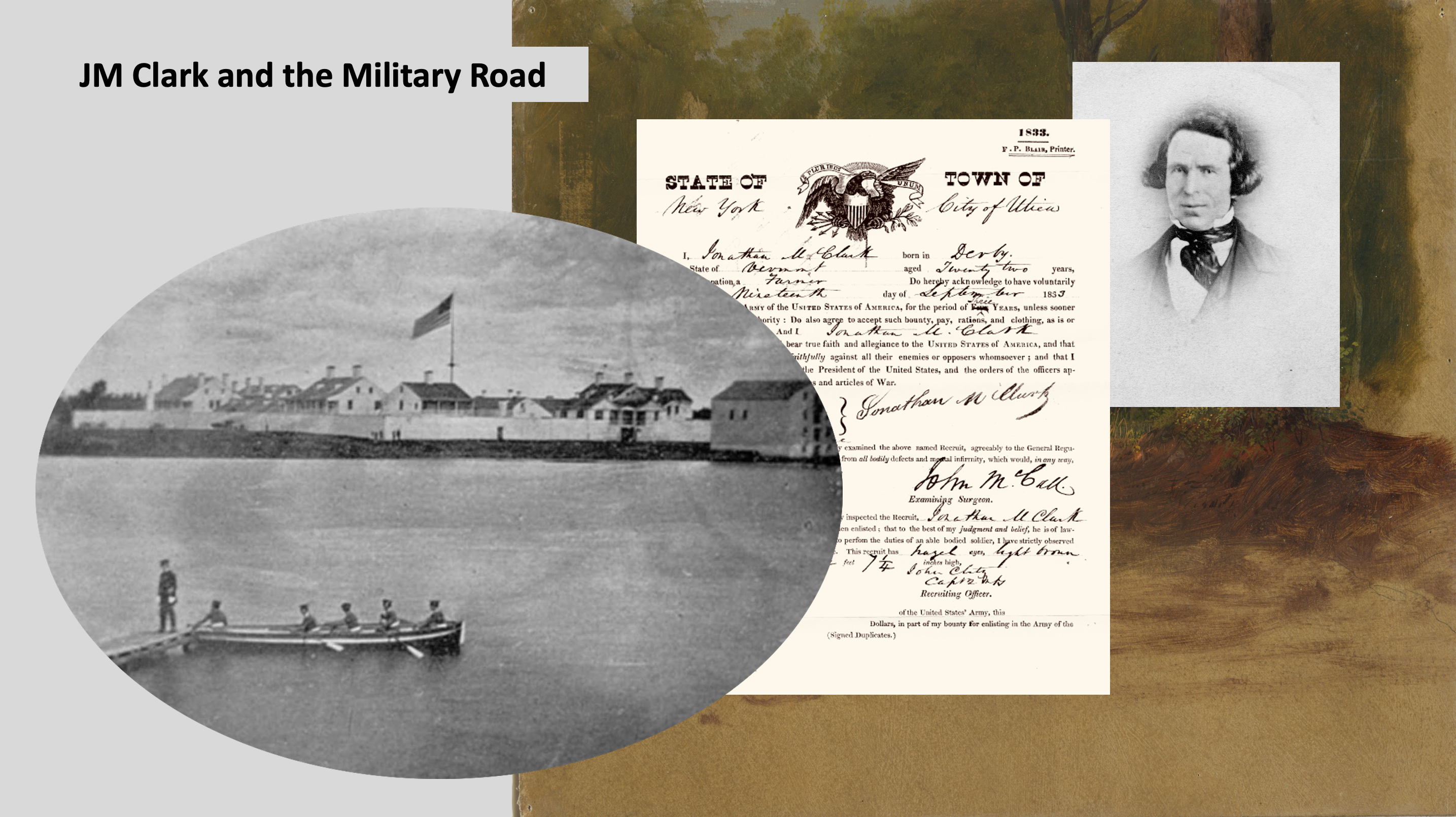
One of my WSDAR presentation slides. From left: JMC’s army post, Fort Howard (Green Bay), JMC’s army enlistment paper, JMC portrait photo.

My talk is scheduled to run for 30 minutes and, as is often the case, I had to cut a lot of information from the presentation in order to keep it inside the time limit. But I don’t want all of those research tidbits to go to waste, so I’m going to post them in a few posts here on the blog. Today, I’m going to list, comment on, and link to some of the key sources that helped me put my WSDAR presentation together. If you have any interest in Wisconsin’s early roads and related transportation issues, I encourage you to check out these sources. Most are freely available online, and I’ll provide links where I can. Happy reading!

Durbin & Durbin, 1984

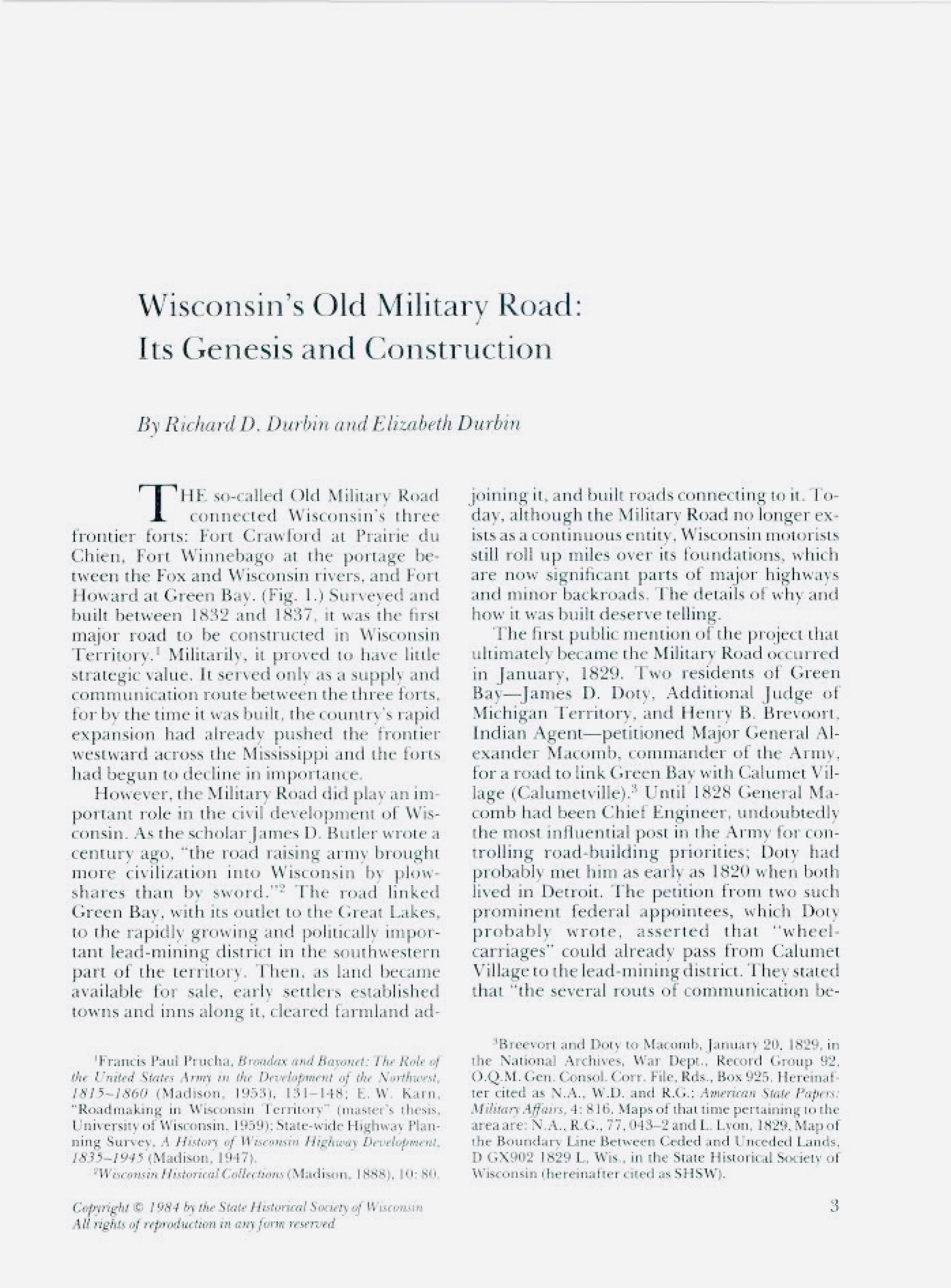
To my knowledge, the best, most detailed, and most comprehensively researched and documented article about the Military Road remains “Wisconsin’s Military Road: Its Genesis and Construction” by Richard D. Durbin and Elizabeth Durbin. It was published in Wisconsin Magazine of History (WMH), Vol. 68, No. 1, Fall, 1984.

The Durbins appear to have consulted a huge number of primary sources, especially the deep collections of the Wisconsin Historical Society (WHS) and the National Archives and Records Administration (NARA). Their article is lavishly illustrated with vintage and modern maps, and will allow the reader to retrace the path of the original Military Road through modern Wisconsin. The authors also document in great detail the many twists and turns of the road’s legislative and appropriations history and the military’s involvement in the project.

Durbin and Durbin is essential reading for this subject, and can be read for free via the Wisconsin Magazine of History Archives at WHS’s excellent website (link to article). And speaking of the Wisconsin Magazine of History…

Continue reading

Monday: Map Day! – Lower Canada’s Eastern Townships in 1842

The Search for JMC’s roots continues!1 For the last few months, I’ve spent hour after hour reading through hundreds of digitized pages of the various manuscript land petitions and related documents that form the Land Petitions of Lower Canada, 1764-1841 database at Library and Archives of Canada (LAC).2

The good news is that I have found a lot of information about various early Clark (or Clarke) surname immigrants that petitioned for land—and actually settled on it—in Lower Canada during the relevant years of circa 1791-1840. Many of the documents that I’ve found contain information about these Clark immigrants, their families, and from whence they come. This is important, as we need to sort the Patriot, Vermont-related Clark families from other Clark immigrants from New York and New England (including American Loyalists), and the various Anglo-Canadian Clark families that sought land in the Eastern Townships at the same time. So, you know what that means…

We need another map!

Now that we have all this data, we need a way to organize and present it. And since so many of our rejected candidates earn their “Nope, not our Clark family” status because they settled far away from Stanstead, I thought it was time to make a big map of where these various Clark petitioners for Lower Canada land actually ended up. Then, in theory, we can eliminate the Clark families that settled “too far” from Stanstead (and adjacent Derby, Vermont), and focus on the Clarks that settled in or near Stanstead itself.

It’s going to take a while to assemble and present all the data. So we need a big, easy to read map created around the time of Jonathan Clark’s childhood and/or youth, from about 1812 until his arrival in New York state in 1831. (The latter date is flexible, as long as we find a map that predates the reorganization of the townships into larger counties in 1847.) We’ve presented some great Lower Canada maps here at CHH but, as is typical of that era, if they are accurate and detailed, they also tend to be visually “busy” and hard to read. But, dear readers, I finally found just the thing…

Continue reading

JMC: The missing years, 1836-1839

I’m still on the search for Jonathan M. Clark’s parents and other kin somewhere in the early-19th-century wilderness of northern Vermont and southern Québec. I hope to publish more about that here in the near future.

As part of that project, I’ve spent quite a bit of time over the past few months organizing and re-examining the many research materials that I’ve gathered about JMC and his world, and I’ve constructed a whole bunch of genealogies for early Vermont, New Hampshire, and Lower Canada families named Clark that turn out—alas!—not to be related to our Jonathan M. Clark.

More mysteries…

Along with the mystery of JMC’s still-unknown family and childhood, Clark House museum director Nina Look and I have been trying to chase down some rumors that suggest Jonathan Clark may have spent his three years between mustering out of the U.S. Army (in 1836), and purchasing land at the land office in Milwaukee (in late 1839), as a surveyor in or near the area around Fort Winnebago, Columbia County, Wisconsin Territory. At the moment, that story remains a mystery, too. I’ll let you know if we find out more.

Anyway, with all these facts, rumors and mysteries—and many, many others—rolling around in my head, I thought it might be useful to outline JMC’s life in a handy, chronological timeline. Here’s a draft of that timeline, including what we do—and don’t—know about Jonathan M. Clark’s whereabouts and activities during his lifetime, as of July 1, 2024. I’ve included links to some relevant Clark House Historian posts where possible; please click on them for more information.

Childhood & Youth

November 28, 1812, (possibly, 1811) born to unknown parents, in or near Derby, VT, or Stanstead, Lower Canada

• Late-1812 to early-1831: JMC’s childhood whereabouts and activities unknown for 18+ years, with one possible exception:

Continue reading

Nope, not our Clark family – Ft. Winnebago edition

Here’s another addition to our list of various Clark-surnamed people that show up in our search for Jonathan M. Clark’s kin, but we now know (with reasonable certainty) were not JMC’s parents or other relatives.

Today’s “Clark” subjects are connected to the history of the U.S. Army’s Fort Winnebago, and the surrounding area of Columbia County, Wisconsin Territory, during the decade of the 1830s.

Fort Winnebago was one of several posts in the upper Midwest garrisoned by the army’s Fifth Regiment of Infantry during Jonathan M. Clark’s three-year term in the army at Fort Howard (1833-1836). From about 1835-1836, the soldiers of the 5th regiment were responsible for cutting Wisconsin’s original east-west Military Road from Ft. Howard at Green Bay, to Ft. Winnebago at the portage between the Fox and Wisconsin Rivers, and thence to Ft. Crawford at Prairie du Chien. In the 1830s, in addition to recent recruit Jonathan M. Clark, at least two other men with the Clark surname held positions with the 5th regiment in Wisconsin. Neither of these notable Clark men—it turns out—is related to JMC.

I’m not going into great detail for each subject, but I’ll try and give enough info to make clear whom we are talking about, and why they are being added to the “Nope, not our Clark family…” list. Leading today’s installment is one of the 5th regiment’s senior officers and members of his pioneering family:

Continue reading

How do you…? A Clark-era handbook

Recently, reader and Jonathan Clark House friend Ed Foster mentioned that he wanted to know more about how various JCH tools were used and necessary supplies were made, for example, how were lye soap or candles made? These are excellent questions, as they help us understand the day-to-day world of the Clarks and their neighbors in a more vivid and detailed way.

So, how did Jonathan and Mary Clark make candles or soap or perform many of the other home- and farm-related tasks that occupied so much of their time? Living in their pre-internet, pre-YouTube era, if they did not learn these skills from a parent or other mentor, how did they master such skills on their own? Fortunately for them, the 19th-century was a golden era of what we would call “How To” books.

The “Endless Variety” of books, circa 1837

Jonathan M. Clark mustered out of the U.S. Army at the end of his three-year’s service with Co. K, 5th Regiment Infantry, in September, 1836. While in service, he may have learned or refined a number of useful skills, especially those related to surveying and road construction. The army thought highly enough of his character and aptitude that he rose from private soldier in September, 1833, to Sergeant in 1836. He was, by several accounts, an intelligent and well-read man.

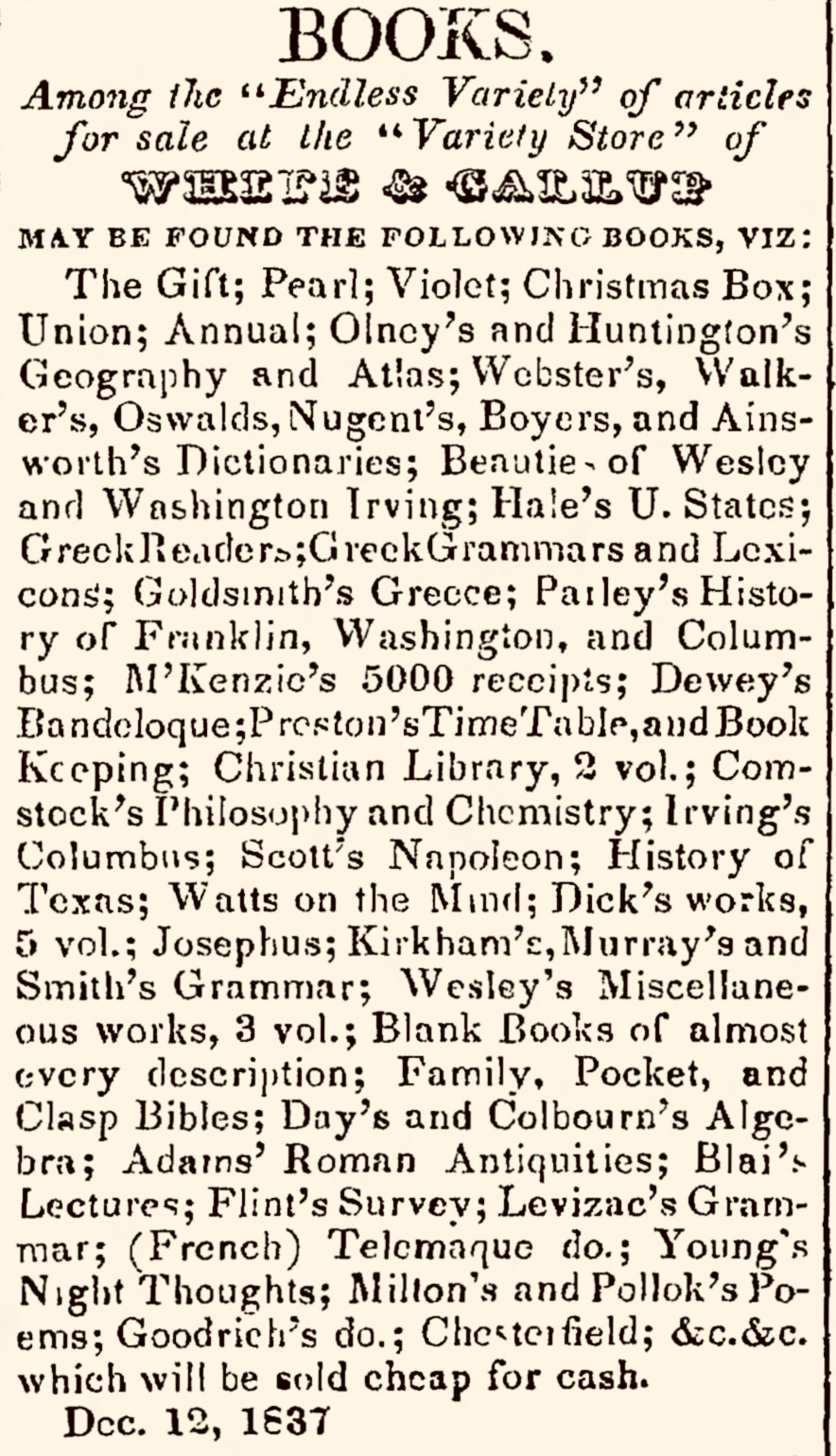
But even an intelligent, experienced man can’t know everything. For that, there were books and stores that sold them. If Jonathan, after he left the army, needed more information on the “practical arts,” he could stop by a shop such as White & Gallup’s “Variety Store” in Green Bay, and probably find the information he needed:

“Books,” advertisement from the [Green Bay] Wisconsin Democrat, 13 Jan 1838, page 1. First published 12 Dec 1837.

One of these advertised volumes caught my eye, just like it may have attracted the eye of Jonathan Clark and many other settlers in the wilds of the Wisconsin Territory in the 1830s…

Continue reading