Mequon – What’s in a name?

UPDATED, April 20, 2021 to include another historic misspelling of “Mequon,” this one from the 1837 first official map of Wisconsin.

____________________________

Mequon is the home of the Jonathan M. Clark House. Mequon is a unique name, and its source, pronunciation, spelling—and, occasionally, location—are the source of a fair amount of confusion and error. So I thought I would gather a few pertinent facts about the name that might help readers avoid some of the pitfalls in Mequon research.

As a reminder:
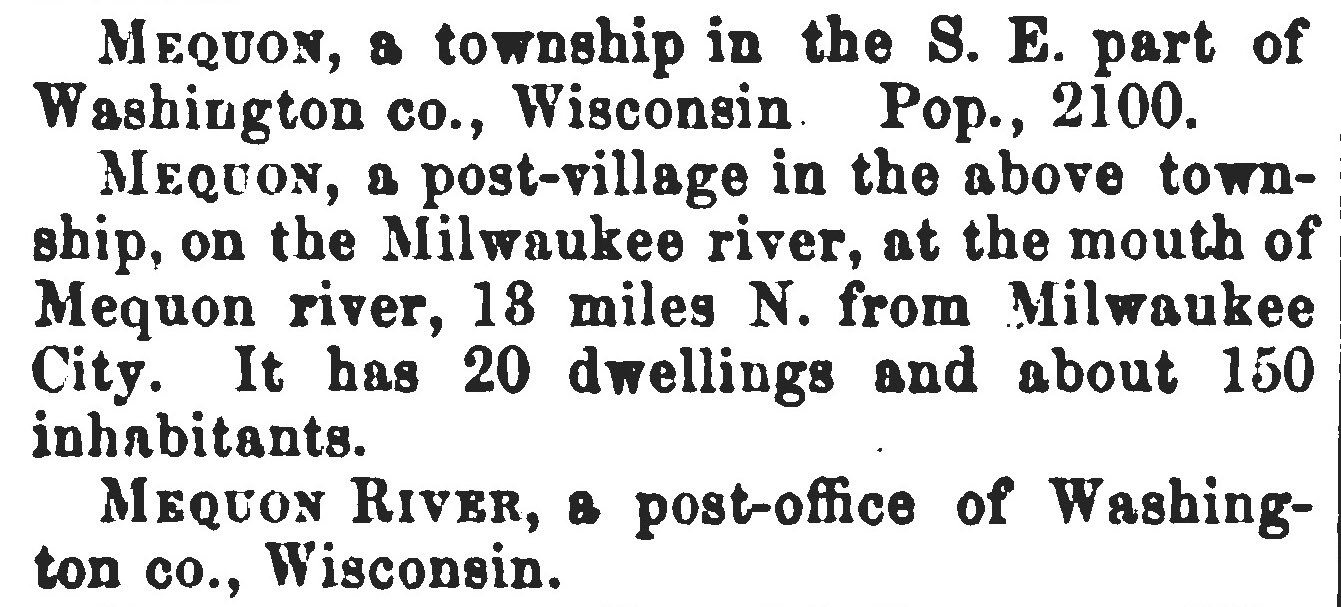
Baldwin, Thomas and J. Thomas, M.D., A New and Complete Gazetteer of the United States […], Philadelphia, 1854, p. 687. Via GoogleBooks.

That’s a pretty accurate, “just the facts,” description of Mequon in 1854. (Although it looks like Gazetteer editors Baldwin and Thomas didn’t get the news that on March 7, 1853, the east part of Washington county—including the Town of Mequon—had split from its parent county to form the new Ozaukee county. And the town vs. township distinction could be more precise, too.)

Continue reading
Monday: Map Day! – 1874 map of Washington and Ozaukee Counties

Today’s map is another unique and wonderful map from the University of Wisconsin–Milwaukee, American Geographical Society Digital Map Collection. It is map of Washington and Ozaukee Counties from 1874, and it is packed with information and unique details.

Map of Washington and Ozaukee Counties, Wisconsin 1873-4 / drawn, compiled and published by G.V. Nash & M.G. Tucker ; engraved & printed by J. Knauber & Co. ; colored and mounted by E.M. Harney. University of Wisconsin-MilwaukeeAmerican Geographical Society Digital Map Collection. Full copyright notice here, presented in this post as a public domain item and/or under fair use provisions of U.S. copyright law. Click map to go to the UWM collection and open larger image in new window.

Continue reading

It’s our Blog Birthday!

Clark House Historian is 5 years old today!!

Jonathan Clark House, Mequon, Wisconsin, July, 2015. Photograph by Reed Perkins. Click to open larger image in new window.

Our very first post, announcing the new blog, went live on March 29, 2016. The information in that post has now been revised and expanded into the About and Disclaimers sections of the blog.

The first posts with historical content followed in April, 2016. I still link to one of those posts—Where are we?—when I need to explain the evolving place names and political geography of the Mequon area.

Since the first Clark House Historian posts in 2016 we have learned a lot more about the Clark house, its occupants and their families, friends and neighbors. If you’re new to the blog—or the Jonathan M. Clark House—here are some good places to begin reading (and be sure to click the links in each article):

Continue reading

In the workshop…

I’m still trying to hammer out a few new posts. Nothing’s ready today. Meanwhile…

Portrait of a Blacksmith in His Workshop, ca. 1855. Photograph. https://www.loc.gov/item/2008680496/. Public domain. Click to open larger image in new window.

Another great image from the Daguerreotype collection at the Library of Congress, still in its handsome original case.

Every town in nineteenth-century America would have at least one blacksmith, ready to make or repair pretty much anything made of metal needed for farm, home, or workshop. Most blacksmiths made tools and specialty iron work, some also made wagons and carriages. Other smiths were trained as farriers, specialists the anatomy and health of the lower limbs and hooves of horses, and the making and fitting of horseshoes.

Continue reading

Peter Turck and Irish Relief

Today is St. Patrick’s Day, originally the religious observance of the feast day of the principal patron saint of Eire.1 In honor of the day, let’s take a look at a few aspects of Irish life in early southeast Wisconsin and the involvement of Mary (Turck) Clark’s father Peter Turck in a civic effort to relieve Irish suffering during the Great Famine.

Irish immigrants in early Wisconsin

The first white visitors to Wisconsin were seventeenth-century French-Canadian explorers, priests and fur trappers, at home along Wisconsin’s lakes and rivers. They were followed by a smattering of British and French settlers in the mid- and later-eighteenth century. Cornish lead miners arrived in the southwest corner of the territory around the turn of the nineteenth-century. And in the mid-1830s, when the federal government officially “opened” the southeast corner of Wisconsin for settlement, there was a large influx of New Englanders and New Yorkers.

There were also a substantial number immigrants from across the sea among the Wisconsin pioneers of the 1830s and ’40s, including settlers from Upper and Lower Canada, Nova Scotia, Great Britain, the Netherlands, the German-speaking lands, and Ireland. By the time of the 1850 federal decennial census, Irish men, women, and children comprised the second-largest group of foreign-born immigrants in the state, surpassed in number only by immigrants from the German-speaking lands.

Continue reading

“Rev.” Peter Turck in New York

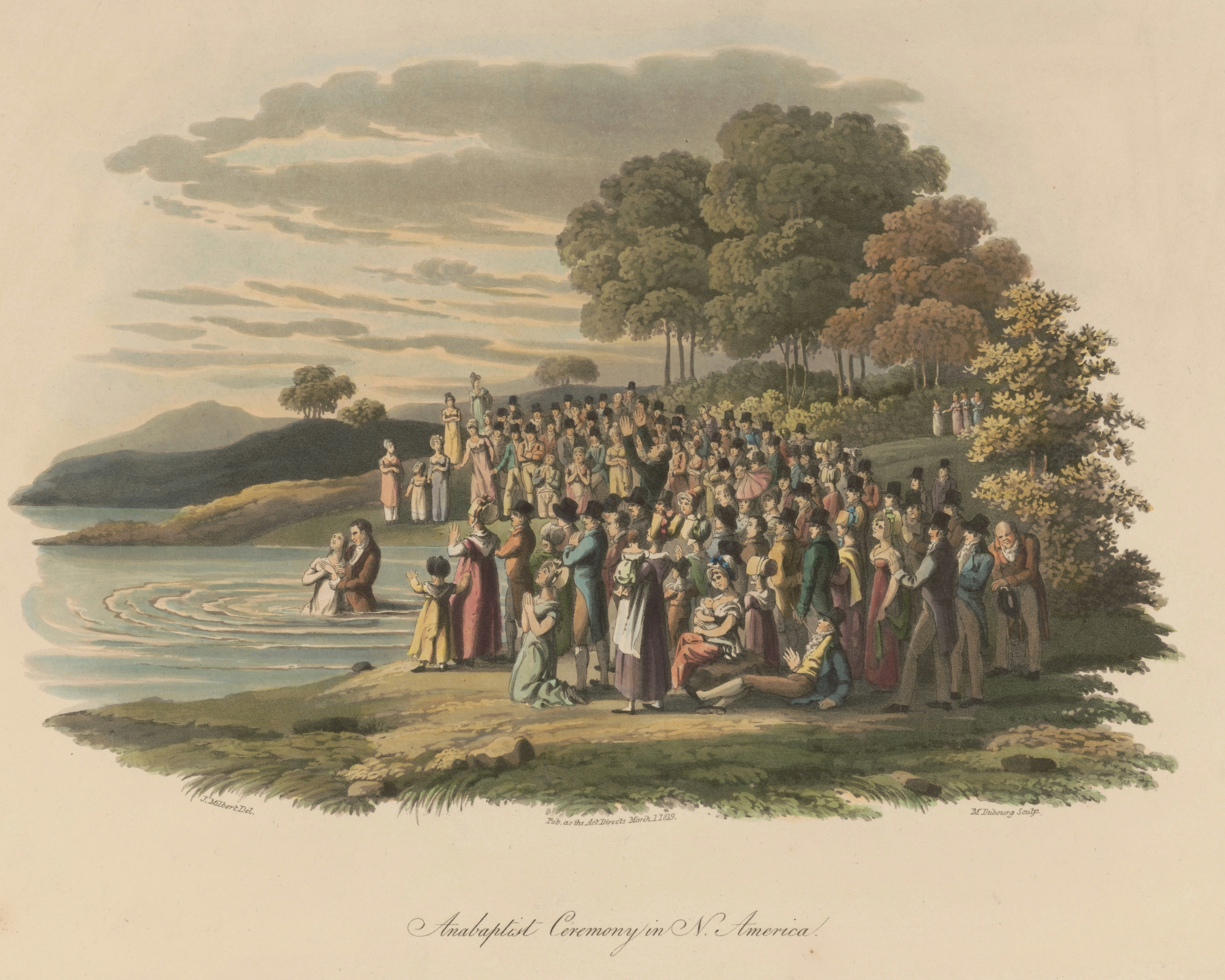
Religion played a large role in the lives of many—but by no means all—19th-century Americans. This was certainly true for Mary (Turck) Clark’s father, Peter Turck (1798-1872). In a number of ways, Peter Turck’s changing relationship to religion is a unique, personal story, but is also a story that encompasses many strands of the religious experience of this formative period in American history.

The Dutch-American heritage

Previously, we looked at Peter’s 1798 DRC baptismal record. Most, if not all, of his siblings were baptized in the Dutch Reformed Church (DRC) in various Columbia County, New York, churches. And as far as I have been able to discover, almost all of Peter Turck’s ancestors were baptized in and members of the DRC in early New Holland and New York, all the way back to the original Turck immigrant, Paulus Jacobsz. Turk (~1635-1703), who came to New Amsterdam (later New York City) before 1660. So how did someone with such long and deep family ties to the Reformed Church—such as Peter Turck—become “an ardent preacher of the Baptist faith”?1

The Second Great Awakening

The Dutch Reformed Church was not the only Christian denomination in the Hudson River valley during Peter Turck’s early years. While a large percentage of the area’s residents were of Dutch and DRC heritage, the valley had many Anglo- and German-Americans as well. All were served by various Protestant denominations including the Baptist, Lutheran and Protestant Episcopal churches, and the Society of Friends. More significantly, Peter Turck’s youth also coincided with the Second Great Awakening of religious fervor in America.

Continue reading