Searching for JMC’s roots in Eastern Township sources: books (part 1)

If this were an academic thesis (don’t worry: it’s not, it’s still a blog), one of the first things we’d do at the start of a project like this is create a “literature review” and accompanying annotated bibliography. Now that we’re restarting our search for JMC’s roots in the border area of northern Vermont and the Eastern Townships of southern Québec, circa 1790-1840, I thought it would be smart to do something similar, but less formal. Over the next several posts we’re going to sort and prioritize the various sources that look useful, and find a way to organize those sources—with their proper bibliographical citations—in a way that will serve us over time.

The Clark House Historian, growing old as he searches for Jonathan M. Clark’s roots…1

Today’s post is Part 1 (of many) of our hybrid literature review and annotated bibliography that—we hope—will finally lead us to JMC’s as-yet-unknown parents, ancestors, possible siblings, and kin.2 We begin with some Lower Canada—Eastern Townships books that I have found more (or less) useful.

Continue reading
Presidents’ Day, 1844

Today is Presidents’ Day, the descendant of the federal holiday originally created in 1879 to celebrate the birthday anniversary of George Washington, our first president and, arguably, the “indispensable man” in America’s fight for independence.

Presidents’ Day did not exist during the early days of Mequon settlement, but the Clarks, Turcks, Bonniwells and their neighbors—whether native-born Americans or recent immigrants—were generally patriotic folk and to one degree or another their politics were mostly free-soil, anti-slavery and pro-Union.

So in their patriotic spirit, here’s a colorful presidential salute for you from the Clarks’ era. It was published in New York in 1844 by Nathaniel Currier, whose prints were for sale, at affordable prices, even in remote locations such as the new Wisconsin Territory.

Currier, Nathaniel (American, 1813-1888). Presidents of the United States, 1844. Hand-colored lithograph on wove paper, 13 x 9in. Brooklyn Museum, Gift of Mrs. Harry Elbaum in honor of Daniel Brown, art critic. Color and exposure adjusted.

What happened to “Lincoln’s Birthday”?

I grew up in Illinois, the “Land of Lincoln,” where Old Abe’s birthday was, and remains, a state holiday. So we had holidays to honor the birthdays of both presidents: Lincoln on February 12, and Washington on February 22. How we got from those separate, specific commemorations to a generic federal holiday (and three day weekend) providing “an occasion to remember all U.S. presidents, to honor Abraham Lincoln’s and Washington’s birthdays together, or any single president of choice,” is a complicated story. Here’s the main info in a nutshell:

Continue reading

Home to Thanksgiving

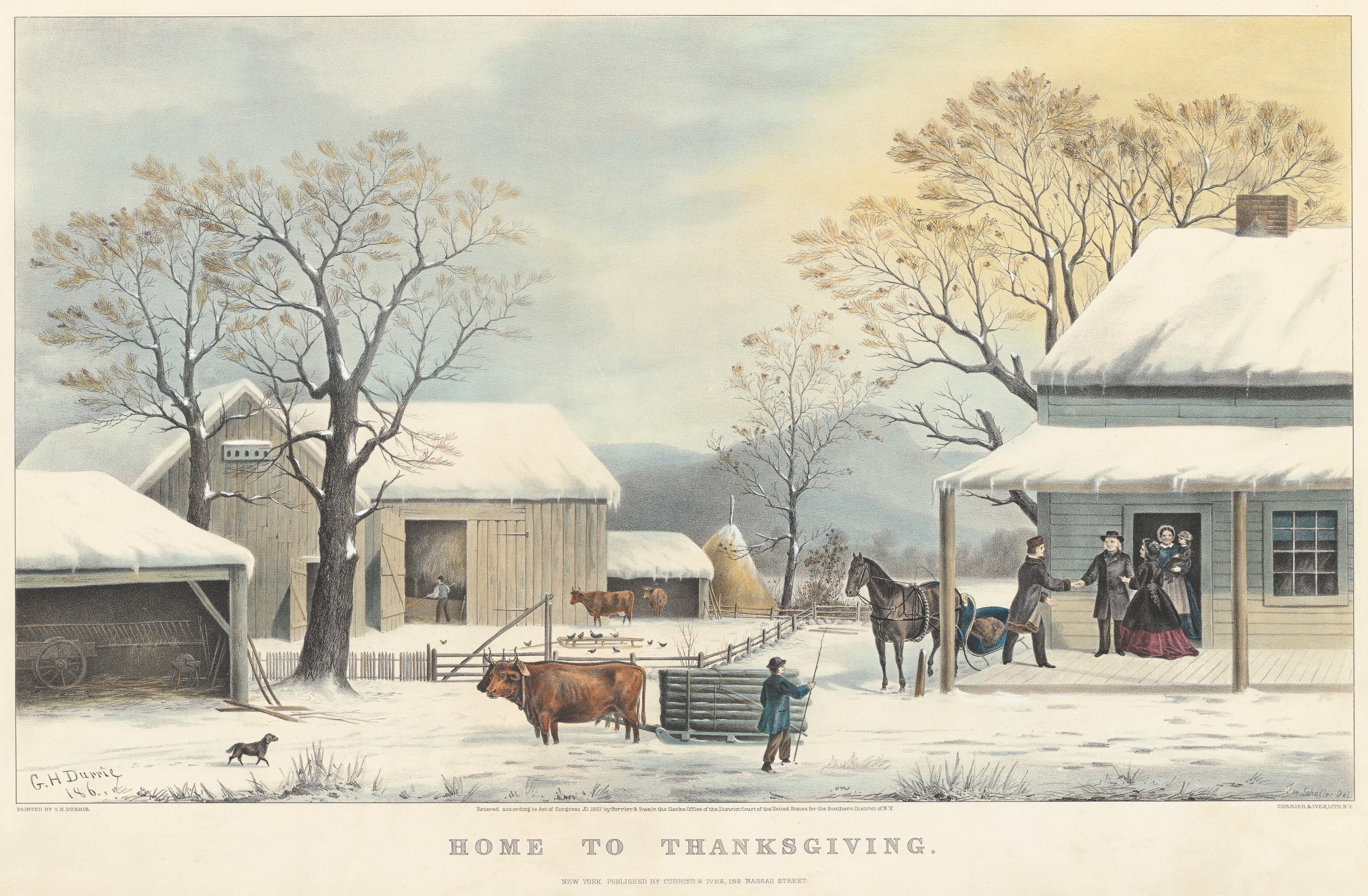
It’s Thanksgiving today, and I’m taking the day off to spend time with family. But in the spirit of the holiday, I thought I’d reprint a lightly revised version of last year’s Thanksgiving post, to share with you a few vintage recipes and a nice Currier & Ives lithograph from the period.1

Thanksgiving, 1867

Durrie, George H. and John Schutler, Home to Thanksgiving, ca. 1867, New York, Currier & Ives. National Gallery of Art, Collection of Mr. and Mrs. Paul Mellon. Public Domain. Click to to open larger image in a new window.

Continue reading

Bonniwell Bonus: the Chatham dockyards

I’m gotten a good bit of research done on my Alfred and Sarah (Turck) Bonniwell project this week, but time (and focus) to write and edit posts has been at a premium. So while I’m still writing and editing, here’s a historic Bonniwell-related image for your enjoyment.

Chatham Dockyards, c. 1763-1789

Mitchell, Thomas (1735-1790), Chatham; view from a height over a dockyard with man-of-war being repaired at centre, a building with a clocktower at right and another building at right, brush drawing in grey wash, with watercolor, over graphite. Copyright, Trustees of the British Museum, (CC BY-NC-SA 4.0 license). Click to open larger image in new window.

Continue reading

Home to Thanksgiving

I’m still preoccupied with non-Clark House matters, and new posts continue to be delayed. But in the spirit of our upcoming national holiday, I thought I’d help your preparations by sharing a few vintage recipes and a nice Currier & Ives lithograph from the period.1

Thanksgiving, 1867

Durrie, George H. and John Schutler, Home to Thanksgiving, ca. 1867, New York, Currier & Ives. National Gallery of Art, Collection of Mr. and Mrs. Paul Mellon. Public Domain. Click to to open larger image in a new window.

By 1867, when this sentimental lithograph was first published, the Clark family had been living in Milwaukee for about six years. Family patriarch Jonathan M. Clark had died a decade earlier, and his only son, Henry M. Clark, had been dead for about a year and a half. Family matriarch Mary (Turck) Clark was living in a Milwaukee house with her unmarried daughters, Libbie, Persie, Theresa, Laura and Josie.

The Clark’s eldest child, Caroline, had married William W. Woodward in 1861. In 1867 the Woodwards were still living and farming in Granville, Milwaukee County, about nine miles south of the old Clark farm in Mequon.

So in 1867, Mary (Turck) Clark and her daughters would not have celebrated Thanksgiving at the old family farm in Mequon. But a picture like this Currier & Ives lithograph might have stirred fond memories of family and friends gathering for earlier Thanksgiving celebrations at the old Clark place.

And, you might wonder, what did the Clarks and their neighbors eat for Thanksgiving in Wisconsin in the mid-1800s? Glad you asked…

Continue reading

Turck, Turk…Durk?

Spelling variations in old records

Durk, Peter [Turck], baptismal record, 1798, detail. “Peter” starts the left column, father “Jacob A. Durk” is at the top of the center column (source). Click to open larger image in new window.

In a previous post, reader Laura Rexroth asked: Why did they spell Peter Turck’s name incorrectly [i.e., Durk] when he was baptized? That’s a great question, and super relevant to successful historical and genealogical research. So let’s talk about the Turck family surname and, by extension, the whole issue of spelling in earlier times and documents.

There are two main issues to keep in mind:
• variations in spelling that existed at the time the source material was created, and
• subsequent misreadings, including incorrect transcription or indexing of sources

Continue reading

CHH Reader Challenge – results!

At the end of last month, while working on some longer posts about the Turcks and Clarks, I had some fun creating the first Clark House Historian Reader Challenge: where you get to be the historian!, and today we have the results. The original challenge went something like this:

Here’s an excerpt of a document that will be part of an upcoming post. Can you read and transcribe it? (Ignore the squiggles in the top right corner, they belong to another record on the same page.)

The original CHH Reader Challenge #1. Click to open larger image in new window.

And I gave y’all a hint, the full page from which this record was excerpted. And as a second hint, I suggested that a look at my discussion of Kurrent handwriting might be helpful.

So what is this a record of, and what does it say?

Continue reading

Monday: Map Day! – Diagram of Stanstead Township, c. 1800-1809

I’m still on the hunt for the elusive parents and kin of Jonathan M. Clark. Based on what we know so far, we are looking in the area of Derby, Orleans County, Vermont and its northern neighbor Stanstead Township, Lower Canada, circa 1800-1830 or so.

There are so many documents to read and sort through in order to get a grasp on the various Clark families that pioneered this area. Our Canadian friends had a land grant system that was quite different from our U.S. system, and this has taken time to get used to. Happily, most of the original paper files have been digitized and made available for free (thanks, Library and Archives Canada!), but the organization of the files remains confusing (why do there seem to be so many duplicate images in many of the files?), and the LAC’s user interface makes browsing slow and cumbersome. That said, we are making progress.

Here’s today’s map:

Continue reading

Happy Birthday, part 2: Cake!

It was Jonathan M. Clark’s birthday!

Note: this post has been updated twice on November 30, 2020, see below.

This past Saturday was the 208th anniversary of the birth of Jonathan M. Clark. If you missed our special birthday post, click here and catch up on all the new and updated information about Jonathan that we’ve discovered and published here at Clark House Historian since 2016.

One of the highlights of Saturday’s post was this photo of Jonathan’s excellent 200th Birthday cake from 2012, courtesy of Anne Bridges:

Click to open larger image in new window. Photo credit Nina Look.

No doubt about it, that is one fine birthday cake. (Thanks, Anne!) But what if you wanted to bake a cake that Jonathan or Mary Clark, or one of their early Mequon neighbors, might recognize? That calls for another look into the first cook book written and published by an American:

Continue reading

How to stuff and roast a turkey – 1796 style

For today’s post I was hoping to have the beginnings of an annotated map of some of the early settlers in Stanstead, perhaps including the locations of some Clark families. But I’m still wading through pages and pages of images of Lower Canada land documents and experimenting with the right approach to making maps that are easy to read and easy to keep up to date.

So, in the spirit of our upcoming national holiday, I thought I’d help you all with your Thanksgiving preparations:

Continue reading