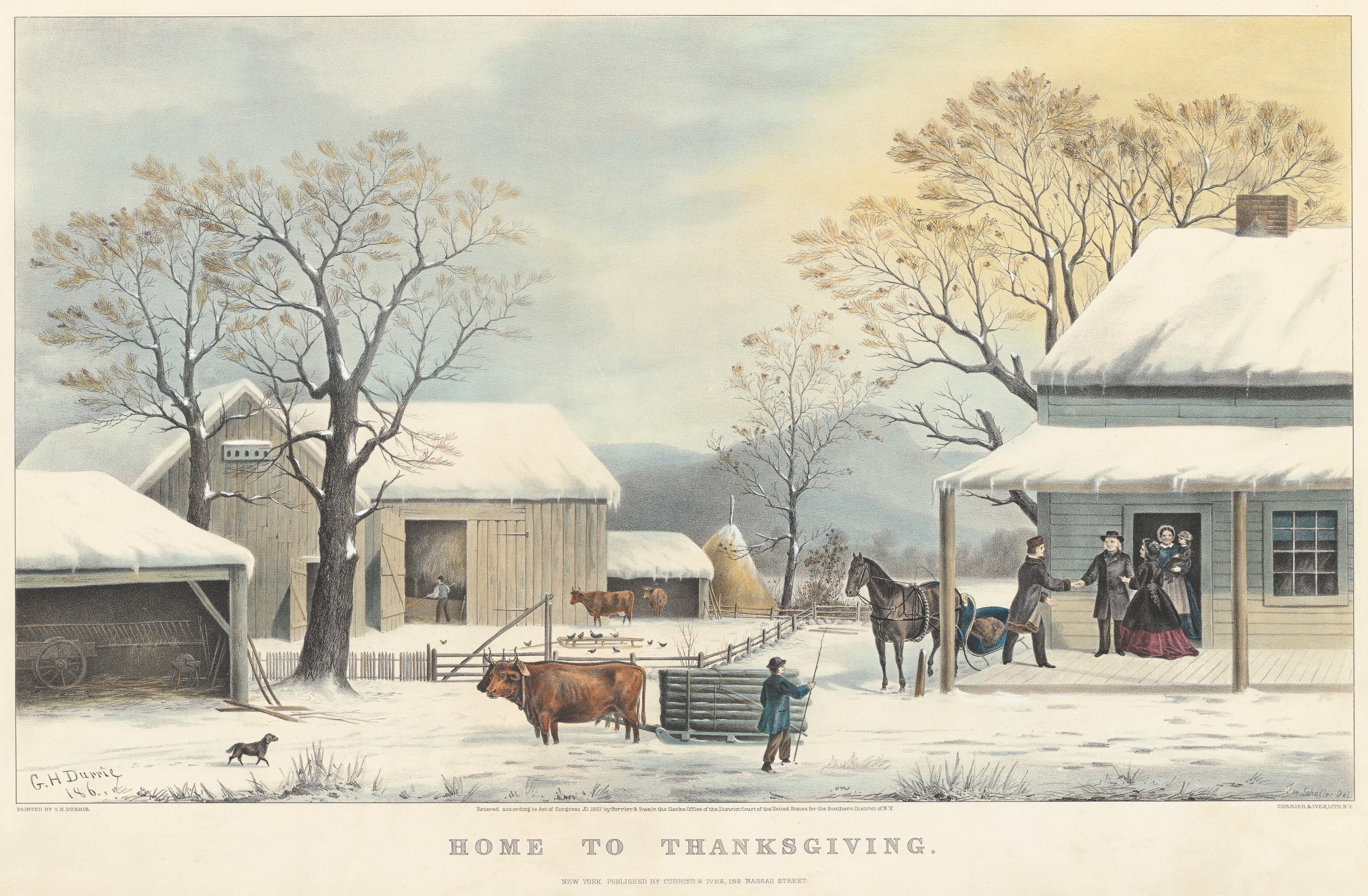
Tomorrow is Thanksgiving. To celebrate the holiday, I thought I’d reprint a lightly revised version of our now-annual CHH Thanksgiving post, to share with you a few vintage recipes and a nice Currier & Ives lithograph from the period.1
Thanksgiving, 1867
Durrie, George H. and John Schutler, Home to Thanksgiving, ca. 1867, New York, Currier & Ives. National Gallery of Art, Collection of Mr. and Mrs. Paul Mellon. Public Domain. Click to to open larger image in a new window.
By 1867, when this sentimental lithograph was first published, the Clark family had been living in the City of Milwaukee’s seventh ward for about six years. Family patriarch Jonathan M. Clark had died a decade earlier, and his only son, Henry M. Clark, had been gone for about a year and a half. Family matriarch Mary (Turck) Clark was living in a house in Milwaukee with her unmarried daughters, Libbie, Persie, Theresa, Laura, Josie and Jennie.
It’s Thanksgiving today, and I’m taking a few days off to spend time with family. But in the spirit of the holiday, I thought I’d reprint a lightly revised version of our now-annual Thanksgiving post, to share with you a few vintage recipes and a nice Currier & Ives lithograph from the period.1
Thanksgiving, 1867
Durrie, George H. and John Schutler, Home to Thanksgiving, ca. 1867, New York, Currier & Ives. National Gallery of Art, Collection of Mr. and Mrs. Paul Mellon. Public Domain. Click to to open larger image in a new window.
The Search for JMC’s roots continues!1 For the last few months, I’ve spent hour after hour reading through hundreds of digitized pages of the various manuscript land petitions and related documents that form the Land Petitions of Lower Canada, 1764-1841 database at Library and Archives of Canada (LAC).2
The good news is that I have found a lot of information about various early Clark (or Clarke) surname immigrants that petitioned for land—and actually settled on it—in Lower Canada during the relevant years of circa 1791-1840. Many of the documents that I’ve found contain information about these Clark immigrants, their families, and from whence they come. This is important, as we need to sort the Patriot, Vermont-related Clark families from other Clark immigrants from New York and New England (including American Loyalists), and the various Anglo-Canadian Clark families that sought land in the Eastern Townships at the same time. So, you know what that means…
We need another map!
Now that we have all this data, we need a way to organize and present it. And since so many of our rejected candidates earn their “Nope, not our Clark family” status because they settled far away from Stanstead, I thought it was time to make a big map of where these various Clark petitioners for Lower Canada land actually ended up. Then, in theory, we can eliminate the Clark families that settled “too far” from Stanstead (and adjacent Derby, Vermont), and focus on the Clarks that settled in or near Stanstead itself.
It’s going to take a while to assemble and present all the data. So we need a big,easy to read map created around the time of Jonathan Clark’s childhood and/or youth, from about 1812 until his arrival in New York state in 1831. (The latter date is flexible, as long as we find a map that predates the reorganization of the townships into larger counties in 1847.) We’ve presented some great Lower Canada maps here at CHH but, as is typical of that era, if they are accurate and detailed, they also tend to be visually “busy” and hard to read. But, dear readers, I finally found just the thing…
A recent CHH comment from reader Meredith Johanson brought an interesting local history newspaper article to my attention. It’s from page 8 of the Sherbrooke [Québec] Daily Record of May 13, 1911, now available as a digital image at BAnQ.
The article was compiled by H. I Bullock, of Beebe Junction, Stanstead county, Québec. The compiler was a descendant of one of the earliest white settler families in the Eastern Townships of Lower Canada, the Ruiter family and, as of 1911, s/he possessed a number of historic Ruiter family documents.
The contents of several of these documents are presented in detail in the article, and include discussions of Ruiter family settlement in the Stanstead area, how farms and homes were created in the heavily-timbered forests of the “New Townships,” various local trades and supplies and their respective wages and costs, and early military affairs, with local militia rosters from 1809 and 1817.
The article is focused on Ruiter family documents, but many other early settlers are mentioned by name, including one William Clark, and several men with the surname Merrill. As far as we know—at the moment—none of these men are directly related to our Jonathan Morrell/Merrill Clark. But the information in this 1911 article does give a hint of what life was like for the first Stanstead-area settlers—such as Jonathan M. Clark’s still-unknown parents—in the early 1800s.
Bartlett, W. H, artist, A First Settlement, drawing, brown wash on wove paper, c. 1840, National Gallery of Canada, public domain.
I have made no cuts to the article, and since the original is long, I have not included extra commentary. I have added more white space between paragraphs for ease of reading, made a few clarifications and citations in the Notes that follow, and added an illustration not found in the original. Here’s the complete transcription. I hope you find it interesting:
Here’s another addition to our list of various Clark-surnamed people that show up in our search for Jonathan M. Clark’s kin, but we now know (with reasonable certainty) were not JMC’s parents or other relatives.
Today’s “Clark” subjects are connected to the history of the U.S. Army’s Fort Winnebago, and the surrounding area of Columbia County, Wisconsin Territory, during the decade of the 1830s.
Fort Winnebago was one of several posts in the upper Midwest garrisoned by the army’s Fifth Regiment of Infantry during Jonathan M. Clark’s three-year term in the army at Fort Howard (1833-1836). From about 1835-1836, the soldiers of the 5th regiment were responsible for cutting Wisconsin’s original east-west Military Road from Ft. Howard at Green Bay, to Ft. Winnebago at the portage between the Fox and Wisconsin Rivers, and thence to Ft. Crawford at Prairie du Chien. In the 1830s, in addition to recent recruit Jonathan M. Clark, at least two other men with the Clark surname held positions with the 5th regiment in Wisconsin. Neither of these notable Clark men—it turns out—is related to JMC.
I’m not going into great detail for each subject, but I’ll try and give enough info to make clear whom we are talking about, and why they are being added to the “Nope, not our Clark family…” list. Leading today’s installment is one of the 5th regiment’s senior officers and members of his pioneering family:
It’s Thanksgiving tomorrow, and I’m taking a few days off to spend time with family. But in the spirit of the holiday, I thought I’d reprint a lightly revised version of our now-annual Thanksgiving post, to share with you a few vintage recipes and a nice Currier & Ives lithograph from the period.1
Thanksgiving, 1867
Durrie, George H. and John Schutler, Home to Thanksgiving, ca. 1867, New York, Currier & Ives. National Gallery of Art, Collection of Mr. and Mrs. Paul Mellon. Public Domain. Click to to open larger image in a new window.
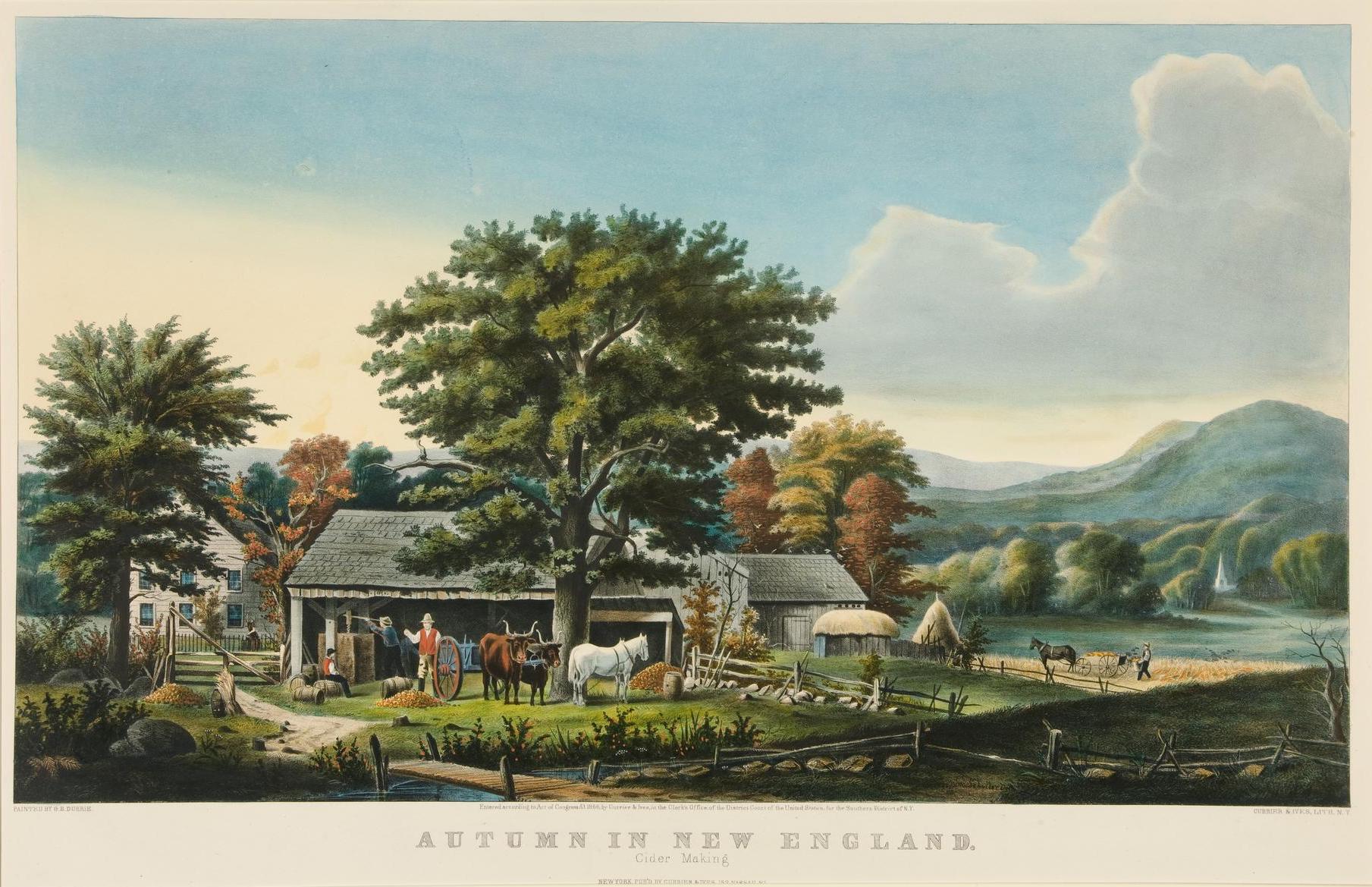
I’ve been distracted by my day job lately, and work on the Search for JMC’s Roots is progressing slowly. So while I keep chipping away at finding and organizing data from 1790s Lower Canada sources, here’s another evocative lithograph from Currier & Ives, depicting a scene that Jonathan Clark might have experienced in his youth.
I’m still reading and transcribing the various “Returns of Persons names who have taken the Oaths” that I’ve found (so far) among the Land Petitions of Lower Canada, 1764-1841. The list-making has been slow going, and nothing is quite ready for posting.
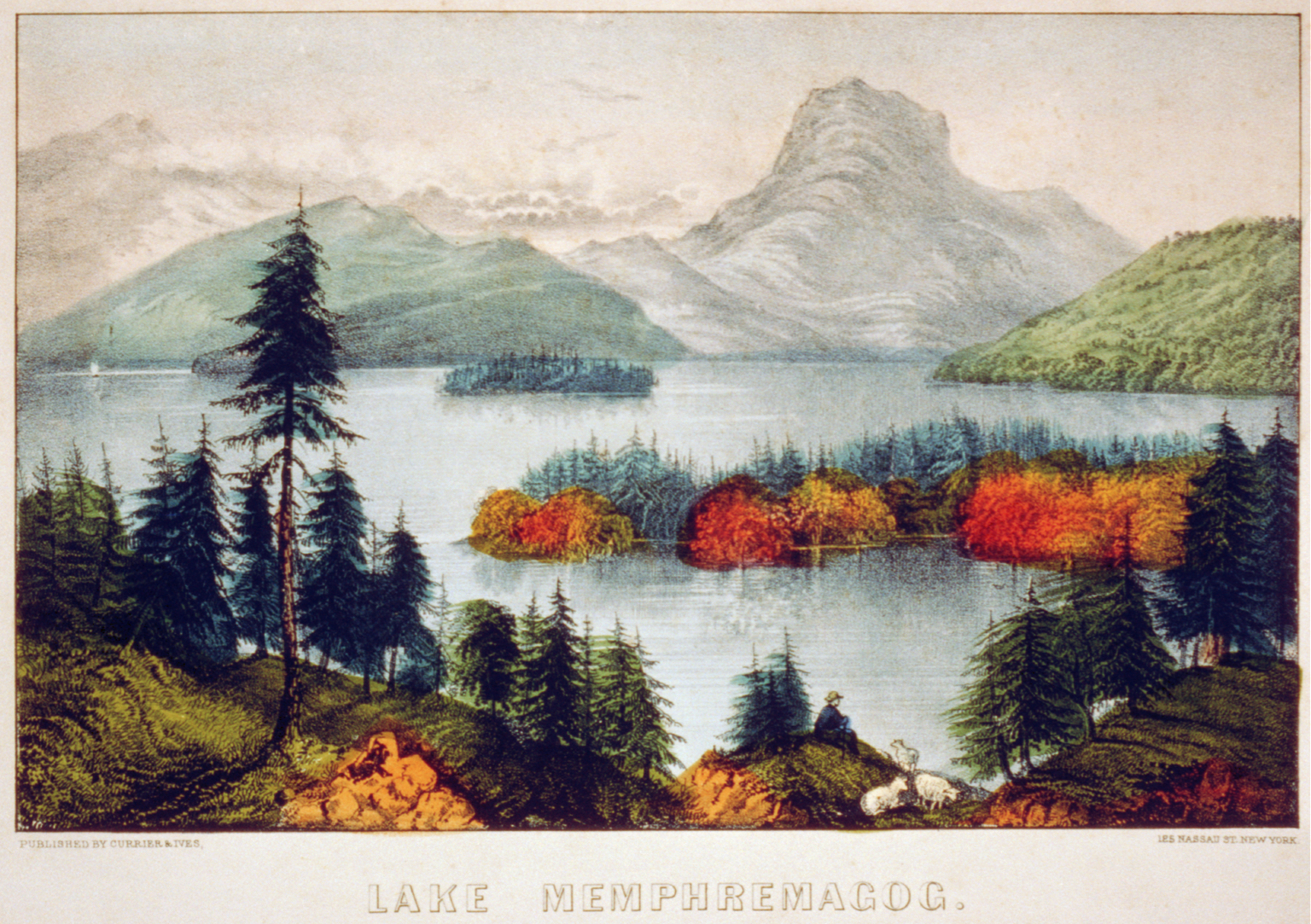
So while you’re waiting for the next installment of our “Searching for JMC’s roots” investigation, I thought you might enjoy this autumnal, hand-colored lithograph of Lake Memphremagog, looking westward across the lake from the shoreline of the northwest part of Stanstead Township—or possibly southwest Hatley Township— toward the mountain known as the Owl’s Head in Potton Township.
Recently, we examined two competing petitions seeking a grant of land for what would become the township of Stanstead, Lower Canada. The first petition was successful, the second, not. We also suspect that many, if not most, of the signers of those petitions—including more that a dozen with Clark surnames—were probably not seriously interested in obtaining Crown lands and then pioneering in the wilderness of the 1790s Eastern Townships. As we continue our search for Jonathan M. Clark’s parents or other kin in 1790s and 1800s Lower Canada and adjacent Vermont and New Hampshire, how can we identify which Clarks might be related to JMC and which are not? What were the next steps for serious prospective Lower Canada immigrants and landowners?
In reviewing the secondary literature (part 1 and part 2) I learned, in a general way, what the next steps were for bona fide immigrants to Lower Canada, people that actually intended to settle in the townships and that desired a land grant. But some of the details were a bit vague. So I went and found the government’s official proclamation outlining the new land grant policy:
UPDATED, Oct. 31, 2023. Rearranged a few paragraphs to highlight the information about a son and grandson of Isaac “Old Rifle” Clark, Satterlee Clark, senior and junior.
As we proceed in our search for Jonathan M. Clark’s kin in the area where southern Québec meets northern Vermont and New Hampshire, I thought it would be useful to begin a list of various Clark-surnamed people that show up in our search, but we know (with reasonable certainty) are not JMC’s parents or other relatives.
I’m not going into great detail for each subject, but I’ll try and give enough info to make clear whom we are talking about, and why they are on the “Nope, not our Clark family…” list. Here is today’s installment.
Sir Alured Clarke, (c. 1745-1832)
Lieutenant Governor of Lower Canada, he helped implement the Constitutional Act of 1791—and its provisions for making grants of the Crown’s “Waste Lands” in the province—and his name appears on many of the early Lower Canada land petitions, including those for Stanstead and Hatley. The Dictionary of Canadian Biography has a fine, lengthy entry (illustrated with an engraved portrait) which concludes that Clarke was “a professional soldier whose modest talents and courteous manner had enabled him to discharge the civil duties of a colonial administrator without either distinguishing or disgracing himself.”



 Clark House Historian