And what can he tell us about Jonathan’s Vermont (or Lower Canada) roots?
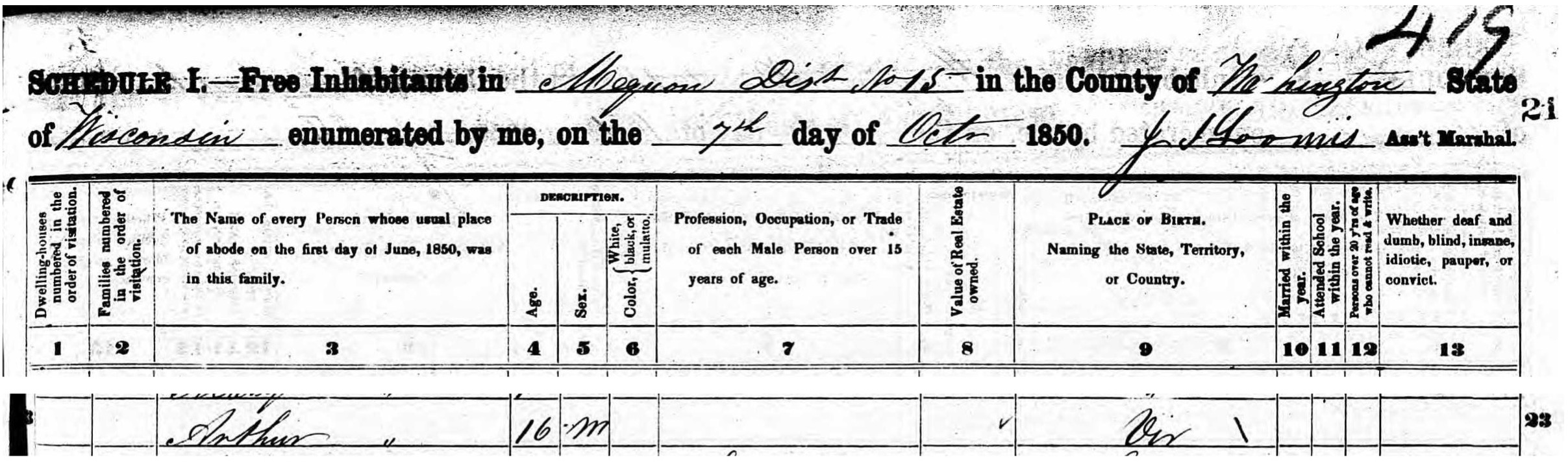
We’ve spent a lot of time looking at the Clark family on the 1850 federal census, and using that document to tease out as much information as possible about Jonathan, Mary, their children and their life in Mequon, circa 1850. If you missed the earlier posts, you can catch up here, here, here, and here. Yet after all that, we are still left with one intriguing question from that census: Who was Arthur Clark?
To date, the only source that connects any “Arthur Clark” to the Jonathan Clark family is line 23 of this page of the 1850 census. What do we find there?
Arthur Clark on 1850 U.S. Federal Census, Mequon Dist. 15, Washington Co., Wisconsin (detail of header and line 23) Click to open larger image in a new window.Continue reading →
Previously—and, yes, it’s been a while—we looked at the Jonathan Clark family as enumerated on the population schedule of the 1850 U. S. Federal Census. If you missed those posts, here are the links for Part 1, Part 2 and Part 3. Take a look at those, and you’ll learn some key facts about the Clarks: the names and ages of each person in the household, and where each was born. That’s important information, but not all. In 1850, the census bureau wanted to know more, and if we look carefully we can discover some interesting things about the family:
Do you have ancestors from the German-speaking world? No? Then perhaps you have genealogy or local history interests in southeastern Wisconsin or other German-settled areas of the USA? Or you’ve bumped into handwritten census images, family correspondence, or other historical documents that seem to be almost written in “normal,” readable cursive, but some—or a lot—of the letters just don’t make sense? Would you like to be able to decipher these records? Then whether your name is Smith or Schmidt, you need to learn a bit about Kurrent, the standard handwriting style of the German-speaking world from around the seventeenth- until the early twentieth-century.
And to make things more confusing, writers of German didn’t always use the Kurrent script. Sometimes they employed “English cursive,” also known as “Latin script,” similar to some of the well-known American and English writing styles of the time, and it’s not unusual to see documents created in both the USA and “the old country” that employ a mix of Kurrent and English cursive styles in the same document.
Here’s a practical example. Take a look at the following list of names, recorded in elegant cursive on page 1 of the 1855 Wisconsin State Census for Mequon, Ozaukee County:
Belated Happy Birthday wishes and congratulations to Clark House 2020 Staff Member of the Year, and volunteer of many talents, Shaw Bridges!
Click the photo below for an illustrated sample of Shaw’s multi-faceted contributions to Jonathan Clark House museum activities, both in public and behind the scenes.
Due to the current Covid-19 situation, Jonathan Clark House museum activities are currently suspended. We hope they will resume soon. Meanwhile, JCH director Nina Look is sending regular updates and announcements, and I’d like to pass them along to you, here.
As you’ll see from the flyer (below), we’re sorry to announce that the annual Pie on the Patio fundraiser auction has been cancelled.
Click on the page to open larger image in a new window.
I know I’ll miss seeing my Clark House friends, enjoying tasty local pie, and supporting the Clark House. But all is not lost…
In spite of the worst pandemic in a century, a quick glance at the news will show that many Americans are celebrating this Memorial Day in our now usual way, as “the first day of summer.” Beaches and parks are open, stores entice customers with deals and sales, and people are crowding shoulder to shoulder in swimming pools and along ocean boardwalks.
But for many of us, Memorial Day remains rooted in its origins as Decoration Day. The first national observance was in 1868, when retired general John A. Logan, commander and chief of the Grand Army of the Republic—the Union veterans’ organization—issued his General Order Number 11, designating May 30 as a memorial day “for the purpose of strewing with flowers or otherwise decorating the graves of comrades who died in defense of their country during the late rebellion, and whose bodies now lie in almost every city, village, and hamlet churchyard in the land.”
This Memorial Day, let’s remember those Clark House family, friends and Mequon neighbors who served in the Civil War, and what they fought—and died—for. The History of Washington and Ozaukee Counties of 1881 lists these 65 volunteers from Mequon:
“Constant vigilance!” — J. K. Rowling, Harry Potter and the Goblet of Fire
Mad Eye Moody’s advice to the Hogwarts students was essential for them and remains apt for anyone doing historical research. Whether working on a large history project or a modest family tree, constant vigilance is needed to avoid bad information. Fortunately, the historian or genealogist’s dementors are not deadly wraiths ready to suck the life force from us, but more mundane creatures such as typos, inaccessible or hard-to-read documents, and—most vexingly—mystery data.
For some reason, in my database I had recorded that Jonathan and Mary Clark’s sixth child, daughter Laura, had a middle name of “Mandlena.” This—unless I’ve overlooked some important but now lost evidence—was nonsense. It’s the sort of mistake that creeps into historical writing via random error; I don’t know how I managed to make this particular honker. So for the record, the Clark’s sixth child was Laura Marcelleau Clark.
To all my blog readers, I hope this finds you well and staying safe at home.
I just received a message from Jonathan Clark House director Nina Look and I thought I’d share it with you:
Dear Friends-
As you might imagine, the Clark House is closed at this time, but we continue to think about the history of our early settlers and how important it is to share that history with our children. I prepared the attached guide with the help of JCH Education Coordinator Margaret Bussone and JCH Curator Fred Derr.
Feel free to pass it on to a young person who may want to “Think like a historian.”
It’s almost March and that means Spring is coming, and so is America’s classic game—baseball. So leave winter behind and join the Friends of the Jonathan Clark House on Wednesday, March 4, from 6:30-8:00 p.m. at the Concordia University Wisconsin Pharmacy Building, room 008, for a lively talk by Dr. Patrick W. Steele on the “History of Baseball in Wisconsin.”
Refreshments will be served and door prizes given. The event is free and open to the public, with a suggested $10 donation to the Friends of the Jonathan Clark House. An RSVP to jchmuseum@gmail.com will help us plan the event. Need more information? Contact Clark House director Nina Look at jchmuseum@gmail.com
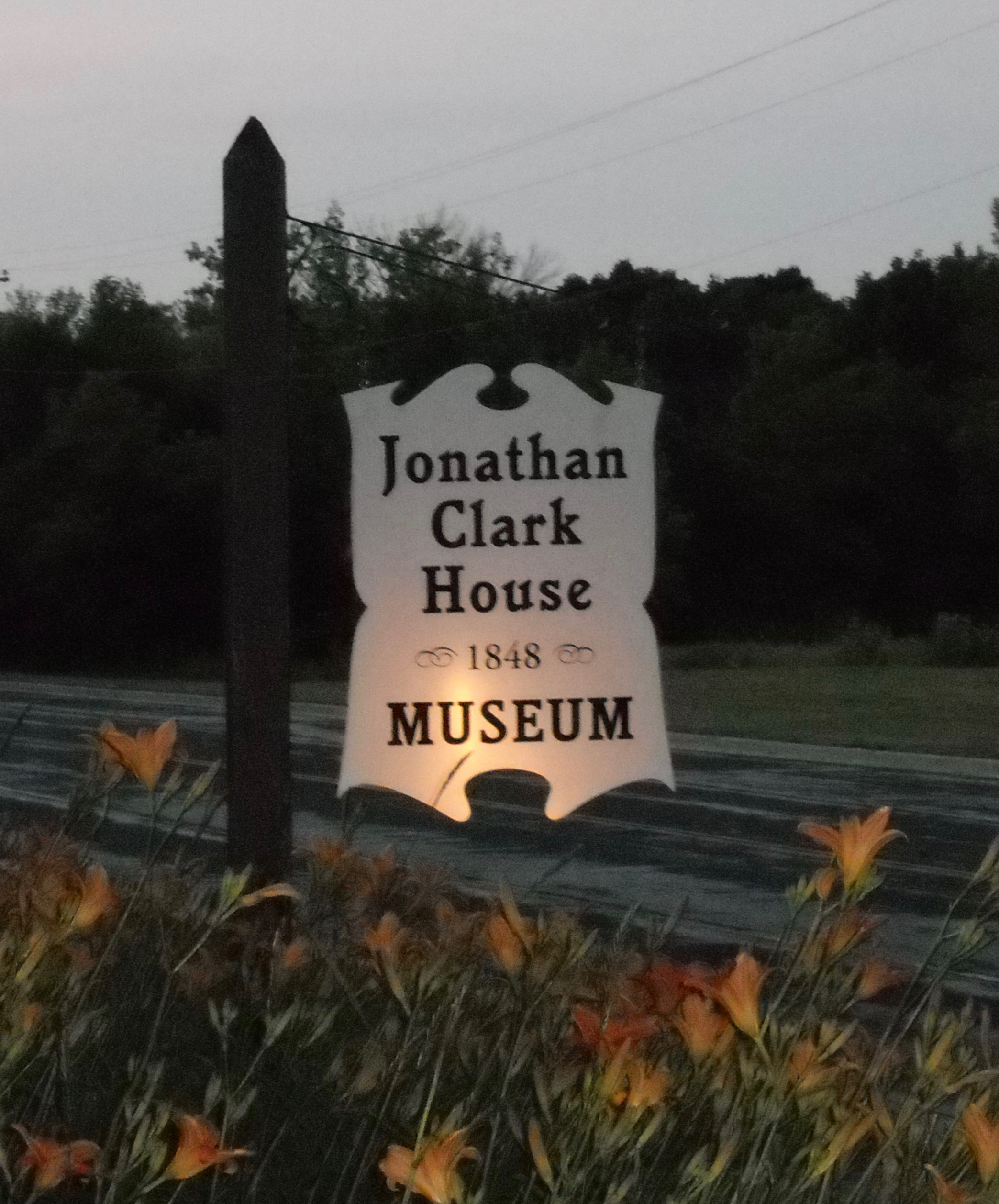
Jonathan Clark House sign, Mequon. Photo by Reed Perkins.
Even if the New Year is already 1/12th done – and we’re still two months away from the blog’s fourth (!) anniversary – Greetings and Best Wishes for a fine 2020 to all of you.
As always, I continue to be busy researching a large number of Clark House related subjects, and I look forward to sharing my findings with you in the coming year and beyond.
The new year is also a fine time for making changes, and I decided it was time to make a big one here at the Clark House Historian blog — no more ads! I don’t know about you, but I was getting pretty tired of reading posts and looking at historic documents while surrounded by images of nasty foot conditions and ambulance-chasing lawyers. So I finally took the plunge and shifted from a free but ad-filled blog to a paid plan with, finally, no ads! I hope you enjoy the more reader-friendly experience.





 Clark House Historian