It’s been a week of constant organizing at my house. A useful and productive week, perhaps, spent sorting, reading, and filing paperwork, and updating the household accounts. But not much writing.
Of course, the need to sort, repair and organize is not limited to our era. I suspect the Clarks, Turcks, Bonniwells—and their neighbors—spent a good bit of time trying to catch up with their 19th-century chores, like this fellow…
Guy, Seymour Joseph (1824–1910), Utilizing a Spare Moment, oil on canvas, c. 1860-1870. Yale UniversityArt Gallery, public domain (CC0 1.0). Click to open larger image in new window.
Unknown photographer, [Occupational Portrait of a Blacksmith, Three-Quarter Length, Working on a Horseshoe at an Anvil, Other Tools to His Side], no place, daguerreotype circa 1840-1860. Library of Congress, public domain, cropped and exposure lightened. Click to open larger image in new window.
I’m at the writer’s “forge,” trying to beat several new blog posts into shape.
Today’s post continues our series about the life of Alfred Bonniwell, youngest son of Mequon’s Bonniwell family, and brother-in-law of Jonathan and Mary (Turck) Clark. If you missed them, our first installments are here, here, here and here. And for more on how the Bonniwells got from New York to Wisconsin in 1839, see Erie Canal – the Bonniwell Family 1832-39 , complete with a handsome, annotated map.
Alfred enters the public record
In our previous posts, we have discussed the lack of specific records documenting Alfred Bonniwell’s life after his baptism in Chatham, Kent, England in 1826, through his migration to Canada and his years in New York.1 That began to change once the family arrived in Wisconsin. Today I’d like to add to our knowledge of Alfred and his family by investigating an essential census schedule that provides important information about their first year in Wisconsin.
1836 & 1838 – Wisconsin’s first territorial censuses
The Bonniwells were still in New York at the time of Wisconsin’s first two territorial censuses in 1836 and 1838, but other notable Mequon pioneers were enumerated as they claimed and cleared land for new farms. If you missed our discussions of these early censuses, you can catch up by reading: • Census Records for the In-Between Years: 1836, locating Jonathan Clark’s unit as they cut the Military Road along the Fox River, and • Census Records for the In-Between Years: 1838, the first census for the original Washington county.
1840 – Federal decennial census
The 1840 federal decennial census2 is the first census that records members of the Bonniwell family in Wisconsin. It was enumerated in “Wiskansin Territory, Washington County, June 1, 1840.”
Ancestry.com. 1840 United States Federal Census [database on-line], Washington, Wisconsin Territory; Roll: 580; Page: 123; Hyde and Bonniwell households; Family History Library Film: 0034498. Image annotated, lightly tinted, and cropped. Click to open larger image in new window.
Today’s post continues our series about the life of Alfred Bonniwell, youngest son of Mequon’s Bonniwell family, and brother-in-law of Jonathan and Mary (Turck) Clark. If you missed them, our first installments are here, here and here. UPDATED, February 2, 2022, to include additional information and a link to an earlier post about Bonniwell brother-in-law Philip Moss. UPDATED, May 22, 2022, to correct Charles Bonniwell’s birth year (should be 1806)
Following their father’s death and burial in Montréal, Lower Canada, on October 18, 1832, the Bonniwell family was at a crossroads. Their original plan to patent land in Lower Canada had to be abandoned. As eldest son Charles Bonniwell recalled;
[…] the family received letters from the brothers who had located in New York [George and William] to come there without delay, and so [we] lost no time in taking the trip by way of Lake Champlain and Whitehall. I went to work in New York [City] where my brothers had employment at the navy yard.1
Whitehall, New York state’s port of entry at the south end of Lake Champlain, was an important waypoint for the Bonniwells, as it would also be for Jonathan M. Clark and other future Mequon neighbors. For more on that, including a handsome lithograph of Whitehall as it appeared c. 1828-1829, see How’d they get here? – JMC, the Bonniwells, and Whitehall, NY
As it turns out, Charles Bonniwell’s statement, “[we] lost no time in taking the trip by way of Lake Champlain and Whitehall,” may be a bit of a generalization. While I have not had a chance to collect or examine copies of the actual naturalization documents for all the Bonniwell boys, the modern index cards for those papers indicate that at the time of father William T. B. Bonniwell’s death the family was already dispersed at several locations. They would eventually reunite and migrate to Wisconsin Territory in 1839.
Where’s Alfred?
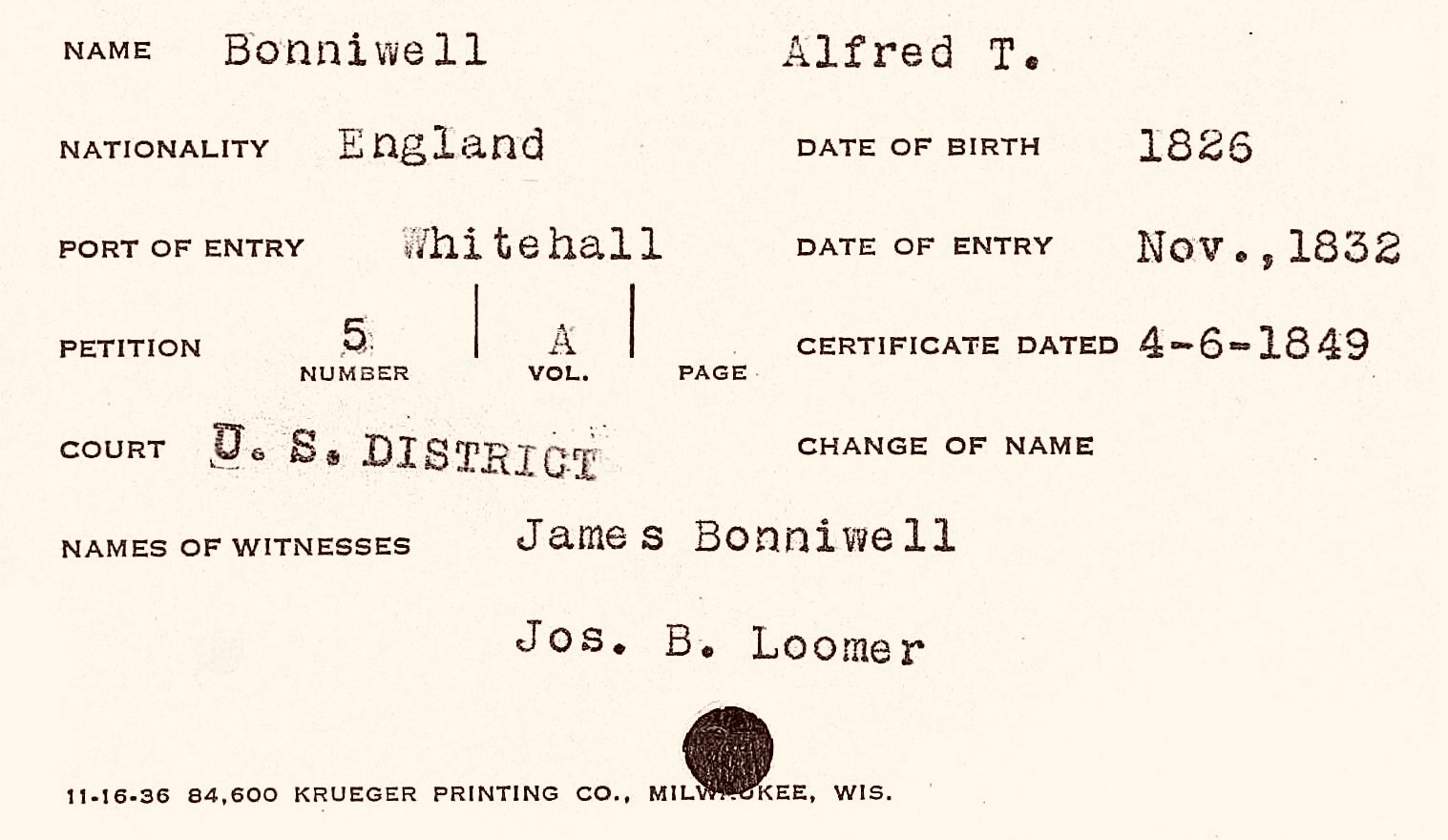
Many aspects of the lives of the Bonniwell family in New York are not well documented, including the activities of young Alfred T. Bonniwell. Alfred was only six and a half years old when his father died in Montréal in October, 1832. According to his naturalization papers (filed in Milwaukee on April 6, 1849, and summarized on this modern index card), we know Alfred entered the United States at Whitehall, New York, sometime in November, 1832.
This index card—and Alfred’s 1849 final citizenship document that it summarizes—are the only two official records that I have located that document Alfred’s years in New York state. Without some of the Bonniwell family papers cited in The Bonniwells, and the newspaper articles featuring Charles’s recollections, much of Alfred’s—and his family’s—life from 1832 to 1839 would be a complete mystery.
Based on brother Charles’s recollections, and other documents we have, we can assume that when Alfred came to the U.S. he was accompanied by his mother and several of his siblings, including brothers Charles (27), James (21), and Walter (age 8), and sister Eleanor (18). But not brother Henry (age about 14); more on Henry’s wanderings, below. But my understanding of which Bonniwell migrated via which port, to which destination, and what they did after arrival, is not completely clear. In fact, the family did not all travel together from Montréal to New York, via Whitehall, in November, 1832. Let’s look at the documents for more information…
Today’s post is another installment in our new series about the life of Alfred Bonniwell, youngest son of Mequon’s Bonniwell family, and brother-in-law of Jonathan and Mary (Turck) Clark. If you missed them, our first installments are here and here. Although I—and others—have written quite a bit about the Bonniwells in Mequon, Alfred and his family have remained something of a mystery. It’s time to try and fix that. So for the next few posts our focus will be on Alfred Bonniwell, his life and descendants, as described in contemporary documents.
Alfred Bonniwell’s earliest record
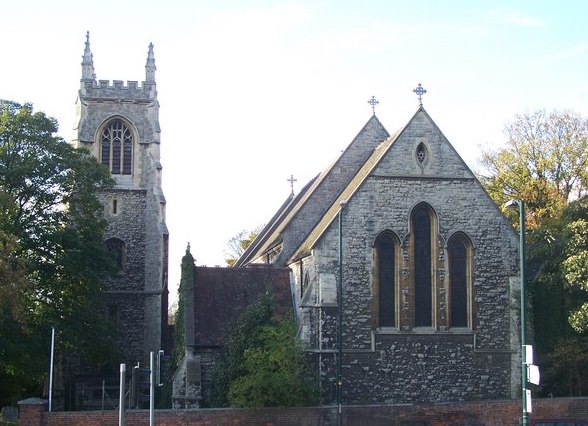
The earliest record of Alfred Bonniwell that I have seen is an index of his 1826 baptism.1 It includes this information:
Name: Alfred Febbett Bonniwell Christening Date: 7 May 1826 Christening Place: St. Mary’s, Chatham, Kent, England Father’s Name: William Bonniwell Mother’s Name Eleanor Bonniwell
Other, later, records indicate that Alfred was born on April 1, 1826. A baptism in the following month or so—such as on May 7th, 1826—would be pretty typical for Anglican parish baptisms of the period. So the date, as well as the names of the parents, are consistent with what we already knew about Mequon’s Alfred Bonniwell.
I’m gotten a good bit of research done on my Alfred and Sarah (Turck) Bonniwell project this week, but time (and focus) to write and edit posts has been at a premium. So while I’m still writing and editing, here’s a historic Bonniwell-related image for your enjoyment.
Chatham Dockyards, c. 1763-1789
Mitchell, Thomas (1735-1790), Chatham; view from a height over a dockyard with man-of-war being repaired at centre, a building with a clocktower at right and another building at right, brush drawing in grey wash, with watercolor, over graphite. Copyright, Trustees of the British Museum, (CC BY-NC-SA 4.0 license). Click to open larger image in new window.
UPDATED 16 July 2022, to correct typo in Alfred’s death year. Correct year is 1895.
At last month’s annual meeting of the Friends of the Jonathan Clark House, assistant director Nina Look mentioned that she had some sort of research project coming later this year, involving the youngest Bonniwell brother, Alfred T. Bonniwell (1826-1895). I’m not quite sure what Nina’s project will focus on, but Alfred is, perhaps, the least-known Bonniwell, and deserves further study.
As a Bonniwell brother, Alfred plays his part in the establishment of one of Mequon’s first cleared and populated areas, the Bonniwell Settlement. The Clark house—and Clark family—played an important role in the early decades of this settlement, and the history of the Clark family is intimately tied up with their neighbors, the Bonniwells. How intimately?
Updated February 22, 2022 to fix a few minor typos, and to add a link to a brief history of American samplers, with an illustrated list of 73 of the 137 American samplers in the Textile Collection of the National Museum of American History.
In addition to raising and educating her children, a 19th-century farm wife like Mary Turck Clark had many other responsibilities, including planning and tending a farm garden, preserving its produce, preparing daily meals for the family and hired hands, and keeping the farm house clean and organized. And Mary, like many women of her era, probably made some or all of her own and her family’s clothes.
The sewing arts
Like most girls of her era, Mary Turck (born in New York, 1821) probably learned the craft of needlework from her mother and, perhaps, as part of her school education. When a young girl like Mary mastered some of the many practical and decorative sewing stitches, she might demonstrate her proficiency by making a sampler.
A sampler might feature simple examples of sewn letters, numbers and perhaps a popular saying or Bible verse. But many samplers were more complex and artistic. An accomplished embroiderer might produce an elaborate sampler featuring detailed images and texts, as in this 1829 sampler from Connecticut.
Thompson, Mariette (1817-1851), [Sampler with family register], 1829. Yale Art Gallery, public domain. Click to open larger image in new window.
Updated Feb. 14, 2022 to add the qualifier “English-speaking” to the second paragraph.
Did you watch the Big Game? Go out to eat? Maybe you had to put in a shift at work? Or did you just take a break and relax at home, gearing up for another week on the job? Perhaps you went to church on Sunday.
In Jonathan and Mary Clark’s era, many of their Mequon neighbors would honor the Sabbath by refraining from all work and worshiping privately at home with their families, or gathering with small groups of neighbors to pray and hear the Word. Beginning in the early-1840s, the English-speaking Protestant Christians living near the Clark House—including many members of the Clark, Bonniwell and Turck families—gathered at the new, one-room, Bonniwell School to worship together at Sunday services; these were often led by their neighbor, the farmer and evangelical Methodist preacher Rev. James W. Woodworth.
Rev. Woodworth has concerns…
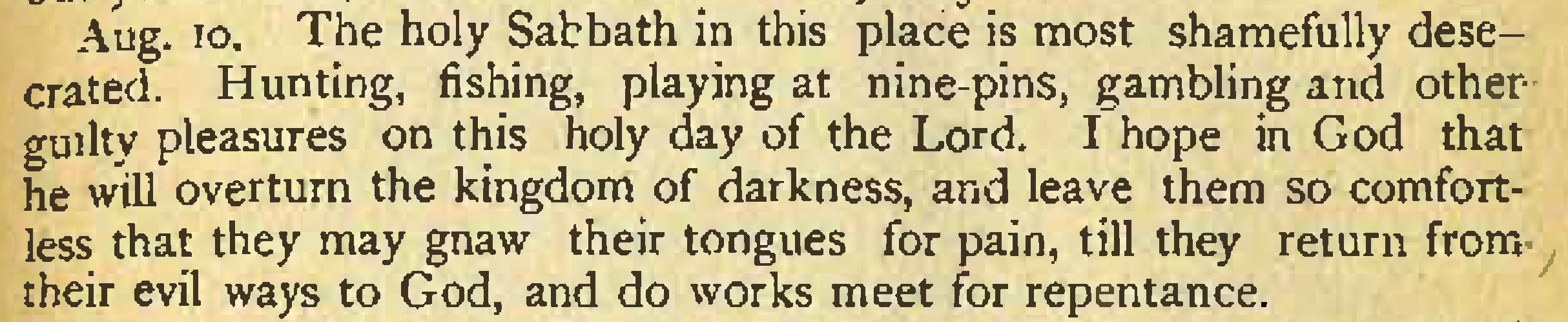
We have talked about Rev. Woodworth previously and, as we have seen before, he was constantly concerned about the state of his neighbors’ souls. It seems that even though the nation was still riding the wave of several decades of the religious revival now known as the Second Great Awakening, the settlers of the young Wisconsin territory and state were not always very good at “keeping the Sabbath holy.” In his diary entry for August 10, 1855, the reverend lamented:
Aug. 10. The holy Sabbath in this place is most shamefully desecrated. Hunting, fishing, playing at nine-pins, gambling and other guilty pleasures on this holy day of the Lord. I hope in God that he will overturn the kingdom of darkness, and leave them so comfortless that they may gnaw their tongues for pain, till they return from- their evil ways to God, and do works meet for repentance.
Woodworth, James W., My path and the way the Lord led me, Milwaukee, 1878, p. 79.
We’ve mentioned Whitehall, New York, on several occasions. Located just east of the south end of Lake Champlain, the town of Whitehall has long claimed to be the “Birthplace of the U.S. Navy.” More importantly for our story, in 1823 Whitehall became the northern terminus of the Champlain Canal, connecting the Hudson River and the Erie Canal to Lake Champlain and points further north.1
Port of Entry
More importantly for our story, Whitehall served as an international port of entry for immigrants coming to New York and New England from Canada and overseas via the St. Lawrence River and Lake Champlain. In the early 1830s, these immigrants included Jonathan M. Clark, who came from Lower Canada in April, 1831,2 and the entire Bonniwell family, who arrived the following year.3
What did our immigrants of 1831 and ’32 see just before they stepped ashore in the United States? The hustle and bustle of a major harbor and center of commerce such as New York, Boston or Philadelphia? Er, no. Instead, this is what greeted our intrepid newcomers:
Whitehall, Lake Champlain
Milbert, Jacques Gerard, Amerique Septentrionale – Etat de New-York. N. 21, pl. 1…White Hall, Lake Champlain, Lithograph by Bichebois and Adam, Paris, 1828–1829. Yale Art Gallery, Mabel Brady Garvan Collection. Public Domain. Click to open larger image in new window.





 Clark House Historian