Unknown photographer, [Occupational Portrait of a Blacksmith, Three-Quarter Length, Working on a Horseshoe at an Anvil, Other Tools to His Side], no place, daguerreotype circa 1840-1860. Library of Congress, public domain, cropped and exposure lightened. Click to open larger image in new window.
I’m at the writer’s “forge,” trying to beat several new blog posts into shape.
Updated February 22, 2022 to fix a few minor typos, and to add a link to a brief history of American samplers, with an illustrated list of 73 of the 137 American samplers in the Textile Collection of the National Museum of American History.
In addition to raising and educating her children, a 19th-century farm wife like Mary Turck Clark had many other responsibilities, including planning and tending a farm garden, preserving its produce, preparing daily meals for the family and hired hands, and keeping the farm house clean and organized. And Mary, like many women of her era, probably made some or all of her own and her family’s clothes.
The sewing arts
Like most girls of her era, Mary Turck (born in New York, 1821) probably learned the craft of needlework from her mother and, perhaps, as part of her school education. When a young girl like Mary mastered some of the many practical and decorative sewing stitches, she might demonstrate her proficiency by making a sampler.
A sampler might feature simple examples of sewn letters, numbers and perhaps a popular saying or Bible verse. But many samplers were more complex and artistic. An accomplished embroiderer might produce an elaborate sampler featuring detailed images and texts, as in this 1829 sampler from Connecticut.
Thompson, Mariette (1817-1851), [Sampler with family register], 1829. Yale Art Gallery, public domain. Click to open larger image in new window.
Updated Feb. 14, 2022 to add the qualifier “English-speaking” to the second paragraph.
Did you watch the Big Game? Go out to eat? Maybe you had to put in a shift at work? Or did you just take a break and relax at home, gearing up for another week on the job? Perhaps you went to church on Sunday.
In Jonathan and Mary Clark’s era, many of their Mequon neighbors would honor the Sabbath by refraining from all work and worshiping privately at home with their families, or gathering with small groups of neighbors to pray and hear the Word. Beginning in the early-1840s, the English-speaking Protestant Christians living near the Clark House—including many members of the Clark, Bonniwell and Turck families—gathered at the new, one-room, Bonniwell School to worship together at Sunday services; these were often led by their neighbor, the farmer and evangelical Methodist preacher Rev. James W. Woodworth.
Rev. Woodworth has concerns…
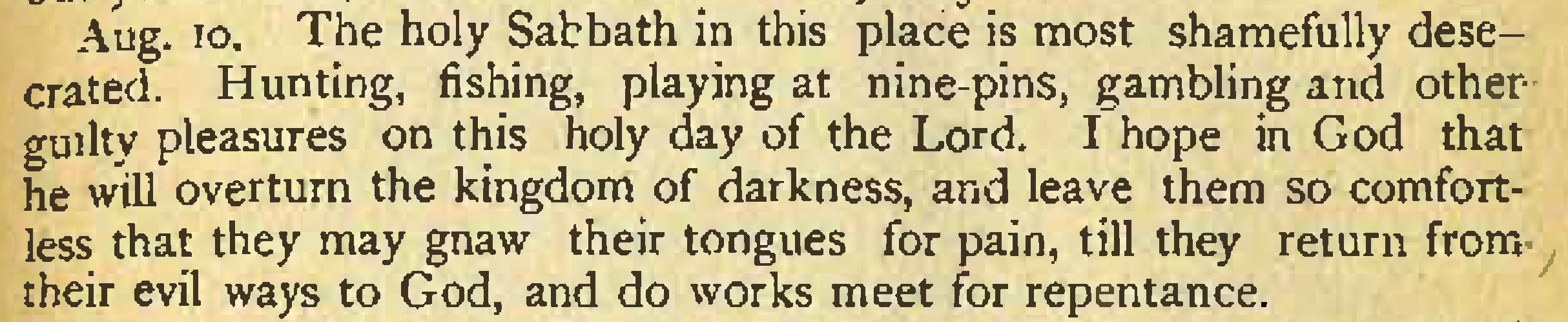
We have talked about Rev. Woodworth previously and, as we have seen before, he was constantly concerned about the state of his neighbors’ souls. It seems that even though the nation was still riding the wave of several decades of the religious revival now known as the Second Great Awakening, the settlers of the young Wisconsin territory and state were not always very good at “keeping the Sabbath holy.” In his diary entry for August 10, 1855, the reverend lamented:
Aug. 10. The holy Sabbath in this place is most shamefully desecrated. Hunting, fishing, playing at nine-pins, gambling and other guilty pleasures on this holy day of the Lord. I hope in God that he will overturn the kingdom of darkness, and leave them so comfortless that they may gnaw their tongues for pain, till they return from- their evil ways to God, and do works meet for repentance.
Woodworth, James W., My path and the way the Lord led me, Milwaukee, 1878, p. 79.
Updated Feb. 11, 2022, with information about Milwaukee’s “original Ice Bear,” Henry Kroeger (see comments, below).
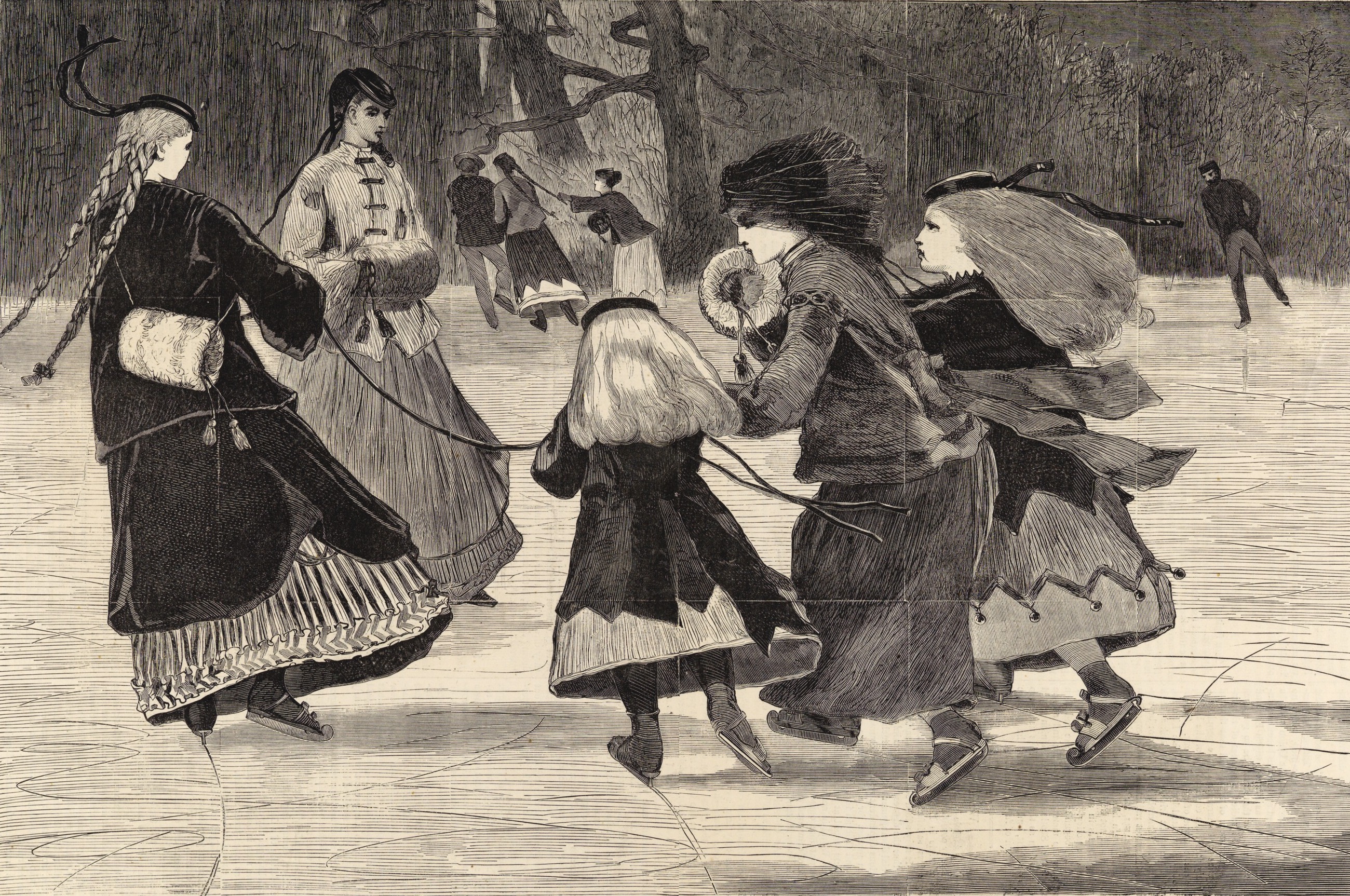
The 24th Winter Olympic Games are now under way in Beijing, with a dizzying profusion of modern sliding and gliding winter sports. Of course, outdoor winter games and sports pre-date the modern Olympics by hundreds, if not thousands, of years. Among the oldest and most popular of these is ice skating.
Homer, Winslow, “Winter” — A Skating Scene, from Harper’s Weekly, January 25, 1868. Smithsonian American Art Museum, The Ray Austrian Collection, gift of Beatrice L. Austrian, Caryl A. Austrian and James A. Austrian. Public domain, CC0. Click to open larger image in new window
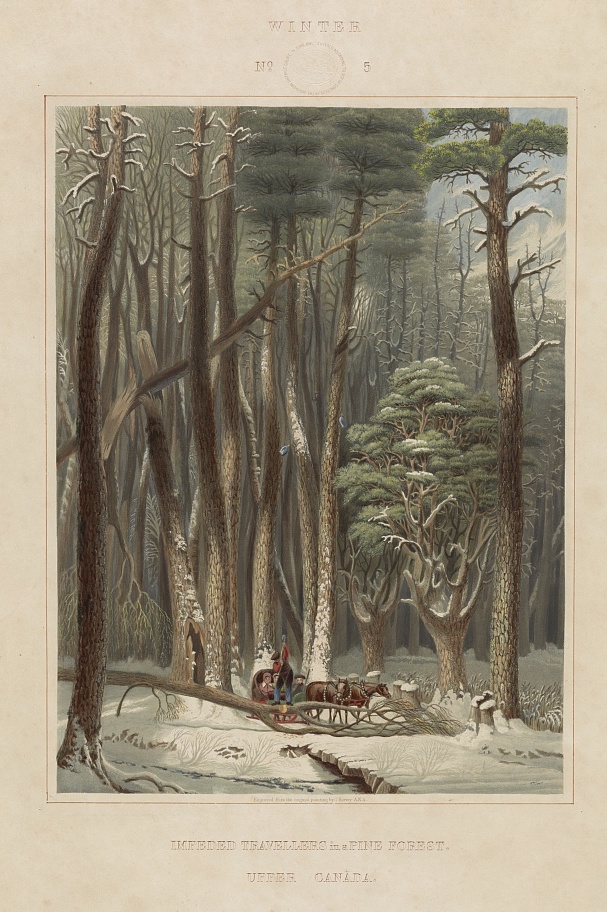
In Jonathan and Mary Clark’s era, if you needed to get somewhere during the winter—for business or for pleasure—you probably rode in a a horse-drawn sleigh. Travel in a sleigh could be fun, even exhilarating, but was not without its perils, most of which came from inadequately maintained roads and trails:
Bennett, W. J. , Engraver, and George Harvey. Winter. No. 5., Impeded Travelers in a Pine Forest, Upper Canada / engraved from the original painting by G. Harvey A.N.A., New York, 1841. Color aquatint. Library of Congress. Click to open larger image in new window.
Happy New Year to all, and best wishes that 2022 will be an improvement on the past year. (A low bar, I know.) Anyway, when I first published this post, on January 1, 2021, I wrote: I’m almost done with my research on the second half of the 1843 concert by the Milwaukie Beethoven Society. (If you missed our earlier posts on that concert, links are here and here.) But it’s New Year’s Day, and I’m not quite done writing about “Part Second.”
Well, it turns out that “not quite done” was an optimistic estimate, as I became distracted by so many other research topics and posts and never got around to discussing the second part of the Milwaukee Beethoven Society’s concert. New Year’s Day is here again, and I’m still not done, alas, but I have not forgotten and—with luck—I will finish that post some time this winter.
A spot of Spofforth to ring in the New Year…
Meanwhile, let’s start the New Year on a cheerful note by reprising last year’s festive musical selection, drawn from that second part of the Milwaukee Beethoven Society’s 1843 premiere concert:
Milwaukee Weekly Sentinel March 15 1843, page 2. Click to open larger image in new window.
It’s the week after Christmas. Perhaps you have family or friends visiting from out of town. If you have children, they’re home from school. How to keep them entertained? If you lived near New York City in 1864, you were in luck. Barnum’s American Museum was ready with spectacular and unique holiday exhibits for the whole family, all for the low, low, price of 25 cents for adults, 15 cents for children under age ten!
Barnum’s American Museum. Christmas and New Year holiday bill, 1864. [New York: Wynkoop, Hallenbeck & Thomas, Book and Job Printers, 113 Fulton St. N.Y], Library of Congress. Click to see larger, easier to read, image.
I’m still catching my breath after writing Thursday’s big post on the life of Caroline Clark’s mentor, John G. McKindley. We’ll return to Caroline (Clark) Woodward, and see how her time with McKindley influenced her adult life and work, in just a bit.
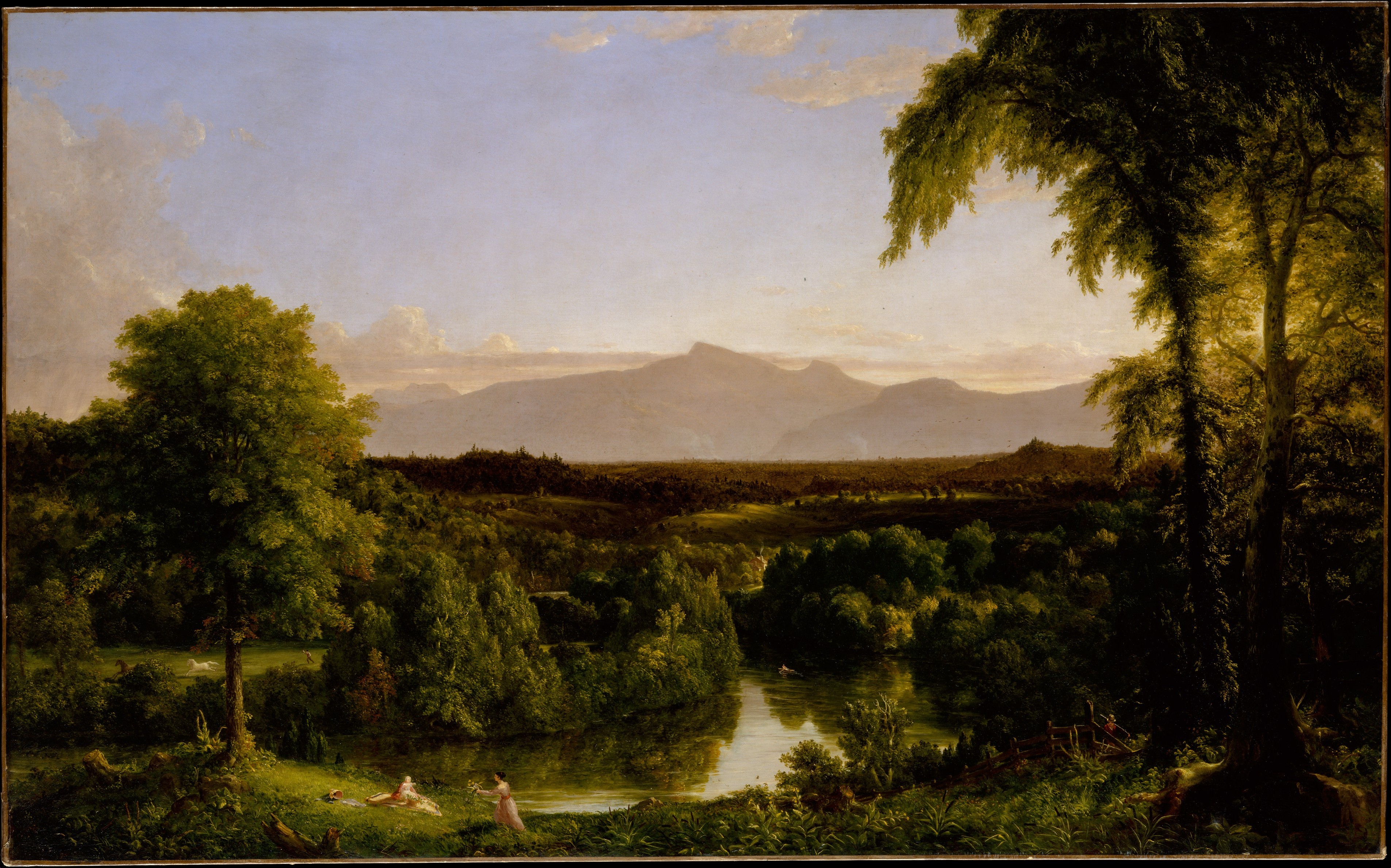
In the meantime, here’s a lovely fall scene that would have looked very familiar to Mary (Turck) Clark’s mother Rachael (Gay) Turck, and to Rachael’s Gay and Van Loon / Van Loan parents and ancestors:
Cole, Thomas, View on the Catskill—Early Autumn, 1836-1837. The Metropolitan Museum of Art, New York, gift in memory of Jonathan Sturges by his children, 1895. Public domain. Click to open larger image in new window.
I’m still sifting through a huge (mostly digital) pile of Caroline M. Clark and William W. Woodward sources and trying to organize them into a series of coherent and interesting posts for you. Sort of like assembling a bunch of hastily-drawn field surveys and turning them into accurate topographical maps or railroad construction plans:
Unknown photographer, W.W. Wright, Chf. Eng. & … Mil. RRds. United States, circa 1861 and 1866. Library of Congress. Click to open larger image in new window.
Caroline (Clark) Woodward, in our first Clark family endorsement!
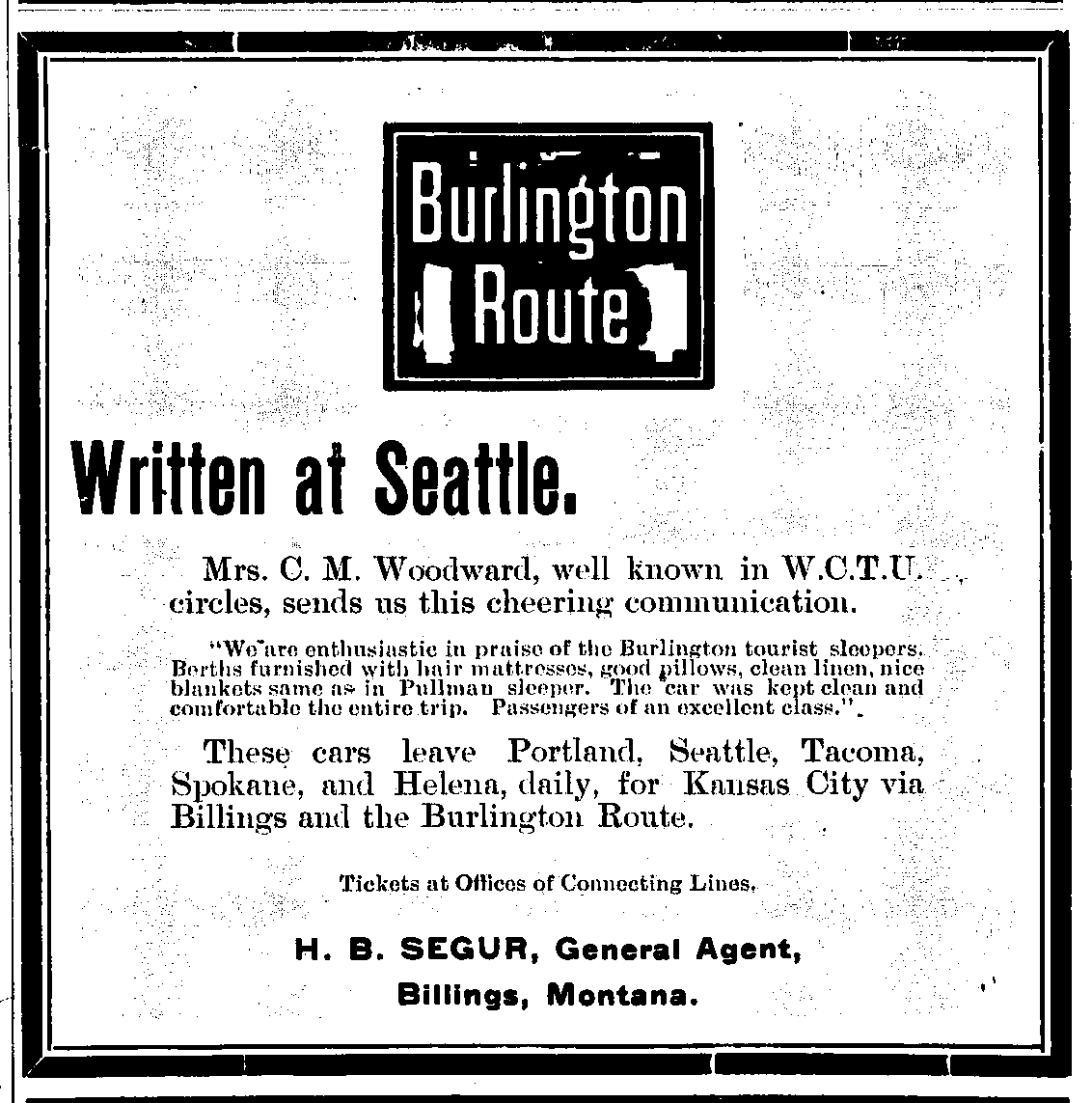
Here’s something new for Clark House Historian: a commercial endorsement from one of Jonathan and Mary Clark’s children! In June, 1900, our own Caroline M. (Clark) Woodward recommended travel on the Burlington Route in this newspaper ad…
Woodward, Caroline in railroad advertisement, Red Lodge Picket, Red Lodge, Montana, June 1, 1900, page 3. Click to open larger image in new window.
Mrs. C. M. Woodward, well known in W.C.T.U. circles sends us this cheering communication.
“We are enthusiastic in praise of the Burlington tourist sleepers. Berths furnished with hair mattresses, good pillows, clean linen, nice blankets, same as in Pullman sleeper. The car was kept clean and comfortable the entire trip. Passengers of an excellent class.”





 Clark House Historian