Who’s Who at Forts Howard & Winnebago, 1829-1837

I’m getting back into the blogging groove, and one of my first projects is to continue our series “Not our Jonathan: other “J. M. Clarks” in 1830s & ’40s Wisconsin.” And in my research for that, I’m looking into the identities of one or more men named “J. M. Clark” that served as chaplain at the 5th Regiment’s post at Fort Winnebago.

An important primary source for this research are the monthly “Returns” or reports, sent from the 5th Regiment’s posts at Forts Howard and Winnebago back to the army’s chief bureaucrat, the Adjutant General, in Washington, D.C. We’ve examined these Returns several times on Clark House Historian, including this post from 2016 which discussed this October, 1833, bit of U.S. Army record-keeping, the Return of the Regiment [for the 5th Regiment Infantry, at Fort Howard], October, 1833, verso:
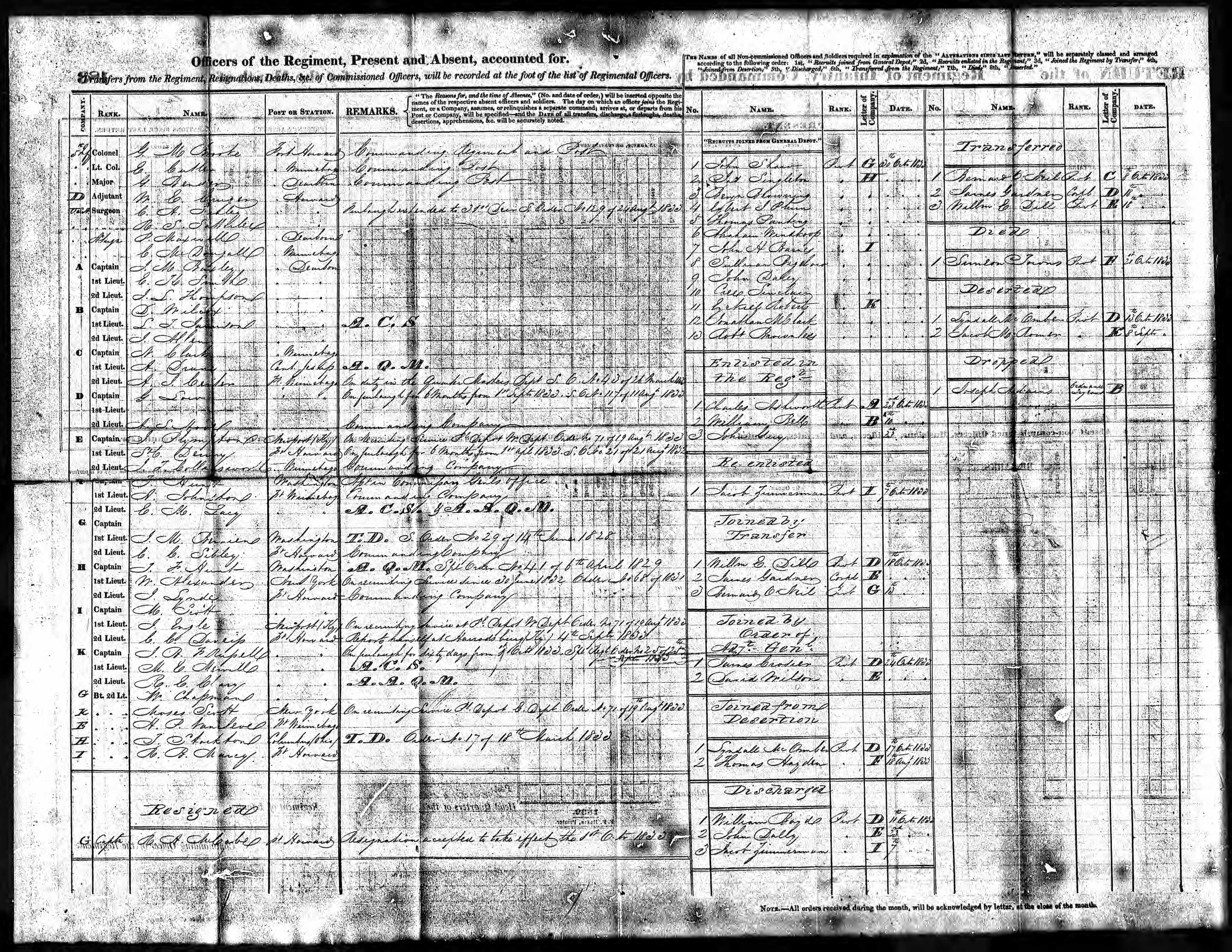
NARA, Washington, D.C.; Returns from Regular Army Infantry Regiments, June 1821 – December 1916; Microfilm Serial: M665; Roll: 54 Military Year : 1832-1842. Return of the Regiment [for the 5th Regiment Infantry, at Fort Howard], October, 1833, verso, from Ancestry.com (pay site).

What’s that name???

For our purposes, one of the most useful features of these monthly Returns is the top left section of the form, which lists the officers of the regiment by [Company], Rank, Name, Post or Station, and with a space for Remarks about their assignments, temporary duty, leaves of absence, and so on. There’s a lot of useful information here, especially the names of the officers and the companies that they lead. But click the image to open a larger version of this image, and see if you can actually read those names:
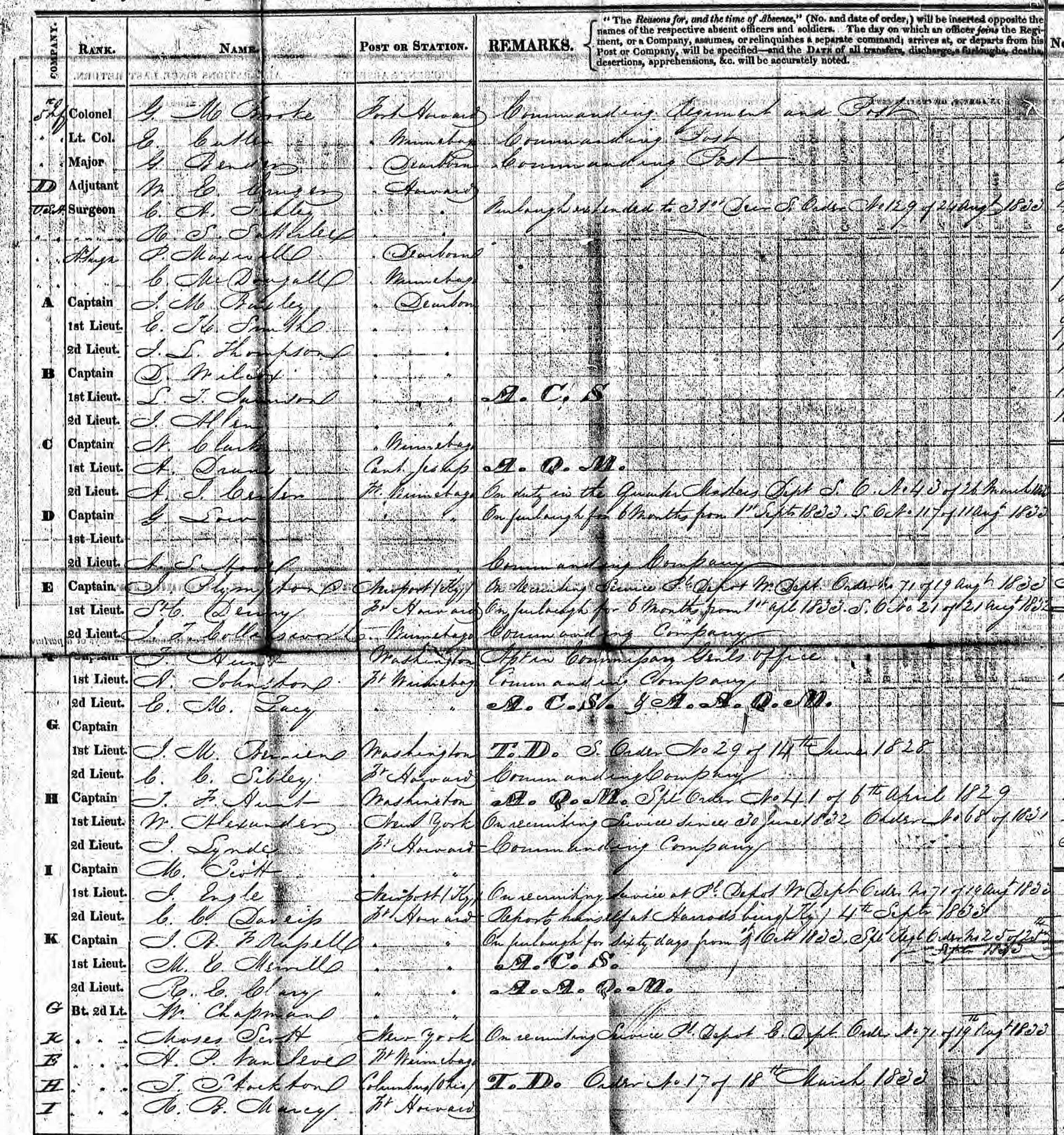
On the one hand, the regimental clerk that filled out this October, 1833, form had pretty tidy penmanship, and the digitized microfilm image is not too bad. But even so, some of the names are hard to decipher. And knowing these names can be really useful, for example when looking for correspondence between these regimental officers and the Adjutant General’s office in D.C. (See our post here, for more on this archive.)

So how do we learn “Who’s Who” on the monthly “Returns from Post” and “Returns of the Regiment”? Fortunately, the government put all that info into a series of very useful books, which are now available, for free, online…

Continue reading
Not our Jonathan: other “J. M. Clarks” in 1830s & ’40s Wisconsin (part 1)

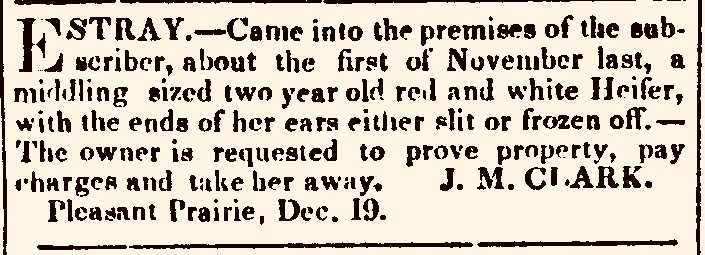
“Estray. […] J. M. Clark” advertisement, Southport [later Kenosha] Telegraph, Dec. 26, 1843, page 4

Hey! How did Mequon’s Jonathan M. Clark end up with a stray red and white heifer on his farm in…Pleasant Prairie, the most southeasterly township in all of Wisconsin, some 56 miles south of the Jonathan Clark House? The short answer is: he didn’t. The man that placed this “stray cow” advertisement in the December 16, 1843, issue of the Southport (later Kenosha) Telegraph was is not “our” J. M. Clark.

So many J. M. Clarks

Throughout the nineteenth century, many men seem to have been referred to, at least in print, by the initial letters of their first and middle names. The builder of Mequon’s Jonathan Clark House was no exception. Many of the documents made during his lifetime refer to him as “J. M. Clark,” and he often signed his name that way as well.1

“J. M. Clark,” signature of Jonathan M. Clark, from his final U.S. naturalization papers, 1853.

Unless the researcher is careful, it’s easy to make assumptions and presume that the “J. M. Clark” that built our historic Mequon home in 1848 is identical with the other “J. M. Clark” men that appear in various Wisconsin Territory documents, land patents, newspapers, and histories. Unfortunately, this is not always the case. To be certain that the “J. M. Clark” referred to in a particular source is “our” Jonathan M. Clark, we need to understand the “who, what, where and when” of each document or event that may—or may not— have involved our Jonathan.

I’m sure my list of suspects is incomplete, but (surprise!) it has turned out to be much longer and more complicated than anticipated. With that in mind, I think I’m going to need several CHH posts to sort out some of the most easily mistaken “J. M. Clark” men that lived and worked in the central and southeastern parts of Wisconsin Territory, yet were definitely not our J. M. Clark, the man born in Lower Canada (or Vermont) in 1812 that went on to build the historic Jonathan Clark House in Mequon in the 1840s.2

Let’s start with earliest and most northerly of these settlers, the first of several Christian ministers surnamed Clark that had links to Wisconsin Territory army posts that were home to our Jonathan M. Clark and his comrades during their service with the U. S. Army’s 5th regiment of infantry, 1833-1836.

Continue reading

Monday: Map Day! – Lower Canada’s Eastern Townships in 1842

The Search for JMC’s roots continues!1 For the last few months, I’ve spent hour after hour reading through hundreds of digitized pages of the various manuscript land petitions and related documents that form the Land Petitions of Lower Canada, 1764-1841 database at Library and Archives of Canada (LAC).2

The good news is that I have found a lot of information about various early Clark (or Clarke) surname immigrants that petitioned for land—and actually settled on it—in Lower Canada during the relevant years of circa 1791-1840. Many of the documents that I’ve found contain information about these Clark immigrants, their families, and from whence they come. This is important, as we need to sort the Patriot, Vermont-related Clark families from other Clark immigrants from New York and New England (including American Loyalists), and the various Anglo-Canadian Clark families that sought land in the Eastern Townships at the same time. So, you know what that means…

We need another map!

Now that we have all this data, we need a way to organize and present it. And since so many of our rejected candidates earn their “Nope, not our Clark family” status because they settled far away from Stanstead, I thought it was time to make a big map of where these various Clark petitioners for Lower Canada land actually ended up. Then, in theory, we can eliminate the Clark families that settled “too far” from Stanstead (and adjacent Derby, Vermont), and focus on the Clarks that settled in or near Stanstead itself.

It’s going to take a while to assemble and present all the data. So we need a big, easy to read map created around the time of Jonathan Clark’s childhood and/or youth, from about 1812 until his arrival in New York state in 1831. (The latter date is flexible, as long as we find a map that predates the reorganization of the townships into larger counties in 1847.) We’ve presented some great Lower Canada maps here at CHH but, as is typical of that era, if they are accurate and detailed, they also tend to be visually “busy” and hard to read. But, dear readers, I finally found just the thing…

Continue reading

Nope, not our Clark family – Ft. Winnebago edition

Here’s another addition to our list of various Clark-surnamed people that show up in our search for Jonathan M. Clark’s kin, but we now know (with reasonable certainty) were not JMC’s parents or other relatives.

Today’s “Clark” subjects are connected to the history of the U.S. Army’s Fort Winnebago, and the surrounding area of Columbia County, Wisconsin Territory, during the decade of the 1830s.

Fort Winnebago was one of several posts in the upper Midwest garrisoned by the army’s Fifth Regiment of Infantry during Jonathan M. Clark’s three-year term in the army at Fort Howard (1833-1836). From about 1835-1836, the soldiers of the 5th regiment were responsible for cutting Wisconsin’s original east-west Military Road from Ft. Howard at Green Bay, to Ft. Winnebago at the portage between the Fox and Wisconsin Rivers, and thence to Ft. Crawford at Prairie du Chien. In the 1830s, in addition to recent recruit Jonathan M. Clark, at least two other men with the Clark surname held positions with the 5th regiment in Wisconsin. Neither of these notable Clark men—it turns out—is related to JMC.

I’m not going into great detail for each subject, but I’ll try and give enough info to make clear whom we are talking about, and why they are being added to the “Nope, not our Clark family…” list. Leading today’s installment is one of the 5th regiment’s senior officers and members of his pioneering family:

Continue reading

A. W. Clark’s 1907 genealogy: Nope, not our Clark family…

For the record, here’s one more source to add to our list of “not Jonathan M. Clark’s kin” dead ends in the search for JMC’s roots in northern Vermont and Lower Canada, circa 1800-1840.

Clark, Almon W., 1541-1907. The Clark family genealogy in the United States, a genealogical record showing sources of the English ancestors. Stamford, N.Y., Press of the Mirror-recorder, 1907. Library of Congress

Continue reading

Darwin Clark: Nope, not our Clark family…

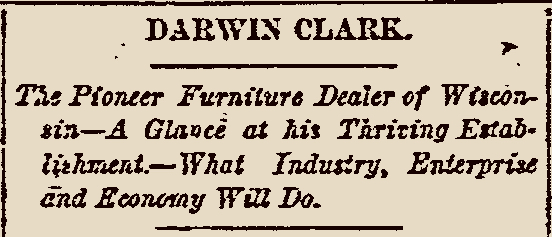
Today we have another addition to our list of various Clark-surnamed people that show up in our search for Jonathan M. Clark’s kin and that we establish (with reasonable certainty) are not JMC’s parents or other relatives. The gentleman in question is early (1837) Madison, Wisconsin Territory, settler Darwin Clark (1812-1899).

“Darwin Clark,” (Madison) Wisconsin State Journal 1884-12-26 p 8 (detail)

Continue reading

Searching for JMC’s roots: Nope, not our Clark family…

UPDATED, Oct. 31, 2023. Rearranged a few paragraphs to highlight the information about a son and grandson of Isaac “Old Rifle” Clark, Satterlee Clark, senior and junior.

As we proceed in our search for Jonathan M. Clark’s kin in the area where southern Québec meets northern Vermont and New Hampshire, I thought it would be useful to begin a list of various Clark-surnamed people that show up in our search, but we know (with reasonable certainty) are not JMC’s parents or other relatives.

I’m not going into great detail for each subject, but I’ll try and give enough info to make clear whom we are talking about, and why they are on the “Nope, not our Clark family…” list. Here is today’s installment.

Sir Alured Clarke, (c. 1745-1832)

Lieutenant Governor of Lower Canada, he helped implement the Constitutional Act of 1791—and its provisions for making grants of the Crown’s “Waste Lands” in the province—and his name appears on many of the early Lower Canada land petitions, including those for Stanstead and Hatley. The Dictionary of Canadian Biography has a fine, lengthy entry (illustrated with an engraved portrait) which concludes that Clarke was “a professional soldier whose modest talents and courteous manner had enabled him to discharge the civil duties of a colonial administrator without either distinguishing or disgracing himself.”

Continue reading

Nope. Not our…Henry Clark in the Civil War

Today we introduce a new category on Clark House Historian, one that I’m calling “Nope. Not our…”

What’s “Nope. Not our…” all about? Well, it’s about keeping track of some of the most important dead ends and disambiguation efforts that are—in fact—a huge “behind the scenes” part of the research that goes into this blog.

“Nope. Not our…” An all-too typical day in the Clark House Historian’s office.1

The fact is, I spend a lot of time chasing down “hot tips” for various unsolved Clark House history mysteries and, sadly, many of those promising clues turn out to be duds. From time to time I have written blog posts discussing specific erroneous or misleading bits of information, and then adding clarifying or corrected information and documents for the record.

But some ambiguous or promising Clark House Historian research paths are so complicated—and have taken so much time to research and document before being proven incorrect—that I need to create a more organized record of which research approaches were tried, and how each succeeded or failed. And since this blog is where I “show my work” as we uncover new chapters of Clark House history, I thought it was time for a CHH category dedicated to eliminating confusion and error in our search for a more complete and accurate history of the Clark House and its pioneering residents and neighbors.

And so we present our new category: “Nope. Not our…” And the honor of the first “Nope” post goes to:

Continue reading

Sarah and Cyrus: part 3

UPDATE May 31, 2021: timeline revised to include “1864” in the dates of enlistment for sons Albert Byron Clark, Charles E. Clark, and Albert Byron’s brother-in-law Francis Rasey.

“The other Clarks” from Mequon to “the other Madison”

Today’s post is the third in a series of several focused on early Mequon settlers Cyrus Clark his wife, Sarah A. Strickland. You know, these folks:

If you missed it, here are the links to Part 1, Part 2, and an earlier related Map Day post. You might want to take a minute to look at those posts first.

New families, new documents, new understandings

Because I’d spent less time researching Cyrus Clark’s and Sarah Strickland’s families than those of Jonathan Clark and Mary (Turck) Clark, I had a lot of catching up to do. Fortunately, I have been helped along the way by descendants Steven Clark Van Slyke and Lynette Thompson who have generously shared their notes and documents (and photographs!)

Inspired by their work, I have given Sarah and Cyrus the Clark House Historian “full treatment” (at least the pandemic-restricted, online-only version). So my Sarah Strickland and Cyrus Clark knowledge is definitely a work in progress, but it’s one that has yielded many new facts and sources that will help guide further research.

With that in mind, today’s post is less of an essay and more of a timeline, documenting what we know about this family, and what we don’t. We’ll focus on Sarah and Cyrus’s time in Mequon and the years afterward elsewhere in Wisconsin, before they “settled” in Madison, South Dakota.

Continue reading

Monday: Map Day! – Another Clark Family

This week we take a break from our usual focus on the extended Jonathan M. and Mary (Turck) Clark family and begin a week of posts about two remarkable, original Mequon settlers and Clark House neighbors: Sarah Allise Strickland (1823-1891) and her husband, Cyrus Clark (1815-1905).

Sarah A. Strickland was born and raised in Nova Scotia, the eldest child of Daniel and Matilda Strickland. Her family was one of the original white settler families in the area; they were enumerated in Milwaukee County on Wisconsin’s first territorial census in 1836.1

Cyrus Clark was born in western Massachusetts and was in Mequon by about 1839. He married Sarah Strickland in Grafton, Washington (later Ozaukee) County, on March 1, 1841. They lived almost forty years in Wisconsin. First in Mequon and Cedarburg, Washington/Ozaukee) County, and then divided their time between their farm in Moscow, Iowa County, and homes of one or more adult children in Oshkosh, Winnebago County. So how—and why—did they end up in South Dakota at the end of their days?

It’s an interesting story, and one that illustrates a characteristic type of pioneer experience: the continued drive to push westward, on to new frontiers and new challenges. It may seem cliché to us, but it was a real, lived experience for many of Cyrus and Sarah’s generation. This week’s posts will look at a number of key moments in their long lives, especially the decades they spent in Wisconsin. And we have some unique and new sources to share, too.

Beginning at the end…

Click to open larger image in new window.

Gravestones of Cyrus Clark and Sarah A. (Strickland) Clark, Graceland Cemetery, Madison, South Dakota.
Photo by Steve Van Slyke, used by permission.

We begin the story of Cyrus and Sarah Clark at the end, in Lake County, South Dakota, their final resting place. And not one, but two maps today, all of which take us far from Mequon and the Jonathan M. Clark house.

Continue reading