Monday: Map Day! – Ft. Howard & Green Bay, 1827

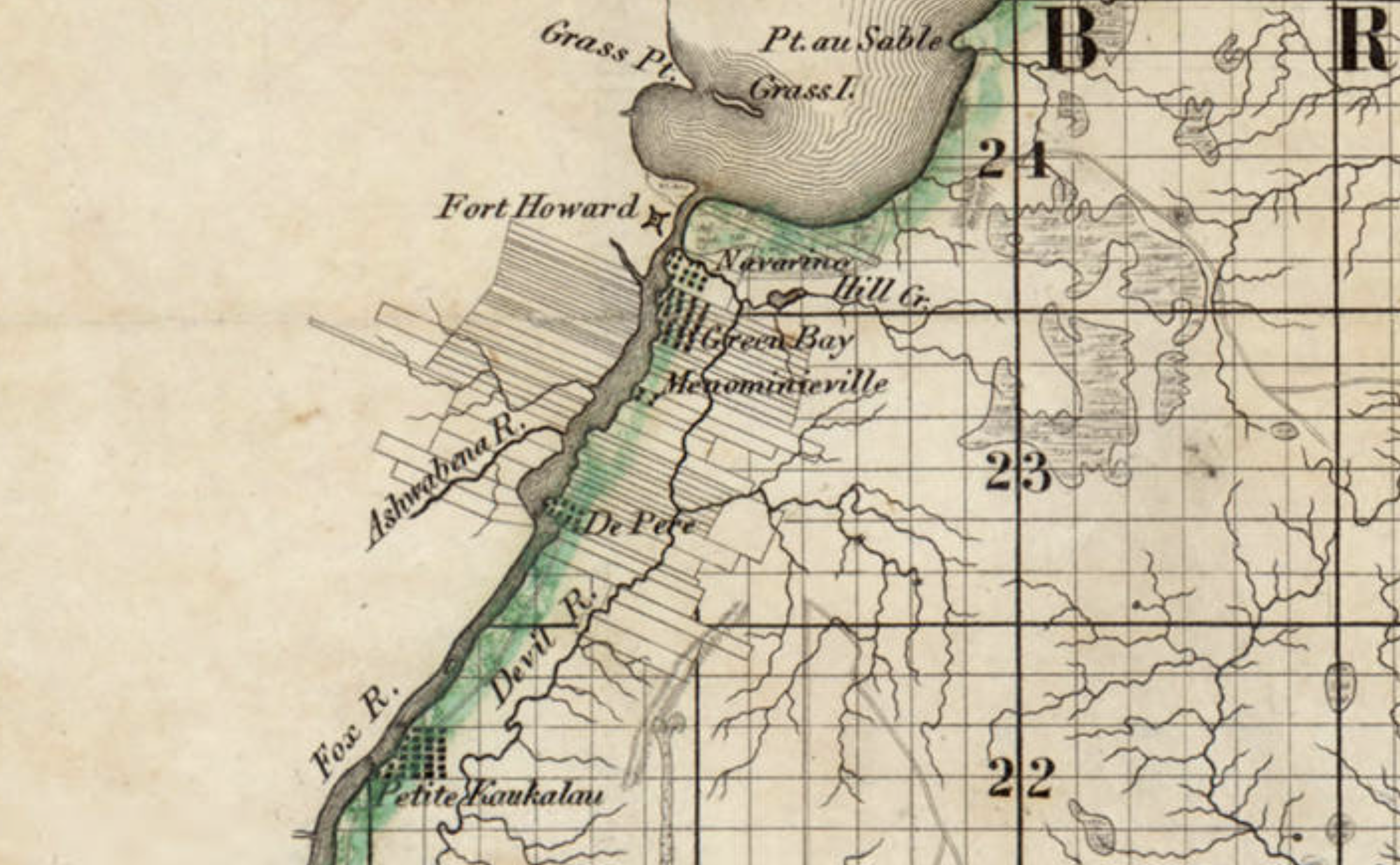
Last time, we illustrated our look at Ft. Howard with this detail from the first widely-available map of Wisconsin—and the first map of the territory based on official surveys—published in 1837:

Detail, Topographical map of Wisconsin Territory / compiled from the Public Surveys on file in the Surveyor General’s office … by Samuel Morrison, Elisha Dwelle [and] Joshua Hathaway, 1837. American Geographical Society Library Digital Map Collection, University of Wisconsin–Milwaukee. Click the detail map to open a larger version in a new window. Click here for a link to the complete map at UW-M with full bibliographic information.

This detail—showing Fort Howard, Navarino and, at the top, the southern end of Green Bay—was the subject of a Monday: Map Day! post in December, 2020, and gives a good picture of the topography and settled areas along the final miles of the Fox River as it empties into Green Bay. But on closer look, the details of the fort and its layout are very vague, limited to one X-shaped symbol. For a better understanding of Fort Howard in its most active era, we need to look at the actual 1823/1827 federal survey upon which the 1837 map was based:

Private Claims at Green Bay, 1823/1827

Detail, [Title section] of map, Private Claims at Green Bay, surveyed in July, Aug.t & Sept.r 1823; see image of complete map for full citation. Click to open larger image in new window.

Continue reading

How’d they get here? Detroit to Ft. Howard, 1834 (part 2)

More Great Lakes Tourism – Summer, 1834

Our series of “How’d they get here?” posts is written to illustrate the nuts and bolts of how our early Mequon pioneers travelled from their original homes or ports of arrival in North America to the newly opened federal lands in Wisconsin Territory, circa 1830-1850. Today’s post continues our previous post, a first-person description of 1830s frontier tourism that we called How’d they get here? Detroit to Ft. Howard, 1834 (part 1).

Picking up where we left off…

Wednesday, July 16, arrival at Green Bay

On Wednesday, as the Sun was slowly sinking to its repose in cloud of the most gorgeous and variegated colors, we arrived at the extremity of Green Bay, and about two miles up the Fox river, we landed at Navarino,2 receiving as we passed a salute from Fort Howard, on the opposite side of the river.

Detail, Topographical map of Wisconsin Territory / compiled from the Public Surveys on file in the Surveyor General’s office … by Samuel Morrison, Elisha Dwelle [and] Joshua Hathaway, 1837. American Geographical Society Library Digital Map Collection, University of Wisconsin–Milwaukee. Click the detail map to open a larger version in a new window. Click here for a link to the complete map at UW-M and its bibliographic information.

This map detail—showing Fort Howard, Navarino and, at the top, the southern end of Green Bay— is from the Topographical map of Wisconsin Territory, published in 1837 and the subject of a Monday: Map Day! post in December, 2020. As a reminder, this 1837 map shows all the lands officially surveyed by the federal government up to the time of publication. In 1837, the territory to the north and west of the Fox and Wisconsin rivers was still reserved for Wisconsin’s Native Americans, so the lands to the north and west of the Fox River are left (mostly) blank on this official map. But this land was not at all “empty.” The Indians, the forests, the wildlife, some of the old Métis and Anglo-American settlers—and the army—were all on the left bank of the Fox River in 1837, as they were in 1834, when the steamboat Michigan and its passengers arrived in Green Bay.

Continue reading

How’d they get here? Detroit to Ft. Howard, 1834 (part 1)

Our series of “How’d they get here?” posts is written to illustrate the nuts and bolts of how our early Mequon pioneers travelled from their original homes or ports of arrival in North America to the newly opened federal lands in Wisconsin Territory, circa 1830-1850. Today’s post looks at another trip to Ft. Howard on the steamboat Michigan, this time in the summer of 1834.

In Monday’s How’d they get here? – JMC to Ft.Howard, 1833, we looked at the likely probability that from October 16 – 30, 1833, Pvt. Jonathan M. Clark left the U.S. Army’s recruiting depot at Ft. Niagara, New York, and traveled the Great Lakes from Buffalo, New York, to his new post at Fort Howard, Green Bay, Michigan (later Wisconsin) Territory. To make that late-season journey the army chartered the new and lavishly appointed steamboat Michigan.

Great Lakes Tourism – Summer, 1834

Less than a year after that October, 1833, voyage the owners of the Michigan announced two special excursions to the “Far West” for the summer of 1834. The first of these was scheduled to leave Buffalo on Thursday, July 10, headed to “the Sault St. Marie (foot of Lake Superior), Michigan and Green Bay, touching at the ports on Lake Erie and at Detroit,” and would “embrace a distance of nearly 2000 miles, during which, passengers will have an opportunity of viewing the splendid scenery of Lakes Erie, St. Clair, Huron, Superior and Michigan, and the rivers, straits and bays connected with them.”

“Steamboat excursion to the Far West,” advertisement, Albany Argus, June 6, 1834, page 3, via genealogybank.com. Click to open larger image in new window.

The second trip would depart Buffalo on August 12th, and would take in all the sights of the July trip, and additional notable points along the south and east coasts of Lake Michigan, including Chicago, Michigan City, “St. Josephs,” and the mouth of Michigan’s Grand River. What could an 1834 tourist to the “Far West” expect on such an excursion? We have a first-hand report from the July trip, which includes an eventful stop at Jonathan M. Clark’s post at Ft. Howard.

Continue reading

Monday: Map Day! – The United States of North America, 1825

UPDATED August 16, 2021, to include more information on the Ho-Chunk language, inadvertently omitted from the original post.


I’m working on more posts for our series about the early Mequon immigrants and “How’d they get here?” I needed a map that showed all of the Great Lakes, as well as the Eastern seaboard states and ports from which these immigrants began their westward journeys. And hey, I found a great map from 1825, the year the Erie Canal was completed:

Finley, Anthony and David H. Vance, Map Of The United States Of North America. Philadelphia, 1825. Credit, David Rumsey Map Collection, David Rumsey Map Center, Stanford Libraries, non-commercial use permitted under Creative Commons license. Click image to open larger map in new window. 

Continue reading

The county’s earliest federal roads (plural)

I need to make a correction. In one of the previous posts of our Infrastructure! series, I wrote:

In early 1841, before the commissioners approved county roads Nos. 1, 2, and 3, there was already one federal road in the county. The Green Bay road was a federal road […]. It ran generally south to north, joining Ft. Dearborn in Chicago to […] Ft. Howard in Green Bay. Along the way it passed through a number of growing settlements including the three villages that would become Milwaukee, and the future towns of Mequon, Cedarburg, and Grafton. 

That’s almost accurate. To be precise, I should have said there was one federal road in the southeast corner of the county—the part that would become the towns of Mequon, Cedarburg and Grafton—the Green Bay road. But, if you consider the whole of old Washington county, there were not one, but two federal roads prior to 1841, the north-south Green Bay road and the east-west Dekorra road.

Both of these roads appear on the first map of Wisconsin Territory drawn from official government surveys, published in 1837. The two federal roads are indicated on the original map by closely-spaced parallel gray lines. On the detail below I’ve highlighted the then-existing eastern portion of the Dekorra road in blue, and the Washington county portion of the Green Bay road in green:

Continue reading

“Distressing sickness” – 1811, Lower Canada, edition

Among the unavoidable trials of life in the 1800s were the recurring waves of infectious diseases that frequently troubled cities, towns, and rural settlements. These epidemics and pandemics were made even more disturbing due to the general scientific ignorance of the times.

And although inoculation for the prevention of smallpox1 was practiced in Europe and North America at various times during the eighteenth century, the concept of “germ theory” would not gain widespread acceptance until the second half of the nineteenth century, and routine vaccination to prevent common illnesses would not be in general use until the decades after World War II. Disease was an omnipresent part of life in early America.

Fever ravages Stanstead

In the winter of 1811, a particularly virulent outbreak occurred in the vicinity of Stanstead, Lower Canada, as reported on page 3 of the Bridgeport, Connecticut, Republican Farmer of Wednesday, February 27, 1811:

Continue reading

Monday: Map Day! – Second Monday in October

I am descended from European immigrants to the “New World.” From the mid-1600s through the 1800s, they came to North America from over a half-dozen European lands. Like Jonathan M. Clark, Mary Turck Clark, and their nineteenth-century Mequon neighbors, I’m here because my ancestors left Old World homes, families, and communities behind and made difficult voyages to America. There is much to admire in their individual stories of migration and settlement in a new nation. There are aspects of their lives that are less than exemplary, too. Discovering and sharing their stories is, for me, one of the most interesting aspects of studying history.

But stories of European immigration are only one part of the history of our continent and our nation. It’s essential we remember that when Europeans began to “discover” the Americas in the late-1400s, there were already large numbers other peoples already here. Their ancestors made the trip here much earlier; it is currently believed that Paleo-Indians migrated to the Americas at least 15,000, and possibly as many as 30,000 years ago. Today’s map is a tribute to—and a call to remember—the many peoples, cultures and communities that existed in the future United States prior to European colonization:

Continue reading

Monday: Map Day! – Another look at Ouisconsin Territory, 1836

UPDATED, February 11, 2024, to include a revised annotated map. But for the full update—with additional notes and corrections—please see the most recent version of this, posted on February 12, 2024.

As a kind of postscript to our look at the early Wisconsin territorial, state and federal censuses, today’s Monday: Map Day! revisits an interesting map that we first discussed on October 29, 2017. Today’s post includes a few updates and corrections based on new information. 

It’s 1836. Where’s…Wisconsin?

In September, 1836, Sgt. Jonathan M. Clark was discharged from the U.S. Army at “Camp Hamilton,” Wisconsin Territory. after serving his three-year term of service with Co. K, Fifth Regiment of Infantry.1  One year later, in the autumn of 1837, Jonathan’s future wife Mary Turck would make the long trip from Palmyra, New York, to Milwaukee and finally Mequon, Washington County, Wisconsin, with her parents Peter and Rachael Turck and six younger siblings. By the end of 1840 Jonathan and Mary would be married and starting their family in Mequon.

That seems simple enough, until you take a moment to wonder how much Jonathan—or especially Mary and her family—knew about this new Wisconsin Territory.  Jonathan had been in the territory since October, 1833, mostly on post at Ft. Howard. In the last year or so of his service he was busy cutting trees and building bridges for the military road along the Fox River waterway from Ft. Howard (Green Bay) towards Ft. Winnebago (near modern Portage). As a road-building soldier, Jonathan might have done some surveying and seen—or helped draw—a variety of maps of the military road and its vicinity. But for a better overview of this new territory, Jonathan or Mary might have sought out a map such as this2:

Continue reading

Census Records for the In-Between Years: 1842

Don’t Forget the (Free!) Territorial and State Censuses

Although they are not as informative as the decennial federal censuses, Wisconsin’s territorial and state census returns can offer useful information about the growth and development of places—such as Mequon—and can add to what we know about a family—like the Clarks—and their neighbors at various times between the once-a-decade federal census population schedules. For a nice explanation and overview of federal, territorial and state census history in Wisconsin, please go to the Wisconsin census FamilySearch.org wiki page. This is an invaluable first stop for locating these records. Be sure to peruse the lists of which records have been preserved for which counties; not all census records have survived. And the Wisconsin Historical Society has a similar page of useful Census Research Tips

The FamilySearch.org Wiki page is kept pretty current, but there have been a few changes that may not be reflected there yet. In one positive development (especially for the safer-at-home researcher), it appears that all of the microfilmed state and territorial censuses are now viewable—at no cost—via the FamilySearch.org portal. (Note that you will have to use a free account to be able to view the digitized images online. So create an account if you don’t already have one, and login before you search the indexes and click the links for the multitude of digitized microfilms.)

Here are some links and tips to speed your search. For the FamilySearch.org index, click here: United States, Wisconsin online census collections. You should land on a page that looks like this:

Continue reading

Map of Ouisconsin Territory, 1836

UPDATED, February 11, 2024, to include a revised annotated map. But for the full update—with additional notes and corrections—please see the most recent version of this, posted on February 12, 2024.

In September, 1836, Sgt. Jonathan M. Clark was discharged from the U.S. Army at “Ft. Hamilton,” Wisconsin Territory, after serving his three-year term of service with Co. K, Fifth Regiment of Infantry.  One year later, in the autumn of 1837, Jonathan’s future wife Mary Turck would make the long trip from Palmyra, New York, to Milwaukee and finally Mequon, Washington County, Wisconsin, with her parents Peter and Rachael Turck and six younger siblings. By the end of 1840 Jonathan and Mary would be married and starting their family in Mequon.

That seems simple enough, until you take a moment to wonder how much Jonathan—or especially Mary and her family—knew about this new Wisconsin Territory.  Jonathan had been in the territory since October, 1833, building portions of the military road along the Fox River waterway from Ft. Howard (Green Bay) towards Ft. Winnebago (near modern Portage). As a road building soldier, Jonathan probably had seen—or helped draw—a variety of maps of the military road and its vicinity. But for a better overview of the larger territory, Jonathan or Mary might have sought out a map such as this:

Continue reading