The American Revolution: are you watching?

The American War of Independence began 250 years ago, more than half a century before the forced removal of Wisconsin’s original native peoples and the beginnings of large-scale, government-sponsored, white settlement in the Wisconsin Territory of the 1830s.

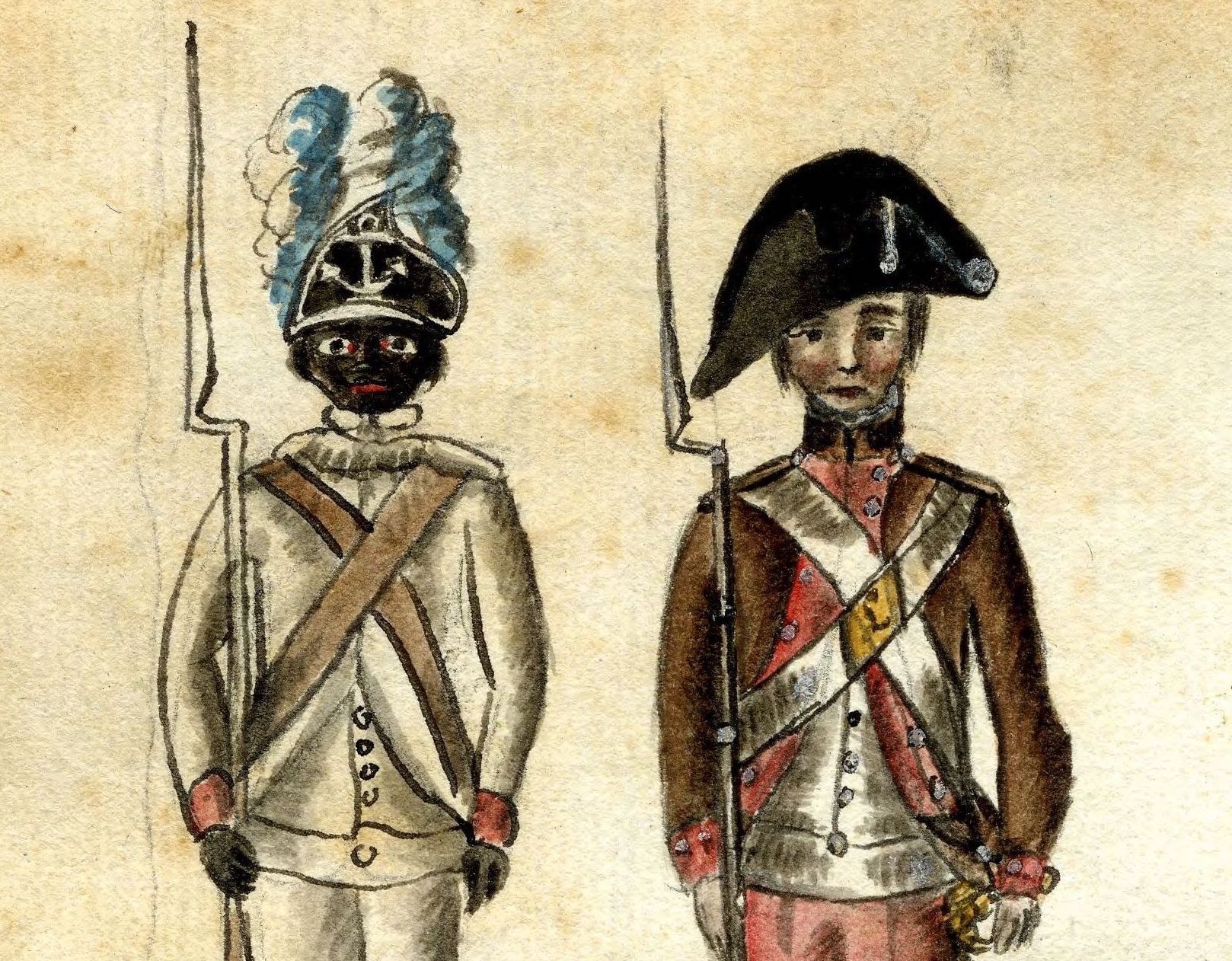
Verger, Jean Baptiste Antoine De, artist, [Soldiers in Uniform], 1781 (detail). The soldier on the right was a New England militiaman, one of many New Englanders (including, we believe, Jonathan Clark’s kin) that fought for the Patriot cause. More on this image, below.

PBS is commemorating the big anniversary by sponsoring and broadcasting “The American Revolution,” a six-part, 12-hour documentary film by Ken Burns and company, exploring the roots of the conflict, the military and diplomatic progress of the war, and the contributions to, and effects of, the war on its many military and civilian participants, including white, Black, and Native American men and women, both Loyalists & Patriots.

I’ve seen the first four episodes and found them lively, interesting, informative, and sometimes deeply moving. I’m no expert on the Revolutionary era, but I know quite a bit, and I find the series includes all the “important” events and persons that one would expect, along with all kinds of nuance and detail which are new to me.

It’s an excellent documentary, well worth your time, and is currently streaming—for free—on PBS.org. And in case you are wondering: yes, there are many topics in this Revolutionary War documentary that connect to, and later influence, the lives many of the early Mequon settler families, including the Clark and Turck families. In particular, be sure to watch the whole first episode, a clear and detailed explanation of the complex background and causes of the fight for American independence.

Continue reading

I’ve been busy…at the Portage! (part 2)

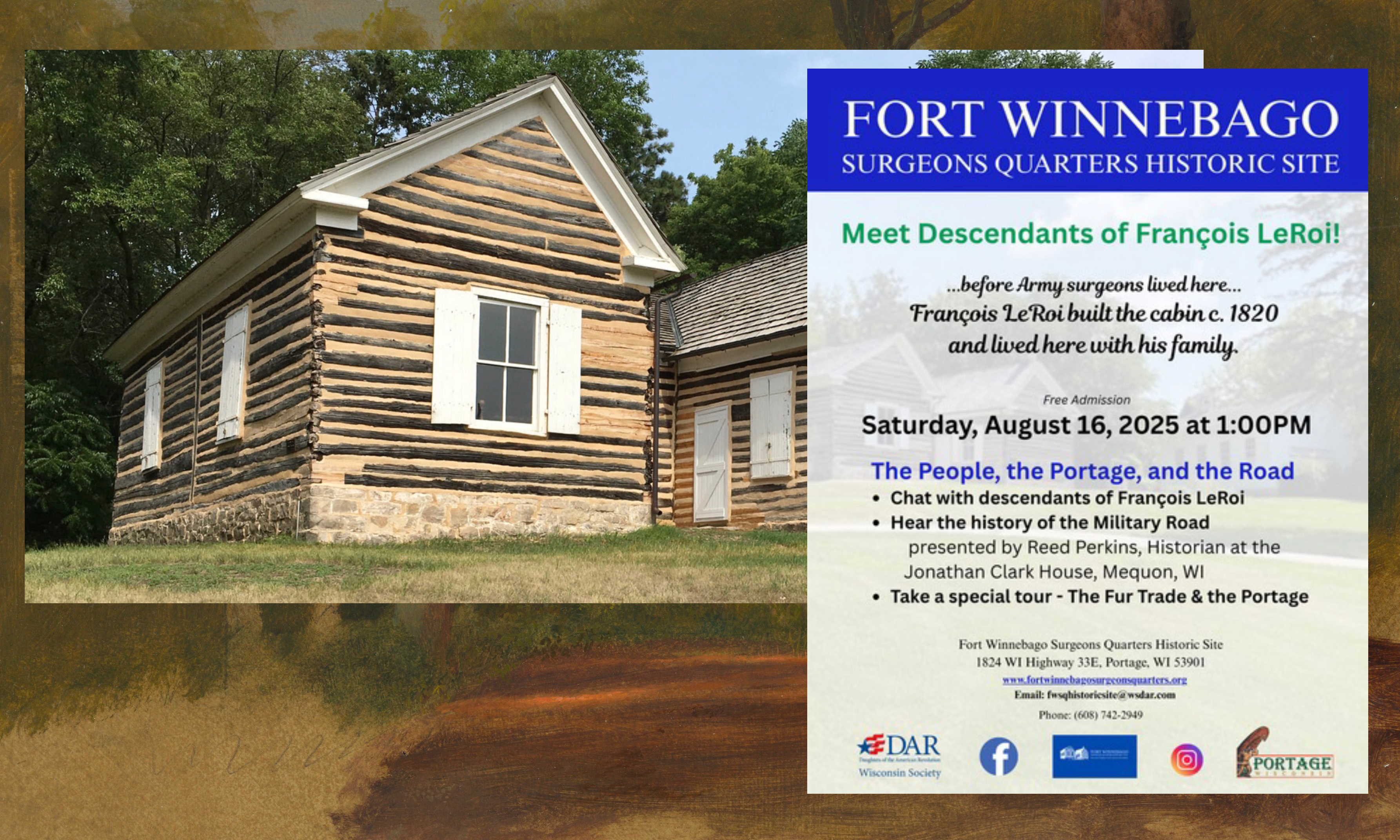
In a recent CHH post I wrote about my Saturday, August 16 visit to, and presentation at, the WSDAR’s excellent Fort Winnebago Surgeons Quarters historic site. That was worth a road trip in itself. But since I was heading up to Portage, I decided to make a history weekend out of the occasion. So on Friday the 15th, I spent a fine few hours touring the nearby Historic Indian Agency House and museum, just a short distance from the Surgeon’s Quarters across the old channel of the Fox River.

Historic Indian Agency House, 2025. Photo credit: Reed Perkins

The Historic Indian Agency House

The Historic Indian Agency House (HIAH) is one of Wisconsin’s oldest museums and a “must see”, for those of you interested in the early days of the Wisconsin Territory and the history of the state’s original Native American inhabitants and their forced removal during white settlement in the 1820s, ’30s and beyond. Like the nearby Fort Winnebago and its remaining Surgeon’s Quarters, the story of the HIAH overlaps and intersects with the story of Jonathan M. Clark and his 1833-1836 military service at Fort Winnebago’s headquarters post, Fort Howard, in Green Bay.

Continue reading

I’ve been busy…at the Portage! (part 1)

It’s been a while, I know! One thing led to another and this summer ended up being a very quiet summer here on the CHH blog, with just a post or two over the past few months. My apologies to you all. However, I have been very busy “behind the scenes,” reading, researching and writing all summer long, and I have lots of new historical information and stories to share with you.

Fort Winnebago Surgeons Quarters—and more

One of the projects that has kept me busy this summer was researching and preparing a presentation that I gave last Saturday, at the historic Fort Winnebago Surgeons Quarters museum as part of their The People, the Portage and the Road event. Originally, my talk was going to be a lightly-revised update of my September, 2024 talk at the Wisconsin Society of the Daughters of the American Revolution’s Fall Workshop in Oshkosh.

That talk, “Building the Military Road,” contained about 45 minutes of detailed information about Wisconsin’s first federal road, and the men that built it—including our own Sgt. Jonathan M. Clark—tightly squeezed into about a half-hour time slot. The presentation was well-received, and I was invited to repeat that talk at this August, 2025, event at the WSDAR’s Fort Winnebago Surgeons Quarters museum in Portage.

However! The August 16th event was also going to be a reunion of the descendants of François LeRoi (aka Francis LeRoy or Roy)—the man that first built and occupied the historic surgeon’s quarters (1816-1829), and it was suggested that I include some Francis LeRoy related information in my talk, a very reasonable request. Since I already knew quite a bit about the Military Road, the Portage, and the life and times at Forts Howard and Winnebago in the 1830s, I thought I would just need to make a few minor cuts to my original talk, find a few, possibly obscure or unknown, LeRoi documents, add them to the presentation and, well, that would be just the thing! Well…

Continue reading

Monday: Map Day! – One more (updated) look at Ouisconsin Territory, 1836

Today’s Monday: Map Day! revisits and makes a correction to an interesting map that we first discussed here on October 29, 2017, and then re-visited on July 11, 2020. And for unknown reasons, that original 2017 post—according to my monthly WordPress statistics report—was the most-viewed post on this site for the month of January, 2024, with 341 views (!).

Burr, David H. Map of the Northern Parts of Ohio, Indiana and Illinois and Michigan and that part of the Ouisconsin Territory lying East of the Mississippi River, 1836, detail of title & author. Library of Congress.

The 2020 re-post was originally conceived as a kind of addendum to our June-July, 2020, multi-part discussion of the earliest Wisconsin territorial, state, and federal censuses. It also served to locate Jonathan M. Clark in Wisconsin Territory during his U.S. Army service from September, 1833, to September 19, 1836.

Today’s post includes one particular correction that I’ve been meaning to make for a while. When I added my original annotations to a detail of this map (in red), in 2017, I made an error. I mislabeled Sgt. Jonathan M. Clark’s location at the time he mustered out of service, a temporary army camp along the under-construction military road from Fort Howard (Green Bay) to Fort Winnebag0 (Portage). JMC’s muster-out location was always referred to in the records of the Fifth Regiment of Infantry as “Camp Hamilton.” For some reason, when I made my annotated detail map, I incorrectly labeled this place “Ft. Hamilton.” A minor error, but worth correcting , especially now that this map is receiving fresh attention.1

It’s 1836. Where’s…Wisconsin?

In September, 1836, Sgt. Jonathan M. Clark was discharged from the U.S. Army at “Camp Hamilton,” Wisconsin Territory, after serving his three-year term of service with Co. K, Fifth Regiment of Infantry.2  One year later, in the autumn of 1837, Jonathan’s future wife Mary Turck would make the long trip from Palmyra, New York, to Milwaukee and finally Mequon, Washington County, Wisconsin, with her parents Peter and Rachael Turck and six younger siblings. By the end of 1840 Jonathan and Mary would be married and starting their family in Mequon.

That seems simple enough, until you take a moment to wonder how much Jonathan—or especially Mary and her family—knew about this new Wisconsin Territory.  Jonathan had been in the territory since October, 1833, mostly on post at Ft. Howard. In the last year or so of his service he was busy cutting trees and building bridges for the military road along the Fox River waterway from Ft. Howard (Green Bay) towards Ft. Winnebago (near modern Portage). As a road-building soldier, Jonathan might have done some surveying and seen—or helped draw—a variety of maps of the military road and its vicinity. But for a better overview of this new territory, Jonathan or Mary might have sought out a map such as this:

Continue reading

1836: Astounding Produce News!

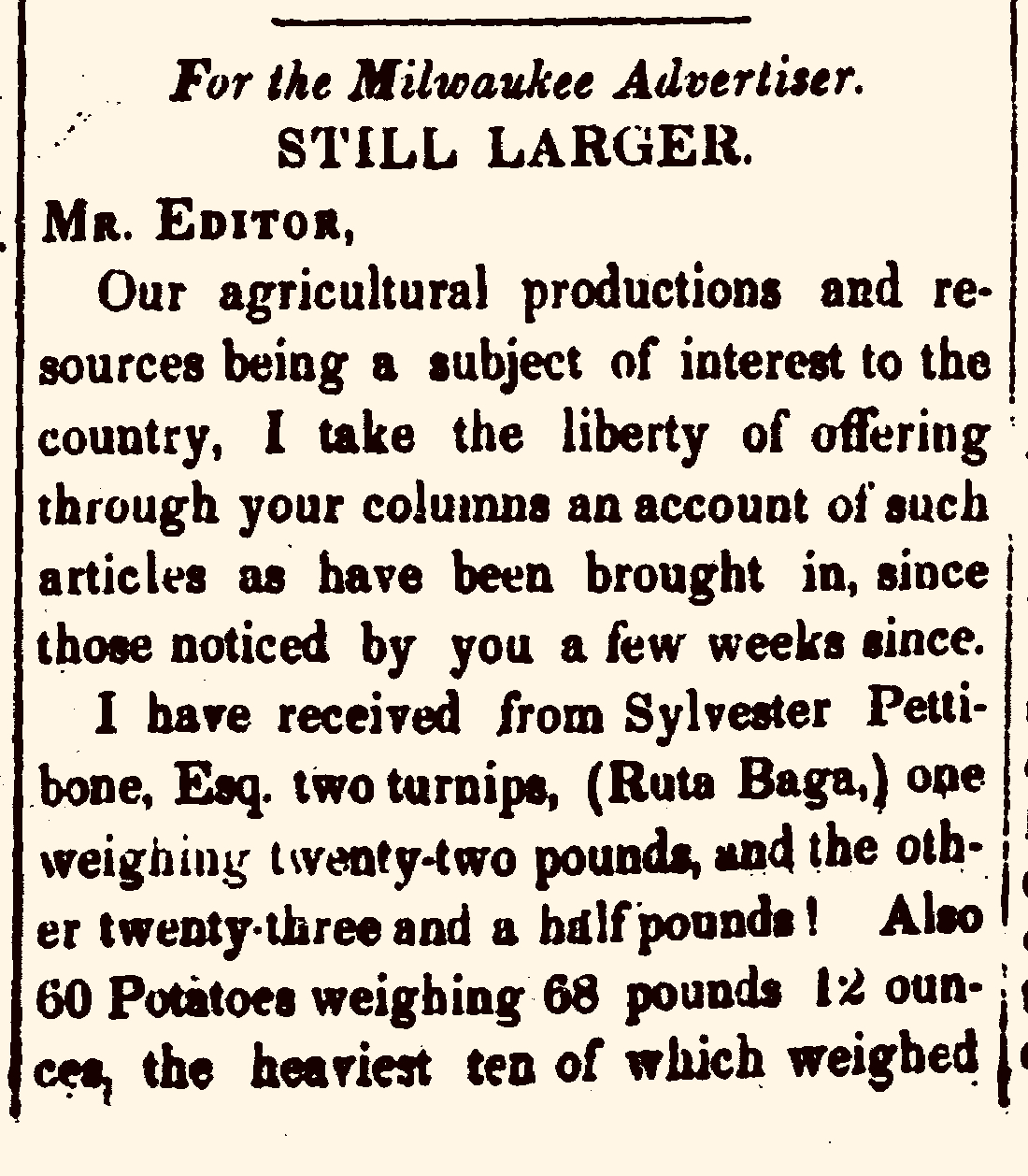
While researching the life of one of Mequon’s first white settlers, Isham Day, I ran across the following breathless bit of regional puffery and promotion, penned by Milwaukee co-founder Byron Kilbourn. It’s from page 2 of the November 17, 1836, edition of the Milwaukee Advertiser:

Lawyer Pettibone has, indeed, grown some astounding turnips (“Ruta Baga”), ‘taters, and carrots in the fertile soil of Milwaukee. Likewise Mr. Douglass with his enormous radishes and “common English” turnips. Have others done anything comparable? Indeed they have, and Mr. Kilbourn has the details…

Continue reading

Presidents’ Day, 1844

Today is Presidents’ Day, the descendant of the federal holiday originally created in 1879 to celebrate the birthday anniversary of George Washington, our first president and, arguably, the “indispensable man” in America’s fight for independence.

Presidents’ Day did not exist during the early days of Mequon settlement, but the Clarks, Turcks, Bonniwells and their neighbors—whether native-born Americans or recent immigrants—were generally patriotic folk and to one degree or another their politics were mostly free-soil, anti-slavery and pro-Union.

So in their patriotic spirit, here’s a colorful presidential salute for you from the Clarks’ era. It was published in New York in 1844 by Nathaniel Currier, whose prints were for sale, at affordable prices, even in remote locations such as the new Wisconsin Territory.

Currier, Nathaniel (American, 1813-1888). Presidents of the United States, 1844. Hand-colored lithograph on wove paper, 13 x 9in. Brooklyn Museum, Gift of Mrs. Harry Elbaum in honor of Daniel Brown, art critic. Color and exposure adjusted.

What happened to “Lincoln’s Birthday”?

I grew up in Illinois, the “Land of Lincoln,” where Old Abe’s birthday was, and remains, a state holiday. So we had holidays to honor the birthdays of both presidents: Lincoln on February 12, and Washington on February 22. How we got from those separate, specific commemorations to a generic federal holiday (and three day weekend) providing “an occasion to remember all U.S. presidents, to honor Abraham Lincoln’s and Washington’s birthdays together, or any single president of choice,” is a complicated story. Here’s the main info in a nutshell:

Continue reading

RBOH: Chewing Gum

Lately, I’ve been spending a lot of time looking through digitized historical newspapers, trying to fill in some of the missing pieces of the Clark House story. In the process, I’ve managed to discover some unique and important information about the Clarks, Turcks, Bonniwells and their neighbors. And I’ve also run into a lot of off-topic but fascinating tidbits about daily life in Wisconsin during the Clarks’ era, such as this random bit of history:

Continue reading

Monday: Map Day! – To the gold fields, 1849 & ’50

I love a great map, and today’s example is particularly fine in several respects: as a detailed view of our hemisphere at a particularly dynamic moment in U.S. history, as an excellent example of mid-19th-century cartography, and—as we’ll see in our next post—as a clear illustration of how members of Mequon’s Bonniwell family made their way to and from the California gold fields in the heady days of the early Gold Rush of 1849 and 1850.1

Gold! where it is and how to get there, 1849

Atwood, John M., Map of the United States, the British provinces, Mexico &c.: showing the routes of the U.S. mail steam packets to California, and a plan of the Gold Region. New York: J. H. Colton, 1849. From the collection of Millard Fillmore. Library of Congress.

I’ve published some great old maps on Clark House Historian, and this is one of my favorites. In our next post, I’ll annotate a copy of this map to illustrate the Bonniwell’s Gold Rush travels in 1849 and the early 1850s. But today I’d like to show the map as it was in 1849, with all its “extra features.” I recommend you begin by clicking the map image, above, which opens a much higher-resolution copy of the map in a new window (FYI, this may take a few seconds; it’s a big, detailed image).

Continue reading

Brown Bag Series, part 2, is today!

We have new partnership project with the Mequon Nature Preserve and MATC’s Kate Erickson, the Brown Bag Series: Mother Earth is Where We All Meet. Today is the second installment in the series, and our executive director Dana Hansen will be speaking on “European Settlement and the Shift of Mindset About the Earth.”

Old World Wisconsin, July, 2016. Photo credit: Anna Perkins. Click to open larger image in new window.

Continue reading