How’d they get here? Detroit to Ft. Howard, 1834 (part 2)

More Great Lakes Tourism – Summer, 1834

Our series of “How’d they get here?” posts is written to illustrate the nuts and bolts of how our early Mequon pioneers travelled from their original homes or ports of arrival in North America to the newly opened federal lands in Wisconsin Territory, circa 1830-1850. Today’s post continues our previous post, a first-person description of 1830s frontier tourism that we called How’d they get here? Detroit to Ft. Howard, 1834 (part 1).

Picking up where we left off…

Wednesday, July 16, arrival at Green Bay

On Wednesday, as the Sun was slowly sinking to its repose in cloud of the most gorgeous and variegated colors, we arrived at the extremity of Green Bay, and about two miles up the Fox river, we landed at Navarino,2 receiving as we passed a salute from Fort Howard, on the opposite side of the river.
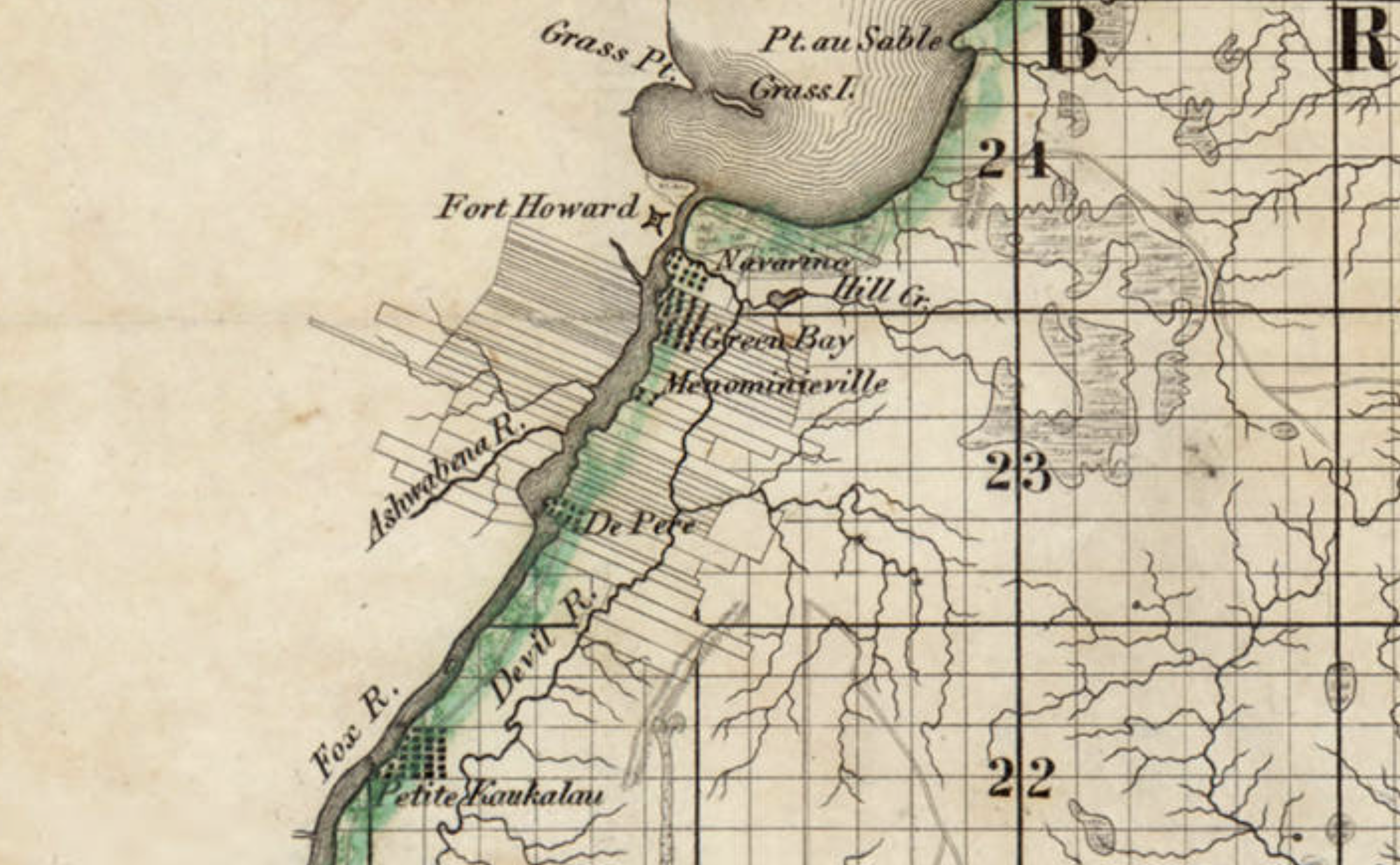
Detail, Topographical map of Wisconsin Territory / compiled from the Public Surveys on file in the Surveyor General’s office … by Samuel Morrison, Elisha Dwelle [and] Joshua Hathaway, 1837. American Geographical Society Library Digital Map Collection, University of Wisconsin–Milwaukee. Click the detail map to open a larger version in a new window. Click here for a link to the complete map at UW-M and its bibliographic information.

This map detail—showing Fort Howard, Navarino and, at the top, the southern end of Green Bay— is from the Topographical map of Wisconsin Territory, published in 1837 and the subject of a Monday: Map Day! post in December, 2020. As a reminder, this 1837 map shows all the lands officially surveyed by the federal government up to the time of publication. In 1837, the territory to the north and west of the Fox and Wisconsin rivers was still reserved for Wisconsin’s Native Americans, so the lands to the north and west of the Fox River are left (mostly) blank on this official map. But this land was not at all “empty.” The Indians, the forests, the wildlife, some of the old Métis and Anglo-American settlers—and the army—were all on the left bank of the Fox River in 1837, as they were in 1834, when the steamboat Michigan and its passengers arrived in Green Bay.

Continue reading
How’d they get here? Detroit to Ft. Howard, 1834 (part 1)

Our series of “How’d they get here?” posts is written to illustrate the nuts and bolts of how our early Mequon pioneers travelled from their original homes or ports of arrival in North America to the newly opened federal lands in Wisconsin Territory, circa 1830-1850. Today’s post looks at another trip to Ft. Howard on the steamboat Michigan, this time in the summer of 1834.

In Monday’s How’d they get here? – JMC to Ft.Howard, 1833, we looked at the likely probability that from October 16 – 30, 1833, Pvt. Jonathan M. Clark left the U.S. Army’s recruiting depot at Ft. Niagara, New York, and traveled the Great Lakes from Buffalo, New York, to his new post at Fort Howard, Green Bay, Michigan (later Wisconsin) Territory. To make that late-season journey the army chartered the new and lavishly appointed steamboat Michigan.

Great Lakes Tourism – Summer, 1834

Less than a year after that October, 1833, voyage the owners of the Michigan announced two special excursions to the “Far West” for the summer of 1834. The first of these was scheduled to leave Buffalo on Thursday, July 10, headed to “the Sault St. Marie (foot of Lake Superior), Michigan and Green Bay, touching at the ports on Lake Erie and at Detroit,” and would “embrace a distance of nearly 2000 miles, during which, passengers will have an opportunity of viewing the splendid scenery of Lakes Erie, St. Clair, Huron, Superior and Michigan, and the rivers, straits and bays connected with them.”

“Steamboat excursion to the Far West,” advertisement, Albany Argus, June 6, 1834, page 3, via genealogybank.com. Click to open larger image in new window.

The second trip would depart Buffalo on August 12th, and would take in all the sights of the July trip, and additional notable points along the south and east coasts of Lake Michigan, including Chicago, Michigan City, “St. Josephs,” and the mouth of Michigan’s Grand River. What could an 1834 tourist to the “Far West” expect on such an excursion? We have a first-hand report from the July trip, which includes an eventful stop at Jonathan M. Clark’s post at Ft. Howard.

Continue reading

How’d they get here? – Steamboats!

How the early settlers came to Mequon, c. 1835-1850 (part 2)

This is part 2 of a series focused on how our Mequon pioneers traveled to southeast Wisconsin in the early days of white settlement, between roughly 1835 and 1850. If you missed part 1, it’s here at Monday: Map Day! – How’d they get here?, plus a short post with bonus image at Steamboat’s coming!

From the late 1820s until about 1850, if you wanted to get from the settled American northeast to the open frontiers of the West, the fastest, safest, and cheapest way to get there was by water. Thousands of New Yorkers, New Englanders, Canadians, and overseas immigrants that had come from Europe to America’s eastern ports, found the Great Lakes route—west on the Erie Canal to Buffalo, and then by water through the Lakes to Chicago and Milwaukee—was their preferred route to new homes on the western frontier. And many of those settlers traveled on the newest, fastest craft afloat: the steamboat.

View of Detroit…1837

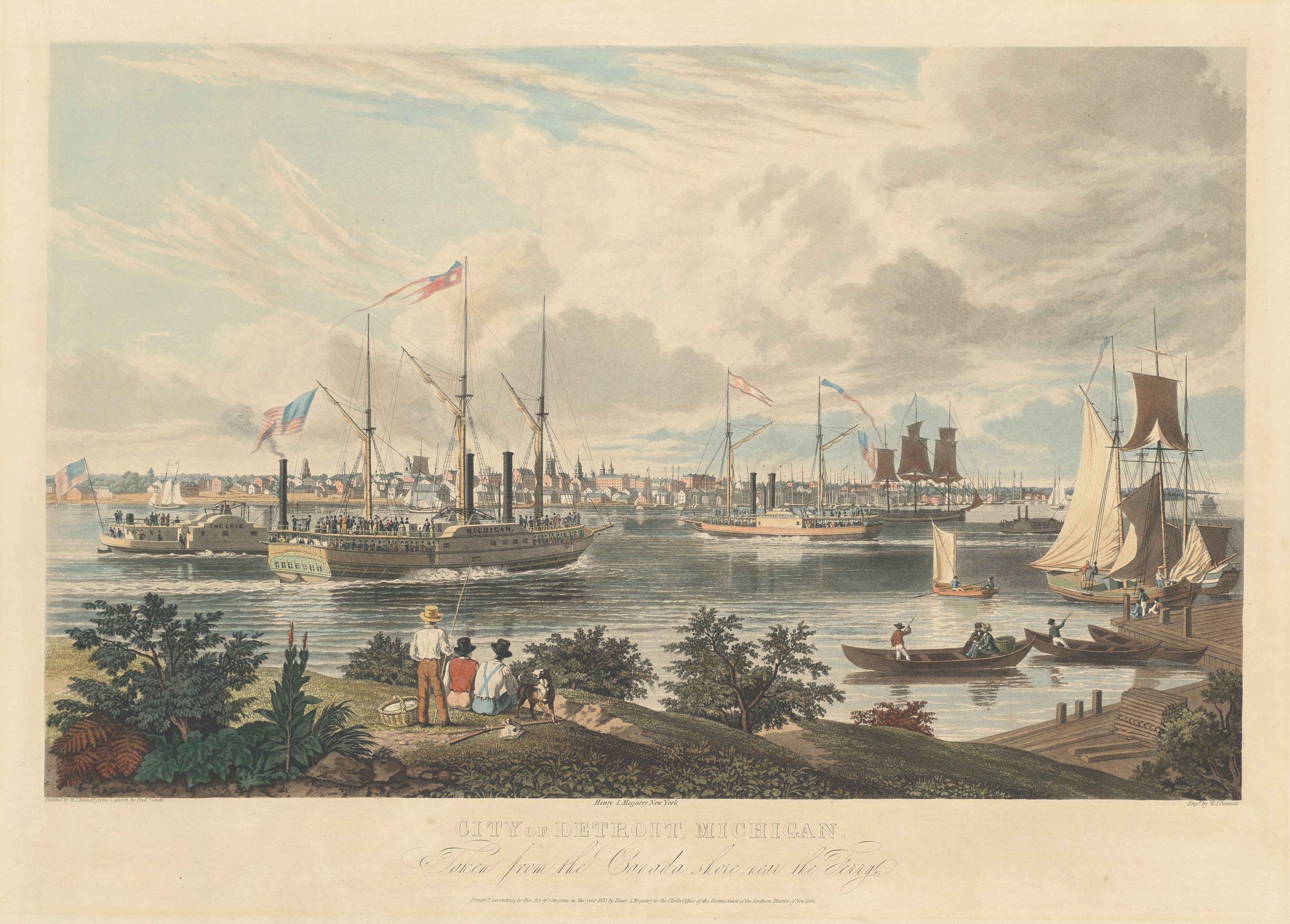
Here’s something really special for Clark House history lovers, a detailed drawing of the various kinds of sailing ships and steamboats as they passed by Detroit, Michigan on a sunny day in 1837, as seen from the Canadian side of the Detroit River. Take a close look; this is the view Peter Turck and his family—including daughter Mary, the future spouse of Jonathan M. Clark—would have seen as they traveled to Milwaukee in August of the same year1:

Bennett, William J., after a sketch by Frederick K. Grain, City of Detroit, Michigan. Taken from the Canada shore near the Ferry., hand-colored aquatint on engraving, ca. 1837. National Gallery of Art, Collection of Mr. and Mrs. Paul Mellon. Public Domain. Click to open larger image in new window.

Continue reading

Hail, Smiling morn!

A spot of Spofforth to ring in the New Year…

Happy New Year to all, and best wishes that 2021 will be an improvement on the past year. I’m almost done with my research on the second half of the 1843 concert by the Milwaukie Beethoven Society. (If you missed our earlier posts on that concert, links are here and here.) But it’s New Year’s Day, and I’m not quite done writing about “Part Second.” So let’s have another festive musical selection, this one drawn from that second part of the Beethoven Society’s premiere concert:

Milwaukee Weekly Sentinel March 15 1843, page 2. Click to open larger image in new window.

We’ll start the year with “Hail Smiling morn” by the English composer Reginald Spofforth (1769-1827). Spofforth was a man of many talents, but was particularly known for his glees. A glee is a kind of convivial part-song, typically for three or more voices and usually—but not always—sung without accompaniment. I’ll have more to say about this particular composer and piece later, but for now, it’s well enough to know that “Hail Smiling morn” is—according to musicologist Nicholas Temperly—”possibly the most popular glee in the entire repertory,” and that’s saying something!

“Hail Smiling morn” remains a popular pub song in parts of England and—as you’ll soon see—in many other venues around the world, both secular and sacred. “Hail Smiling morn” is frequently sung by church choirs as a Christmas or Easter carol. I think it works wonderfully for New Year’s Day, too. Below are three spirited modern performances of the piece. Just click the image to open a new YouTube window for each video. (The piece is only about 3 minutes long; enjoy all three performances!)

The first video is from a Sunday pub sing at The Royal, in Dungworth—near Sheffield—England. In many ways this is the modern equivalent of the friendly and well-lubricated singing at the glee and catch clubs of 18th-century England:

Click image or this YouTube link to open video in new window. Photo: screenshot of performance.

Continue reading

Haydn’s “The Creation”

Today’s post was originally intended to complete our coverage of the Milwaukie Beethoven Society’s first performance, on March 23, 1843. But I got caught up unscrambling a mixup I made on my post about the first part of that concert, and got behind in new research and writing, so that post is not yet ready. I expect to finish my look at the Beethoven Society concert this coming Wednesday. Sorry for the delay.

Until then, how about listening to some wonderful, joyous music, to drive away the gloom and darkness of Winter, 2020?

Continue reading

Monday Musicale!

The Beethoven Society, part 2

UPDATED, December 27, 2020: I managed to mix together my notes on the two works by Haydn—adapted by William Gardiner as “his” pasticcio oratorio “Judah”—that appeared on this first concert of the Milwaukie Beethoven Society. I have updated this post to correct the information and links about piece no. 2, from “Part First” of the performance, “Now elevate the sign of Judah.” The information about the chorus “Lo he cometh”—the 8th item on “Part Second”—has been moved to its correct place in our upcoming post about the second part of the concert, scheduled for Monday, December 28, 2020. Sorry for the confusion. —R.P.

In Friday’s post we introduced what is commonly believed to be Milwaukee’s first concert society, the Milwaukie Beethoven Society. If you missed it, please take a moment to read that post for background on the group and its place in early Milwaukee’s cultural life. They gave their first performance on Thursday, March 23rd, 1843, at the Milwaukee Court House. The advertised program was:

Milwaukee Weekly Sentinel March 15 1843, page 2. Click to open larger image in new window.

The program for the evening was typical for the era, featuring solo songs (“song,” “air,” “ballad”), vocal duets, trios and quartets, and choruses for the full ensemble. (It’s also possible that the duets, trios and quartets may have been sung one-on-a-part, or with the full chorus divided into two, three or four parts to cover the “solo” lines.) On this initial performance, the Beethoven Society did not play any strictly orchestral works.  This suggests that the the newly-formed ensemble may have understood itself to be more of an “oratorio society”—focused on vocal and choral repertoire with instrumental accompaniment—rather than a “symphony orchestra” with an affiliated chorus.

Oratorio Societies

Even as early as 1843, it’s not surprising that the citizens of Milwaukee could form a performing ensemble of some 35 singers and instrumentalists. Oratorio societies were very popular throughout 19th- and early-20th century America for aesthetic and practical reasons. From a practical point of view—and my own more recent experience—it was probably much easier to assemble a reasonably capable group of men and women to form a decent mixed-voice, SATB, chorus. As we discussed last week, many 19th-century Americans were taught the rudiments of music and singing in school, in church, and at home. In the 19th-century, singing in harmony was a common part of worship, education, and home life.  And you don’t need to invest in expensive instruments and years of regular lessons to become a contributing member of a good amateur chorus. Then as now, the talent pool for a good community chorus is usually deeper than for a full amateur orchestra.

Artistically, choral repertoire fulfilled a need for individual and community music-making and aesthetic and spiritual uplift. In today’s post you’ll see that many of the works on the concert—whether originally sacred or secular—were adapted from their original texts and purposes and fitted out with new, English language, Bible-based or liturgical texts. And if not sacred, the texts of the other pieces—with one or two exceptions—tended to be either somewhat sentimental or deeply maudlin. (It was the Victorian era, after all.)

The orchestra

Continue reading

“…hear them discourse most excellent music”

The Beethoven Society, part 1

In our previous post, I teased a first look at the Town of Milwaukee’s first concert organization, the Milwaukie (sic) Beethoven Society. The first mention of the society that I can locate is this announcement in the February 8, 1843, edition of the local newspaper:

Milwaukee Weekly Sentinel February 8, 1843, page 2. Click to open larger image in new window.

This was an ambitious undertaking in a collection of villages that would not unite and become the city of Milwaukee until another three years had passed. In fact, when the Wisconsin territorial census was enumerated in 1842, the combined population of the “Town of Milwaukee”—comprising the West Ward, East Ward, Walker’s Point and adjacent lands—came to a mere 2,730 men, women and children. How was such a musical society—and concert—possible only one year later?

Continue reading

Beethoven’s Birthday!

Today is the 250th anniversary of the birth of composer Ludwig van Beethoven (1770-1827). I’m going to celebrate…and continue work on an upcoming post about Milwaukee’s first musical organization, the Milwaukee Beethoven Society!

Milwaukee Weekly Sentinel February 8, 1843, page 2. Click to open larger image in new window.

Life for early Milwaukee-area settlers was frequently difficult, but often less primitive than we imagine. Among other attributes, Milwaukee has long been a musical place. As early as 1843, the short-lived Milwaukee Beethoven Society brought the first organized concert performances to the neighboring towns that—three years later—would join to become the City of Milwaukee.

1843 was also the year that so many early Mequon immigrants, including Jonathan M. Clark, journeyed to the Milwaukee land office and court house to register and pay for the land they had settled, and obtain their federal land patents. These early Mequon residents knew Milwaukee; it was their center for law, business, shopping, news, and meeting out-of-town visitors. Did Jonathan and Mary Clark make a trip to Milwaukee to hear the Beethoven Society perform? It’s fun to speculate, but we really don’t know.

I’m collecting information on the Beethoven Society’s organizers and their first (and only?) two concerts. In my next post, I aim to gather that information together along with links to online performances of most of the pieces from the first concert so that you can enjoy something like the experience of that debut performance from the comfort of your computer, tablet or phone.

Meanwhile, today is a big day for music lovers. Grab a celebratory beverage (and piece of cake, if you have one1) and enjoy this stirring performance of …

Continue reading