Caroline Clark – from student to teacher

We’re looking into the life of Jonathan M. and Mary (Turck) Clark’s first child, Caroline Clark. If you need to catch up, you might start with some pivotal dates and events in the lives of Caroline and her Clark family in:

Then check out these previous posts in our current Caroline (Clark) Woodward series:

The biographical materials we looked at in those posts were a good introduction to Caroline’s life (through 1893), but lacked some key information about her youth, and especially her transition from a scholastic “prodigy” in rural Mequon to—supposedly—a teacher in Milwaukee’s public schools. And in order to examine her time as a Milwaukee public school student and teacher, we had to take a deep dive into the life and work of her esteemed high school principal, Caroline Clark’s mentor, John G. McKindley.
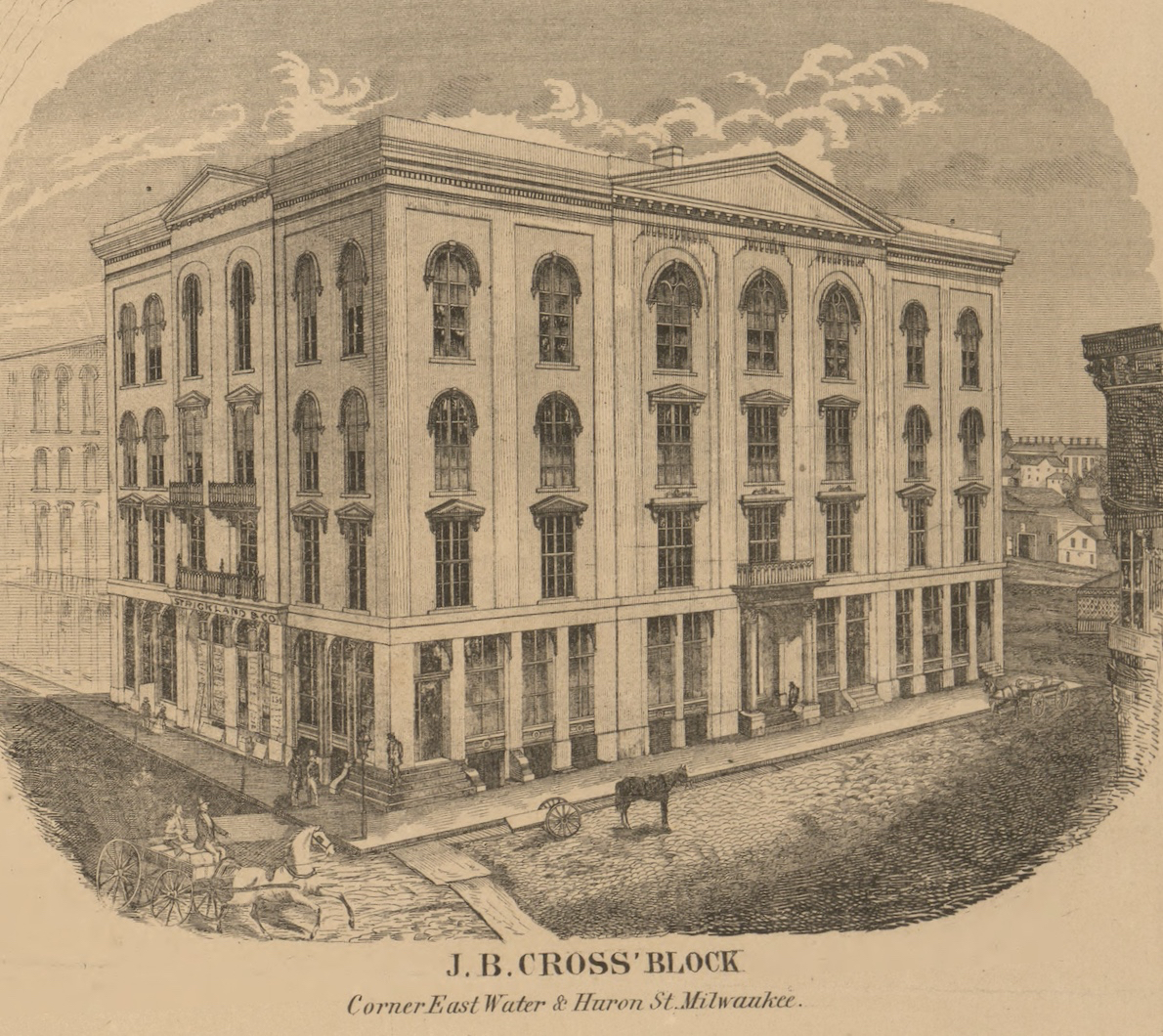
Walling, Henry Francis. Map of the county of Milwaukee, Wisconsin. New York: M.H. Tyler, 1858, Library of Congress, (inset showing Cross’ Block).

View of Cross’ Block circa 1858, home of the Milwaukee School Board until destroyed by fire on December 30, 1860.1, 2

Continue reading
Caroline Clark’s mentor, John G. McKindley

In today’s post, we continue our examination of the life and work of Jonathan M. and Mary (Turck) Clark’s oldest child, Caroline Mary (Clark) Woodward (1840-1924). In our earlier post, Caroline M. (Clark) Woodward: a closer look at that 1893 biography, we came across this passage:

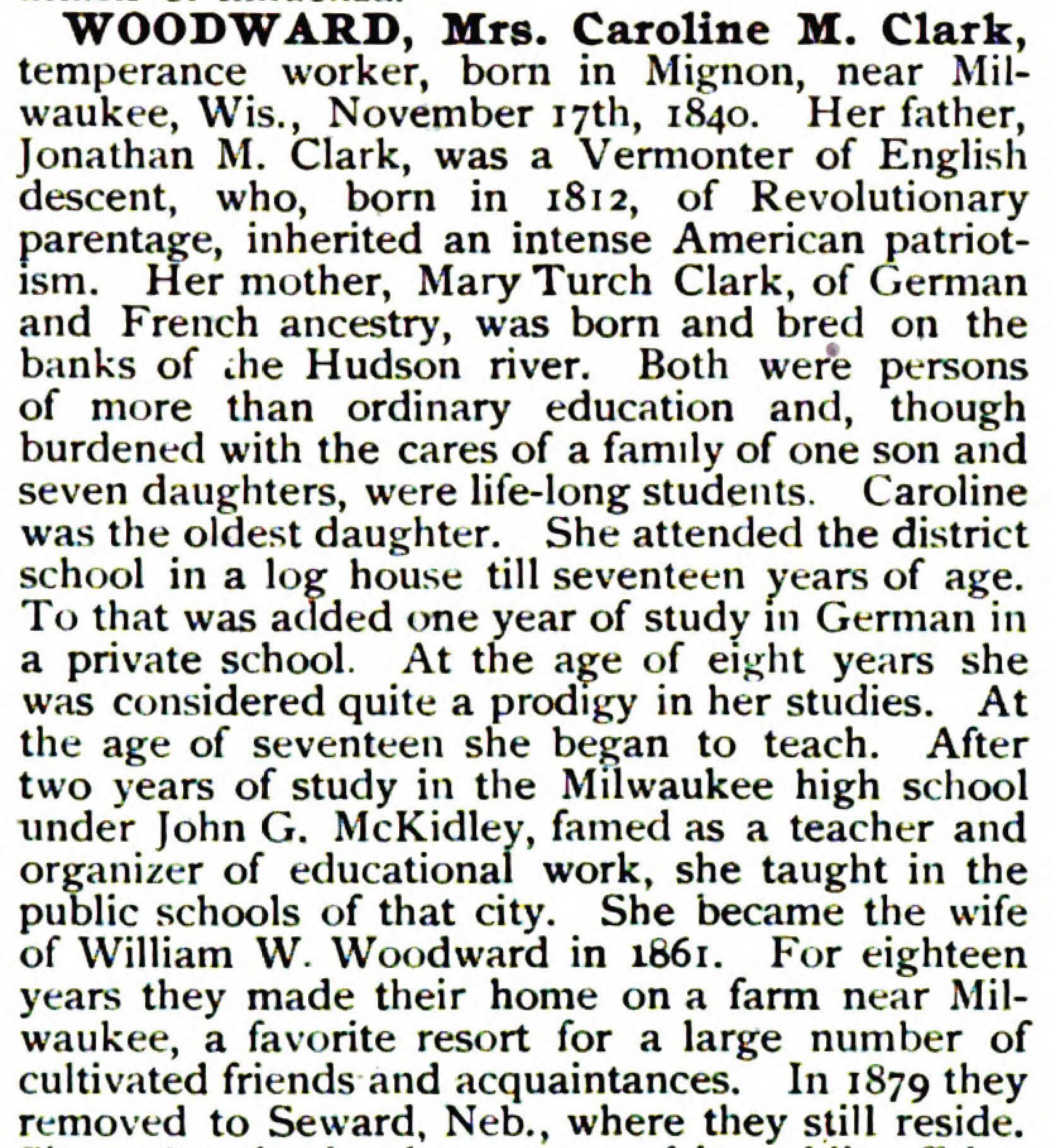
Caroline was the oldest daughter. She attended the district school in a log house till seventeen years of age. To that was added one year of study in German in a private school. At the age of eight years she was considered quite a prodigy in her studies. At the age of seventeen she began to teach. After two years of study in the Milwaukee high school under John G. McKidley [sic, McKindley], famed as a teacher and organizer of educational work, she taught in the public schools of that city.

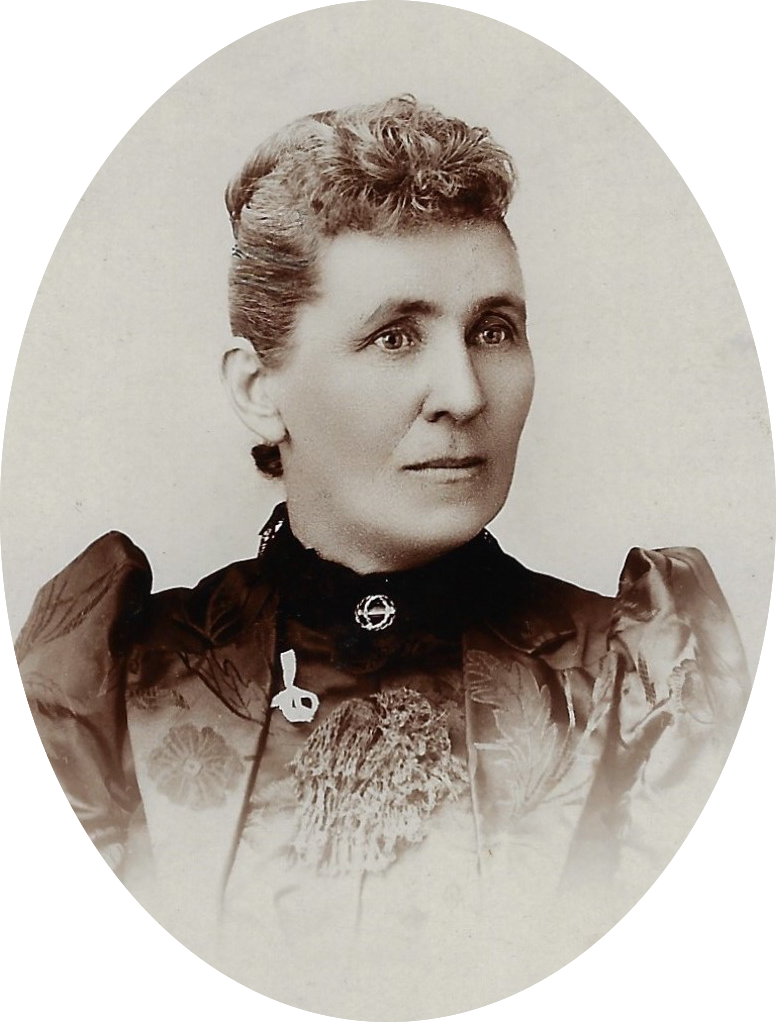
Photo of Caroline M. (Clark) Woodward courtesy of Frances Willard House Museum & WCTU Archives, Evanston, Illinois. Text: Willard, Frances E., and Mary A. Livermore, editors. A woman of the century ; fourteen hundred-seventy biographical sketches […], Buffalo, 1873, page 779.

Think back…

Imagine this: You are now more than 50-years-old. You have achieved statewide and national prominence as an organizer for the largest women’s social and political organization of the 19th-century. You and your spouse manage a family farm, continue to raise your several adopted and foster children, and you have a successful business of your own, selling insurance. And when you are asked to provide the details of your life for inclusion in a major biographical dictionary of leading American women, you make sure to include, by name…one of your high school teachers?

That’s exactly what Caroline (Clark) Woodward did in 1893, when she highlighted her two years of study with John G. McKindley at the Milwaukee public high school. And that prompts a few questions: who was J. G. McKindley? why is he cited in Caroline’s 1893 biography? when would he have worked with Caroline? was he really “famed as a teacher and organizer of educational work”? and how big a deal was “high school” in Wisconsin in the 1850s and ’60s, anyway?

Continue reading

Caroline M. (Clark) Woodward: a closer look at that 1893 biography

Today, as we continue to explore the life of Jonathan M. and Mary (Turck) Clark’s eldest child, Caroline Mary Clark—later usually known as Mrs. C. M. Woodward—we’ll take a fact-by-fact look at the biographical sketch of Caroline that was published in 1893, re-printed unchanged in 1897, then abridged and reprinted in 1912. For a full discussion of these three publications, see last Monday’s Caroline M. (Clark) Woodward: first steps toward a biography.

Willard, Frances E., and Mary A. Livermore. 1893. A woman of the century ; fourteen hundred-seventy biographical sketches accompanied by portraits of leading American women in all walks of life ; ed. by Frances E. Willard and Mary A. Livermore, assisted by a corps of able contributors, title page and page 779.

Today’s post will be less of a fully-formed essay, and more of a running analysis, commentary, and proof-reading of this 1893 biographical sketch. We’ll take one portion at at time, starting at the beginning. The source text will be presented as a shaded quotation, followed by my commentary and corrections in simple black text on white background, with highlighted links to additional sources and explanations and, of course, a few footnotes, too. Here we go…

Continue reading

Caroline M. (Clark) Woodward: first steps toward a biography

In our most recent blog post, Another family portrait! Caroline (Clark) Woodward, c. 1890s, we located and discussed the history of a previously unknown photo of Jonathan M. and Mary (Turck) Clark’s eldest child, Caroline Mary Clark, later usually known as Mrs. C. M. Woodward:

Townsend Elite Studio, [Portrait, Caroline M. (Clark) Woodward], inscribed “Mrs. C. M. Woodward, Supt. Work among Railroad Employes, N.W.C.T.U.”, photograph, circa 1889-1900. Photo courtesy Frances Willard House Museum & WCTU Archives, Evanston, Illinois. Click to open larger image in new window.

Caroline’s life was the most public—and perhaps best documented—of all the members of Jonathan M. Clark family, and is overdue for a closer examination. So today we begin a multi-part look at Caroline’s story, starting with three biographical sketches that were published during her lifetime.

Continue reading

A Dental Divertimento…

UPDATED, September 17, 2021, to add a few details about the Morrison children, Jennie’s dental practice in the 1880s and ’90s, and the date of her divorce from second husband A. G. Widger.

Due to unforeseen circumstances, I won’t be blogging much this week. (Let’s just say that the cause of my hiatus has inspired today’s post, featuring a brief introduction to the life of the Clarks’ youngest child, Dr. Jennie M. Clark, D.D.S.)

Unknown photographer, [Dentist], daguerreotype with applied color, circa 1855. Smithsonian American Art Museum, Museum purchase from the Charles Isaacs Collection made possible in part by the Luisita L. and Franz H. Denghausen Endowment. CC0. si.edu. Click to open larger image in a new window.

Clark House dentists

I’m not sure who Mequon’s first dentist was, or when he set up shop. It’s entirely likely that the Jonathan Clark family did not visit a dentist until they moved to Milwaukee (and they still may not have seen a dentist once there). But Mequon’s Jonathan Clark House plays an important part in the lives of two Mequon/Milwaukee area dentists.

Continue reading

“An afflicted father” – Peter Turck’s 1862 letter to Gen. Butler

This week our attention has been turned to New Orleans, the adopted home of Peter Turck’s eldest son—and Mary (Turck) Clark’s younger brother—Joseph R. Turck. Our previous post, J. R. Turck – from Mequon to New Orleans, sketched a brief outline of Joseph’s life, including a half century lived in the Crescent City. That post also discussed Joseph’s very brief service in a Confederate “home guard” militia unit during the Civil War, and how he had lost touch with his Wisconsin family during and after the capture of New Orleans in 1862.

A rare Peter Turck manuscript

We have a number of examples of Peter Turck’s signature—and an occasional bit of text in his hand—from various land documents, marriage licenses, federal census pages, citizen petitions, and other documents from the 1840s to the 1860s. Today’s document is the only letter I have seen in Peter Turck’s own hand, and it gives us a rare insight into Peter Turck’s paternal feelings (as expressed in the typically florid and deferential language of the era) and some additional details about the life of his eldest son, Joseph.1 It’s an interesting letter, and I thought you might like to read it.

Turck’s letter is preserved as part of National Archives and Record Administration (NARA) publication M345, Papers Relating to Citizens, compiled 1861 – 1867. These are letters sent by U.S. civilians to the Provost Marshal’s office of the Union Army. The Provost Marshal was, essentially, the chief of the military police in an area occupied by Union troops.

This letter was published in NARA series M345, microfilm roll 0270, item Joseph R. Turck. It’s accessible online at Fold3.com (pay site). The transcription is mine, and preserves Peter Turck’s occasional curious spelling or punctuation errors. The original letter appears to cover two sides of a single sheet of paper. The original envelope was not microfilmed; it was probably discarded by the New Orlean’s provost marshal’s staff in 1862.

Milwaukee, July 25th 1862

Turck, Peter to Gen. Benjamin F. Butler, July 25, 1862, page 1 of 2. NARA publication M345 Papers Relating to Citizens, compiled 1861 – 1867. Roll 0270, Joseph R. Turck, Fold3.com, accessed 20 March 2014. Click to open larger image in new window.

Continue reading

How’d they get here? – Steamboats!

How the early settlers came to Mequon, c. 1835-1850 (part 2)

This is part 2 of a series focused on how our Mequon pioneers traveled to southeast Wisconsin in the early days of white settlement, between roughly 1835 and 1850. If you missed part 1, it’s here at Monday: Map Day! – How’d they get here?, plus a short post with bonus image at Steamboat’s coming!

From the late 1820s until about 1850, if you wanted to get from the settled American northeast to the open frontiers of the West, the fastest, safest, and cheapest way to get there was by water. Thousands of New Yorkers, New Englanders, Canadians, and overseas immigrants that had come from Europe to America’s eastern ports, found the Great Lakes route—west on the Erie Canal to Buffalo, and then by water through the Lakes to Chicago and Milwaukee—was their preferred route to new homes on the western frontier. And many of those settlers traveled on the newest, fastest craft afloat: the steamboat.

View of Detroit…1837

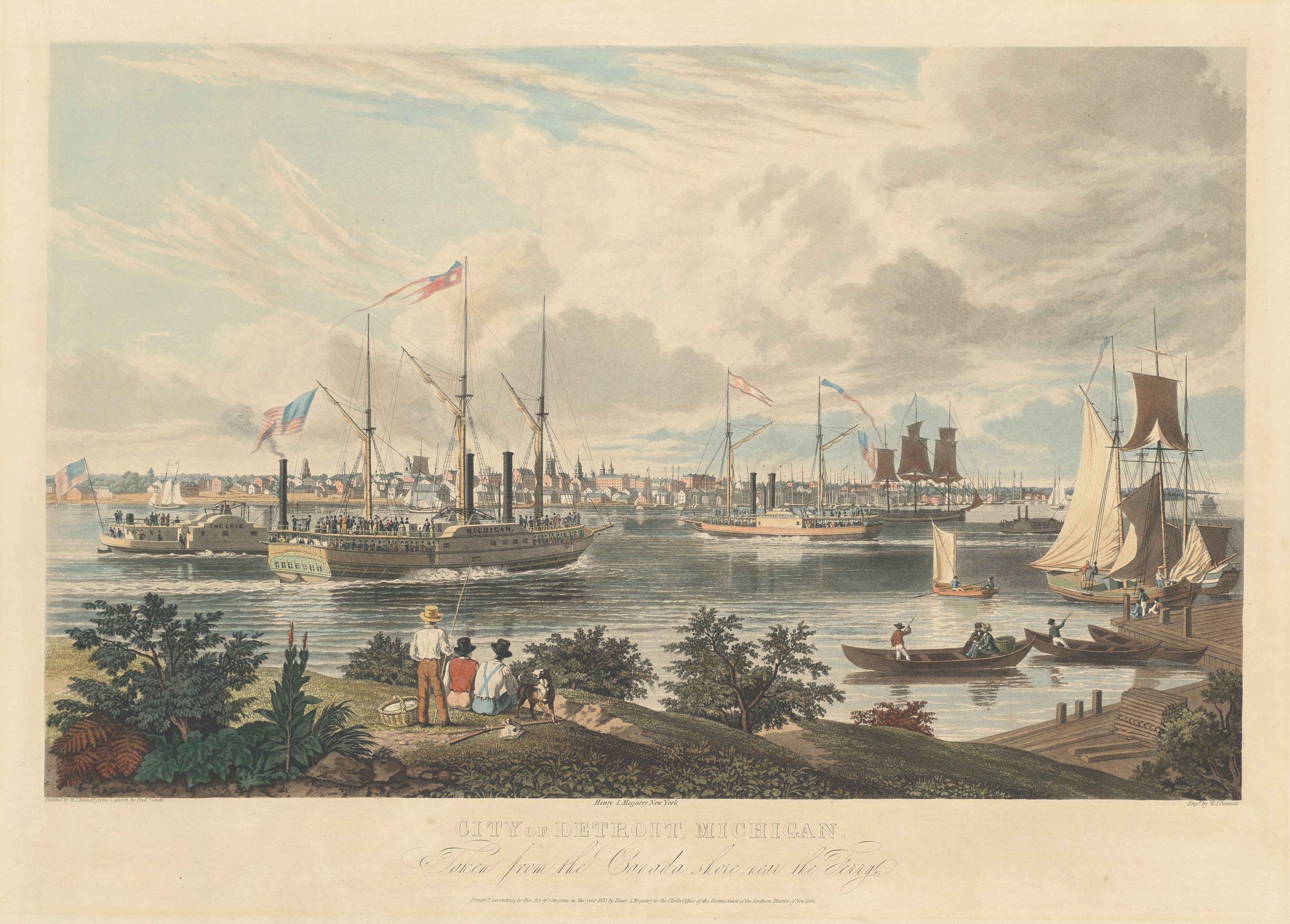
Here’s something really special for Clark House history lovers, a detailed drawing of the various kinds of sailing ships and steamboats as they passed by Detroit, Michigan on a sunny day in 1837, as seen from the Canadian side of the Detroit River. Take a close look; this is the view Peter Turck and his family—including daughter Mary, the future spouse of Jonathan M. Clark—would have seen as they traveled to Milwaukee in August of the same year1:

Bennett, William J., after a sketch by Frederick K. Grain, City of Detroit, Michigan. Taken from the Canada shore near the Ferry., hand-colored aquatint on engraving, ca. 1837. National Gallery of Art, Collection of Mr. and Mrs. Paul Mellon. Public Domain. Click to open larger image in new window.

Continue reading

Monday: Map Day! – How’d they get here?

UPDATED, February 11, 2024, to include a revised version of the annotated detail map of Ouisconsin, 1836. But for the full update—with additional notes and corrections—please see the most recent version of our discussion the Ouisconsin map of 1836 on our post of February 12, 2024.
UPDATED, July 6, 2021, to answer a reader’s question: “Where was Jonathan Clark just before he went to Fort Howard?” Scroll down to Comments for the answer.

How the early settlers came to Mequon, c. 1835-1850 (part 1)

Clark House education director Margaret Bussone and our education team are putting together a project centered on how our Mequon pioneers traveled to southeast Wisconsin in the early days of white settlement, between roughly 1835 and 1850. I thought I’d help out by gathering some relevant materials and sharing them with the education team—and you—here on the blog.1

So this week we’re going to look at how the settlers found their way here, and how they traveled on land, lake, or river. Rather than writing lots of words about each map or image, I’d like to gather a whole bunch of useful items in each post and put them out there as resources for all to use. Later in the week, we’ll look at various modes of travel on land and on water. Today we’ll look at some maps.2 Some of these maps were readily available to our would-be immigrants, others might have been one-of-a-kind or otherwise hard to obtain.

An overview, The U.S. in 1834

When the following map was published in 1834, Jonathan M. Clark was finishing the first year of his three-year enlistment in the U.S. army. He was stationed at Ft. Howard, on the Green Bay of Lake Michigan, in what was then the civil District of Huron, a soon-to-be-outdated term for the western portion of the Michigan Territory.3

Mequon’s earliest settlers would be coming to lands that were poorly mapped and little understood by most European-Americans. The most this map could show—in a very general way—is where the “open” areas were for future migration and settlement.

Norris, William, and Daniel K Minor. Map of the railroads and canals, finished, unfinished, and in contemplation, in the United States. New York: Railroad Journal, 1834. Map. Library of Congress. Click to open larger map in new window.

Continue reading

Henry Clark’s final resting place

UPDATED, July 4, 2021 to add a photograph of Henry Clark’s memorial inscription.

What we do — and don’t — know about the Clarks’ only son (part 5)

This is the fifth in a series of posts about the life of Henry M. Clark:
• Part 1: Meet the Children: Henry M. Clark
• Part 2: Henry Clark and the Civil War draft
• Part 3: Henry Clark – Civil War draftee

• Part 4: Henry Clark’s last days
• and a related tidbit: Avoiding the draft, 1862 style

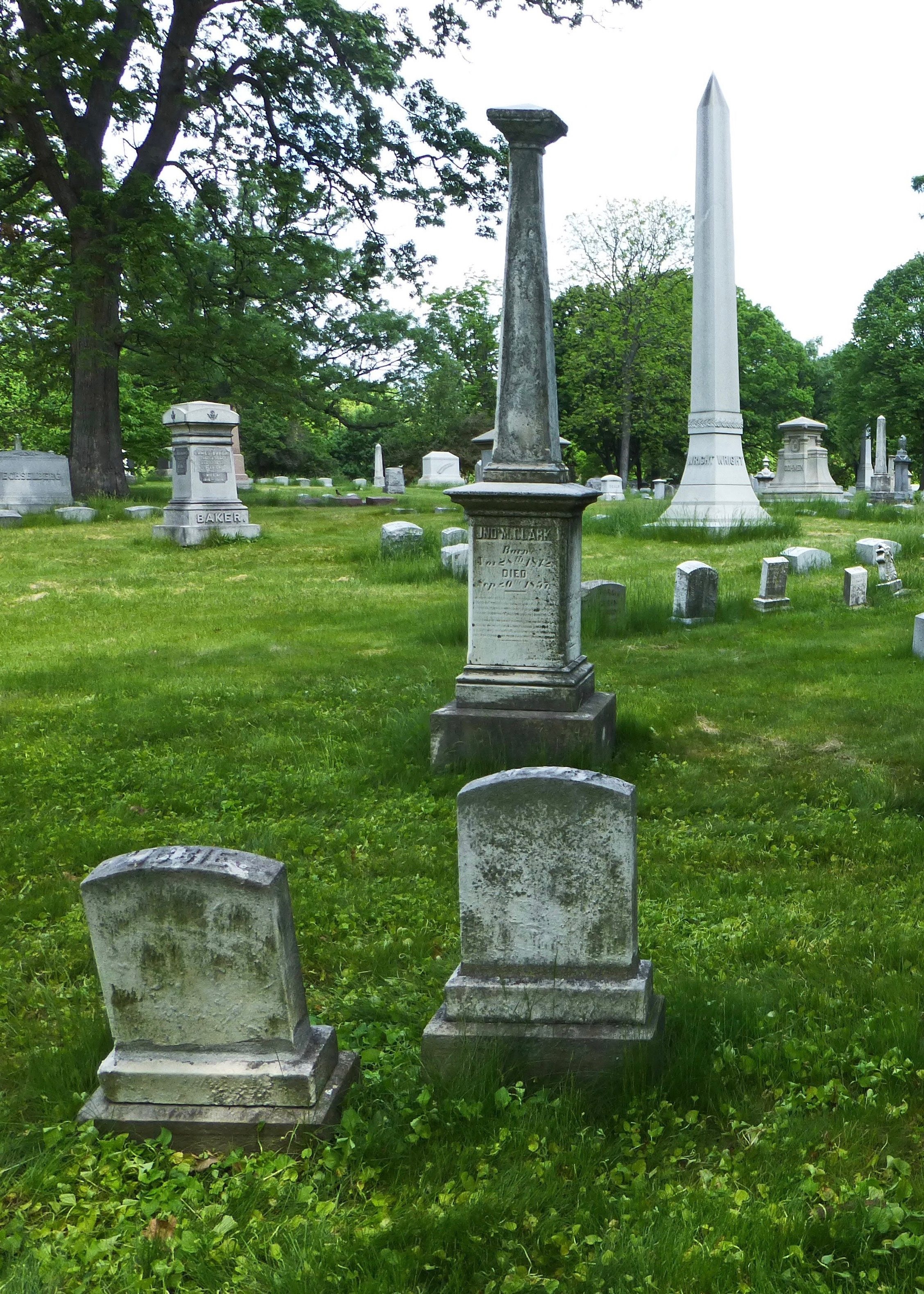
As we learned in our previous post, Henry Clark—only son of Jonathan M. and Mary (Turck) Clark—was buried “in Cedarburg” on Monday, April 23, 1866. But if you seek Henry’s final resting place, you’ll find him next to his father, mother, and sister Josie in the Clark family lot at historic Forest Home Cemetery in Milwaukee. How this came to be, and what this tells us about Clark family history, is the subject of today’s post.

Clark family graves, lot 3, block 44, section 10, Forest Home Cemetery, Milwaukee, Wisconsin. Photo courtesy Liz Hickman, 2016. Click to open new image in larger window.

Continue reading

Henry Clark’s last days

UPDATED, June 30, 2021 to add an endnote.

What we do — and don’t — know about the Clarks’ only son (part 4)

This is the fourth in a series of posts about Henry Clark, his life, and his possible military service.
• Part 1: Meet the Children: Henry M. Clark
• Part 2: Henry Clark and the Civil War draft
• Part 3: Henry Clark – Civil War draftee
• and a related tidbit: Avoiding the draft, 1862 style

In our previous post, we discovered that Henry M. Clark was drafted for Civil War military service on November 10, 1863. Today we will look at the existing evidence recording Henry’s death and burial in April, 1866, aged 23. So far, we lack reliable documentation for Henry’s life during the 28 months between those dates; we’ll continue the search for Henry’s possible Civil War service in a series of upcoming posts.

The question remains: why did Henry Clark, only son of Jonathan M. and Mary (Turck) Clark, die so young? Milwaukee death records for the 1860s are uneven and incomplete; it’s not surprising that no death certificate exists. I have not been able to find a death notice in the Milwaukee newspapers. But we do have two contemporary sources that can shed some light onto the mystery of this Clark family loss.

Densmore W. Maxon’s 1866 diary

On April 2, 1846, Mary Turck Clark’s younger sister Elizabeth Turck (1828-1913) married an ambitious young settler, Densmore W. Maxon (1820-1887). Maxon began his Wisconsin years as a surveyor, and eventually rose to prominence as a businessman and politician. He laid out the village of Cedar Creek, Town of Polk, Washington county, about 18 miles north and west of the Jonathan Clark house in Mequon. Densmore and Elizabeth Maxon lived in Cedar Creek for the next 41 years.

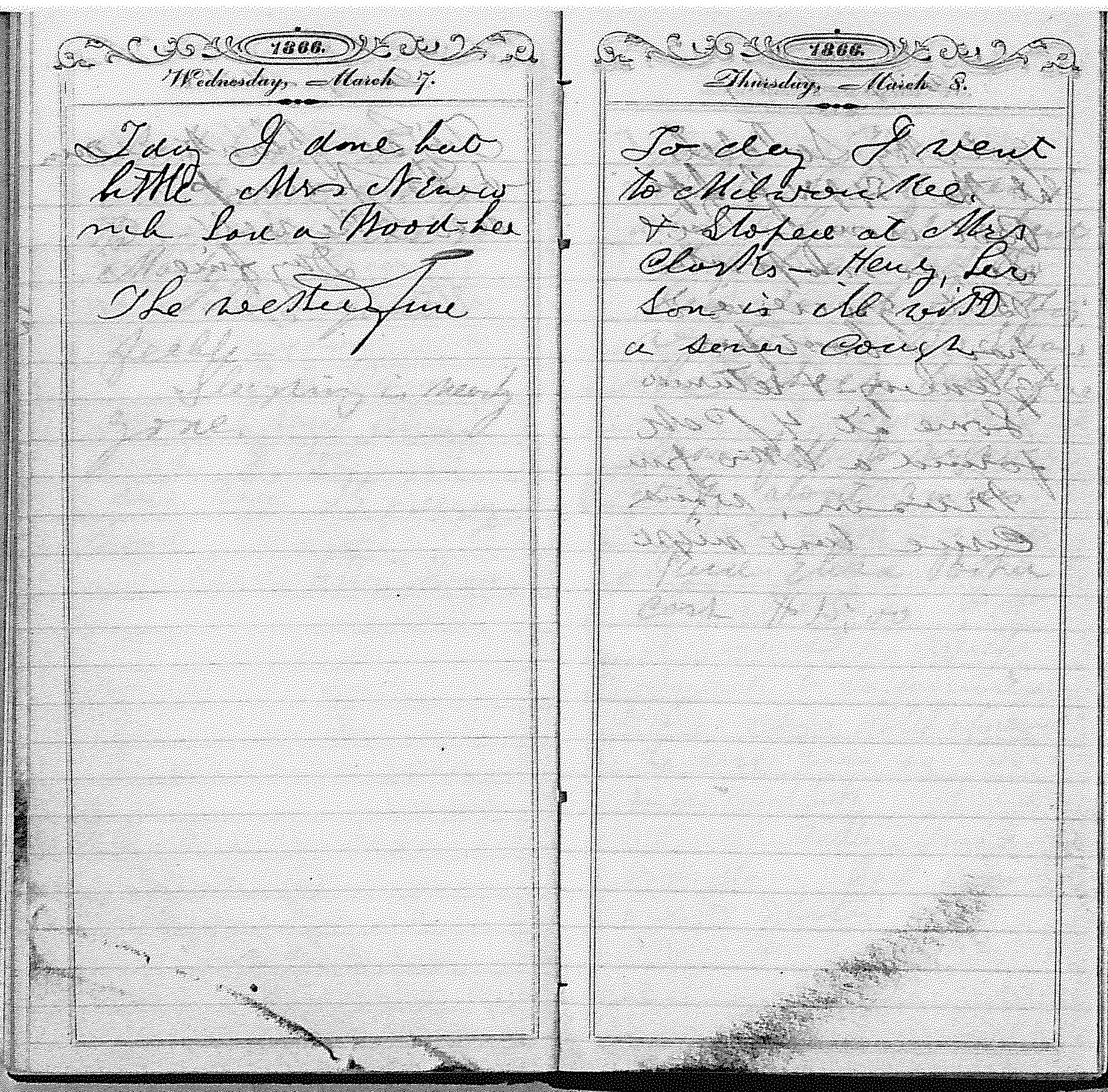
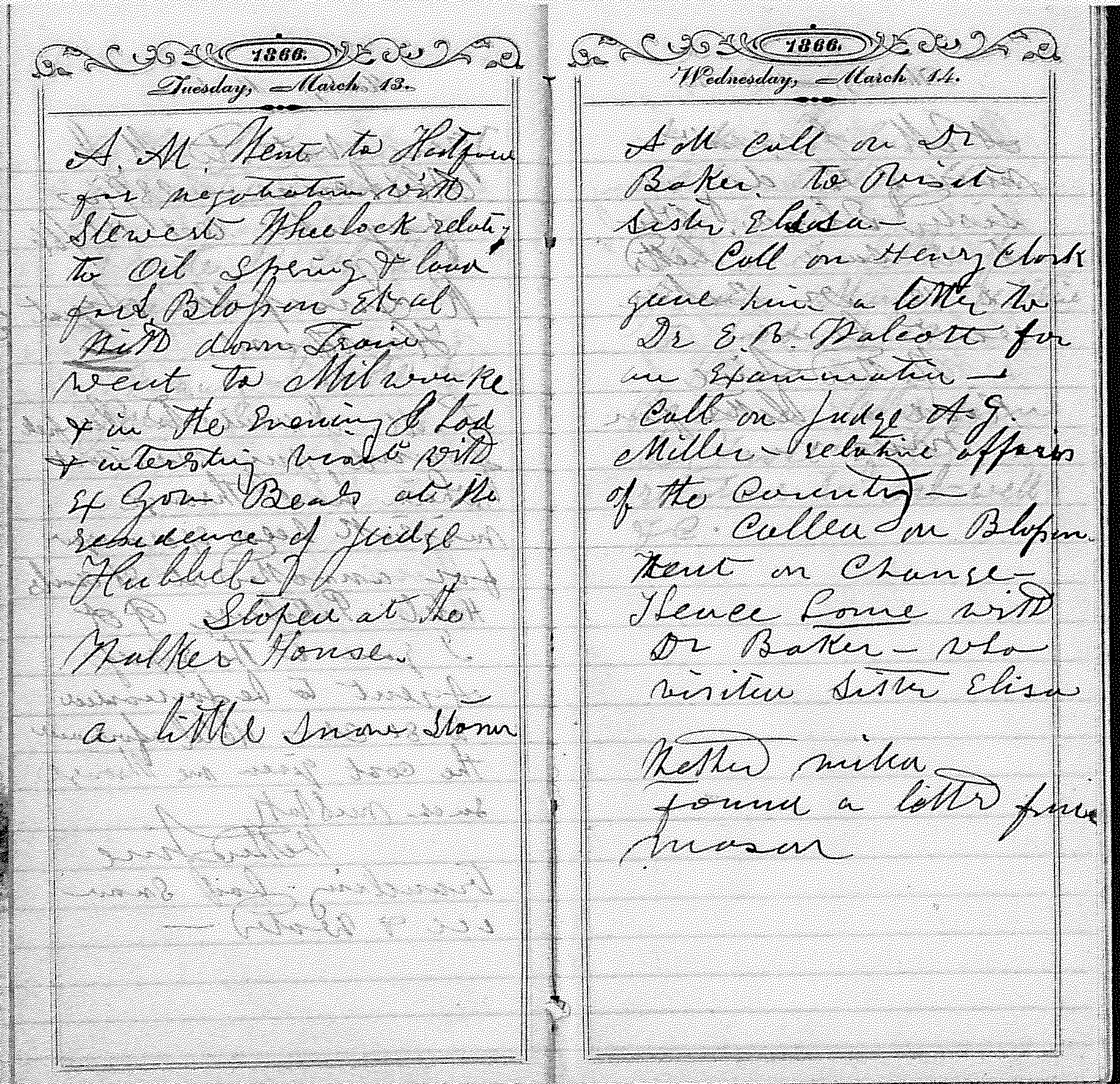
The lives of the Maxons, Clarks and Turcks are deeply intertwined from the 1840s onwards. For at least one year, 1866, Densmore Maxon kept a pocket diary. These pages contain his notes on the final days of nephew, Henry Clark:

Continue reading