Busy researching…

I’m in the middle researching and writing several multi-part Clark House Historian posts, so no essay today. How about a sunny photo of the Clark House parlour, instead?

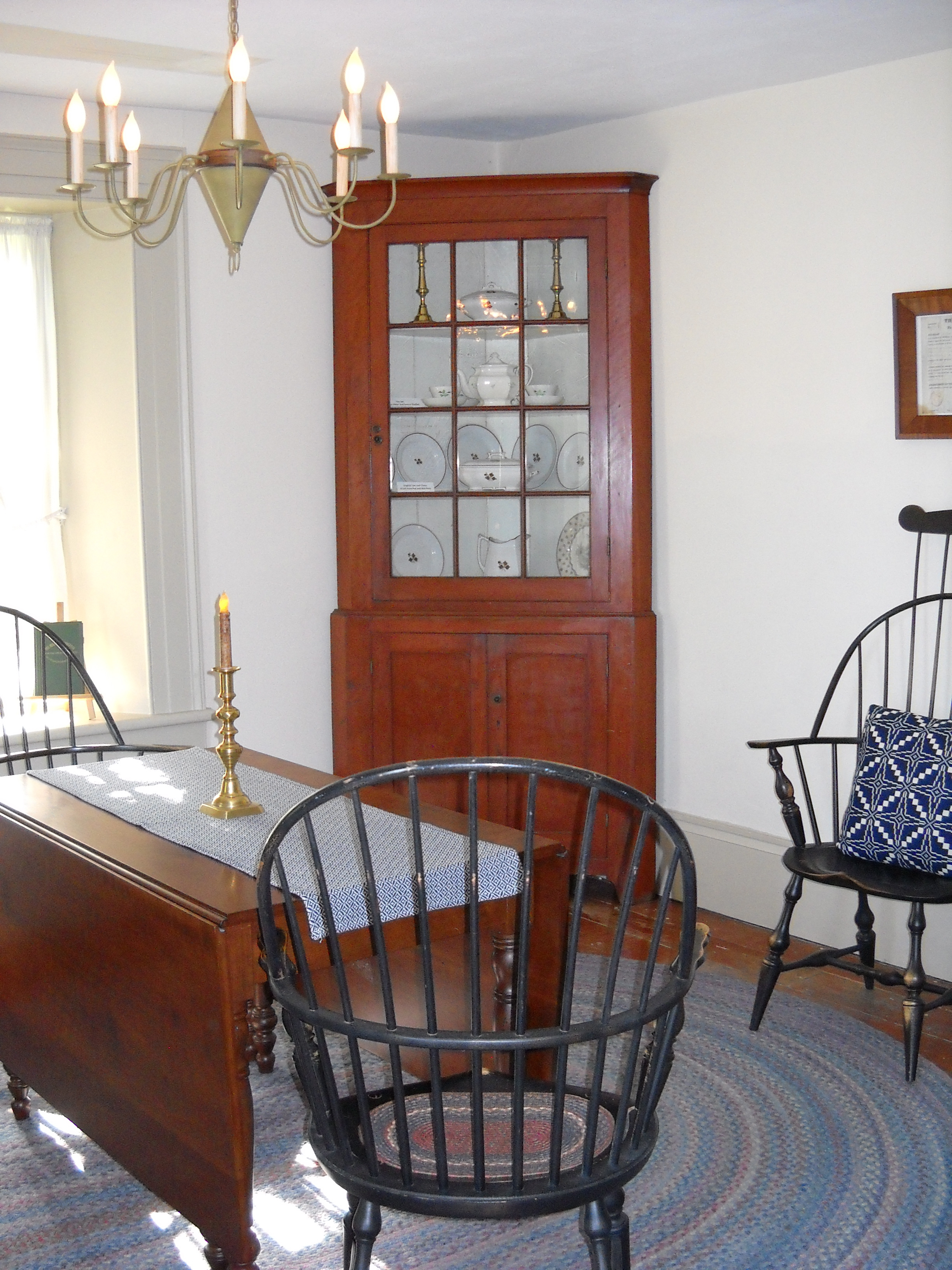
Photo by Reed Perkins, 2015. Click to open larger image in new window.

The cherry gate-leg drop leaf table dates from about 1850, and is used at Jonathan Clark House Museum board meetings. The bow backed Windsor chairs are based on 1840s originals. These reproductions date from around the 1940s or so.

The cherry corner cupboard is from about 1840. The finish and most of the glass are original. The tea leaf pattern china and twig pattern tea set in the parlour cupboards were donated by local antiques collectors. And the period reproduction light fixture was made in a small shop in Vermont.

Hope you have a fine day and a lovely weekend.

Back soon with surprises!

View from the window…

There’s a lot going on behind the scenes at Clark House Historian these days. I’ve got a half-dozen blog posts in various stages of completion, plus ongoing research and information-checking projects with Nina Look, Liz Hickman, and others. And, I’ve just heard from a third-great-granddaughter of two of the original Mequon settler families! How cool is that? More on those folks in an upcoming post—or two!

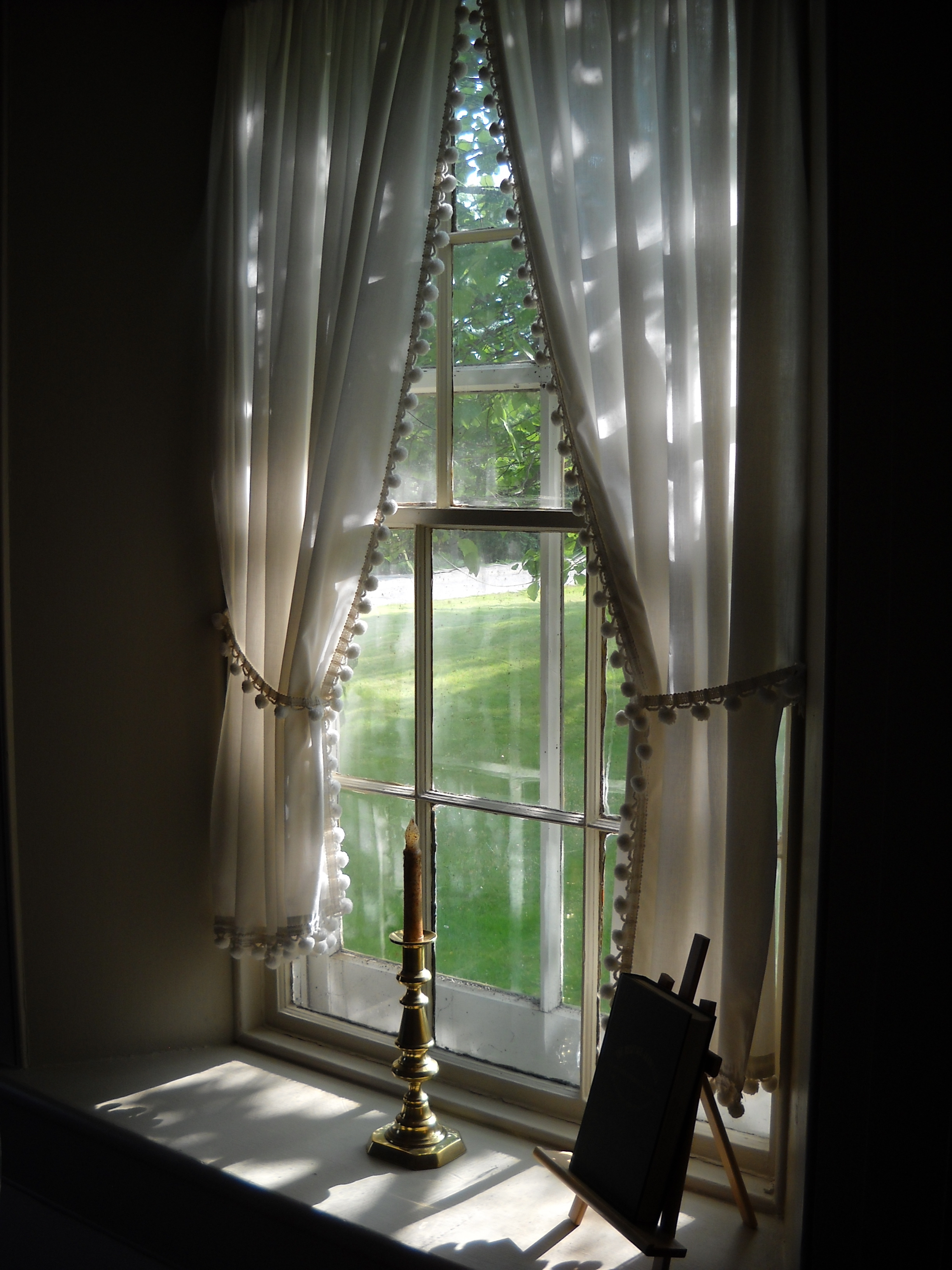
So let’s take a break, and enjoy a relaxing summer view from the Clark House. In this instance, a lovely July, 2015, view from the Clark’s front parlour, looking to the southwest toward present-day Bonniwell Road. According to the 1872 “Shoolmap” of Mequon, neighbors John Kurz and J. H. Townsend lived just across the street. A bit farther west down the road were—still—the farms of old friends and original Mequon settlers William Bonniwell and Jesse Hubbard.

Photo by Anna Perkins, used by permission. Click to open larger image in new window.

Monday: Map Day! – Another look at Ouisconsin Territory, 1836

UPDATED, February 11, 2024, to include a revised annotated map. But for the full update—with additional notes and corrections—please see the most recent version of this, posted on February 12, 2024.

As a kind of postscript to our look at the early Wisconsin territorial, state and federal censuses, today’s Monday: Map Day! revisits an interesting map that we first discussed on October 29, 2017. Today’s post includes a few updates and corrections based on new information. 

It’s 1836. Where’s…Wisconsin?

In September, 1836, Sgt. Jonathan M. Clark was discharged from the U.S. Army at “Camp Hamilton,” Wisconsin Territory. after serving his three-year term of service with Co. K, Fifth Regiment of Infantry.1  One year later, in the autumn of 1837, Jonathan’s future wife Mary Turck would make the long trip from Palmyra, New York, to Milwaukee and finally Mequon, Washington County, Wisconsin, with her parents Peter and Rachael Turck and six younger siblings. By the end of 1840 Jonathan and Mary would be married and starting their family in Mequon.

That seems simple enough, until you take a moment to wonder how much Jonathan—or especially Mary and her family—knew about this new Wisconsin Territory.  Jonathan had been in the territory since October, 1833, mostly on post at Ft. Howard. In the last year or so of his service he was busy cutting trees and building bridges for the military road along the Fox River waterway from Ft. Howard (Green Bay) towards Ft. Winnebago (near modern Portage). As a road-building soldier, Jonathan might have done some surveying and seen—or helped draw—a variety of maps of the military road and its vicinity. But for a better overview of this new territory, Jonathan or Mary might have sought out a map such as this2:

Continue reading

1857: Disaster

As the year 1857 began, things seemed to be going well for the Clark family. Jonathan M. and Mary Turck Clark had been married for seventeen years. On May 25, 1857, they welcomed the birth of their eighth child, daughter Jennie Marietta Clark. She joined six older sisters—Caroline, Elizabeth, Persie, Theresa, Laura and Josie—and one brother, Henry.

The family had been living in their handsome, two-story home of stone and wood—now the Jonathan Clark House Museum—for nine years. They owned 160 acres of fine farmland, and appeared to be one of the more successful and comfortable farm families in the area.

But not all was well in the neighborhood. In November, 1856, typhus struck Rev. James W. Woodworth’s father, Peter. By late December, Rev. Woodworth’s daughters Rosetta and Julietta were both ill with the disease. In early February, Rev. Woodworth’s wife, Cerena Loomer Woodworth was taken ill with typhus, followed by daughter Sophia a few days later.

Continue reading

Summer in the Kitchen

I’m working on a number of longer posts, none of which are ready yet. So how about a Jonathan Clark House Museum photo instead?

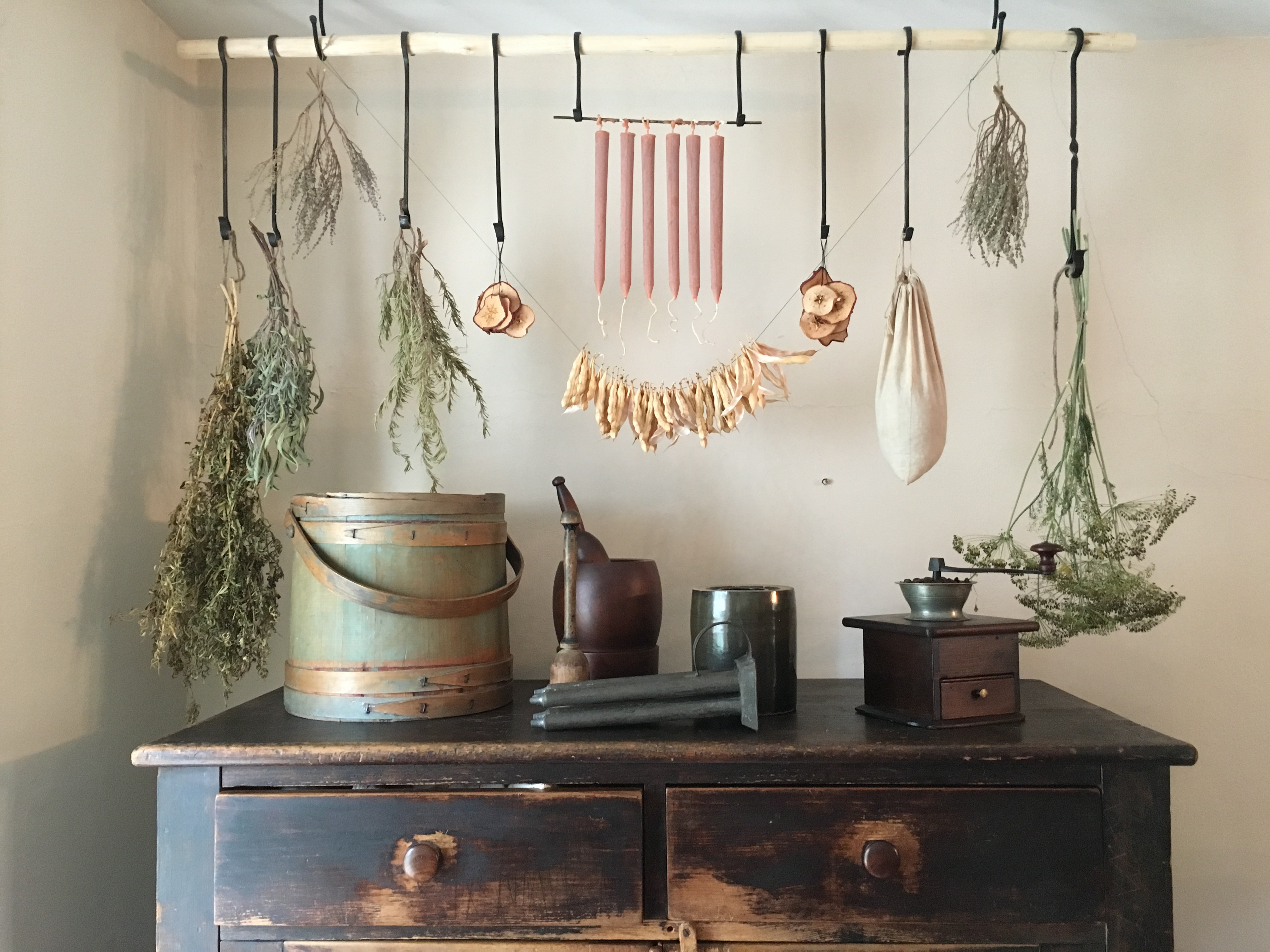
Part of the kitchen at the Jonathan Clark House museum, Mequon, Wisconsin, July, 2016. Photo by Anna Perkins, used by permission. Click to open larger image in new window.

Mary Turck Clark—and the Clark children—probably spent part of each spring, summer and early fall day tending a sizable herb and vegetable garden. Herbs added flavor to food and were also valued for their medicinal properties. But herbs often grow faster than you can use them. What to do? Hang them up to dry, and enjoy their scents, flavors and healing qualities throughout the coming year.

In early July, if the weather had been good—lots of sun and perhaps an inch or two of rain each week—the Clark family might have enjoyed the first fresh green beans of the summer. That would have been a real treat after months and months of dried produce and the last, tired, potatoes, turnips, onions, carrots and such from the root-cellar1.

By the time autumn arrived, the last beans on the bush would have been big and kind of stringy. Not as tasty as the mid-summer beans, they would be hung up to dry so that the beans could be saved, ready for planting the next spring.

Continue reading

Monday Miscellany!

Clark House News and an Update

I hope you enjoyed your Independence Day weekend. Our “Monday: Map Day!” feature is taking the week off. In its place, here is a round-up of some recent Jonathan Clark House news and a blog update/correction or two.

Three Cheers for Liz!

I was glad to assist Clark House museum director Nina Look in putting together this “tip of the hat” to Clark family descendant and stalwart Jonathan Clark House Museum friend and supporter Liz Hickman. This went out to Clark House board members and volunteers in mid-June, and I’m happy to share it with you here:

Continue reading

Clark House News

Staying Safe — and Up to Date…

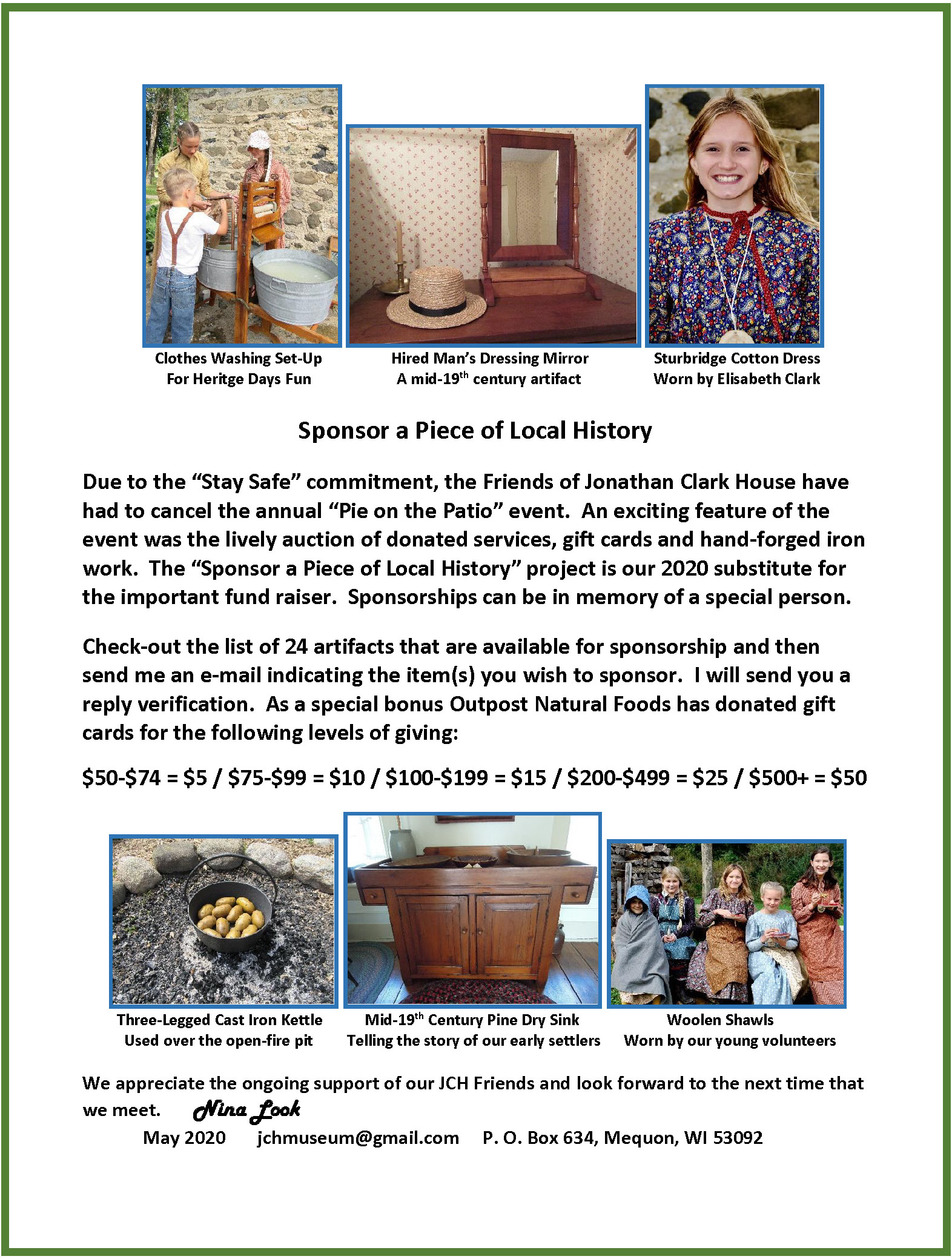
Due to the current Covid-19 situation, Jonathan Clark House museum activities are currently suspended. We hope they will resume soon. Meanwhile, JCH director Nina Look is sending regular updates and announcements, and I’d like to pass them along to you, here.

As you’ll see from the flyer (below), we’re sorry to announce that the annual Pie on the Patio fundraiser auction has been cancelled.

Click on the page to open larger image in a new window.

I know I’ll miss seeing my Clark House friends, enjoying tasty local pie, and supporting the Clark House. But all is not lost…

Continue reading

Think Like a Historian…

To all my blog readers, I hope this finds you well and staying safe at home.

I just received a message from Jonathan Clark House director Nina Look and I thought I’d share it with you:

Dear Friends-

As you might imagine, the Clark House is closed at this time, but we continue to think about the history of our early settlers and how important it is to share that history with our children. I prepared the attached guide with the help of JCH Education Coordinator Margaret Bussone and JCH Curator Fred Derr.

Feel free to pass it on to a young person who may want to “Think like a historian.”

Nina Look, Director

CLARK HOUSE Think Like a Historian image

Click this link to open the CLARK HOUSE Guide for Young Visitors

Continue reading