Well, whaddya know? Christmas is just around the corner…
JCH Parlour with Christmas tree and decor. Photo credit Reed Perkins
Holiday Lights 2024
December 2 & 3, 2024, brought us the latest edition of our Holiday Lights gathering of Clark house friends old and new. There was good food, tasty beverages, lively conversation, and fine seasonal music, all dished up in the unique ambience of our historic Jonathan Clark House Museum.
As we do every year, the house was decorated with appropriate 1840s-style decorations, including the table-top Christmas tree and ornaments, and the evergreen bough decorations on the window sills, shown above.
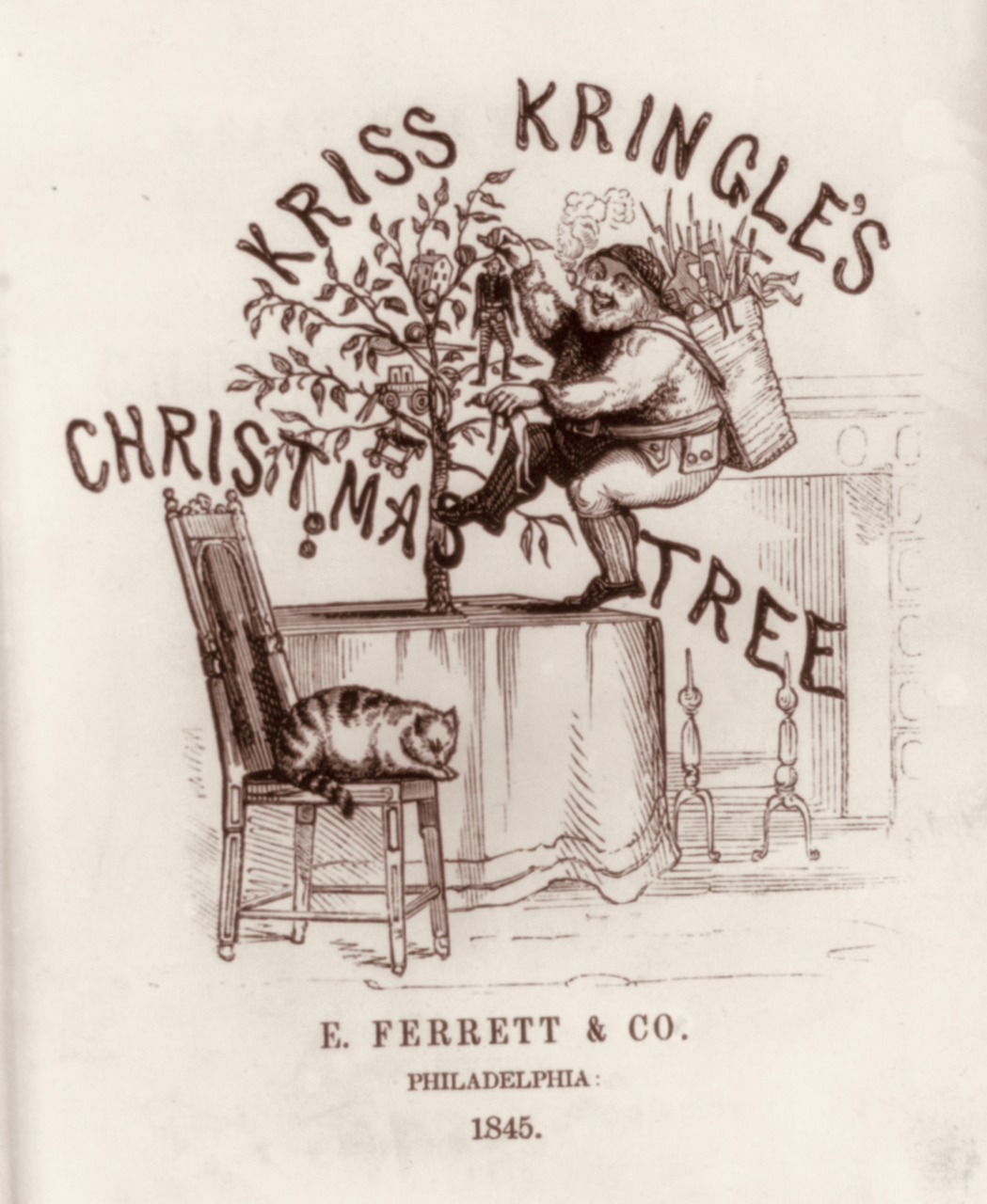
KrissKringle’s Christmas Tree [title page], E. Ferrett & Co., Philadelphia, 1845. Library of Congress
I grew up in the Chicago suburbs, and I remember the holiday thrill of riding the Chicago & Northwestern commuter train downtown with my parents, and then walking into the majestic State Street headquarters of Chicago’s grandest department store, Marshall Field & Company. Our mission? A trip up to the “toy floor” at Field’s, where we would wait in line to tell Santa all the wonderful things we would like to receive for Christmas that year.1
It goes without saying that I haven’t been able to fit on Santa’s lap for a very long time. But as the Clark House Historian, I still have holiday dreams and wishes, and today I’d like to share some of them with you. Who knows, perhaps Santa will work his magic once again?
(Official disclaimer: I do not serve on the JCH Board of Directors, or any of its committees. This is my Christmas daydream, a fantasy of what I’d like to see unfold at my favorite museum, given unlimited resources. And besides, as the great Chicago architect and city planner Daniel Burnham famously said: “Make no little plans. They have no magic to stir men’s blood!”)
My list is organized into several parts, the first of these is…
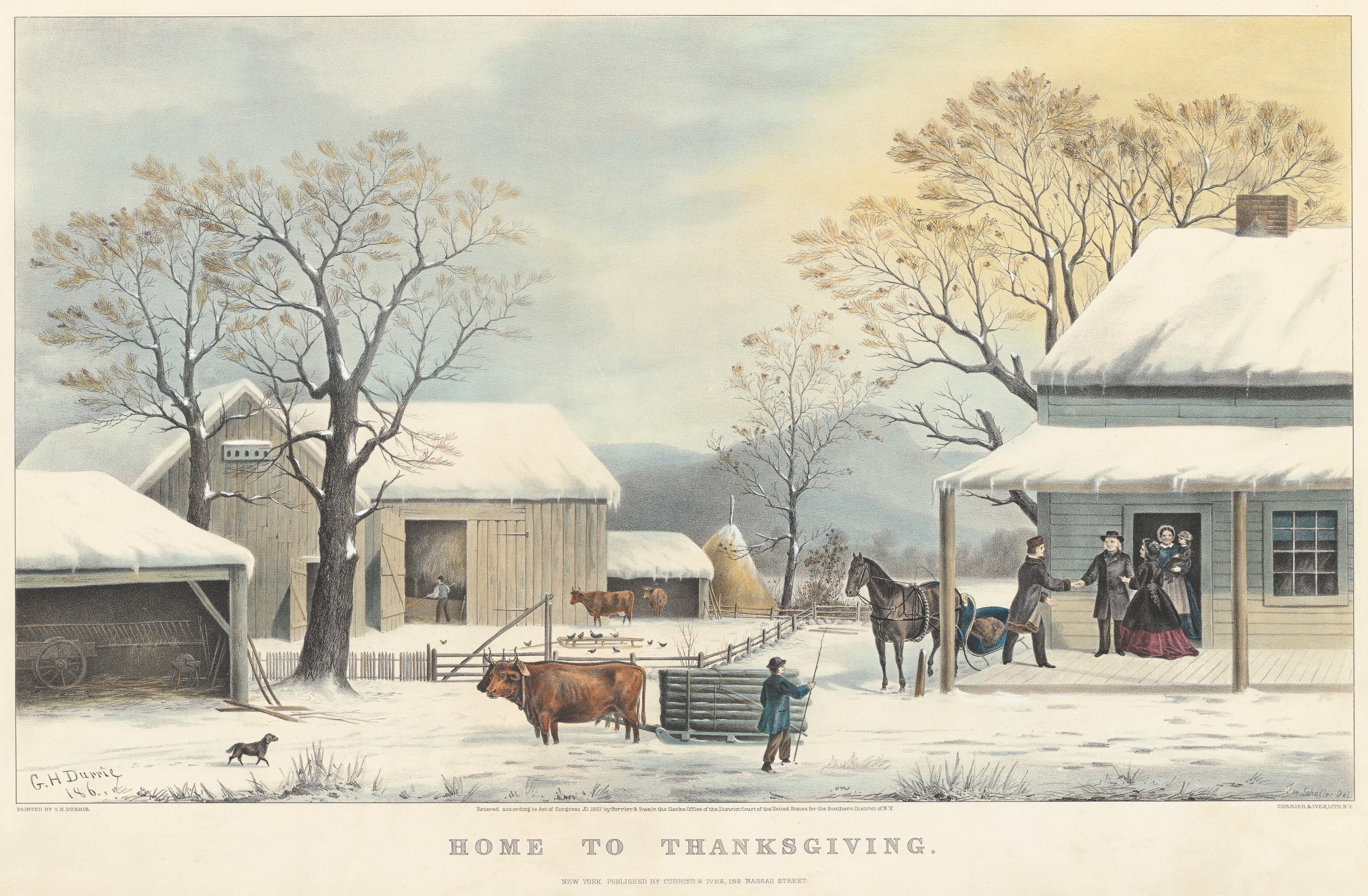
It’s Thanksgiving today, and I’m taking a few days off to spend time with family. But in the spirit of the holiday, I thought I’d reprint a lightly revised version of our now-annual Thanksgiving post, to share with you a few vintage recipes and a nice Currier & Ives lithograph from the period.1
Thanksgiving, 1867
Durrie, George H. and John Schutler, Home to Thanksgiving, ca. 1867, New York, Currier & Ives. National Gallery of Art, Collection of Mr. and Mrs. Paul Mellon. Public Domain. Click to to open larger image in a new window.
Veterans Day is today. For a perspective on the day—and our early Mequon veterans—here’s a post originally published at Clark House Historian on November 11, 2016, and revised, expanded and republished several times since. These stories, by the way, are not the only stories of local veterans that I have collected. My recent research has discovered some amazing stories of German immigrant and Black American soldiers that fought for the Union—and Ozaukee county—as part of Wisconsin’s Civil War experience. And I still have much to learn about the Civil War service of Mary Clark’s brother, Benjamin Turck and the post-war travails of Persie Clark’s husband, the war-wounded U.S. Navy veteran and pensioner Henry D. Gardner. I hope to tell those stories here, at Clark House Historian, in the near future.
Armistice Day
One hundred and six years ago, on the eleventh day, of the eleventh month, at the eleventh hour—Paris time—the Armistice of Compiègne took effect, officially ending the fighting on the Western Front and marking the end of World War I, the optimistically named “War to End All Wars.”
In the United States, the commemoration of the war dead and the Allied victory began in 1919 as Armistice Day, by proclamation of President Woodrow Wilson. Congress created Armistice Day as a legal holiday in 1938. Starting in 1945, a World War II veteran named Raymond Weeks proposed that the commemorations of November 11 be expanded to celebrate all veterans, living and dead. In 1954 Congress and President Eisenhower made that idea official, and this is what we commemorate today. There are many veterans with a connection to the Jonathan Clark house. We honor a few of them in this post.
Jonathan Clark, Henry Clark, and the U.S. Army
Jonathan M. Clark (1812-1857) enlisted as a Private in Company K, Fifth Regiment of the U. S. Army, and served at Ft. Howard, Michigan (later Wisconsin) Territory, from 1833 until mustering out, as Sargent Jonathan M. Clark, in 1836. In the 1830s, Fort Howard was on the nation’s northwestern frontier. Jonathan’s Co. K spent much of the summers of 1835 and 1836 cutting the military road across Wisconsin, from Ft. Howard toward Ft. Winnebago, near modern Portage, Wisconsin.
Fort Howard, Wisconsin Territory, circa 1855, from Marryat, Frederick, and State Historical Society Of Wisconsin. “An English officer’s description of Wisconsin in 1837.” Madison: Democrat Printing Company, State Printers, 1898. Library of Congress. Click to open larger image in new window.
The Clark House Historian at his desk, wondering where October went…1
It’s been over a month since our last Clark House Historian post! Sorry about that. It’s not that I haven’t been busy with JCH writing and organizing. I have been. But most of my work for the last month has been done behind the scenes as the Jonathan Clark House graphic designer and webmaster.
For a good roundup of what’s been going on, please head over to our JCH official website and click on the News & Events page for details.
Today is Labor Day, the holiday celebrating the working men and women of our nation, and I thought I’d commemorate the day with a lightly-revised re-post of this piece from 2023.
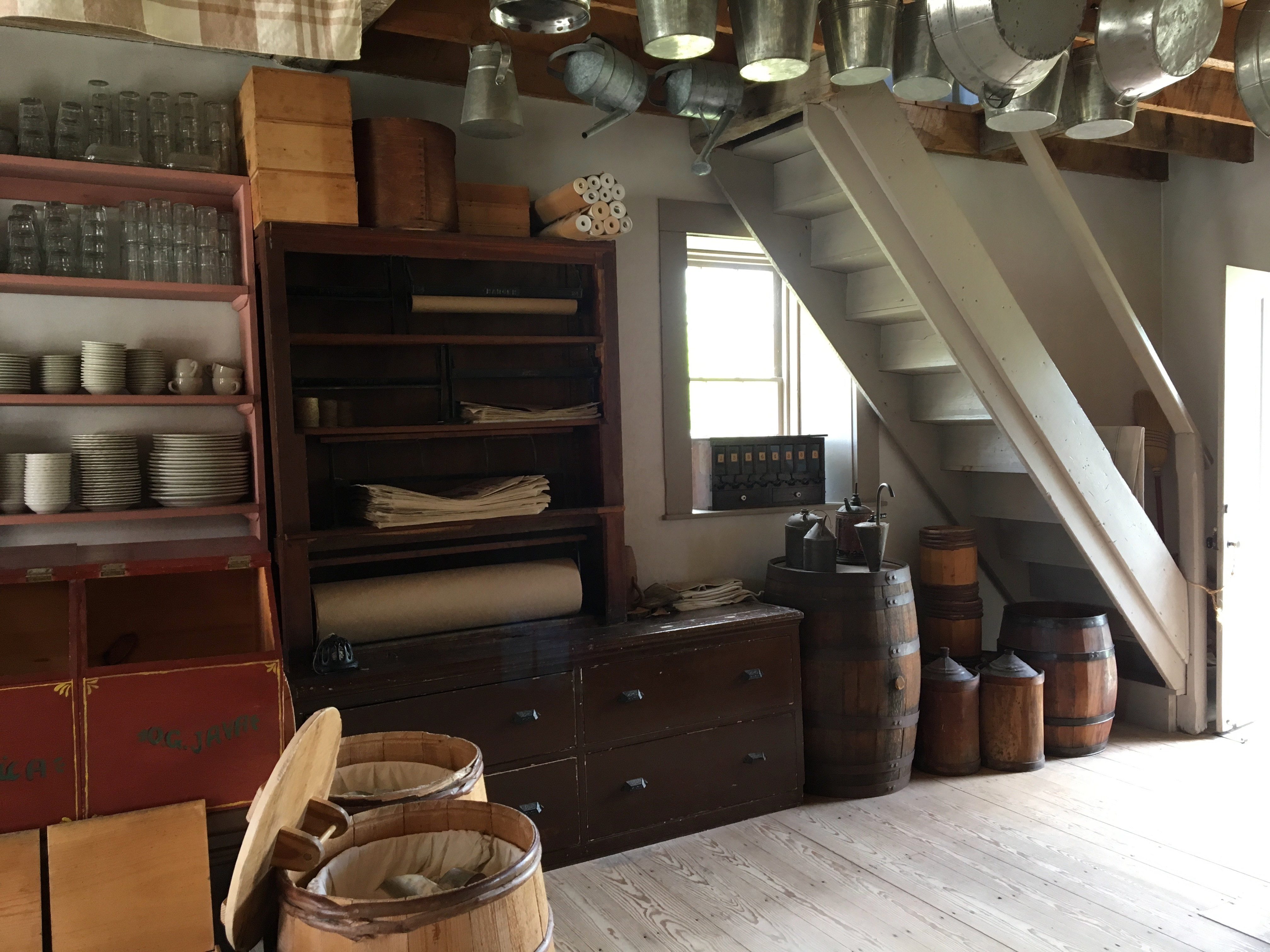
This Labor Day, I’ll be at home, working on my upcoming lectures for the state DAR and the Cedarburg History Museum. Last year, I had to work at our local mercantile establishment. You know, a store kind of like this one, only much bigger, stocked with just about anything you need for modern living:
I don’t really have the day “off” today—too much writing to do—and won’t be marching in a parade, but I’d still like to honor the holiday and salute the American worker, past and present. With that in mind, let’s revisit some of the nineteenth-century occupations we’ve talked about previously at Clark House Historian, highlighting a few of the many skills, trades, and occupations common during the Clark House era.
Since it is a holiday, I’m not going to add long commentaries to each photo. Enjoy the photo galleries, and click each gallery to open larger versions of each image. And click the highlighted links to visit the original CHH posts, filled with lots more information about the different skills, tools, and jobs, and the full image credits.
248 years ago today, representatives of all thirteen of Britain’s American colonies, gathered “in congress” in Philadelphia, and publicly declared our independence from “George the Third, by the Grace of God, King of Great Britain, France, and Ireland, Defender of the Faith, and so forth,” and his distant and unresponsive legislature. The Americans proposed to separate—forever—from their Divinely appointed King, and form a new and independent nation, the “united States of America.” This decision was bold, completely unprecedented in a world dominated by autocratic monarchs, and potentially fatal for anyone that supported this Declaration of Independence. From the King’s point of view, the authors, his subjects, were committing treason.
After a public reading of the Declaration of Independence at Bowling Green, on July 9, 1776, New Yorkers pulled down the statue of King George III.
The authors of the Declaration were clear-eyed about the stakes, yet unwavering in their desire to separate from the King. They closed their—our—Declaration of Independence with their unanimous avowal that, […] for the support of this Declaration, with a firm reliance on the protection of divine Providence, we mutually pledge to each other our Lives, our Fortunes and our sacred Honor.
The Declaration of Independence is our pivotal foundational document. People risked their lives and fortunes by creating and signing it. Thousands of Patriots died in the subsequent War of Independence in order to make the “united States of America” a reality. A large number of British-Americans, still loyal to their monarch, fled the 13 colonies and migrated to the King’s remaining possessions to the north, including Nova Scotia and the Province of Quebec.
Through it all, the ideals expressed in the Declaration inspired generation after generation of Americans, including Jonathan Clark and his ancestors, as attested in this excerpt from daughter Caroline (Clark) Woodward’s 1893 biographical sketch:
[…] Jonathan M. Clark, was a Vermonter of English descent, who, born in 1812, of Revolutionary parentage, inherited an intense American patriotism.
Jonathan Clark and his Mequon neighbors—including native-born “Americans,” as well as more recent immigrants from Ireland, the German lands, the United Kingdom, Nova Scotia, and elsewhere—knew the Declaration, read it aloud at patriotic events (in English and German!), and shared its anti-monarchical sentiments.
This July 4th, before you head to the beach or light the barbecue, why not refresh your memory and read the document that created our nation, and forever declared our freedom from the “absolute Despotism” of kings?
In Congress, July 4, 1776.
The unanimous Declaration of the thirteen united States of America,
When in the Course of human events, it becomes necessary for one people to dissolve the political bands which have connected them with another, and to assume among the powers of the earth, the separate and equal station to which the Laws of Nature and of Nature’s God entitle them, a decent respect to the opinions of mankind requires that they should declare the causes which impel them to the separation.
Our annual Memorial Day post, first published in 2020. Updated for 2024 with new information about the Civil War service of Isham and Emily (Bigelow) Day’s eldest child, Cpl. James Lemon Day (1834-1863).
Graves of Unknown Union Soldiers, Memphis National Cemetery, photo by Clayton B. Fraser, (Library of Congress), public domain. Memphis National Cemetery is the final resting place of Mequon’s Watson Peter Woodworth, and almost 14,000 of his Union Army comrades.
Today is the day our nation officially observes Memorial Day. For many Americans, Memorial Day represents “the first day of summer,” and is traditionally celebrated with trips to the lake, picnics, parades, and sales on cars, appliances, and other consumer goods.
But for many of us, Memorial Day remains rooted in its origins as Decoration Day. The first national observance was in 1868, when retired general John A. Logan, commander and chief of the Grand Army of the Republic—the Union veterans’ organization—issued his General Order Number 11, designating May 30 as a memorial day “for the purpose of strewing with flowers or otherwise decorating the graves of comrades who died in defense of their country during the late rebellion, and whose bodies now lie in almost every city, village, and hamlet churchyard in the land.”
On this Memorial Day, let’s take a moment to remember what this day truly represents.
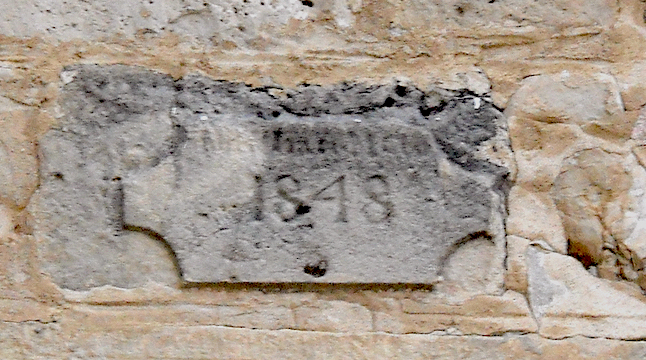
1848 was a big year for Jonathan and Mary (Turck) Clark. Their family now included four children: Caroline (b. 1840), Henry (b. 1843), Libbie (b. 1845) and infant daughter Persie (b. 1847). And 1848 was the date that Jonathan M. Clark inscribed—just below his own name—on the Clark House “cornerstone” that still decorates the lintel above the Clark House front (south) door.
Photo credit: Reed Perkins, 2015
1848 was a landmark year in many respects. Gold was discovered in California, the War with Mexico ended with the Treaty of Guadelupe Hidalgo and, most importantly for our Mequon pioneers, the Wisconsin Territory adopted a state constitution and was admitted by act of Congress as the 30th state in the Union.
Of course, on January 1, 1848, those events—and many others—still lay in the future, in the New Year. We’ve blogged about some of those events here at Clark House Historian, and we’ll have more to say about other 1848 events in the future. But did you ever wonder how our Mequon settlers observed the change from one year to the next during the 1840s and 1850s?
I’m still taking some time to relax and catch up on my reading. Meanwhile, I hope you enjoy the repost of this Revised! and Enhanced! holiday piece that first appeared in December, 2021.
It’s the week after Christmas. Perhaps you have family or friends visiting from out of town. If you have children, they’re home from school. How to keep them entertained? If you lived near New York City in 1864, you were in luck. Barnum’s American Museum was ready with spectacular and unique holiday exhibits for the whole family, all for the low, low, price of 25 cents for adults, 15 cents for children under age ten!






 Clark House Historian