Finding Your Mequon Roots (part 2)

And we’re back! Continuing our short series on Finding Your Mequon Roots. If you missed the first part of the series, I suggest you click here and read that first.

Part 1 was all about one of my favorite first-look documents when doing genealogy or local history research, the decennial U.S. Federal Census population schedule. The first census that exists for Annie Becker and her parents was the census of 1900. Click here for a full size image of the census page.

Continue reading

Finding Your Mequon Roots (part 1)

Clark House Historian reader Lisa Stearns writes:

I am doing a bit of research on my family and my great grandmother was born in Mequon in 7/21/1882 and I believe she was one of 11 children. Would you be able to direct me to anywhere in the area that may have records of schools, churches, etc. that they were members of? I think they lived on the East side of Mequon. My great grandmother’s name was Anna Becker and her parents were Nic Becker and Elizabeth (Barth) Becker

Thanks for reading the blog, Lisa. Yes, I’d be happy to guide you to some good information and sources for local research. And since there may be other readers with similar interests, I though I’d write a few posts on how to get started on Mequon area research, using Lisa’s ancestor as a local example. Continue reading

1840 Election Updates

The previous post on the first election in old Washington County relied heavily on the 1881 History of Washington and Ozaukee Counties. It’s a useful book, and it’s possible that the  author(s) or editor(s) that prepared it for publication spent some time with the historical documents that still existed at that time, or at least talked to some of the older settlers who had personal memories of the events. Still, I like to have primary or more contemporary secondary sources whenever available, so I went looking and found a few. In the process, I’ve cleared up some dates and details surrounding the first election and the early organization of the county. Continue reading

Fort Howard, October 1833 (part 1)

Jonathan M. Clark arrived and reported for duty at Fort Howard, the headquarters of the U.S. Army’s Fifth Regiment of Infantry on Sunday, October 20, 1833. He served there until his  discharge at the end of service in 1836. What did he do for those three years?

After the national excitement over the brief Blackhawk War in 1832, the northwest frontier was generally calm. The federal government continued to negotiate treaties with the Native Americans, urging them ever westward. Most Indians and white settlers observed the treaty boundaries and there was only the occasional “scare” from the original inhabitants. So what were the soldiers to do?

Let’s take a further look at Ft. Howard’s “Return of the Fifth Regiment of Infantry” for the month of October, 1833 and see what we can find. Here’s the front side: Continue reading

Pvt. Clark, reporting for duty

One of the most useful facts we discovered in looking at Jonathan M. Clark’s entry in the U.S. Army’s Register of Enlistments was that Jonathan was assigned to the Fifth Infantry, Company K. In the 1830s, the Fifth Infantry’s mission was to protect the expanding northwestern frontier.

The regiment’s companies were stationed at Ft. Dearborn (present day Chicago), Ft. Howard (Green Bay) and Ft. Winnebago (at the portage between the Fox and Wisconsin rivers, near the city of Portage). It was the regiment’s job to protect the settlers from the Native Americans (and vice versa), keeping the peace along the boundaries between the two peoples, as established in a series of treaties that, for the most part, continuously pushed the Indians farther and farther westward, toward the Mississippi River and beyond. Continue reading

JMC in the U.S. Army Register

Every effective fighting force must be organized, and the United States Army is no exception. In war or peace, the army has to manage a complex array of soldiers, supplies and facilities. This requires bureaucrats and their paperwork. Once Jonathan M. Clark joined the Army in September, 1833, his federal paper trail began.

To find Jonathan among all the other recruits and their paperwork, and to follow him through his army years, we need some kind of guide or index and thankfully, since 1798 the army has maintained just what we need, its Register of Enlistments. Here’s JMC’s entry in the volume covering enlistments from January 1828 through 1835, organized alphabetically by surname. He’s near the bottom—look for enlistee number 189:
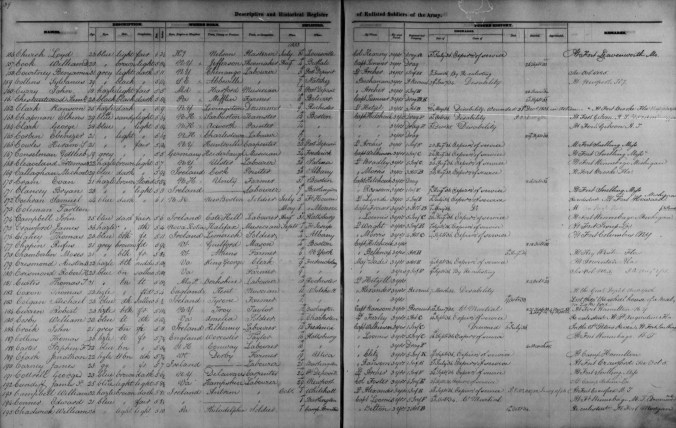
CLARK, Jonathan in US Army Register

Jonathan M. Clark in NARA M233. Registers of Enlistments in the United States Army, 1798-1914. Roll: MIUSA1798_102878. Accessed online via Fold3.com

Click image to open at full size in a new window.

Continue reading

JMC Joins the Army: A Closer Look

I love primary sources. Not only can you learn interesting information—that may include actual, accurate, facts (with allowances for misspellings and such)—but primary sources often convey a flavor or sense of the moment and suggest additional lines of inquiry. With that in mind, let’s take a closer look at Jonathan M. Clark’s 1833 U. S. Army enlistment paper as featured in our earlier post “Jonathan Joins the Army” and see what we can infer from the information there.

First of all, how do we know this Utica, New York, enlistment belongs to “our” Jonathan M. Clark? Census and other records show that there are plenty of Clarks from New England, born about the same time as our JMC, some of whom served in the army, and some of whom came to the Michigan/Wisconsin Territory in the early 1830s. My research shows there may even have been a second, unrelated, “Jonathan M. Clark” in the Territory at about the same time. So how do we connect our JMC with this 1833 army recruit?

Continue reading

Blog Stuff

Random blog stuff, FWIW:

• I’m still getting the hang of WordPress’s blog platform and features. I create the posts on a Mac desktop, and I’d love to know how the blog looks and performs on various platforms: smartphones, tablets, laptops, desktops, Mac and PC, and such.

• So far, I’ve transcribed a few original documents and posted them as WordPress block quotes. The block quote tool is limited in its formatting choices, and often does weird and unpredictable things to indents, spacings and font sizes. And the dark-ish gray font on the light gray block quote box could pose readability problems for some readers. Question for you readers: would it be better if I posted black and white pdfs of word-processed transcriptions (which would also allow more precise transcription of the original document format), or are the block quotes OK?

Continue reading

Jonathan and Mary, together.

This document is probably the earliest record we have of Jonathan M. Clark in old Washington County, Wisconsin. It is the handwritten marriage license that Jonathan obtained in early 1840. Transcribed, it reads:

    To whom it may concern Marriage Being intended Between Jonathan M Clark and Mary Turck and application being made to me for a Marriage license by the above named Clark I therefore being satisfied by the oath of the party applying of the legality of said the aforesaid marriage union do hereby license and authorise the same

     Granvlle March 13 1840

                                         Andrew Smith Justice peace

Continue reading