The Clark Family in 1850, part 2

A Closer Look at the 1850 Census: Ages and Dates

How well does the information on the 1850 census schedule agree with the Clark Family Record and other Clark family documents and known facts?

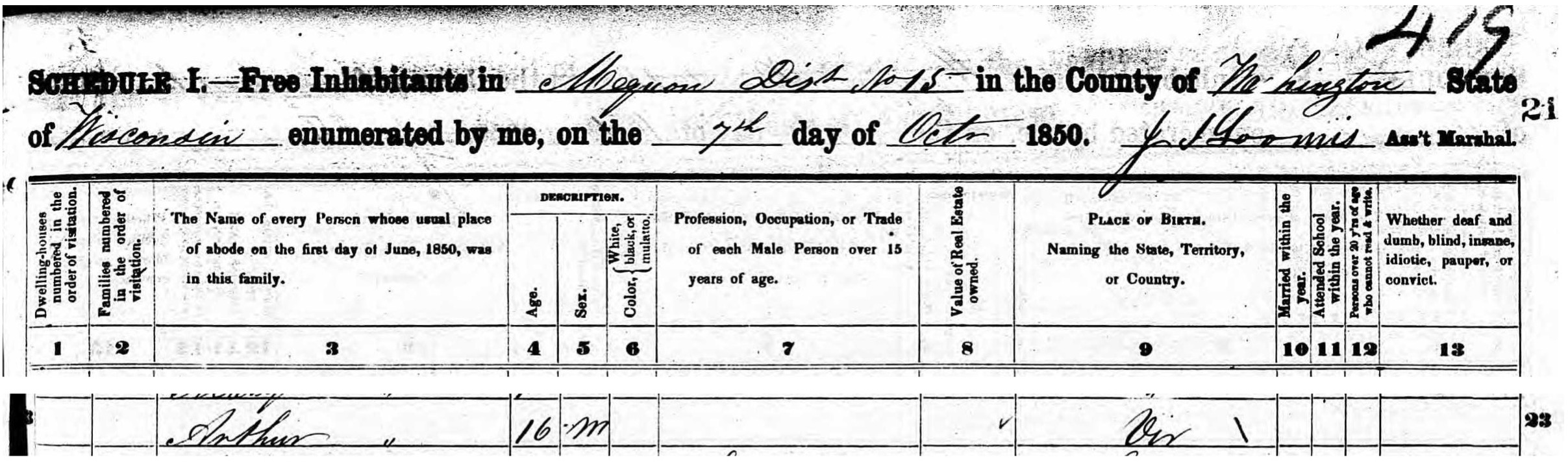
First, examine the census page header. It was enumerated by J. I. Loomis (a resident of Polk township, Washington county) and covered the “Free Inhabitants in Mequon Dist. No 15 in the County of Washington State of Wisconsin enumerated by me, on the 7th day of Oct. 1850.” Continue reading

The Clark Family in 1850, part 1

Looking at the 1850 Census: A Growing Family

Continuing our look at important sources for Clark family history, let’s return to the decennial U.S. federal census. If you missed it, be sure to read our earlier post on Jonathan, Mary, and ? on the 1840 Census. The 1850 census was the seventh United States federal —and first “all name”— decennial census; every free person—man, woman or child—living on June 1, 1850, was to be counted and named on a separate line on the census form. It was also the first federal census to ask for certain additional information, such as each individual’s place of birth and occupation. (Enslaved African-Americans were enumerated on a separate form and not by name, but by sex, age, and owner. Click here for more information on the 1850 and 1860 so-called Slave Schedules.)

Based on what we know from the Clark Family Record and other sources, as of the official enumeration day, June 1, 1850, if the census enumerator and his Clark family “informant” were both accurate in providing and recording the data, we should expect to find the following living family members listed on the 1850 census: parents Jonathan and Mary Clark and their children Caroline, Henry, Elizabeth, Persis, and new baby Teresa. Let’s look at the census page and see what the enumerator recorded: Continue reading

History Mystery! No. 2

The Clark Family Record: What is it? Who created it?

Welcome to our second installment of the Clark House Historian’s History Mystery! in which you, the reader, are invited to Help the Historian and solve one of the many persistent mysteries surrounding Jonathan M. Clark, his family, and related unknowns of local history. In a previous post, we got to Meet the Children of the Clark family. One of the sources for that post is an image that I received from Clark descendant Liz Hickman (thanks, Liz!) of what looks like a single page removed from an old family bible. The page lists birth dates for Jonathan M. Clark, Mary Turck Clark, and their children, and death dates for Jonathan and his only son, Henry. It’s a key document for Clark family research and yet there is much we don’t know about it.  History Mystery! No. 2 seeks to answer: What is the Clark “Family Record,” who created it, and how accurate is it?

Here’s a copy of the image from our files: Continue reading

Santa Claus Visits, 1867: Reviewed

I hope you enjoyed our previous post: Santa Claus Visits Milwaukee, 1867, based on the diary of J. W. Woodworth.

Rev. Woodworth’s book is a unique and often entertaining source, but it’s always nice to back up personal recollections with additional contemporary documents. So I did a quick search of online Milwaukee area newspapers from the 1840s through about 1870 and found many mentions of Santa Claus and related traditions beginning in the late 1840s. And on page five of the Wednesday, December 25, 1867 edition of the Daily Milwaukee News I found this news item which adds a few piquant details in support of Rev. Woodworth’s diary entry: Continue reading

Santa Claus Visits Milwaukee, 1867 (updated)

Christmas is celebrated as an important religious and community holiday by many Americans. Christians worship and commemorate the birth of Jesus, and they and many other Americans enjoy a break from work and gather with family to feast and exchange gifts. But it was not always this way.

In many of the American colonies, Christmas was not observed as a religious or secular holiday. The seventeenth-century Puritan leaders of the Massachusetts Bay Colony considered Christmas to be non-biblical and pagan influenced, and in Boston and other parts of New England any observance of Christmas was prohibited and, for a few years, illegal. The holiday was not generally accepted in many parts of the United States until after the federal government made December 25 a national holiday in 1870. Continue reading

Rev. Woodworth’s Autobiography

James W. Woodworth (1813-1893) and his brother Ephraim were among the earliest settlers in Mequon. They came from Nova Scotia, as did several other early Mequon settlers and families, including Isaac Bigelow, Daniel Strickland and Stephen Loomer. On March 1, 1838, J. W. Woodworth married fellow Nova Scotia emigrant and Mequon neighbor Mary Cerena Loomer. The marriage was believed to be the first Christian marriage in old Washington county and was performed by Mary Turck Clark’s father, Peter Turck, “an anabaptist preacher.”

J. W. Woodworth, like so many Protestant Christians of his era, was a man in search of a powerful and authentic connection to God. He found his answer in the 1830s and ’40s through Methodism. And, after many years of intense self-instruction, camp meetings, private prayer and preaching at local worship services, Woodworth was certified as a Methodist minister.

For much of his life Rev. Woodworth kept a diary of both the spiritual and mundane events of his life. He published the diary in Milwaukee in 1878 as My Path and the Way the Lord Led Me.  Continue reading

Fort Howard, November 1833

Previous posts have discussed Jonathan M. Clark’s enlistment in the U.S. Army’s Fifth Regiment of Infantry, Company K (part 1, part 2, part 3) and his arrival at Fort Howard (Green Bay), in the Michigan (later Wisconsin) Territory (part 1, part 2, part 3) on October 20, 1833. Let’s rejoin the regiment and see what kept Co. K busy during Pvt. Clark’s first full month on duty, November, 1833. Continue reading

History Mystery! No. 1 (of many)

Jonathan & Mary & ? on the 1840 Census

Introducing a new feature on the blog: History Mystery! In which you, the reader, are invited to Help the Historian solve one of the many persistent mysteries surrounding Jonathan M. Clark, his family, and related bits of local history.  History Mystery! No. 1 seeks to answer the question: Who was that older guy living with newlyweds Jonathan and Mary Clark in June, 1840? Here are the clues: Continue reading

Finding Your Mequon Roots (part 3)

This is Part 3 of our short introduction to Finding Your Mequon Roots. If you haven’t already, I recommend starting with Part 1 and Part 2.

Before we take a break from our Mequon neighbors of the 1900s and return to Jonathan Clark and his family in the mid-1800s, let’s take a look at a few more “macro” and “micro” things one can find by taking a closer look at a U.S. census population schedule. Once again, here’s the Becker family of Mequon, as found on lines 32 to 34 of this 1900 U.S. federal census population schedule: Continue reading

Finding Your Mequon Roots (part 2)

And we’re back! Continuing our short series on Finding Your Mequon Roots. If you missed the first part of the series, I suggest you click here and read that first.

Part 1 was all about one of my favorite first-look documents when doing genealogy or local history research, the decennial U.S. Federal Census population schedule. The first census that exists for Annie Becker and her parents was the census of 1900. Click here for a full size image of the census page.

Continue reading