Erie Canal – Macedon, New York

As a follow up to our look at the Erie Canal and our Turck and Clark families, I’ve been researching and writing about some other early Mequon settlers and their migrations to Mequon from Lower Canada, Nova Scotia, New England and New York. It’s taking longer than I expected.

Until those posts are ready, here’s a photo of one of the historic Erie Canal locks, near Macedon, Wayne County, New York. Peter and Rachael (Gay) Turck lived nearby from sometime around 1828 until they went west to Buffalo, New York to begin their steamship journey to Milwaukee in July or August, 1837. A large number of other early Mequon immigrants, including the Bonniwell and Woodworth families, also would have passed through this lock (or its predecessor) on their way their new homes in Wisconsin.

Historic Erie Canal Lock No. 60, near Macedon, Wayne Co., New York, looking to the west. Photo by Reed Perkins, 2011. Click to open larger image in new window.

This is the expanded, second version of this lock. When it was built in 1821, as part of the original canal, it was Lock 71. As a nearby marker explains:

Continue reading

Turck, Turk…Durk?

Spelling variations in old records

Durk, Peter [Turck], baptismal record, 1798, detail. “Peter” starts the left column, father “Jacob A. Durk” is at the top of the center column (source). Click to open larger image in new window.

In a previous post, reader Laura Rexroth asked: Why did they spell Peter Turck’s name incorrectly [i.e., Durk] when he was baptized? That’s a great question, and super relevant to successful historical and genealogical research. So let’s talk about the Turck family surname and, by extension, the whole issue of spelling in earlier times and documents.

There are two main issues to keep in mind:
• variations in spelling that existed at the time the source material was created, and
• subsequent misreadings, including incorrect transcription or indexing of sources

Continue reading

CHH Reader Challenge – results!

At the end of last month, while working on some longer posts about the Turcks and Clarks, I had some fun creating the first Clark House Historian Reader Challenge: where you get to be the historian!, and today we have the results. The original challenge went something like this:

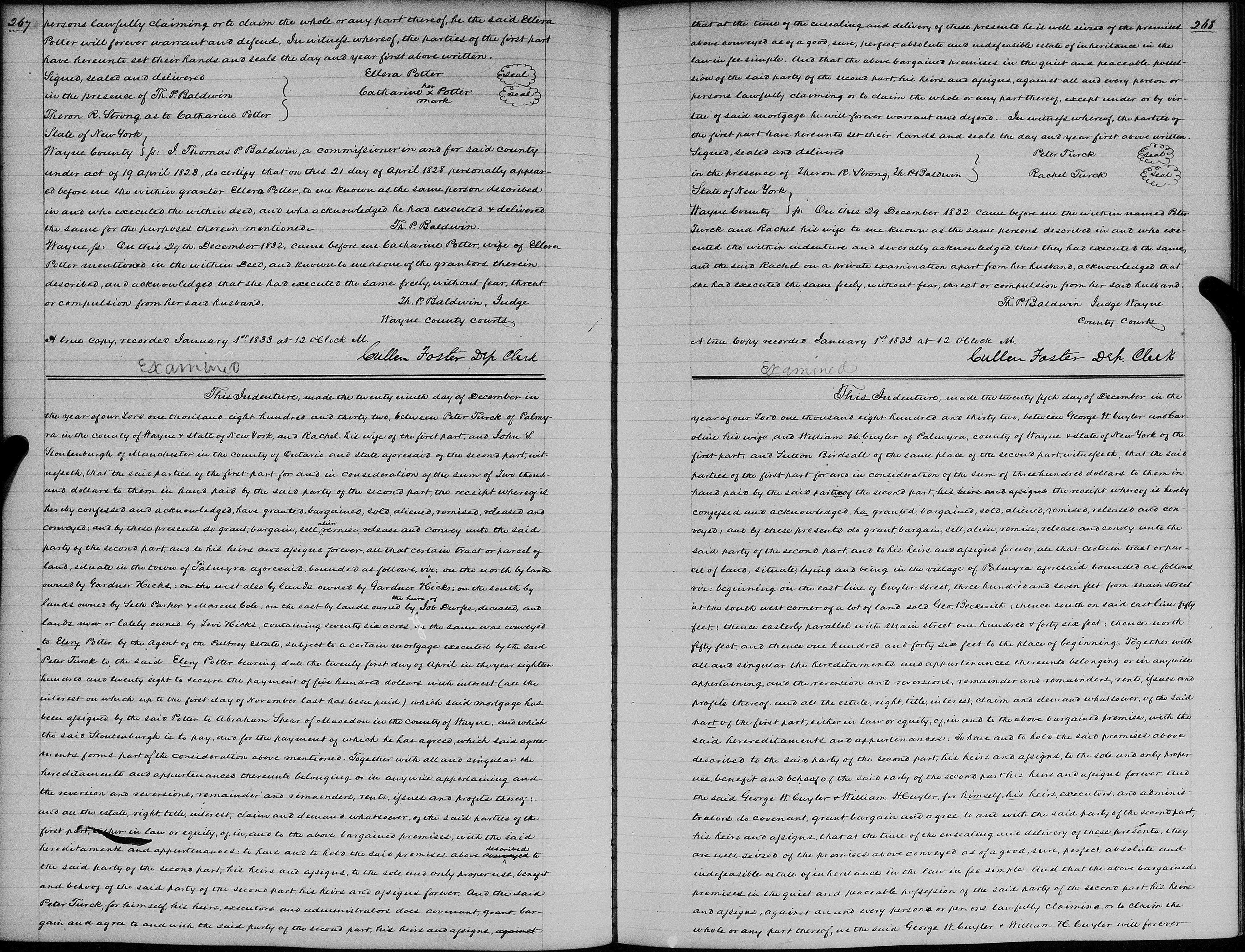
Here’s an excerpt of a document that will be part of an upcoming post. Can you read and transcribe it? (Ignore the squiggles in the top right corner, they belong to another record on the same page.)

The original CHH Reader Challenge #1. Click to open larger image in new window.

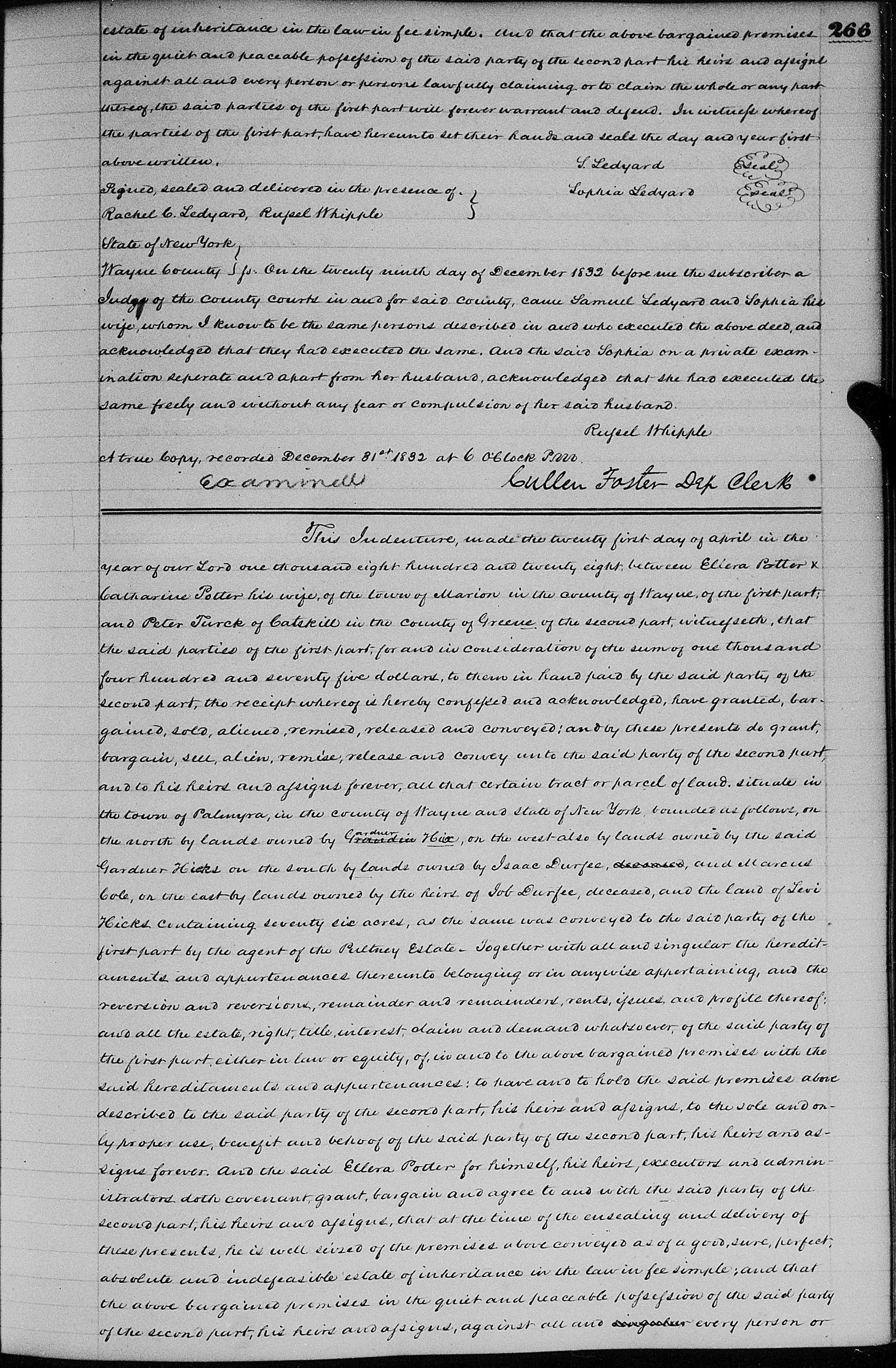
And I gave y’all a hint, the full page from which this record was excerpted. And as a second hint, I suggested that a look at my discussion of Kurrent handwriting might be helpful.

So what is this a record of, and what does it say?

Continue reading

CHH Reader Challenge!

I’m working on some longer posts about Peter Turck, Mary Turck Clark, and other Jonathan Clark House related topics. One of those posts should be ready by Friday.

Meanwhile, here’s a Clark House Historian Reader Challenge: where you get to be the historian!

Here’s an excerpt of a document that will be part of an upcoming post. Can you read and transcribe it?

CHH Reader Challenge #1. Click to open larger image in new window.

Ignore the squiggles in the top right corner, they belong to another record on the same page.

Need a hint? Here’s the whole page that this record is taken from:

Continue reading

Monday: Map Day! – Columbia County, New York, 1829

Peter Turck’s Home

Continuing our look at Mary Turck Clark and her family, today we look at a map of Columbia County, New York, the birthplace of Mary’s father Peter Turck, most of his eight siblings, and home of Mary’s paternal grandparents—Peter Turck’s parents—Jacob A. and Anna Maria “Maritje” (Klein) Turck. For more on the Turcks and New York, you may want to read our previous posts on Peter and Rachael (Gay) Turck’s New York, 1829/32 and Mary Turck’s Greene County, New York.

Today we’ll be looking at Columbia County, one of the predominantly Dutch-American counties along the Hudson River, south of Albany, New York. Columbia County lies east of Greene county, just across the Hudson river. Here’s a detail from a map we looked at previously, showing the relationship between Greene and Columbia counties:

Burr, David H., Map of the State of New-York and the surrounding country by David H. Burr. Compiled from his large map of the State, 1832.[…] Entered according to Act of Congress Jany. 5th., 1829 by David H. Burr of the State of New York. Engd. by Rawdon, Clark & Co., Albany & Rawdon, Wright & Co., New York [detail]. Credit, David Rumsey Map Collection, David Rumsey Map Center, Stanford Libraries, non-commercial use permitted under Creative Commons license. Click image to open larger map in new window.

Our new map is from the same atlas, and shows many more details of Peter Turck’s Columbia County, circa 1829:

Continue reading

Blog Updates!

Clark House Historian blog is approaching its fifth anniversary, so I’m making some updates to the layout and content of the site. To find the new info click the highlighted links in this post, or the new permanent links in the main menu, under the blog header. Here are the details:

The ABOUT page has been lightly updated, and I’ve added a page of DISCLAIMERS, too.

The big news is that the blog now has an INDEX. With almost five years of research and writing, the blog now has over 140 posts comprising more than 125,000 words. So I’ve begun indexing the blog’s contents. Indexing will take a while—especially once I get to 2020—so please be patient. As of this morning, the index is complete for all of the posts from 2016, and most of 2017.

Continue reading

Inauguration Day

Today we celebrate the inauguration of the forty-sixth president of the United States. The inauguration of a president is traditionally a time to take stock and ponder the direction of the republic. I expect that President Biden—like many of his predecessors—will try and make the best of his opportunity. (I’m writing this before the ceremony; I don’t know if he succeeded.) For a little inspiration—for us all—let’s look back at one of the great American speeches—perhaps the most moving and inspired of all the inaugural addresses—delivered at one of the most difficult and dangerous moments in our history.

A second term, and Union victory, were not certain…

For much of 1864, president Abraham Lincoln’s prospects for reelection looked dim. Union forces had suffered notable defeats and horrifying casualties in early 1864, and many in the North were tired of the cost of the war, both in dollars and human suffering. If not for Gen. William Tecumseh Sherman’s timely capture of Atlanta on September 2, 1864, Lincoln might have lost the election to Gen. George B. McClellan. McClellan sought to end the war by negotiating an armistice with the South. Such an armistice would have ended the fighting, but would not have solved the cause of the war: the continued existence of chattel slavery in the South and in the new U.S. territories and states forming in the West. But Lincoln’s popularity soared after Sherman’s decisive victories during the Atlanta campaign—especially after the fall of Atlanta—and the incumbent president won a decisive popular and electoral college victory on November 8, 1865.

Continue reading

Winter in Ozaukee County

It’s been quite a week, and I am still working on several longer posts. Until next time, here’s a winter scene from the Town of Cedarburg, about five and a half miles north of the Jonathan Clark House…

Cedarburg Covered Bridge, Ozaukee County, Wisconsin, photo c. 1934, public domain, from the Historic American Buildings Survey (HABS) via the Library of Congress. Click to open larger image in new window.

Continue reading

When was Mary Turck born?

Just when you think you know the answer…

A few days ago, Clark House museum director Nina Look asked me a simple question: when, exactly, was Mary Turck Clark born? So I looked in my database and I came up with…two answers: Mary Turck Clark was born on either May 4th, 1820 or May 3, 1821. So I reviewed my dates and sources, and today’s post is about what I (re-)discovered, and what I still have to investigate.

Haven’t we been over this before?

Why, yes, we have. Here are links to earlier posts on essential sources of Mary Turck Clark birth date and birth year information, starting with my second Clark House Historian post, this now-outdated post about Mary from 2016. Other, more recent, posts have gone into detail examining Mary, her family, and their likely birth dates as found on the U.S. federal decennial censuses:

I’ve not yet blogged about Mary’s 1870 or 1880 federal censuses—both enumerated in Milwaukee—but I’ve seen them and used them in my research. More on these in a moment.

Continue reading

Santa Claus Visits Milwaukee, 1867

Christmas Eve is tomorrow night, so I thought you might enjoy another look at our previous Santa Claus posts, from December 25 and 30, 2017. I have combined the two original posts and incorporated a few revisions and updates to the text. Ho! Ho! Ho!

Christmas in early America

For many years now, Christmas has been celebrated by many Americans as an important religious and community holiday. Christians gather to worship and commemorate the birth of Jesus, and they and other Americans enjoy a break from work and gather with family to feast and exchange gifts. But it was not always this way.

But in many of the American colonies, Christmas was not observed as a religious or secular holiday. The seventeenth-century Puritan leaders of the Massachusetts Bay Colony considered Christmas to be non-biblical and pagan influenced. In Boston and other parts of New England any observance of Christmas was prohibited and, for a few years, actually illegal. The holiday was not generally accepted in many parts of the United States until after the federal government made December 25 a national holiday in 1870.

Continue reading