Join us at the Cedarburg History Museum this Saturday!
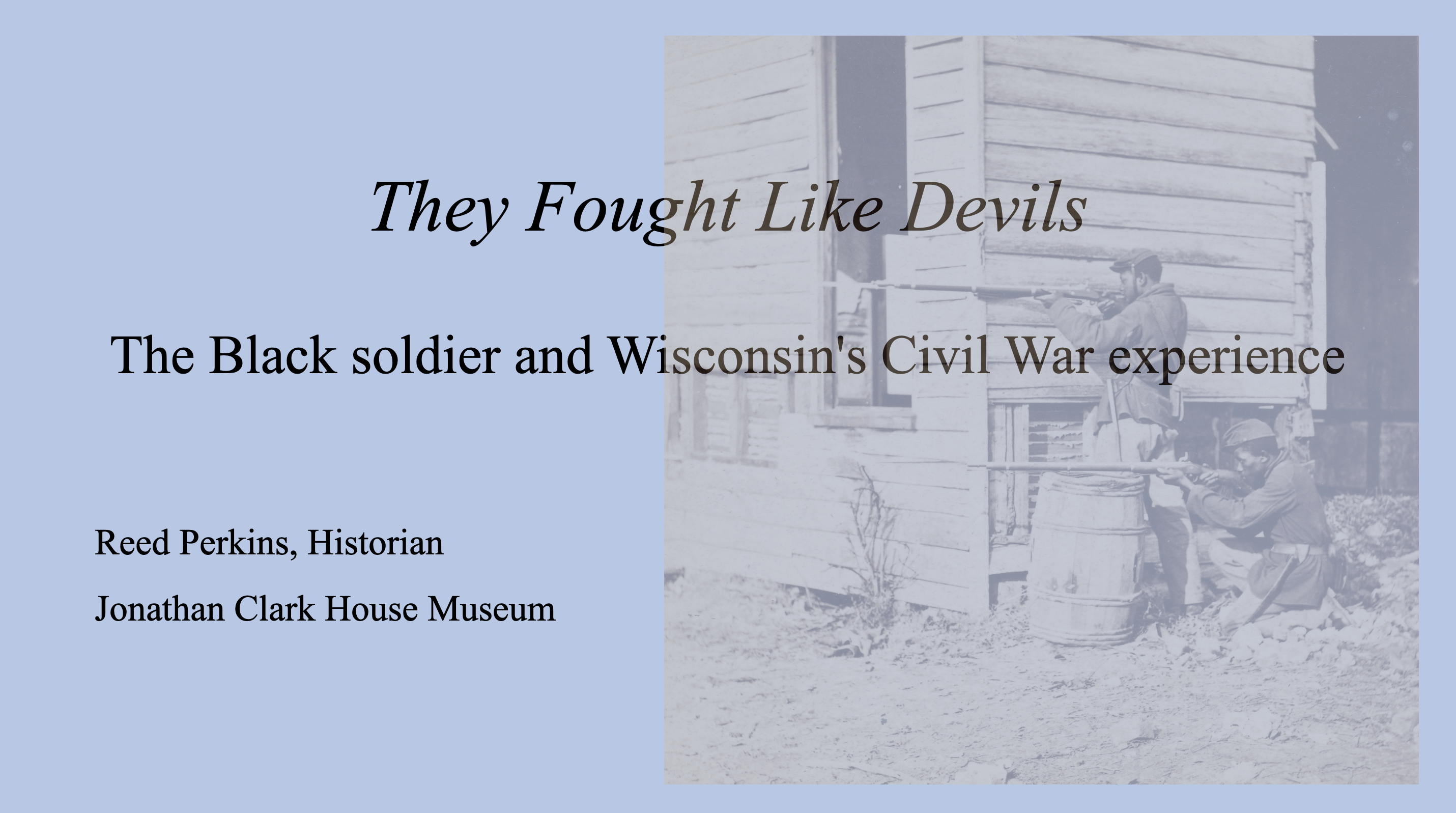
Just a reminder: I’ve been asked back to the Cedarburg History Museum to give another talk in their 2024 Civil War lecture series. My topic will be “They Fought Like Devils” – the Black soldier and Wisconsin’s Civil War experience , a multi-faceted subject that is often overlooked when discussing Wisconsin’s part in the Civil War. All are invited to the presentation at 6:00 p.m., Saturday, September 28. Seating is limited, so to attend my talk—or any of the CHM free lectures—don’t forget to RSVP to museum director Joel Willems at 262-377-5856 or joel@cedarburghm.org to reserve a place.
I just put the final edits on my upcoming presentation for the Fall Meeting of the Wisconsin Society, Daughters of the American Revolution. I’ll be talking about Wisconsin’s first federal road—the Old Military Road—and the men that built it, including our own Jonathan M. Clark.
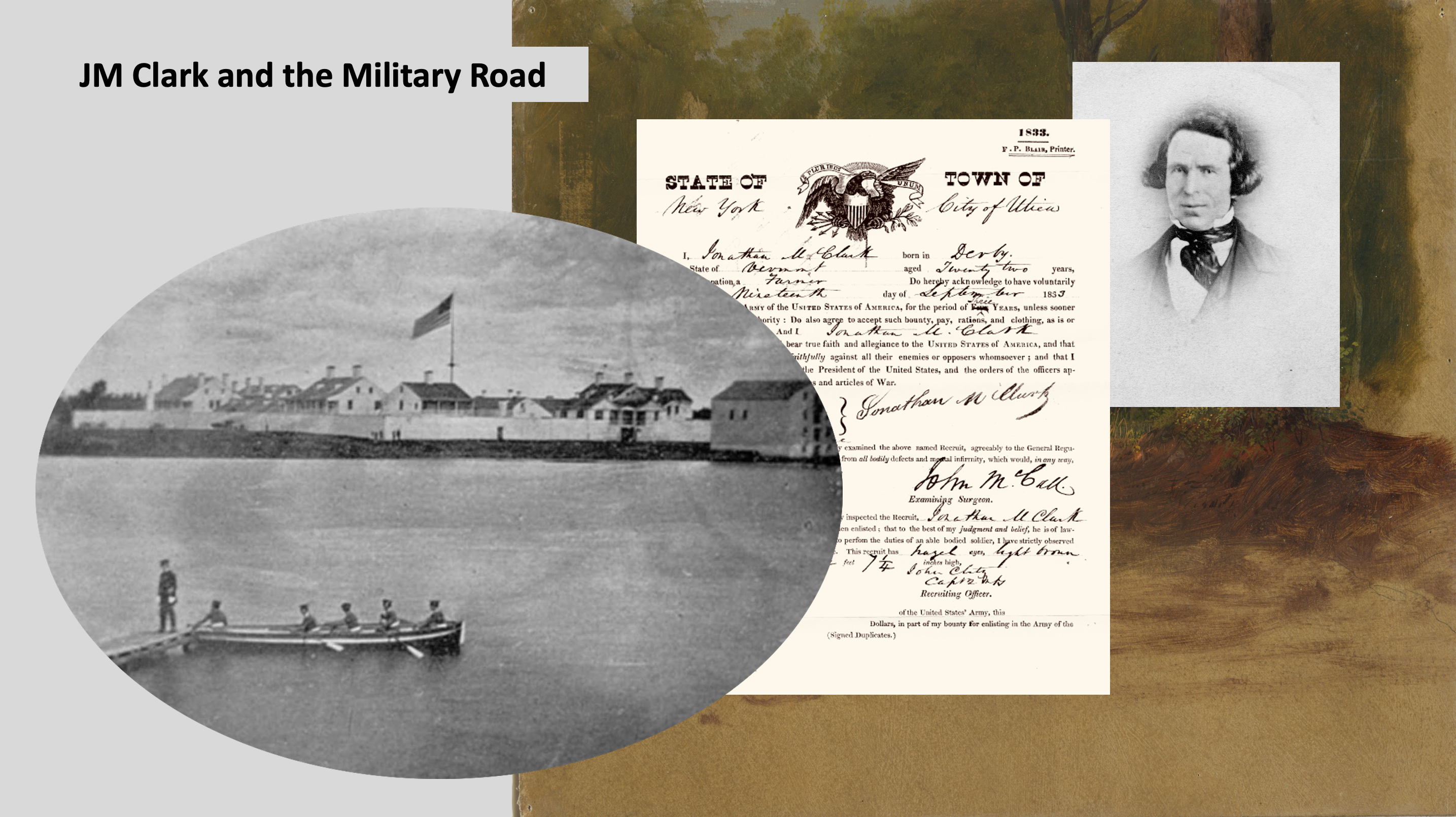
One of my WSDAR presentation slides. From left: JMC’s army post, Fort Howard (Green Bay), JMC’s army enlistment paper, JMC portrait photo.
My talk is scheduled to run for 30 minutes and, as is often the case, I had to cut a lot of information from the presentation in order to keep it inside the time limit. But I don’t want all of those research tidbits to go to waste, so I’m going to post them in a few posts here on the blog. Today, I’m going to list, comment on, and link to some of the key sources that helped me put my WSDAR presentation together. If you have any interest in Wisconsin’s early roads and related transportation issues, I encourage you to check out these sources. Most are freely available online, and I’ll provide links where I can. Happy reading!
Durbin & Durbin, 1984
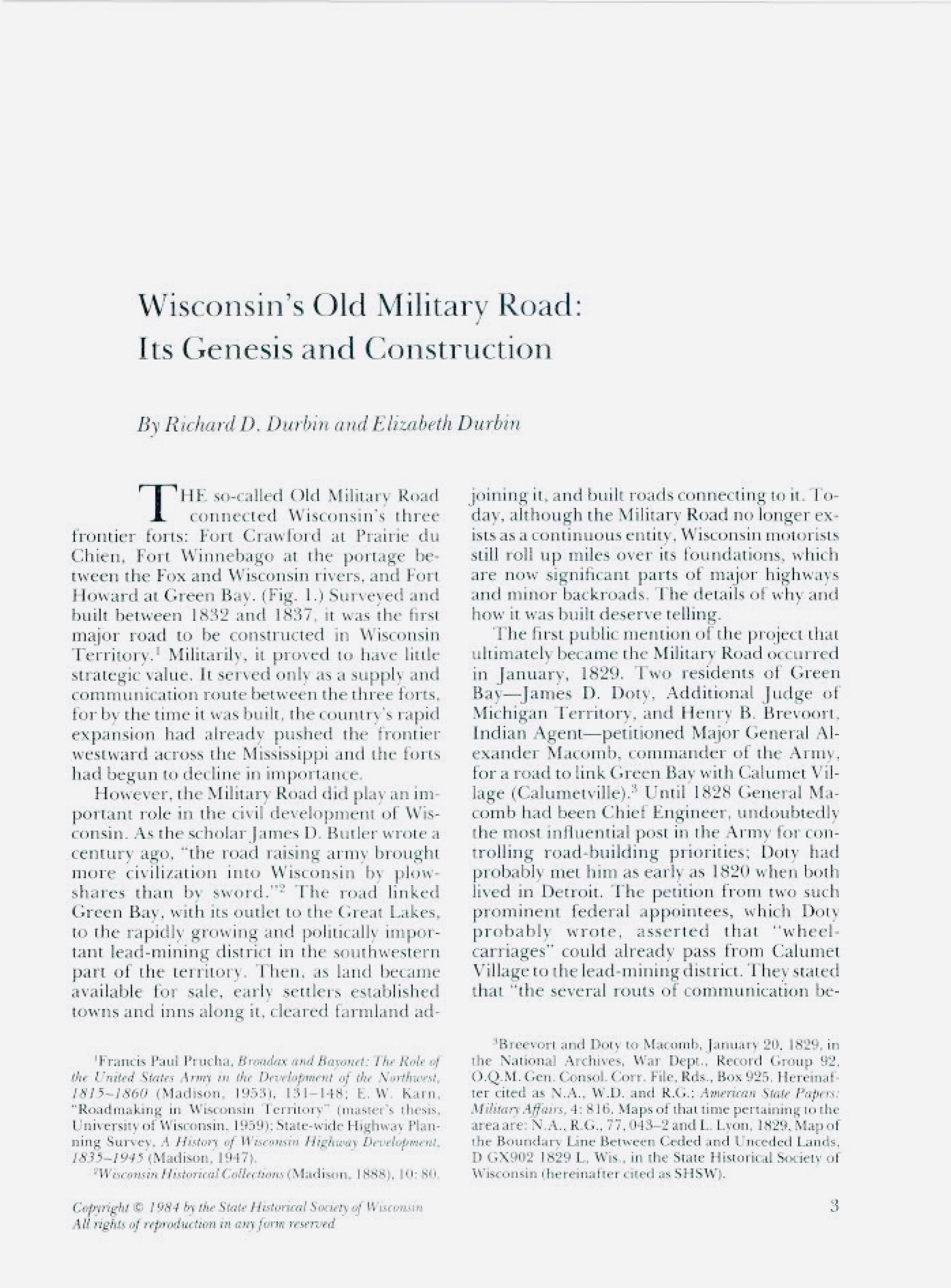
To my knowledge, the best, most detailed, and most comprehensively researched and documented article about the Military Road remains “Wisconsin’s Military Road: Its Genesis and Construction” by Richard D. Durbin and Elizabeth Durbin. It was published in Wisconsin Magazine of History (WMH), Vol. 68, No. 1, Fall, 1984.
The Durbins appear to have consulted a huge number of primary sources, especially the deep collections of the Wisconsin Historical Society (WHS) and the National Archives and Records Administration (NARA). Their article is lavishly illustrated with vintage and modern maps, and will allow the reader to retrace the path of the original Military Road through modern Wisconsin. The authors also document in great detail the many twists and turns of the road’s legislative and appropriations history and the military’s involvement in the project.
Durbin and Durbin is essential reading for this subject, and can be read for free via the Wisconsin Magazine of History Archives at WHS’s excellent website (link to article). And speaking of the Wisconsin Magazine of History…
Today is Labor Day, the holiday celebrating the working men and women of our nation, and I thought I’d commemorate the day with a lightly-revised re-post of this piece from 2023.
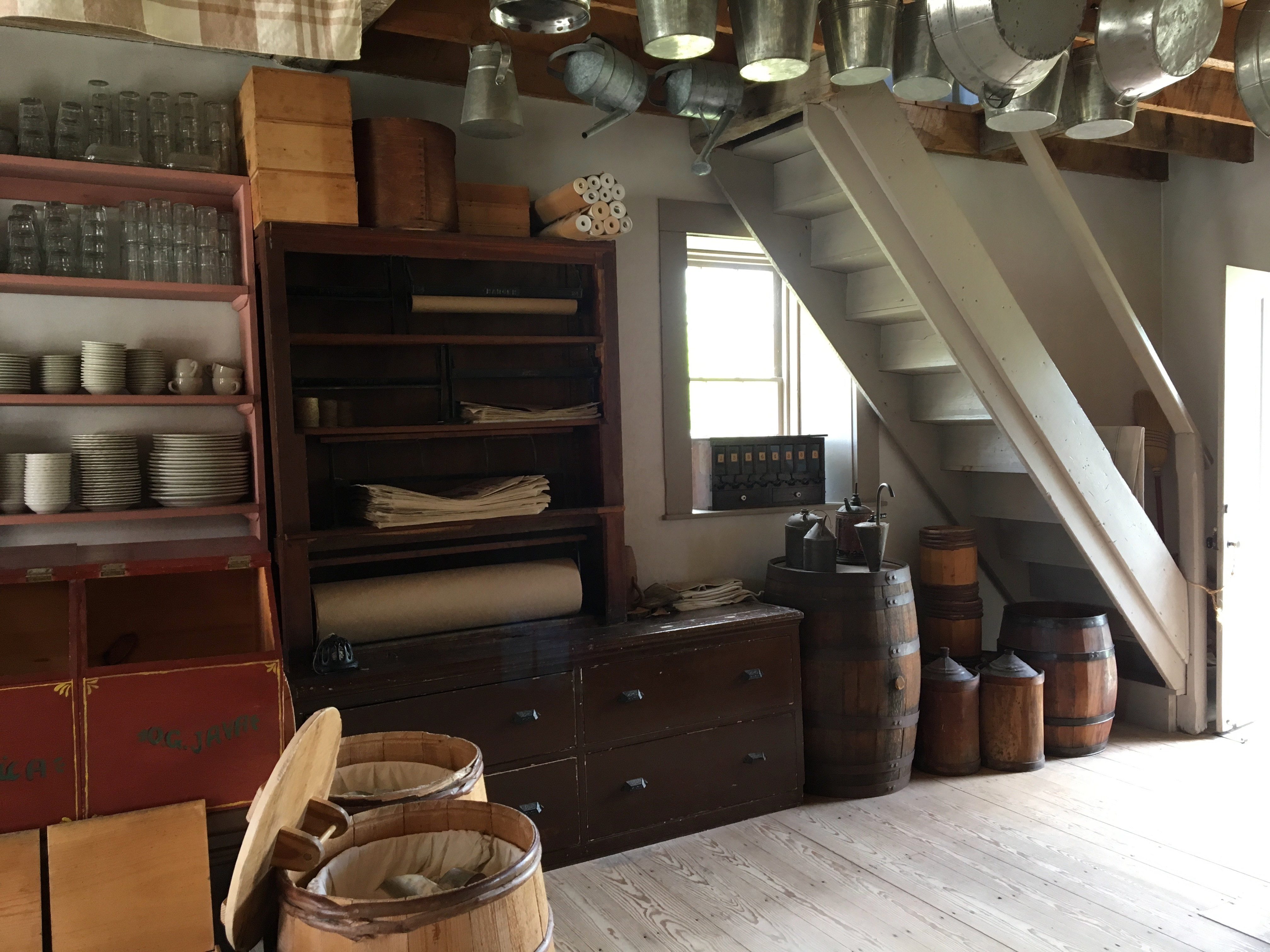
This Labor Day, I’ll be at home, working on my upcoming lectures for the state DAR and the Cedarburg History Museum. Last year, I had to work at our local mercantile establishment. You know, a store kind of like this one, only much bigger, stocked with just about anything you need for modern living:
I don’t really have the day “off” today—too much writing to do—and won’t be marching in a parade, but I’d still like to honor the holiday and salute the American worker, past and present. With that in mind, let’s revisit some of the nineteenth-century occupations we’ve talked about previously at Clark House Historian, highlighting a few of the many skills, trades, and occupations common during the Clark House era.
Since it is a holiday, I’m not going to add long commentaries to each photo. Enjoy the photo galleries, and click each gallery to open larger versions of each image. And click the highlighted links to visit the original CHH posts, filled with lots more information about the different skills, tools, and jobs, and the full image credits.
I know it’s been a while since my last post, but I’ve been busy! Jonathan Clark House executive director Nina Look and I just finished the latest JCH newsletter, and there’s a lot of Clark House history coming your way this fall, both here on the blog, and “live and in person.” In particular, I’m currently racing to finish not one, but two, illustrated presentations that I’ll be giving in September.
JMC, the Old Military Road, and the DAR
I’ve been asked to speak at the Fall Workshop of the Wisconsin Society, Daughters of the American Revolution. My topic will be “Building the Military Road, Wisconsin Territory’s First Federal Road.” I’ll be incorporating much of the 1830s and ’40s army and road-building information that I’ve blogged about here at CHH, as well as new primary source materials and contemporary illustrations.
The presentation will take place after dinner, Friday, September 13, at the WSDAR Fall Workshop in Oshkosh. The event is limited to registered DAR members and their guests. My thanks to Wisconsin State Regent Sandra Snow and the members of the WSDAR for their kind invitation to speak.
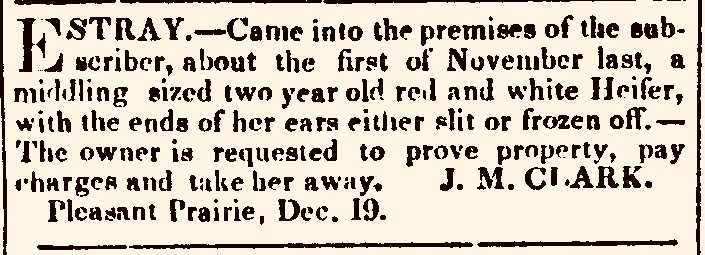
“Estray. […] J. M. Clark” advertisement, Southport [later Kenosha] Telegraph, Dec. 26, 1843, page 4
Hey! How did Mequon’s Jonathan M. Clark end up with a stray red and white heifer on his farm in…Pleasant Prairie, the most southeasterly township in all of Wisconsin, some 56 miles south of the Jonathan Clark House? The short answer is: he didn’t. The man that placed this “stray cow” advertisement in the December 16, 1843, issue of the Southport (later Kenosha) Telegraph was is not “our” J. M. Clark.
So many J. M. Clarks
Throughout the nineteenth century, many men seem to have been referred to, at least in print, by the initial letters of their first and middle names. The builder of Mequon’s Jonathan Clark House was no exception. Many of the documents made during his lifetime refer to him as “J. M. Clark,” and he often signed his name that way as well.1
“J. M. Clark,” signature of Jonathan M. Clark, from his final U.S. naturalization papers, 1853.
Unless the researcher is careful, it’s easy to make assumptions and presume that the “J. M. Clark” that built our historic Mequon home in 1848 is identical with the other “J. M. Clark” men that appear in various Wisconsin Territory documents, land patents, newspapers, and histories. Unfortunately, this is not always the case. To be certain that the “J. M. Clark” referred to in a particular source is “our” Jonathan M. Clark, we need to understand the “who, what, where and when” of each document or event that may—or may not— have involved our Jonathan.
I’m sure my list of suspects is incomplete, but (surprise!) it has turned out to be much longer and more complicated than anticipated. With that in mind, I think I’m going to need several CHH posts to sort out some of the most easily mistaken “J. M. Clark” men that lived and worked in the central and southeastern parts of Wisconsin Territory, yet were definitely not our J. M. Clark, the man born in Lower Canada (or Vermont) in 1812 that went on to build the historic Jonathan Clark House in Mequon in the 1840s.2
Let’s start with earliest and most northerly of these settlers, the first of several Christian ministers surnamed Clark that had links to Wisconsin Territory army posts that were home to our Jonathan M. Clark and his comrades during their service with the U. S. Army’s 5th regiment of infantry, 1833-1836.
Updated, August 4, 2024, to add a few explanatory links, to clarify the years of arrival of B. Clow and D. Maxon, and to clarify which families stayed in Washington/Ozaukee county, and which sold out and moved on.
Home away from home
Until the late-1850s, there were no railroads connecting Mequon to Milwaukee. If you needed to go to the city—for shopping, shipping, social calls or legal business—you either had to ride a horse, a wagon, a carriage (a sleigh in the winter), or simply walk there and back. It was about a 19 mile journey, over roads of dubious quality and variable states of repair. Even in fine weather, a one way trip might take the better part of the day.
So it was not unusual for Mequon farmers, such as the Clarks and their neighbors, to need a place to stay overnight when they ventured to the city. And from early days, one of the top destinations for Milwaukee travelers was the American House hotel. In 1844, the American House looked like this…
Advertisement, “American House,” [Prairieville (later Waukesha), Wisconsin] American Freeman, 28 Sept 1844 p 4
Take a moment to click the image and open a larger version in a new window. Zoom in and admire the couples strolling on the balconies and the arriving, or departing, stagecoach at the front door. All in all this looks pretty deluxe, by 1840s’ standards. But the hotel business, then as now, was always changing. Less than six years later the American House would be expanded, refurnished, and under new management…
The Search for JMC’s roots continues!1 For the last few months, I’ve spent hour after hour reading through hundreds of digitized pages of the various manuscript land petitions and related documents that form the Land Petitions of Lower Canada, 1764-1841 database at Library and Archives of Canada (LAC).2
The good news is that I have found a lot of information about various early Clark (or Clarke) surname immigrants that petitioned for land—and actually settled on it—in Lower Canada during the relevant years of circa 1791-1840. Many of the documents that I’ve found contain information about these Clark immigrants, their families, and from whence they come. This is important, as we need to sort the Patriot, Vermont-related Clark families from other Clark immigrants from New York and New England (including American Loyalists), and the various Anglo-Canadian Clark families that sought land in the Eastern Townships at the same time. So, you know what that means…
We need another map!
Now that we have all this data, we need a way to organize and present it. And since so many of our rejected candidates earn their “Nope, not our Clark family” status because they settled far away from Stanstead, I thought it was time to make a big map of where these various Clark petitioners for Lower Canada land actually ended up. Then, in theory, we can eliminate the Clark families that settled “too far” from Stanstead (and adjacent Derby, Vermont), and focus on the Clarks that settled in or near Stanstead itself.
It’s going to take a while to assemble and present all the data. So we need a big,easy to read map created around the time of Jonathan Clark’s childhood and/or youth, from about 1812 until his arrival in New York state in 1831. (The latter date is flexible, as long as we find a map that predates the reorganization of the townships into larger counties in 1847.) We’ve presented some great Lower Canada maps here at CHH but, as is typical of that era, if they are accurate and detailed, they also tend to be visually “busy” and hard to read. But, dear readers, I finally found just the thing…
A recent CHH comment from reader Meredith Johanson brought an interesting local history newspaper article to my attention. It’s from page 8 of the Sherbrooke [Québec] Daily Record of May 13, 1911, now available as a digital image at BAnQ.
The article was compiled by H. I Bullock, of Beebe Junction, Stanstead county, Québec. The compiler was a descendant of one of the earliest white settler families in the Eastern Townships of Lower Canada, the Ruiter family and, as of 1911, s/he possessed a number of historic Ruiter family documents.
The contents of several of these documents are presented in detail in the article, and include discussions of Ruiter family settlement in the Stanstead area, how farms and homes were created in the heavily-timbered forests of the “New Townships,” various local trades and supplies and their respective wages and costs, and early military affairs, with local militia rosters from 1809 and 1817.
The article is focused on Ruiter family documents, but many other early settlers are mentioned by name, including one William Clark, and several men with the surname Merrill. As far as we know—at the moment—none of these men are directly related to our Jonathan Morrell/Merrill Clark. But the information in this 1911 article does give a hint of what life was like for the first Stanstead-area settlers—such as Jonathan M. Clark’s still-unknown parents—in the early 1800s.
Bartlett, W. H, artist, A First Settlement, drawing, brown wash on wove paper, c. 1840, National Gallery of Canada, public domain.
I have made no cuts to the article, and since the original is long, I have not included extra commentary. I have added more white space between paragraphs for ease of reading, made a few clarifications and citations in the Notes that follow, and added an illustration not found in the original. Here’s the complete transcription. I hope you find it interesting:
I’m still on the search for Jonathan M. Clark’s parents and other kin somewhere in the early-19th-century wilderness of northern Vermont and southern Québec. I hope to publish more about that here in the near future.
As part of that project, I’ve spent quite a bit of time over the past few months organizing and re-examining the many research materials that I’ve gathered about JMC and his world, and I’ve constructed a whole bunch of genealogies for early Vermont, New Hampshire, and Lower Canada families named Clark that turn out—alas!—not to be related to our Jonathan M. Clark.
More mysteries…
Along with the mystery of JMC’s still-unknown family and childhood, Clark House museum director Nina Look and I have been trying to chase down some rumors that suggest Jonathan Clark may have spent his three years between mustering out of the U.S. Army (in 1836), and purchasing land at the land office in Milwaukee (in late 1839), as a surveyor in or near the area around Fort Winnebago, Columbia County, Wisconsin Territory. At the moment, that story remains a mystery, too. I’ll let you know if we find out more.
Anyway, with all these facts, rumors and mysteries—and many, many others—rolling around in my head, I thought it might be useful to outline JMC’s life in a handy, chronological timeline. Here’s a draft of that timeline, including what we do—and don’t—know about Jonathan M. Clark’s whereabouts and activities during his lifetime, as of July 1, 2024. I’ve included links to some relevant Clark House Historian posts where possible; please click on them for more information.
Here’s another addition to our list of various Clark-surnamed people that show up in our search for Jonathan M. Clark’s kin, but we now know (with reasonable certainty) were not JMC’s parents or other relatives.
Today’s “Clark” subjects are connected to the history of the U.S. Army’s Fort Winnebago, and the surrounding area of Columbia County, Wisconsin Territory, during the decade of the 1830s.
Fort Winnebago was one of several posts in the upper Midwest garrisoned by the army’s Fifth Regiment of Infantry during Jonathan M. Clark’s three-year term in the army at Fort Howard (1833-1836). From about 1835-1836, the soldiers of the 5th regiment were responsible for cutting Wisconsin’s original east-west Military Road from Ft. Howard at Green Bay, to Ft. Winnebago at the portage between the Fox and Wisconsin Rivers, and thence to Ft. Crawford at Prairie du Chien. In the 1830s, in addition to recent recruit Jonathan M. Clark, at least two other men with the Clark surname held positions with the 5th regiment in Wisconsin. Neither of these notable Clark men—it turns out—is related to JMC.
I’m not going into great detail for each subject, but I’ll try and give enough info to make clear whom we are talking about, and why they are being added to the “Nope, not our Clark family…” list. Leading today’s installment is one of the 5th regiment’s senior officers and members of his pioneering family:






 Clark House Historian