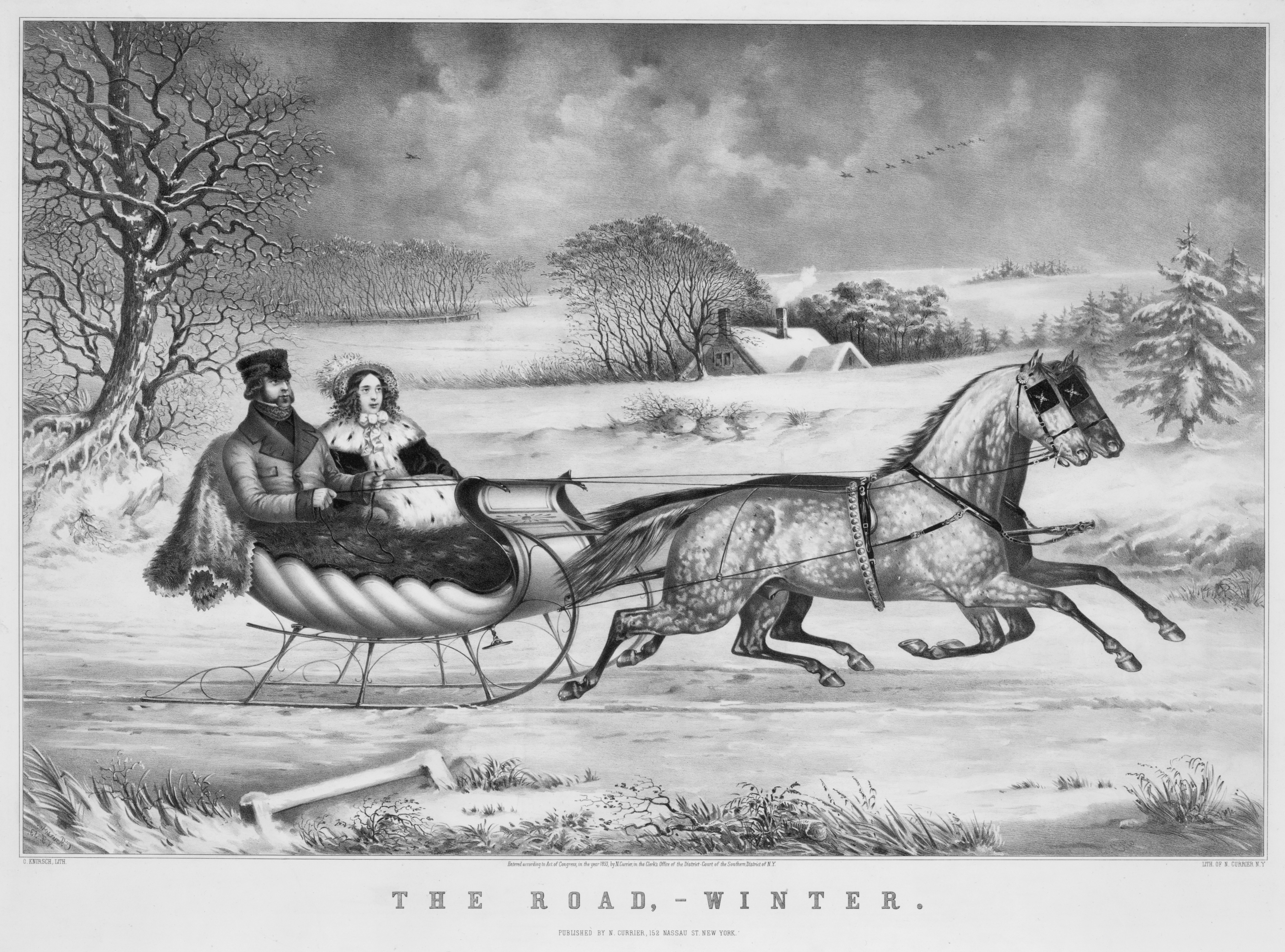
We got some snow in southeast Wisconsin over the weekend, and I’ve spent good parts of the past two days shoveling the driveway and sidewalk. (And then—of course—shoveling the driveway a second time after the city plow finally came through.) Of course, snow was a feature of Jonathan and Mary Clark’s time, too:
Currier & Ives. (1853) The road, winter / O. Knirsch, lith. United States, 1853. New York: Published by Currier & Ives. [Photograph] Retrieved from the Library of Congress, https://www.loc.gov/item/93511164/ (lightly retouched for color balance). Click to open larger image in new window.
We don’t know if the Clarks owned a sleigh while they lived in Mequon. I suspect they probably did, though their sleigh—and their clothing—may not have been quite as posh as those in this Currier & Ives lithograph from 1853.
The original version of this post was the second-ever post on Clark House Historian. It represented what we knew at the time about Mary Turck, the daughter of Peter Turck and Rachael Gay, wife of Jonathan M. Clark, and mother of the eight Clark family children. The original April, 2016, post was pretty accurate, but we have learned a lot more about Mary and her Turck and Clark families in the meantime. So here is a revised version of that post with errors corrected and ambiguities clarified—where possible.
Please note that there are many more facts about Mary and her Clark and Turck families that I’ve written about in the past almost-5 years that are not linked to in this post. If you are looking for more information about Mary, I highly recommend using the blog’s SEARCH function and our new INDEX. And if you still can’t find the info you want, please ask me! Just use the Leave a Replybox, below, or the CONTACTlink, above.
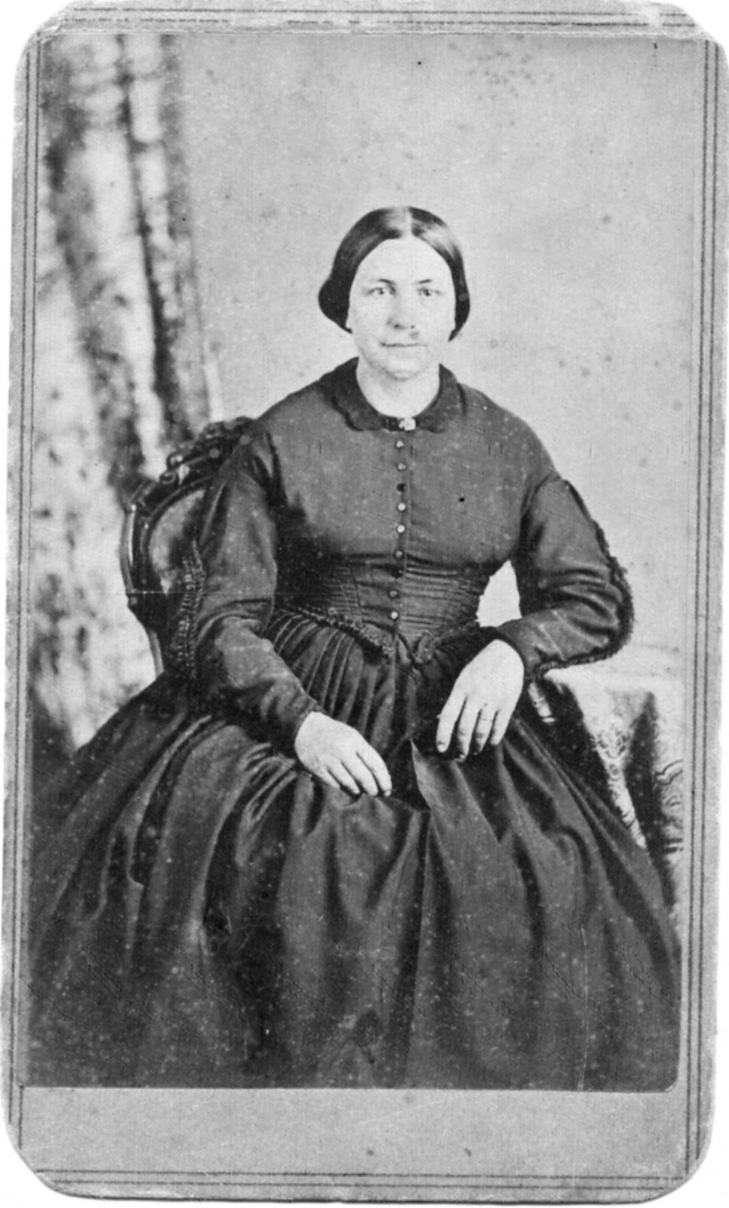
Mary Turck Clark: Mequon Pioneer
Mary Turck Clark. Photograph courtesy Liz Hickman. Click to open larger image in new window.
Continuing our look at Mary Turck Clark and her family, today we look at a map of Columbia County, New York, the birthplace of Mary’s father Peter Turck, most of his eight siblings, and home of Mary’s paternal grandparents—Peter Turck’s parents—Jacob A. and Anna Maria “Maritje” (Klein) Turck. For more on the Turcks and New York, you may want to read our previous posts on Peter and Rachael (Gay) Turck’s New York, 1829/32 and Mary Turck’s Greene County, New York.
Today we’ll be looking at Columbia County, one of the predominantly Dutch-American counties along the Hudson River, south of Albany, New York. Columbia County lies east of Greene county, just across the Hudson river. Here’s a detail from a map we looked at previously, showing the relationship between Greene and Columbia counties:
Burr, David H., Map of the State of New-York and the surrounding country by David H. Burr. Compiled from his large map of the State, 1832.[…] Entered according to Act of Congress Jany. 5th., 1829 by David H. Burr of the State of New York. Engd. by Rawdon, Clark & Co., Albany & Rawdon, Wright & Co., New York [detail]. Credit, David Rumsey Map Collection, David Rumsey Map Center, Stanford Libraries, non-commercial use permitted under Creative Commons license. Click image to open larger map in new window.
Our new map is from the same atlas, and shows many more details of Peter Turck’s Columbia County, circa 1829:
As we discussed last Monday, 2021 is the bicentennial of Mary Turck Clark’s birth. So this year I’d like to focus on Mary, her parents and her seven siblings: where they came from, how they got to Wisconsin, and where they went afterwards. Today we’ll start to get our Turck-family bearings with a look at an excellent map of Greene County, New York, an important place in the lives of Mary, her parents, and her extended family.
The Hudson River Dutch-Americans
Mary Turck’s parents and ancestors descended from Dutch-American families that had been in New York since colonial times. For more background and a fine 1829/32 map of the whole state, take a minute to re-read our previous Monday: Map Day!, Peter and Rachael (Gay) Turck’s New York, 1829/32. The initial Dutch immigrants to New Netherland landed on Manhattan Island; it wasn’t long before Dutch settlers headed inland, west and north up the Hudson River. By the time Mary Turck was born in 1821, there had been generations of Dutch-Americans living along the Hudson. The story of Mary’s extended family—the Turck, Gay, Groom, and Van Loon families and their kin—is centered around a handful of Hudson River counties. Some of the boundaries and place names changed over the centuries, but much of the story of Mary Turck’s family will be found in the documents, maps and places of Ulster and Greene counties on the west bank of the river and Dutchess and Columbia counties on the east side.
Burr, David H., Map of the State of New-York and the surrounding country by David H. Burr. Compiled from his large map of the State, 1832.[…] Entered according to Act of Congress Jany. 5th., 1829 by David H. Burr of the State of New York. Engd. by Rawdon, Clark & Co., Albany & Rawdon, Wright & Co., New York [detail]. Credit, David Rumsey Map Collection, David Rumsey Map Center, Stanford Libraries, non-commercial use permitted under Creative Commons license. Click image to open larger map in new window.
A few days ago, Clark House museum director Nina Look asked me a simple question: when, exactly, was Mary Turck Clark born? So I looked in my database and I came up with…two answers: Mary Turck Clark was born on either May 4th, 1820 or May 3, 1821. So I reviewed my dates and sources, and today’s post is about what I (re-)discovered, and what I still have to investigate.
Haven’t we been over this before?
Why, yes, we have. Here are links to earlier posts on essential sources of Mary Turck Clark birth date and birth year information, starting with my second Clark House Historian post, this now-outdated post about Mary from 2016. Other, more recent, posts have gone into detail examining Mary, her family, and their likely birth dates as found on the U.S. federal decennial censuses:
I’ve not yet blogged about Mary’s 1870 or 1880 federal censuses—both enumerated in Milwaukee—but I’ve seen them and used them in my research. More on these in a moment.
I’m still on the hunt for the elusive parents and kin of Jonathan M. Clark. Based on what we know so far, we are looking in the area of Derby, Orleans County, Vermont and its northern neighbor Stanstead Township, Lower Canada, circa 1800-1830 or so.
There are so many documents to read and sort through in order to get a grasp on the various Clark families that pioneered this area. Our Canadian friends had a land grant system that was quite different from our U.S. system, and this has taken time to get used to. Happily, most of the original paper files have been digitized and made available for free (thanks, Library and Archives Canada!), but the organization of the files remains confusing (why do there seem to be so many duplicate images in many of the files?), and the LAC’s user interface makes browsing slow and cumbersome. That said, we are making progress.
December’s here, and I’m starting to get into the holiday spirit. That means lots of—mostly pleasant—chores and tasks at my home this week. So, no blog essay Wednesday or today.
But how about a holiday view of the Clark House, just to bring a little light to our wintry evenings?
Note: this post has been updated twice on November 30, 2020, see below.
This past Saturday was the 208th anniversary of the birth of Jonathan M. Clark. If you missed our special birthday post, click here and catch up on all the new and updated information about Jonathan that we’ve discovered and published here at Clark House Historian since 2016.
One of the highlights of Saturday’s post was this photo of Jonathan’s excellent 200th Birthday cake from 2012, courtesy of Anne Bridges:
Click to open larger image in new window. Photo credit Nina Look.
No doubt about it, that is one fine birthday cake. (Thanks, Anne!) But what if you wanted to bake a cake that Jonathan or Mary Clark, or one of their early Mequon neighbors, might recognize? That calls for another look into the first cook book written and published by an American:
November 28, 2020, is the 208th anniversary of the birth of Jonathan M. Clark. To celebrate, I’m reposting a revised, expanded and annotated version of one of my first Clark House Historian posts. Since this was first published, on April 20, 2016, we have learned much more about the lives of Jonathan Clark, Mary Turck Clark, their family and their neighbors. Please check out the footnotes and click on the links for some of this newer, more accurate, information.
Happy Birthday, Jonathan! (and thanks to Nina Look for the timely reminder).
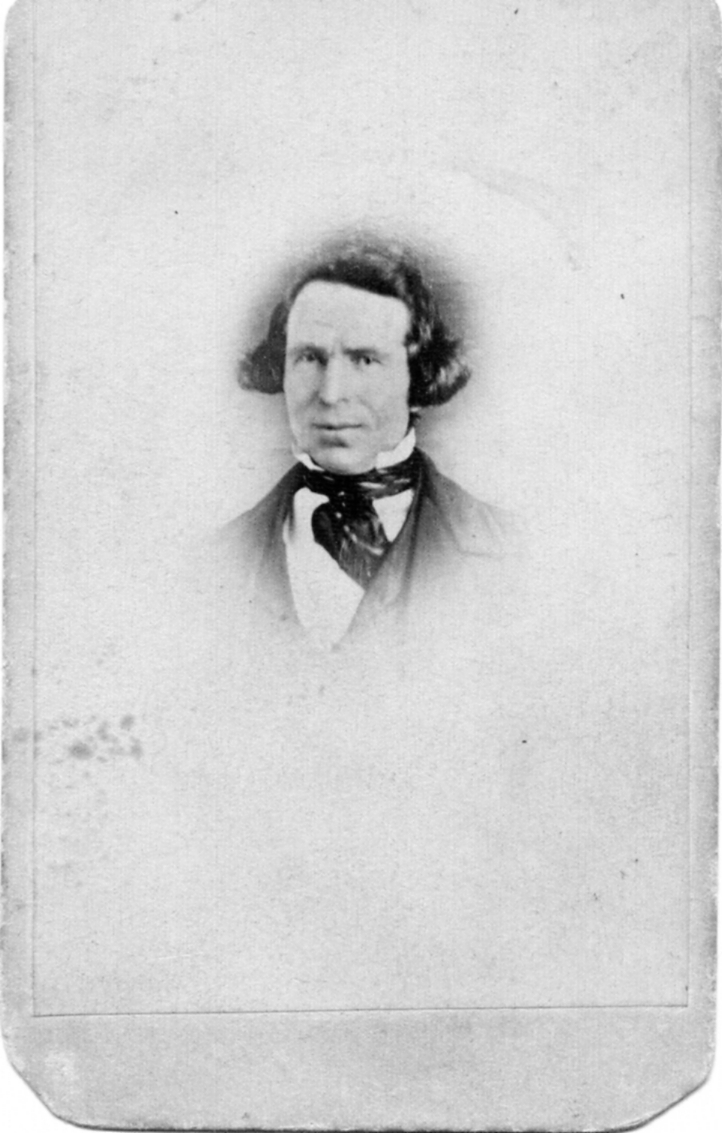
JMC: Man of Mystery
Jonathan M. Clark. Photograph courtesy Liz Hickman.
Among the unavoidable trials of life in the 1800s were the recurring waves of infectious diseases that frequently troubled cities, towns, and rural settlements. These epidemics and pandemics were made even more disturbing due to the general scientific ignorance of the times.
And although inoculation for the prevention of smallpox1 was practiced in Europe and North America at various times during the eighteenth century, the concept of “germ theory” would not gain widespread acceptance until the second half of the nineteenth century, and routine vaccination to prevent common illnesses would not be in general use until the decades after World War II. Disease was an omnipresent part of life in early America.
Fever ravages Stanstead
In the winter of 1811, a particularly virulent outbreak occurred in the vicinity of Stanstead, Lower Canada, as reported on page 3 of the Bridgeport, Connecticut, Republican Farmer of Wednesday, February 27, 1811:


 Clark House Historian