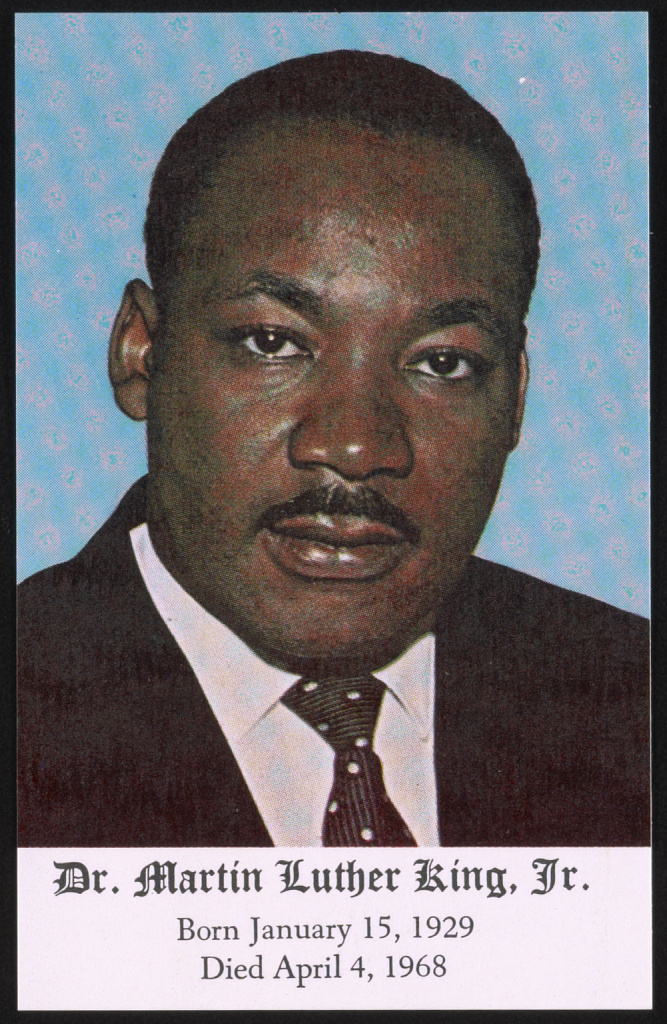
Martin Luther King Jr. Day

Today is the day set aside to commemorate the life and work of Dr. Martin Luther King, Jr. (1929-1968), one of the first and foremost proponents of Gandhi-style non-violent protest in the West, and one of the most inspirational and influential civil-rights, labor-rights and anti-war advocates in American history.

Unknown photographer. “Dr. Martin Luther King, Jr. Born January 15, 1929, died April 4, 1968.” From the Rosa Parks Collection, Library of Congress, https://www.loc.gov/item/2015651821/. Used here under Free Use provisions of U.S copyright law.

Among many honors, Dr. King was awarded the Nobel Peace Prize in 1964. The Norwegian Nobel Committee has a good biography here and additional information including a series of school lessons with lesson plans, videos, photos and other materials here. These are excellent resources for all of us. While Dr. King is—justly—remembered for his “Letter from a Birmingham Jail” and his 1963 “I have a dream” speech, it’s important that we remember the full depth and breadth of his life and work, and not just a few often-repeated quotes and sound bites.

Continue reading
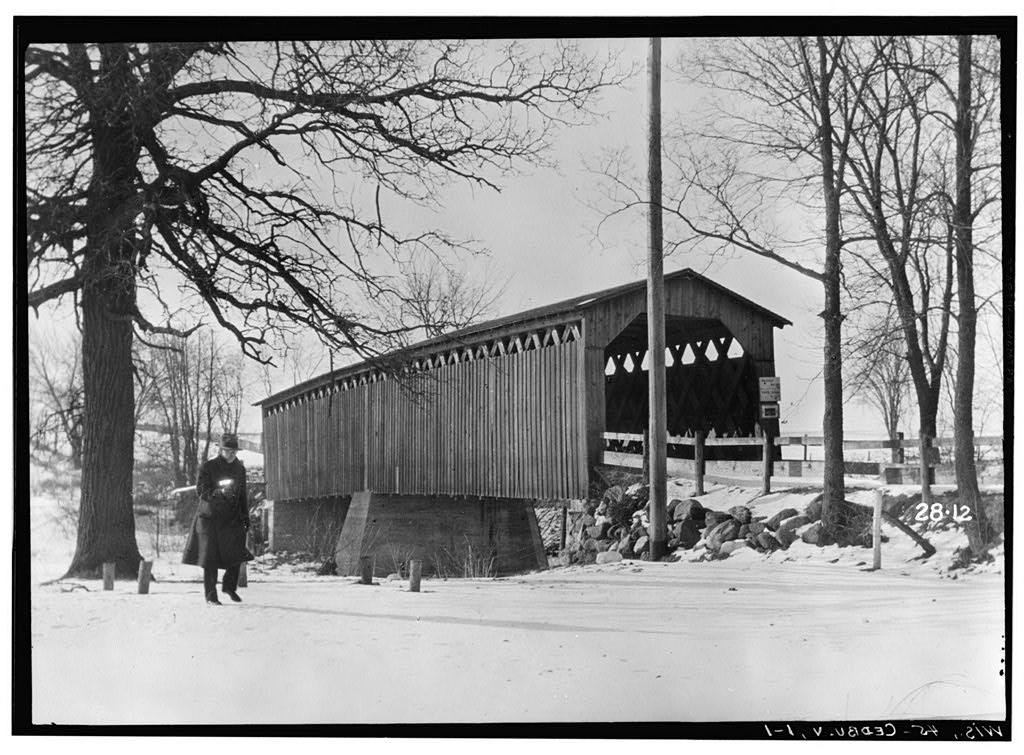
Winter in Ozaukee County

It’s been quite a week, and I am still working on several longer posts. Until next time, here’s a winter scene from the Town of Cedarburg, about five and a half miles north of the Jonathan Clark House…

Cedarburg Covered Bridge, Ozaukee County, Wisconsin, photo c. 1934, public domain, from the Historic American Buildings Survey (HABS) via the Library of Congress. Click to open larger image in new window.

Continue reading

JCH Annual Report, 2020

In spite of the stresses and disruptions the ongoing Covid-19 pandemic has brought to all of our lives, 2020 was a busy and productive year for the Jonathan Clark House Museum, and the many Clark House friends and volunteers that support its mission to collect, preserve and share the history of the Jonathan Clark House and the early settlers of Mequon-Thiensville.

As is her custom, Clark House Museum executive director Nina Look has put together an excellent—and generously illustrated—document summarizing our 2020 activities. To catch up with all that’s gone on in the past year with the museum and the Friends, and to enjoy all 12 pages of the report, either click this link, or click the photo of the report’s first page (below). Either should open the complete 2020 Annual Report in a new window for reading or downloading:

Continue reading

Monday: Map Day! – Mary Turck’s Greene County, NY, 1829

As we discussed last Monday, 2021 is the bicentennial of Mary Turck Clark’s birth. So this year I’d like to focus on Mary, her parents and her seven siblings: where they came from, how they got to Wisconsin, and where they went afterwards. Today we’ll start to get our Turck-family bearings with a look at an excellent map of Greene County, New York, an important place in the lives of Mary, her parents, and her extended family.

The Hudson River Dutch-Americans

Mary Turck’s parents and ancestors descended from Dutch-American families that had been in New York since colonial times. For more background and a fine 1829/32 map of the whole state, take a minute to re-read our previous Monday: Map Day!, Peter and Rachael (Gay) Turck’s New York, 1829/32. The initial Dutch immigrants to New Netherland landed on Manhattan Island; it wasn’t long before Dutch settlers headed inland, west and north up the Hudson River. By the time Mary Turck was born in 1821, there had been generations of Dutch-Americans living along the Hudson. The story of Mary’s extended family—the Turck, Gay, Groom, and Van Loon families and their kin—is centered around a handful of Hudson River counties. Some of the boundaries and place names changed over the centuries, but much of the story of Mary Turck’s family will be found in the documents, maps and places of Ulster and Greene counties on the west bank of the river and Dutchess and Columbia counties on the east side.

Burr, David H., Map of the State of New-York and the surrounding country by David H. Burr. Compiled from his large map of the State, 1832.[…] Entered according to Act of Congress Jany. 5th., 1829 by David H. Burr of the State of New York. Engd. by Rawdon, Clark & Co., Albany & Rawdon, Wright & Co., New York [detail]. Credit, David Rumsey Map Collection, David Rumsey Map Center, Stanford Libraries, non-commercial use permitted under Creative Commons license. Click image to open larger map in new window.

Continue reading

When was Mary Turck born?

Just when you think you know the answer…

A few days ago, Clark House museum director Nina Look asked me a simple question: when, exactly, was Mary Turck Clark born? So I looked in my database and I came up with…two answers: Mary Turck Clark was born on either May 4th, 1820 or May 3, 1821. So I reviewed my dates and sources, and today’s post is about what I (re-)discovered, and what I still have to investigate.

Haven’t we been over this before?

Why, yes, we have. Here are links to earlier posts on essential sources of Mary Turck Clark birth date and birth year information, starting with my second Clark House Historian post, this now-outdated post about Mary from 2016. Other, more recent, posts have gone into detail examining Mary, her family, and their likely birth dates as found on the U.S. federal decennial censuses:

I’ve not yet blogged about Mary’s 1870 or 1880 federal censuses—both enumerated in Milwaukee—but I’ve seen them and used them in my research. More on these in a moment.

Continue reading

Hail, Smiling morn!

A spot of Spofforth to ring in the New Year…

Happy New Year to all, and best wishes that 2021 will be an improvement on the past year. I’m almost done with my research on the second half of the 1843 concert by the Milwaukie Beethoven Society. (If you missed our earlier posts on that concert, links are here and here.) But it’s New Year’s Day, and I’m not quite done writing about “Part Second.” So let’s have another festive musical selection, this one drawn from that second part of the Beethoven Society’s premiere concert:

Milwaukee Weekly Sentinel March 15 1843, page 2. Click to open larger image in new window.

We’ll start the year with “Hail Smiling morn” by the English composer Reginald Spofforth (1769-1827). Spofforth was a man of many talents, but was particularly known for his glees. A glee is a kind of convivial part-song, typically for three or more voices and usually—but not always—sung without accompaniment. I’ll have more to say about this particular composer and piece later, but for now, it’s well enough to know that “Hail Smiling morn” is—according to musicologist Nicholas Temperly—”possibly the most popular glee in the entire repertory,” and that’s saying something!

“Hail Smiling morn” remains a popular pub song in parts of England and—as you’ll soon see—in many other venues around the world, both secular and sacred. “Hail Smiling morn” is frequently sung by church choirs as a Christmas or Easter carol. I think it works wonderfully for New Year’s Day, too. Below are three spirited modern performances of the piece. Just click the image to open a new YouTube window for each video. (The piece is only about 3 minutes long; enjoy all three performances!)

The first video is from a Sunday pub sing at The Royal, in Dungworth—near Sheffield—England. In many ways this is the modern equivalent of the friendly and well-lubricated singing at the glee and catch clubs of 18th-century England:

Click image or this YouTube link to open video in new window. Photo: screenshot of performance.

Continue reading

Clark House Season’s Greetings, 2020

Before we come to the end of 2020, I’d like to share a little seasonal cheer with this pictorial look back at previous holidays at the Jonathan Clark House Museum. Many thanks to Nina Look, the JCH board, the community, and all the Clark House volunteers and young historians who give so much of their time and resources to keep the house alive.

If you’d like to support the Clark House and its mission to collect, preserve and share the history of the house and the early settlers of Mequon and Thiensville, please click here to make a donation. Thanks for reading, thank you for your support, and best wishes for a Happy and Healthy New Year!

Original photo pages by Nina Look. Click each page to open larger image in a new window:

Continue reading

Haydn’s “The Creation”

Today’s post was originally intended to complete our coverage of the Milwaukie Beethoven Society’s first performance, on March 23, 1843. But I got caught up unscrambling a mixup I made on my post about the first part of that concert, and got behind in new research and writing, so that post is not yet ready. I expect to finish my look at the Beethoven Society concert this coming Wednesday. Sorry for the delay.

Until then, how about listening to some wonderful, joyous music, to drive away the gloom and darkness of Winter, 2020?

Continue reading

Christmas, 1944

One of the useful things about studying history—if you pay attention—is that it can give you a bit of perspective on life and current events. This year, 2020, has been an objectively awful year, no doubt about it. A previously unknown virus has killed hundreds of thousands, infected millions, and brought economic misery to even more. Our communities and our political system have undergone stresses they have not seen since the mid-19th century.

Social distancing and mask wearing have become necessary to protect our health and our neighbors. Many of us are frustrated and sad that we will must spend our holidays apart from family and friends. It’s a tough ending for a rough year.

So this Christmas, I wanted to share something with you from my family collection. It’s a reminder that—when push comes to shove—we can work together and get through difficult times—like 2020—and even find ways to celebrate the spirit of the season in spite of difficult circumstances.

Continue reading

Santa Claus Visits Milwaukee, 1867

Christmas Eve is tomorrow night, so I thought you might enjoy another look at our previous Santa Claus posts, from December 25 and 30, 2017. I have combined the two original posts and incorporated a few revisions and updates to the text. Ho! Ho! Ho!

Christmas in early America

For many years now, Christmas has been celebrated by many Americans as an important religious and community holiday. Christians gather to worship and commemorate the birth of Jesus, and they and other Americans enjoy a break from work and gather with family to feast and exchange gifts. But it was not always this way.

But in many of the American colonies, Christmas was not observed as a religious or secular holiday. The seventeenth-century Puritan leaders of the Massachusetts Bay Colony considered Christmas to be non-biblical and pagan influenced. In Boston and other parts of New England any observance of Christmas was prohibited and, for a few years, actually illegal. The holiday was not generally accepted in many parts of the United States until after the federal government made December 25 a national holiday in 1870.

Continue reading