Spring is here and things are happening at the Jonathan Clark House Museum. All the info is in our latest newsletter. Click the image or this link to open (and save) your own copy of the full pdf:
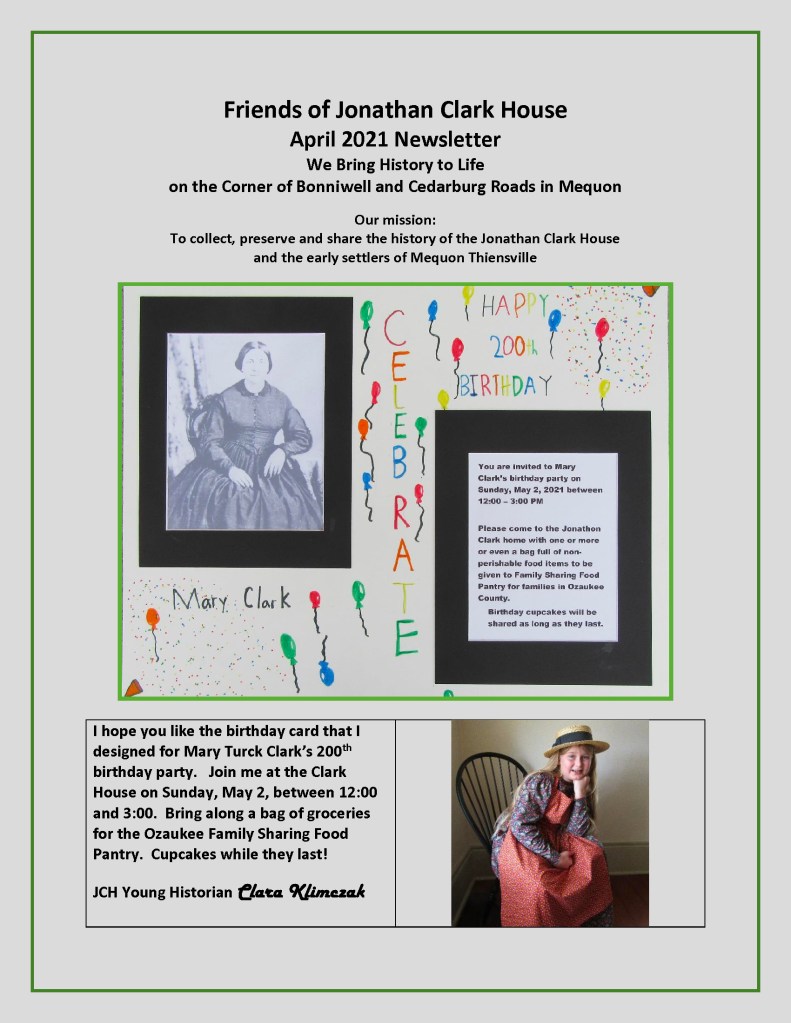
Spring is here and things are happening at the Jonathan Clark House Museum. All the info is in our latest newsletter. Click the image or this link to open (and save) your own copy of the full pdf:
It’s early April, and the growing season is not far off. For a farmer like Jonathan M. Clark, it’s a little early yet for plowing and sowing, but not too early to make plans and sharpen the tools. For a farmer’s wife, like Mary (Turck) Clark, it’s not too soon to think about the farm garden, its crops and layout.
I don’t know if Mary and Jonathan were regular readers of the popular and affordable farmers’ almanacs of their era; I wouldn’t be surprised if they were. There were many to chose from. Perhaps they had a copy of something like:

The Cultivator […], New Series, Vol. VII, Albany, 1850, title page. Click to open larger image in new window.
Continue readingThere were a lot of deadly, infectious diseases in 19th-century North America. When Jonathan M. Clark was young, the causes and cures for most of these illnesses were a mystery. Germ theory was unknown, and for many people hygiene was, at best, a hit-or-miss affair. But even in that era, we can be certain Jonathan M. Clark was inoculated against one of the worst recurring plagues of all time: smallpox.
General Regulations of the U.S. Army, 1821, Art. 73, no. 90
As a new recruit to the U.S. Army, Jonathan M. Clark was subject to the army’s regulations, including article 73, number 90:

Click to open larger image in new window. Original via Internet Archive
Continue readingClark House Historian is 5 years old today!!

Jonathan Clark House, Mequon, Wisconsin, July, 2015. Photograph by Reed Perkins. Click to open larger image in new window.
Our very first post, announcing the new blog, went live on March 29, 2016. The information in that post has now been revised and expanded into the About and Disclaimers sections of the blog.
The first posts with historical content followed in April, 2016. I still link to one of those posts—Where are we?—when I need to explain the evolving place names and political geography of the Mequon area.
Since the first Clark House Historian posts in 2016 we have learned a lot more about the Clark house, its occupants and their families, friends and neighbors. If you’re new to the blog—or the Jonathan M. Clark House—here are some good places to begin reading (and be sure to click the links in each article):
Continue readingThe Jonathan Clark House Museum is searching for a Part-Time Executive Director
The Friends of the Jonathan Clark House are pleased to announce an opening for a (paid!) part-time Executive Director. The Friends, a 501(c)3 non-profit group, were organized in 2012 with a mission “to collect preserve and share the history of the Jonathan Clark House and the early settlers of Mequon-Thiensville.” Now—in addition to our amazing volunteer staff and supporters—we’re adding this part-time executive director position.
Details
Please click here for the handy two-page pdf of the job description and application process, or click on these images for a full-size look at the same info:

Executive Director position description, page 1 of 2. Click to open larger image in new window.
Continue readingI’m still trying to hammer out a few new posts. Nothing’s ready today. Meanwhile…

Portrait of a Blacksmith in His Workshop, ca. 1855. Photograph. https://www.loc.gov/item/2008680496/. Public domain. Click to open larger image in new window.
Another great image from the Daguerreotype collection at the Library of Congress, still in its handsome original case.
Every town in nineteenth-century America would have at least one blacksmith, ready to make or repair pretty much anything made of metal needed for farm, home, or workshop. Most blacksmiths made tools and specialty iron work, some also made wagons and carriages. Other smiths were trained as farriers, specialists the anatomy and health of the lower limbs and hooves of horses, and the making and fitting of horseshoes.
Continue readingIt’s the first day of spring, and the crocus are already blooming in southeastern Wisconsin.
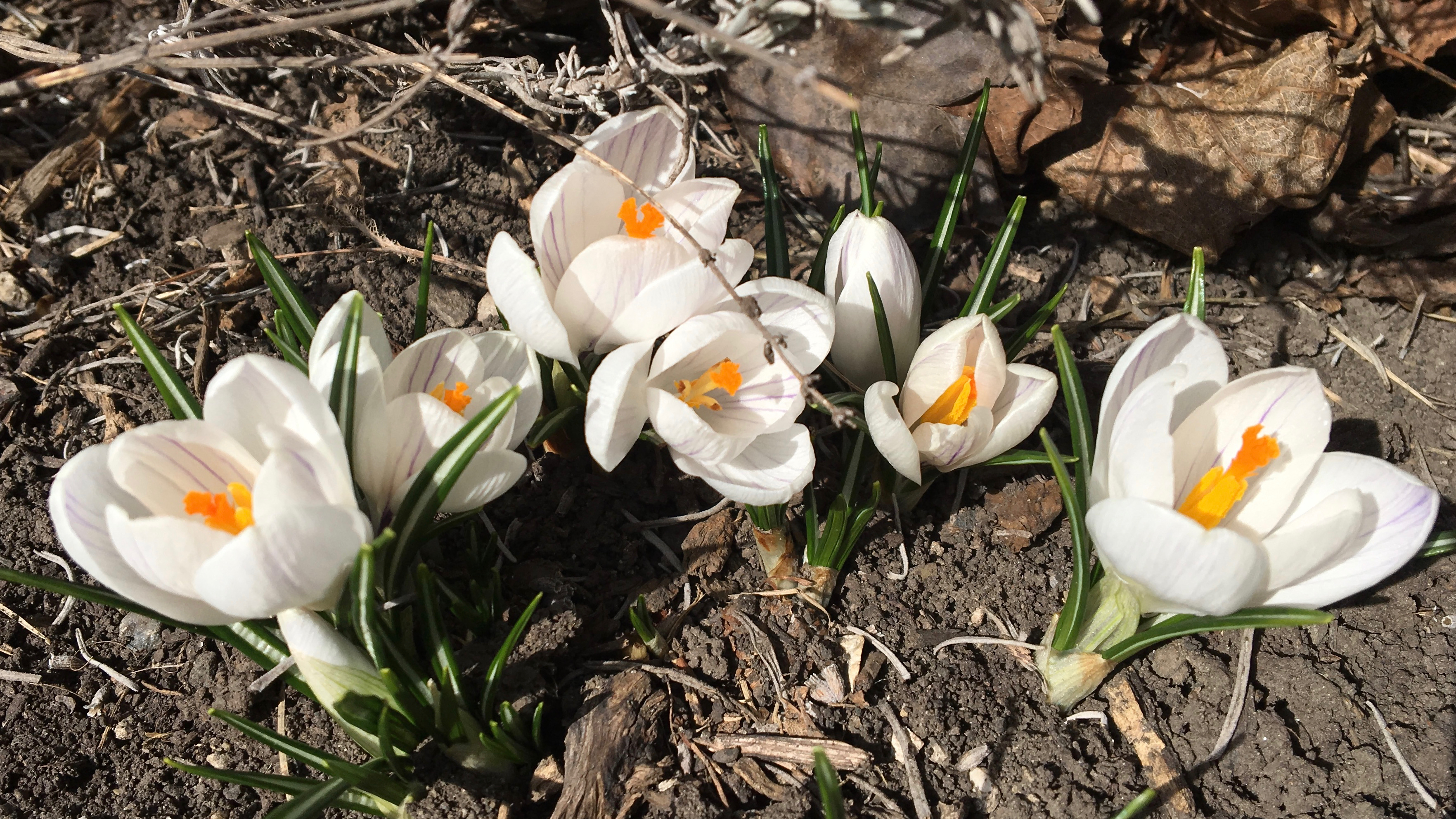
Photo credit: Laura Rexroth. Click to open larger image in new window.
Continue readingAnother in our occasional series of Random Bits of History.
A wonderful new digital archive of early Wisconsin documents
Earlier in 2021, the Wisconsin Historical Society published this intriguing announcement:

From Wisconsin Historical Society Columns newsletter, January-April, 2021. Click to open larger image in new window.
Continue reading
Today is St. Patrick’s Day, originally the religious observance of the feast day of the principal patron saint of Eire.1 In honor of the day, let’s take a look at a few aspects of Irish life in early southeast Wisconsin and the involvement of Mary (Turck) Clark’s father Peter Turck in a civic effort to relieve Irish suffering during the Great Famine.
Irish immigrants in early Wisconsin
The first white visitors to Wisconsin were seventeenth-century French-Canadian explorers, priests and fur trappers, at home along Wisconsin’s lakes and rivers. They were followed by a smattering of British and French settlers in the mid- and later-eighteenth century. Cornish lead miners arrived in the southwest corner of the territory around the turn of the nineteenth-century. And in the mid-1830s, when the federal government officially “opened” the southeast corner of Wisconsin for settlement, there was a large influx of New Englanders and New Yorkers.
There were also a substantial number immigrants from across the sea among the Wisconsin pioneers of the 1830s and ’40s, including settlers from Upper and Lower Canada, Nova Scotia, Great Britain, the Netherlands, the German-speaking lands, and Ireland. By the time of the 1850 federal decennial census, Irish men, women, and children comprised the second-largest group of foreign-born immigrants in the state, surpassed in number only by immigrants from the German-speaking lands.
Continue reading
 Clark House Historian