In our previous post I made use of a paragraph from a recently rediscovered 1891 profile of Jonathan and Mary (Turck) Clark’s eldest child, Caroline M. Clark, later Mrs. C. M. Woodward. Caroline was the most publicly active, visible, and well-documented of all of the Clark siblings, and we have published a number of blog posts on her life and career, including this comprehensive piece: Caroline M. (Clark) Woodward: a closer look at that 1893 biography. I recommend reading that post and clicking all the links; they lead you to other, detailed CHH posts about specific moments and events in Caroline’s life.

Today I’d like to share with you the complete 1891 profile that I quoted in our March 26, 2026, post. It originally appeared as one long column of text on page 1 of the Lincoln, Nebraska, “New Republic” newspaper, on August 20, 1891. Caroline (1840-1924) was fifty years old when this article appeared, and had another thirty years of active work in the temperance and women’s rights fields ahead of her.
Given the amount of accurate detail in the article, I suspect that the information came directly from Caroline herself. In fact, given how well-written and how accurate the whole profile is, I would not be surprised if Caroline wrote most, or all of it herself. For ease of reading, I have divided the article into several sections, created paragraph headers, and added a few notes on some of the facts mentioned in each section.
Mrs. C. M. Woodward
The article opens with a vivid recollection of Caroline’s parents, Jonathan and Mary (Turck) Clark. In its tone and specifics, it foreshadows the 1893 biographical sketch of Caroline that we discussed in October, 2021.
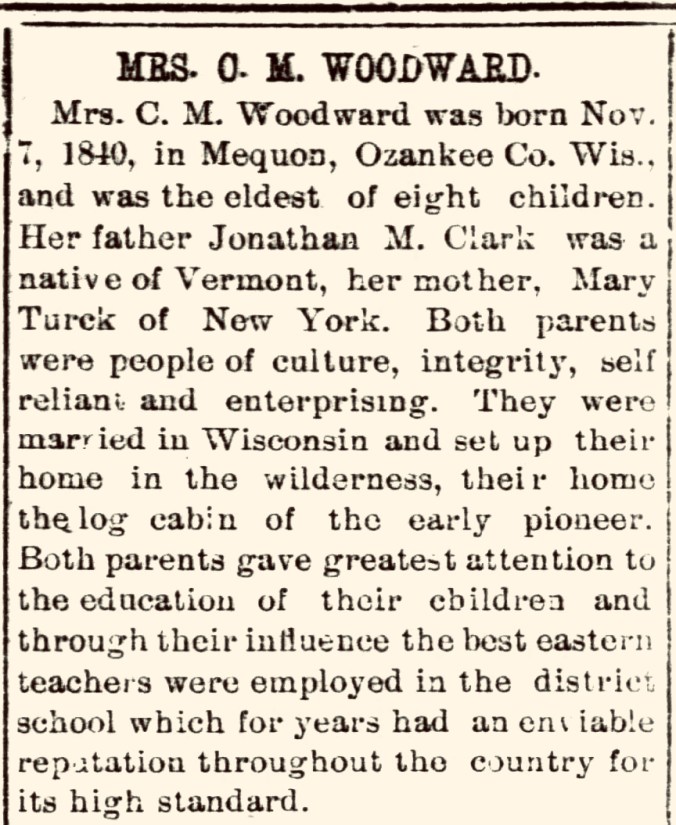
The only touch of hyperbole here might be the bits about “the best eastern teachers” and the “enviable reputation throughout the country.” On the other hand, several of the early teachers at the nearby “Bonniwell” school had been educated abroad, including English immigrant Tamar (Mrs. George) Bonniwell and German pioneer Edward Janssen. And Caroline’s studies at the newly-established Milwaukee high school, led by noted educationist John G. McKindley, were considered advanced for their day.
High school, teaching & marriage
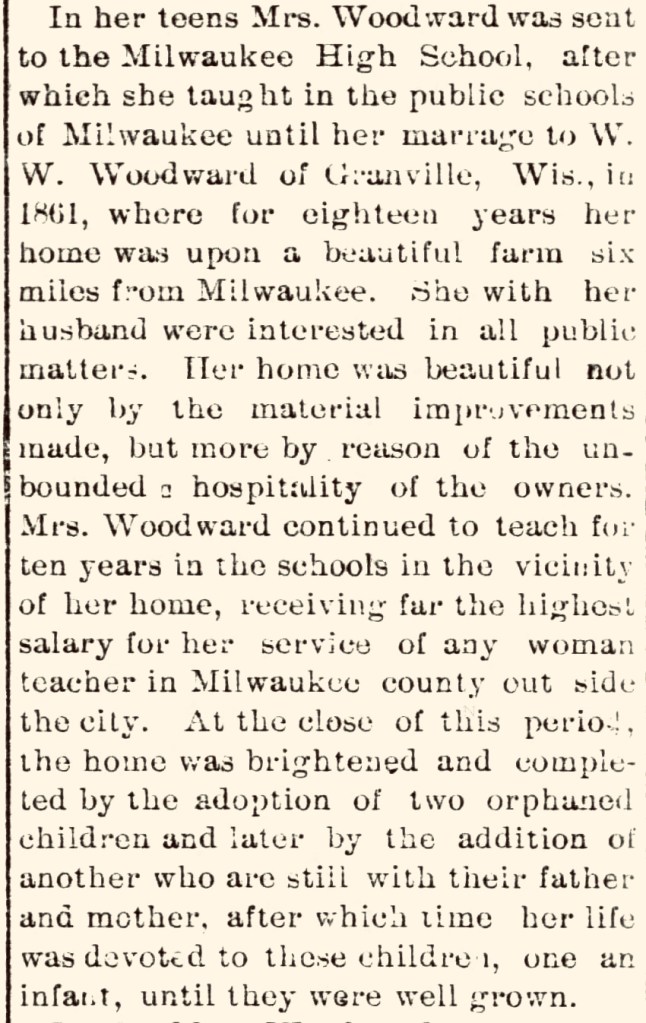
Caroline did teach, for 8 months, in the Milwaukee Public Schools, until her marriage to William W. Woodward in May, 1861. The newlyweds then lived and farmed on the Woodward farm in Granville, Milwaukee county (T8N-R21E, 100 acres in sec. 23, 44 acres in sec. 13), about three and a half miles south of Mequon.
As far as I know, Caroline did not teach in the Milwaukee city schools after May, 1861. But it’s certainly possible that she continued to teach for the next 10 years in the Granville town schools. (This is a new research direction for me and I don’t know whether Granville rural school records still exist for the 1860s and ’70s.)
Caroline and William Woodward’s children
Caroline and William Woodward had no children of their own, but they fostered or adopted at least six. At least three were born in Wisconsin: Philip Ford (1851-1870), Robert H Boylen (1867-1954), Mary A. “Matie” Osgood (1871-1901) and perhaps others, including other members of the Boylen family. After relocating to Nebraska in 1879, Caroline and William adopted or fostered at least three more children: Leonora “Nora” Collamore (1876-1918), Mary A. Adamcek/Adamiek (1899- died sometime after 1924) and an unknown “Little Grandniece.”
From time to time, William W. Woodward was also called upon to serve as temporary legal guardian for various Clark or Turck family members and, on occasion, neighbors. Most notably, in 1874 the neighboring family of William and Isabella Boylen, suffered the loss of mother Isabella, and father William Boylen was not capable (or willing?) to take charge of the family. William Woodward was appointed temporary legal guardian of (all of?) the Boylen children. The youngest Boylen child, Robert, was only 4 years old when his mother died; Caroline and William Woodward adopted him (date not known). Additional details of the Woodward family, including the histories and legal status of the various adopted and fostered children, is complicated and not yet fully understood.
Church work, Nebraska, and more church work
Caroline (Clark) Woodward was a devout and vigorous Christian; as an adult, she was a member of the Methodist Episcopal Church. In 1871, she began to be active in social causes by joining the Women’s foreign Missionary Society of the Methodist Episcopal Church.
In 1879 William Woodward’s health deteriorated, for causes unknown, and the family moved to Nebraska. They lived about 75 miles west of Omaha, initially in Seward county and later in Butler county.
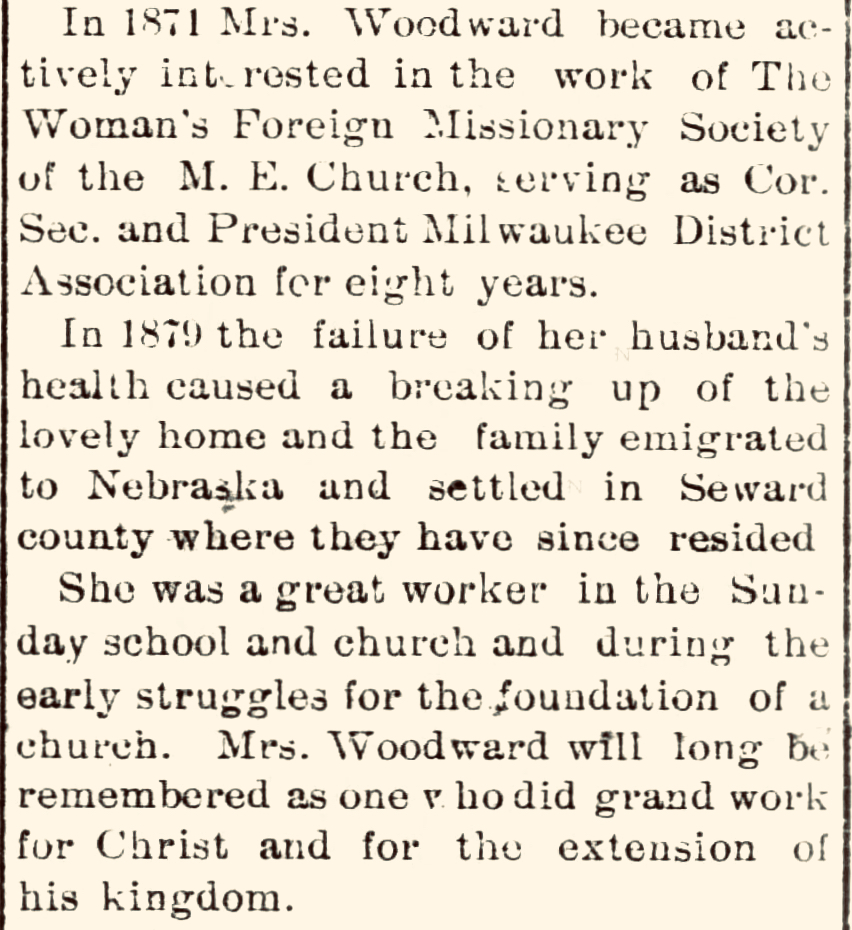
The reference, above, to “early struggles for the foundation of a church” probably refers to efforts to establish a Methodist church in either Utica or Seward, Seward county, or David City, Butler county.
Temperance work
Perhaps the central focus of Caroline (Clark) Woodward’s adult life—after family and religion—was the temperance movement and, in particular, her work with the Women’s Christian Temperance Union (W.C.T.U). The next portion of the 1891 profile records her most significant achievements with the W.C.T.U. up to the date of the article, August 20, 1891:
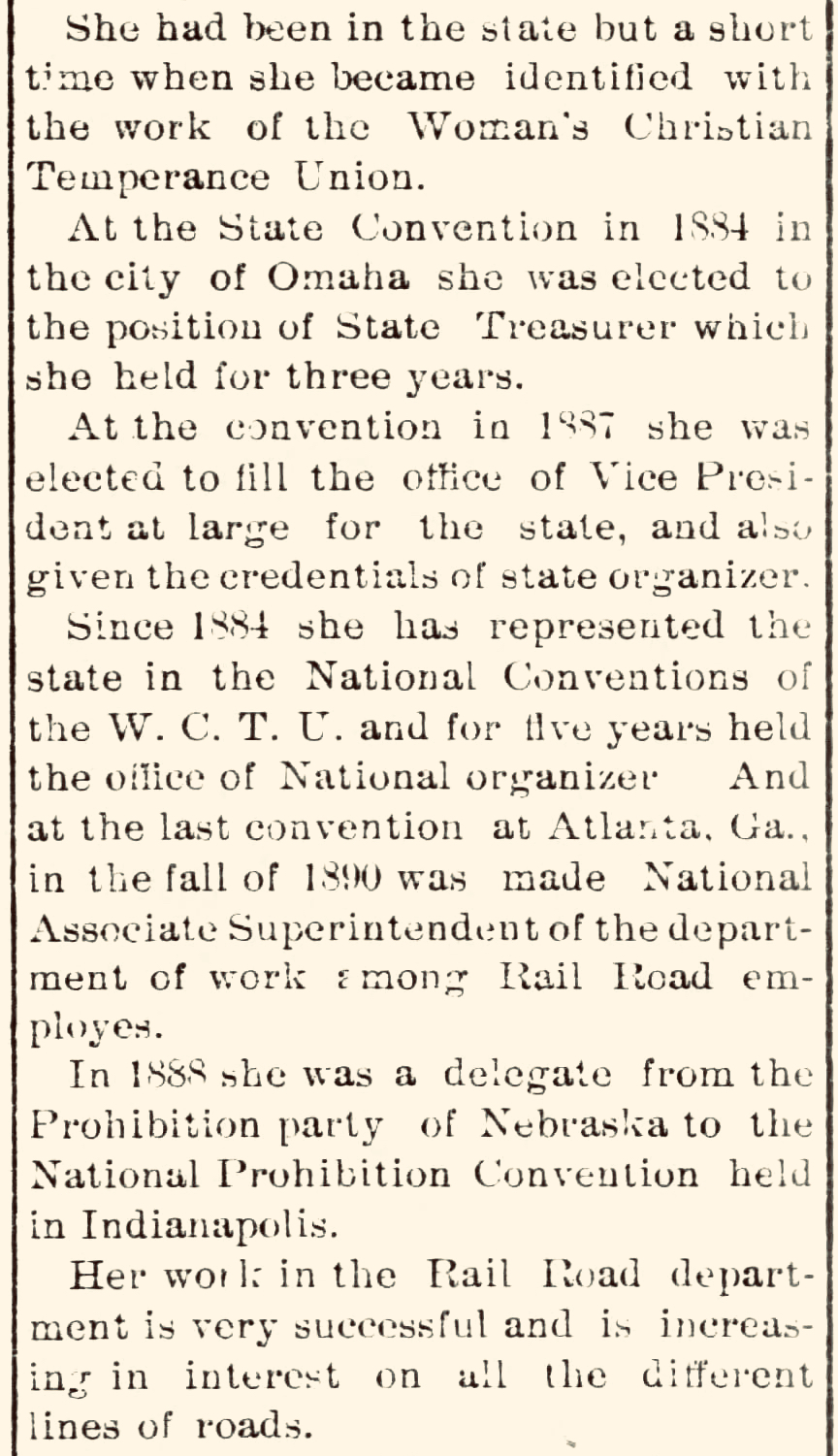
Her work with the Nebraska W.C.T.U. caught the attention of the Union’s leadership, including the W.C.T.U. national president, the remarkable Frances Willard. And Caroline was also active in politics. She was a delegate to the 1888 National Prohibition Convention, and in 1894 she was the (unsuccessful) Nebraska Prohibition Party candidate for Congress, to represent Nebraska’s 4th congressional district.
In closing
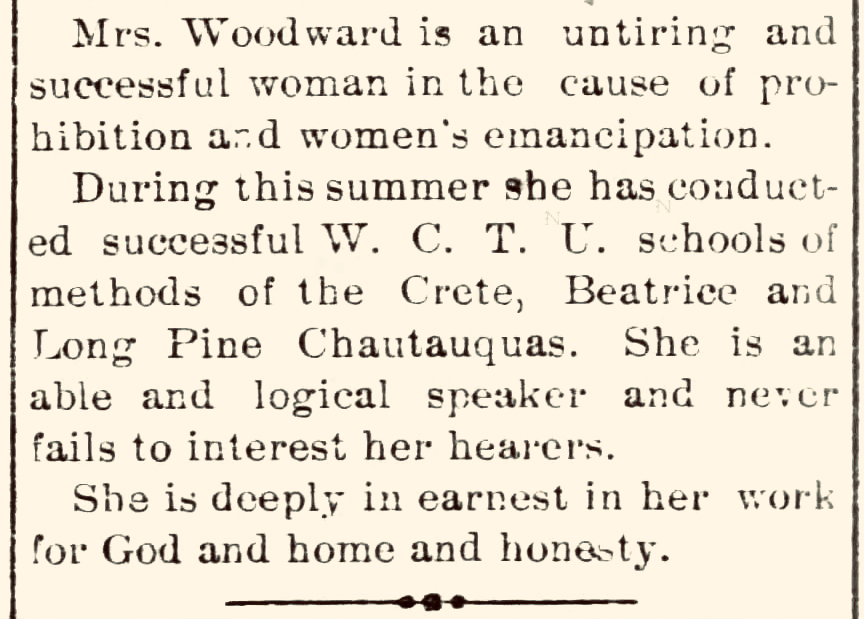
The last paragraphs of this 1891 article have much to say in praise of Caroline (Clark) Woodward’s character and accomplishments, and I believe the praises to be sincere and well-earned. I have read dozens and dozens of other newspaper accounts, both long articles and short news items, reporting on Caroline’s life and activities, and they all agree with the tone and details of this 1891 profile. Even Caroline’s detractors—and she had some, especially among the brewers, distillers, and tavern keepers of the Midwest—had to acknowledge her energy, intellect and honest devotion to her causes.
Caroline’s experience as a teacher must have also been a help in her temperance work, especially as she organized and led the W.C.T.U.’s effective training program, the so-called “schools of methods” at some of Nebraska’s summer Chautauqua gatherings.
Postscript
I”m not a Methodist, or a teetotaler, but I deeply admire Caroline (Clark) Woodward’s devotion to family, education, her God, and her chosen social causes. Like her parents—and many of her siblings—Caroline was not one to sit idly by and let life just happen to her. She had things to do, and she went and did them, and in so doing had a profound effect on many of the thousands of men and women who met her, heard her speak, and were touched by her work.
That’s today’s post. I’ll be back with more Clark House history soon.
In the meanwhile, do you have any comments? any questions? Let me know, I’d love to hear from you. You can comment publicly via the “Leave a comment…” box on this page, or you can send me a private message via the blog’s Contact feature.
 Clark House Historian
Thank you for this post which focuses on such a strong and interesting woman of her time. I hope you will continue to gather information about Carolyn Clark Woodward. Please consider creating a series of features like this on other female movers and shakers that you have encountered in your research.
LikeLike
Thanks! I’m glad you enjoyed the post.
Happily for us all, Clark House history includes the life stories of a number of remarkable women, and I’ll be writing more about them in coming months.
And while waiting for more CHH posts on these women, I recommend using our (improved!) Index and the blog’s Keyword Search feature to locate more stories of our strong pioneer women. In particular, take a look at our many existing posts for Mary (Turck) Clark and her daughters Caroline (Clark) Woodward and Jennie (Clark) Morrison. Daughter Persie (Clark) Gardener led an amazing life, too, as did her sister, Josie. Josie Clark’s life was very brief, yet accomplished all the same. All these women are on my shortlist of “to do” CHH profiles.
Thanks again, and happy reading!
LikeLike