The lives of Mary Clark’s sister Elizabeth (Turck) Maxon, her husband Densmore W. Maxon, and the Maxon children are deeply intertwined with the history of Washington and Ozaukee counties, and with the lives of many of the early settlers, especially the Clark, Turck and Clow families.
From the early 1840s until at least the 1880s, members of the Maxon family—and especially D. W. Maxon— played important, recurring roles in Clark and Turck family affairs. That being the case, I thought we might benefit from a reasonably detailed overview of D. W. Maxon’s life, and I found a good one in A. M. Thomson’s A Political History of Wisconsin, second edition (C. N. Caspar Company, Milwaukee, 1902).
D. W. Maxon
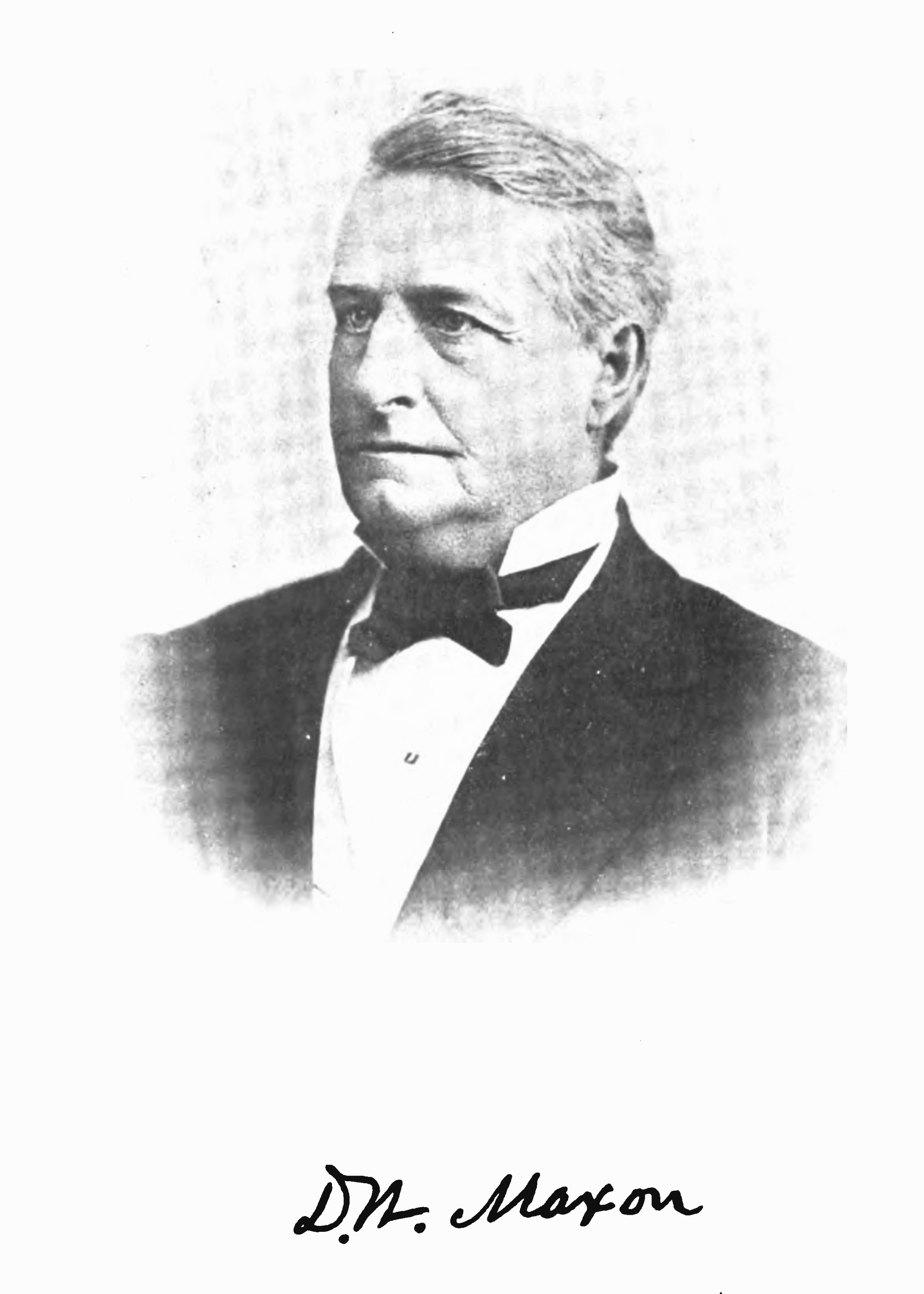
The biography spans pages 431-433. D. W. Maxon’s portrait, with signature (above), is found facing page 236. I have proofread the transcribed text and added some paragraph breaks and headers for ease of reading. Otherwise the text, displayed here in grey-background “quotation” paragraphs, is complete as published in 1902.
Youth and emigration to Wisconsin
[435] Densmore William Maxon was a well known and influential person in the halls of legislation at Madison from the beginning of the period of Statehood until as recent a date as the first administration of Grover Cleveland. He was a native of Vernon, Oneida county, New York. where he was born September 20th, 1830 [sic, 1820]. He was educated at the Oneida Conference Seminary at Cazenovia, N.Y. He studied both law and civil engineering in his younger days, but never practiced the former profession. His intensely active disposition made him indisposed to confine himself to the practice of the law. Coming to Wisconsin in 1843 he first settled in Milwaukee and shortly afterwards in Washington county, where he entered through the United States Government the land upon which afterwards was located the site of the village of Cedar Creek, a portion of which land is still retained in the family as the homestead by unbroken title from the Government.
Surveyor & Politician
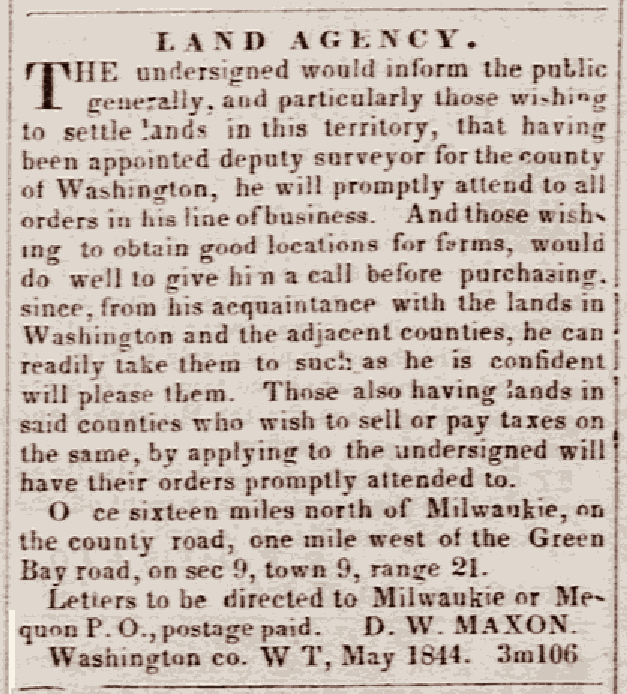
Advertisement, “Land Agency.” D. W. [Densmore William] Maxon, Milwaukee Weekly Sentinel, July 27, 1844. page 2.
Soon after becoming a resident of the Territory of Wisconsin, 1he was appointed Deputy County Surveyor of Washington county, which office he held for a number of years. The Blue Book of Wisconsin registers him nominally as a farmer, but ‘he was in reality a man of public affairs. In 1848 he was elected to the first State Assembly at which the State Constitution went into effect, and he was reëlected [432] a member of the Assembly in 1852, 1867, 1868, 1869, 1870, 1871, 1872 and 1882.
For the four years 1857-1861 he was a member of the State Senate. In 1865 he was the candidate of the Democratic party for Lieutenant-Governor. Among the laws of which Mr. Maxon was the father is that which substituted the County Board of Supervisors for the old County Commissioners, a step recognizing local self-government in county affairs. The bill was known as “A No. 1” and for a number of sessions met defeat, but finally, through perseverance, became the law of the State.
Mental Health Advocate
He was also the father of the bill requiring the State and Federal Constitutions to be taught in public schools, and also the law creating the Northern Hospital for the Insane, and shortly before his death he declared that he wanted no better monument to his memory than this institution. Prior to its construction many insane persons were confined in county jails and in county poor houses. He visited many of these institutions and procured the data upon which he finally succeeded in convincing the Legislature that this unfortunate class were “wards of the State” and ought not to be treated and confined as criminals and paupers. He gave his personal attention to the building of this institution, and was for many years the President of its Managing Board of Trustees.
Public Servant
Mr. Maxon also procured the passage of both State and Federal legislation creating the Wisconsin Railroad Farm Mortgage Land Co. and obtained from the C., M. & St. P. R. R. what was then considered a worthless grant, and prosecuted the claim thus obtained in the Interior Department at Washington and in the courts of the United States, which resulted in the recovery of a quarter of a million dollars for distribution among the farmers who had lost their farms by mortgages given to the old La Crosse and Horicon Railroad. In 1879 Mr. Maxon was placed in charge of the land grant of the Sturgeon Bay and Lake Michigan canal at a time when it was on the verge of bankruptcy. He so pushed the sales and managed its affairs as to save the enterprise from impending failure. The canal was completed in a few years and is now a much used thoroughfare in the navigation of our inland lake.
Family matters

“Maxon Farmhouse, West Bend [sic, Cedar Creek], Washington County, Wisconsin,” (built 1847 or 1850—sources differ—with more recent additions to the rear). Photo from the Historic American Buildings Survey, HABS WI-112, circa 1936. Library of Congress.
He was married to Miss Elizabeth Turck April 6th, 1846, and [435] died March 21st, 1887, at Santa Cruz, California, while on a visit to his aged mother. He is survived by his widow, who resides at the old homestead, and six children–captain M. M. Maxon, who graduated from West Point in 1869 and served on the frontier until 1891, at which time he went upon the retired list on account of disabilities contracted in the service; Glenway Maxon, of Milwaukee, an attorney at law; Dow Maxon, of Cedar Creek, who owns and operates several creameries in Washington county; Mrs. Dr. J. S. Cutler, of Wauwatosa, Wis.; D. W. Maxon, Jr., and Miss Ada Maxon, who reside at Cedar Lake, Washington county, Wis.
Only the beginning…
In his prime, D. W. Maxon was an influential and effective businessman, legislator, and advocate for Wisconsin’s farmers, public works projects, (defrauded) investors, and those needing mental health care. In times of crisis, he was someone to be relied upon, as we noted earlier in our coverage of Henry Clark’s last days.
The career of Elizabeth and D. W. Maxon’s son, Glenway Maxon (1851-1929), followed a similar path. In addition to buying and selling real estate, Glenway Maxon appears to have been a trusted advisor and friend. Much like Clark in-law Philip Moss, Glenway Maxon was sometimes employed by the courts as a probate executor. And like Moss, Maxon sometimes served as a guardian for orphaned children and widows, or for children or adults judged “insane” or otherwise incompetent to manage their own affairs. As we will learn in a future series of CHH posts, Glenway Maxon provided such services for several members of the extended Clark family, over a period of many years.
Glenway Maxon’s younger brother Dow Maxon (c. 1854-1923) also played a role in Turck and Clark family history. In his early adult years he was a Washington county farmer; he later took over the management of the Densmore Maxon Cedar Creek sawmill and creamery.
Operating sawmills was, it seems, a Turck family specialty, too. Mary (Turck) Clark’s father, Peter Turck, became Mequon’s first business man when he opened his sawmill on Pigeon Creek in 1837. And several of Mary’s brothers carried on the sawmill business, including Joseph R. Turck, James Byron Turck and, most notably her youngest brother, Benjamin Turck (1839-1921).
CHH readers and Clark House museum visitors may recall that young Benjamin Turck was enumerated as a member of the Mary Clark household on the 1860 federal population census. We presume he was helping his widowed Aunt Mary with the management of the 160-acre Clark family farm. Later in life, at least for a while, Benjamin Turck was the lessee of the D. W. Maxon sawmill (June 2, 1870 Daily Milwaukee News). Benjamin Turck spent much of his adult life in the West Bend and Cedar Creek area, owning or managing various sawmill and creamery operations.
So many connections…
It’s complicated, isn’t it?
So many threads of overlapping family connections, business relationships, and current affairs tie our early pioneer families together. It takes time just to locate evidence and determine the actual facts of events and relationships. It takes even more time to adequately understand how things are connected, so that one can think and write clearly about them. The many-faceted relationships among our Clark, Turck, Bonniwell and Maxon families are prime examples of this. I hope you’re enjoying the adventure as we go deeper into the genealogical and historical thickets of Clark House history.
Any questions? comments? corrections? suggestions? Please let me know.
More coming soon. See you then!
 Clark House Historian
Pingback: William Opitz – real estate agent (1855) | Clark House Historian