In our previous post, we were introduced to the Desmond family, early Irish immigrants to old Washington/Ozaukee county and neighbors of Jonathan and Mary Clark. To our good fortune, one of the Desmond sons, Humphrey Desmond, wrote a memoir of his father Thomas that includes some unique family genealogy and tales of pioneer days in our area.
If you missed Part 1, I suggest you go ahead and read that post first. Then return here to continue with Part 2 of selections from A Memoir of Thomas Desmond, with a chapter on The Desmond Genealogy, by Humphrey J. Desmond, 77 pages, Milwaukee, 1905. And remember: you can read the complete memoir at this link, which is a part of the admirably organized and comprehensive online genealogy project The Desmond Archives.
Pioneer Days
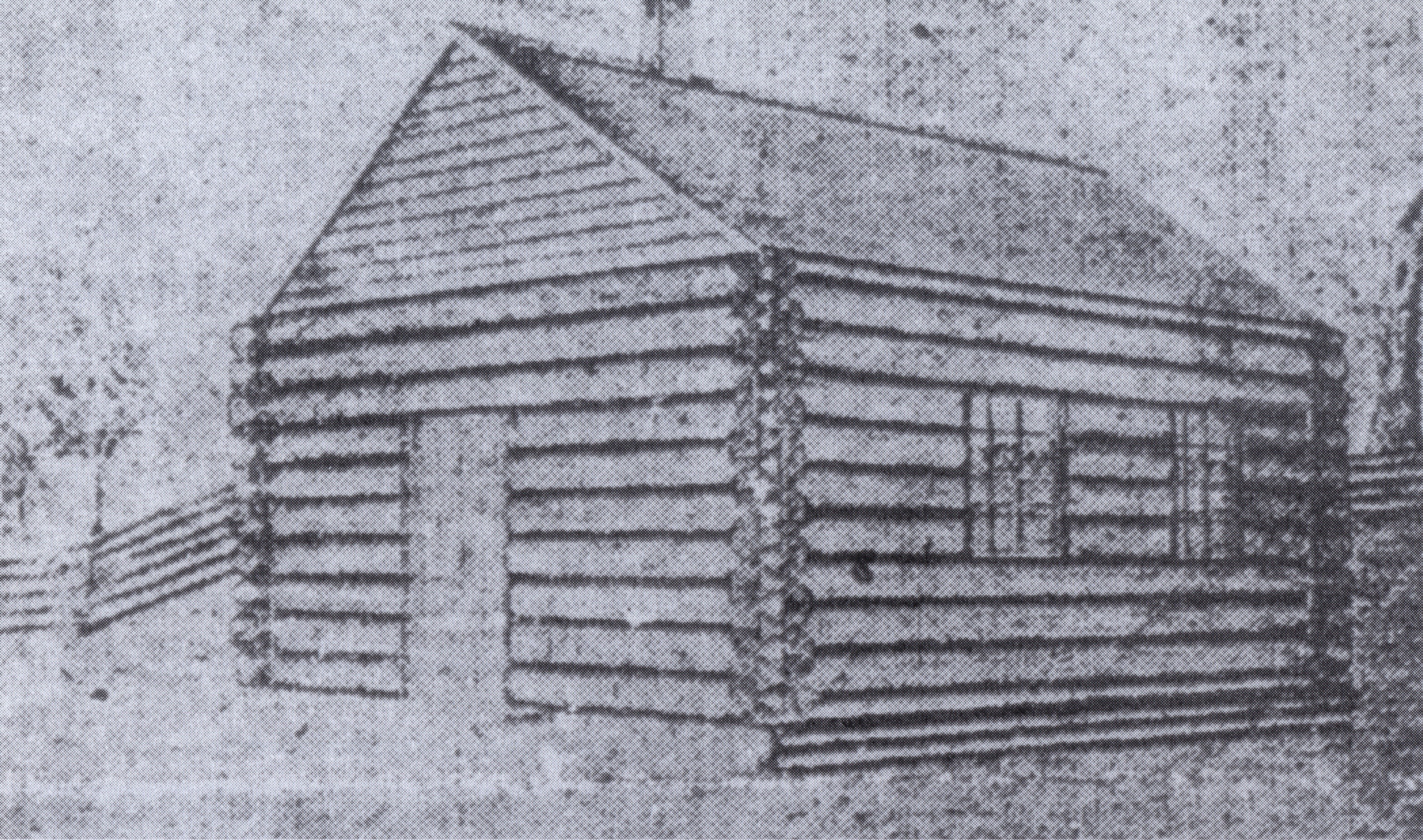
Chapter 3 of Desmond’s memoir will be of particular interest to CHH readers. It relates various early Mequon events, some involving the Desmond family’s Catholic faith, their Bonniwell neighbors, and the local school that the Bonniwells helped build in the early 1840s. That first “Bonniwell School,” located less than a mile west of the Jonathan Clark house on what is now the southeast corner of Bonniwell and Wauwatosa roads in Mequon, was sketched in 1864 by Evander Bonniwell. The sketch (above) is reproduced here from page 71 of George B. Bonniwell’s comprehensive family history, The Bonniwells: 1000 Years. (Used by permission.)
[31]        III.   PIONEER DAYS

THE "hazard of new fortunes" undertaken by the Desmond family involved the clearing away of woods with the ax of the pioneer and the building of a commodious log house.
    The pioneers of this neighborhood were the Bonniwell brothers, who had settled there about 1835 [sic, 1839], and it was known as the Bonniwell settlement.
    Indians still roamed the forests of southeastern Wisconsin in 1843. My [32] father, then ten years old, alone in the house one day, was visited by a brave to whom he gave a large loaf of bread. The Indian loosened his belt as he ate the loaf, and when it was all gone departed peaceably on his journey.
    There was a log school house to which my father went. Books were not plentiful in those days. He studied his spelling lesson during the noon hour from the book of a desk mate. He had to start at the foot of the class, but one day he got to the head and kept his place.
    A new teacher came later to the school who opened the sessions with Bible reading from the King James version. Thomas Desmond made objection and felt obliged to leave [33] the school rather than be forced to conform. For this action, taken upon his own initiative; he was publicly commended by the Catholic priest whose mission it was to visit the Catholic families of that section.
    Mass for the scattered pioneer Catholic families was often said in my grandfather's house, and Bishop Henni (who came to the Milwaukee diocese in 1844) and Father Kundig sojourned there at one time over night.
    My father tells of walking into Milwaukee one day in 1847, to get an altar stone for a missionary priest from Bishop Henni. The bishop tied the altar stone about the boy's shoulders and sent him back on his long journey.
Marriage, politics & Civil War
Hidden within the rush of events in chapter 4 are some interesting details that need further study. The dates of Thomas Desmond’s occupancy of the family farm may help us more accurately date the important Mequon “Shoolmap” of circa 1857-1872. We also learn some interesting facts about the family’s political leanings, and that at least one member of the family fought for the Union in the Civil War.
[36]         IV.    A NEW HOUSEHOLD

ON April 6, 1856, Thomas Desmond and Johanna Bowe were married.
    She was then about twenty-two years of age. She had come from Ireland with her father, a brother and a younger sister in 1847 and after some years in Buffalo, where her father died, she came west to Wisconsin to visit two uncles, John and Jeremiah Bowe, then settled on farms in the vicinity of the Desmonds.
    For ten years (1856-66) my father [37] resided on the farm originally cleared by the family. It was located in the town of Mequon, Ozaukee county, a mile and a half from Cedarburg, then a little village, now a small city reached by the Chicago, Milwaukee & St. Paul railway, about an hour's ride north of Milwaukee.
    The frame house where he lived and a very good barn which he built in 1853 still stand.
    During most of the winters he taught district school. His chief occupation, of course, was that of farming.
    On an adjacent farm lived his brother Dennis, between whom and himself there was always a strong feeling of companionship and mutual confidence. [38] The older brother, John Desmond, had come West after 1852 and gone into the hardware business at Port Washington. Two of my father's sisters, Mrs. Mary McGrath and Mrs. Jeremiah Bowe, were settled on farms four or five miles distant, and a brother, Patrick Desmond also married, had gone to the front in the Army of the Cumberland.
    Ozaukee county was in those days (as it is today) very strongly Democratic. There was opposition to the war. My father and his brother Dennis were "war Democrats," differing from their neighbors herein. The older brother, John Desmond, was a Republican and at one time the nominee of his party in Ozaukee county for State Senator.

[39] [Blank page.] [40] [Portrait of Thomas Desmond omitted]
Leaving Mequon
Chapter 5 details the life of Thomas Desmond and his family after their 1866 move to Milwaukee, including Thomas’s work with the public schools and as an insurance salesman. There is much of interest here, but I have omitted most of the chapter for reasons of space.
[41]        V.    MILWAUKEE

APRIL 16, 1866, my father having rented his farm (a few years later he sold it), moved with his family to Milwaukee. He was then about thirty-two years of age. His family now included three children. Two others had died in infancy.
    My father made this change without any definite plans as to what he would do in Milwaukee. He had tired of the farm and thought a change advisable. [42] In November, 1866, he took a position as clerk of the public school board. Subsequently (1872) he was elected secretary of the school board. He held this position until May, 1880, a period of nearly fourteen years.
    It was work very congenial to his tastes. […]
Characteristics
The longest, and in some ways most interesting chapter in the memoir is the sixth, devoted to Thomas Desmond’s personal characteristics. I have selected a few key portions of this chapter and publish them here. I hope they give the reader a better sense of the man, and also an appreciation for his firm personal and religious convictions, which he upheld in an era of frequent, and sometimes violent, anti-Catholic, anti-Irish, and anti-immigrant rhetoric and actions.
[50]        VI.    CHARACTERISTICS

ASIDE from his business activities he was always interested in church and public affairs. From 1866 to 1875, while the Sunday school of St. John's Cathedral was conducted under lay auspices he participated in that work, and for a time was superintendent and librarian. He had been present at the laying of the corner stone of the Cathedral in 1852 and from 1866 to 1901 was a pewholder, a member of several of the parish societies, and [51] always a contributor to the periodic calls made necessary in  the discharge of the indebtedness of the congregation.
    Religiously, I cannot say that he was emotionally devout. His religion was more on  the intellectual side. but he was a practical Catholic from conviction and thoroughly aware of the grounds of his faith and doctrines of his church.
    In his travels about the state and in his relation with men of all beliefs he liked to discuss in a friendly manner religious matters, but never obtrusively--the occasion usually coming in some remark made in his hearing. His discussions were always amicable and many a non-Catholic thanked him for giving them a clearer [52] idea of the position of the church. It was a matter of principle with him never to allow an erroneous view of the Catholic church to go uncorrected and he always took exception to such expressions as "Romanist" or "Papist." At different times several of his children, at his suggestion stood up in the public school room against historical views prejudicial to the Catholic church and against other practices of a sectarian character.
    His views in this matter are indicated in a letter which he wrote me in 1878:
    "If Catholic students have no respect paid to their religious convictions the sooner it is know [sic] the better. And it is the duty of anyone [53] that knows such to be the case to make it known.
    " * * But do it without passion--do it in respectful, dignified, clear, but forcible language. I would advise you to be every [sic] ready and open to avowing your creed and standing upon the rights of citizenship; to ever resist imposition, come from what quarter it may.
    "Let them see that one can be a Catholic openly, and while manly, and every [sic] ready to defend your rights--yet kind, orderly and respectful to teachers in language, thought and action--but fearless in resisting and denouncing bigotry, falsehood or betrayal of trust."

    [58] […] He was an earnest believer in the duty of Irish-American co-operation in promoting Home rule for Ireland. He served on the committee which organized the first notable contribution to the Parnell movement from Wisconsin and was present at all the principal local meetings in behalf of the Irish cause from 1879 to 1890.

    [63] […] And here I may note the many ways in which he looked after the education of his family in their younger days and advised and counseled with them as to their careers when they entered upon their work in life. [64] He neglected [none] of the ordinary duties of a parent. My brother and myself he instructed at home until we were almost prepared to enter the high school. Either we inherited, or found ourselves compelled by our environment, to a taste for books and reading. […]
There is much more to learn about Thomas Desmond, his habits, character and achievements in this chapter. See the complete memoir for details.
Final years and death
The memoir closes with two final chapters. Chapter 7 is dedicated to Thomas Desmond’s last years and includes some additional genealogical information. Chapter 8, “Death,” records the contents of numerous published death notices, obituaries and a public letter of condolence. The chapter, and the memoir, concludes with a note that, in addition to the included transcribed notices from the various Milwaukee and Wisconsin papers, “The Germania,” “The Columbia, “The Catholic Telegraph” of Cincinnati, the “Irish Standard” of Minneapolis, “The Catholic Tribune” of St. Joseph, “The Catholic Journal” of Memphis, “The Catholic Mirror” of Baltimore, “The Chicago Citizen,” and several other papers also had appropriate notices of the deceased.”
Postscript
I hope you enjoyed these excerpts from the Desmond memoir. Thanks again to Des Desmond for preserving, digitizing and sharing this rare material with us.
I’ve not written much about our Irish immigrant settlers on CHH; their story—so far—has been somewhat tangential to the main lines of my Clark family investigations. But I have found some interesting material related to the early days of the nearby “Irish” settlement of Hamilton (once known, supposedly, as “New Dublin”), and the autobiography of our local itinerant Methodist preacher Rev. James W. Woodworth contains several first-person anecdotes of some occasional (and often baffling and uncomprehending) interactions between Mequon’s “American” and Irish settlers.
Would you like me to write about these topics on a future blog post or two? Let me know via the public Leave a Comment form (below), or send me a private message via the Contact form.
I’ll be back soon, with more Clark House history. See you then.
____________________________
UPDATED January 28, 2026, to add links to our CHH “previous post” and to the Wikipedia article on the Irish agrarian secret society called the “Whiteboys.”
 Clark House Historian
I enjoyed reading about the Desmond Family and would enjoy reading about other JMC neighbors. Also, were there any local newspapers during JMC times that would give insight into how people were living in the Mequon area during JMC times?
LikeLike
Hello Ed!
I’m glad you liked the Desmond family posts. I enjoyed researching and writing them.
I’ll be writing more of these “Meet the Neighbors” posts in the coming months, probably beginning with the Jesse Hubbard family; their land adjoined the west side of the old Jonathan Clark property and I have found quite a bit of info about the Hubbards and their role in early Mequon. Until then, here’s a link to several other previous “Meet the Neighbors” and similar posts. And of course, the blog has lots of info on Mary Clark’s family, the Turcks, and her prolific neighbors (and in-laws), the Bonniwells. Play around with the “Category” selector and/or the blog’s Search function to narrow your search.
The newspaper question is a good one. The first Wisconsin paper, as I recall, was the Green Bay Intelligencer which began (I think) in 1833, the same year JMC began his 3 year military duty at nearby Fort Howard.
Weekly papers began to appear in Milwaukee in the late-1830s and often cover some of the news of what became Ozaukee county, although they usually lack a lot of those little “local flavor” articles which are the kind of social history info that we really want, when we can find it.
There were, in fact several papers that covered old Washington/Ozaukee county from as early as 1847 onwards (with gaps in coverage). Unfortunately, most issues of the earliest papers no longer exist. Some issues did survive, and are microfilmed and available for research via the Wisconsin Historical Society. For details, consult their Guide to Wisconsin Newspapers 2025, available as a free, downloadable pdf at this link. You’ll be looking for the Washington Co. and Ozaukee Co. papers.
So the fragile, ephemeral nature of old newspapers is why I have to lean on the early Milwaukee papers for Washington/Ozaukee news. One day, when I have the time, I’m going to Madison and spend a day scrolling through the extant old Washington/Ozaukee county newspaper microfilms and see what I can find.
—Reed
LikeLike
Thanks for your quick response and additional information.
LikeLike
My pleasure.
LikeLike
Pingback: Celebrating our Irish history | Clark House Historian