We’re having some very cold weather this weekend, not unusual for Wisconsin in mid-winter. But it got me thinking, wondering what sort of winter weather did the Clarks and Turcks and Bonniwells experience, and what effect the did the cold have on their daily lives?
To find out, I started by searching digitized old newspapers, looking for the phrase “below zero,” in Wisconsin, between the years 1833-1899. Oh boy, did I get results! After narrowing my search to more local sources, I found this news item on page 2 of the Wednesday, January 2, 1884 issue of the Cedarburg News:
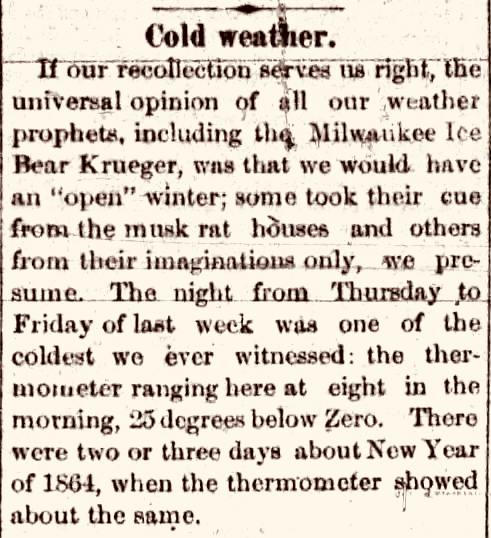
This article suggests that the winter of 1883-1884 was expected to be somewhat mild; an “open” winter was one with little or no snow cover on the ground. All the signs and predictions thought this would be the case. Apparently, the local muskrats had built their houses differently in 1883, as muskrats do when they expect a milder winter. The “universal opinion” of the “local weather prophets”—including Milwaukee’s famed “Ice Bear,” Henry Kroeger—thought so, too. But on the night of December 28-29, 1883, the thermometers in Cedarburg—just a few miles from the old Jonathan Clark farm—dropped to 25 degrees below zero (Farenheit). It was the coldest morning in decades.
But by the 1880s many of the older members of the Clark, Turck, and Bonniwell families had died, and many of the younger generation had left Ozaukee county and relocated to Milwaukee, Chicago, Minnesota, and elsewhere. Some or most of them may have missed this late-1883 cold snap. But this short article also mentions another, similar record cold spell, one that Mary Turck Clark and her children actually lived through, in Milwaukee, around the New Year of 1864.
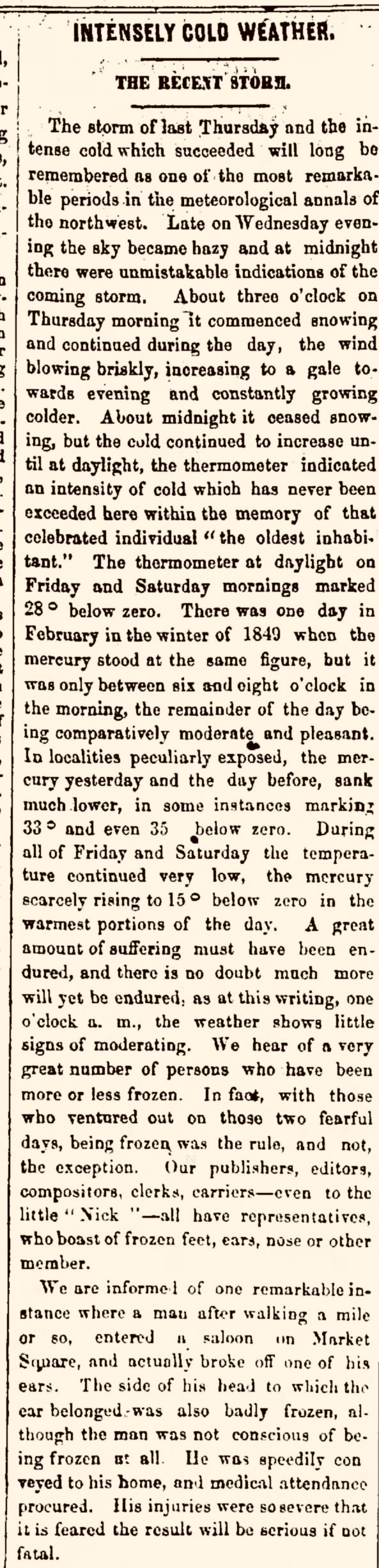
Intensely Cold Weather
This earlier storm, with blowing snow followed by intense cold, hit Milwaukee at about three in the morning on Thursday, December 31, 1863, and lasted for two or three days. The Daily Milwaukee News of Sunday, January 3, 1864 devoted a full column and a half of page 4 to a summary of the blizzard and its bitterly cold aftermath. At daylight on January 1 and 2, 1884, the thermometer showed a local record low temperature of 28° below zero. Some outlying areas recorded temperatures as low as 33° and 35° below. For the first two days of 1884, Milwaukee’s warmest temperatures only reached 15° below zero.
The first part of the article gives details of the storm, the cold, and its harsh effects on local residents:
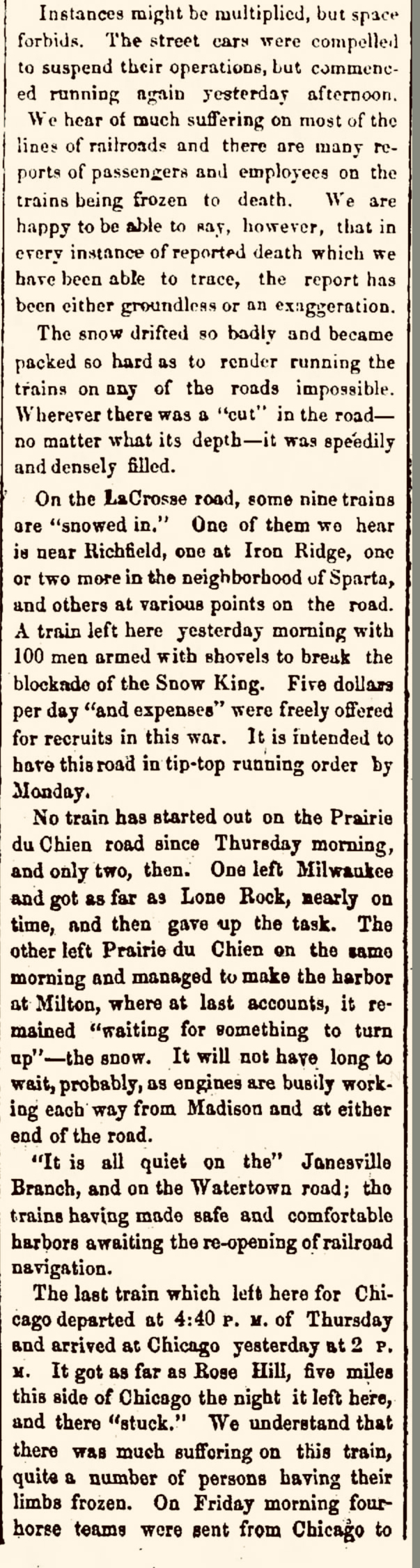
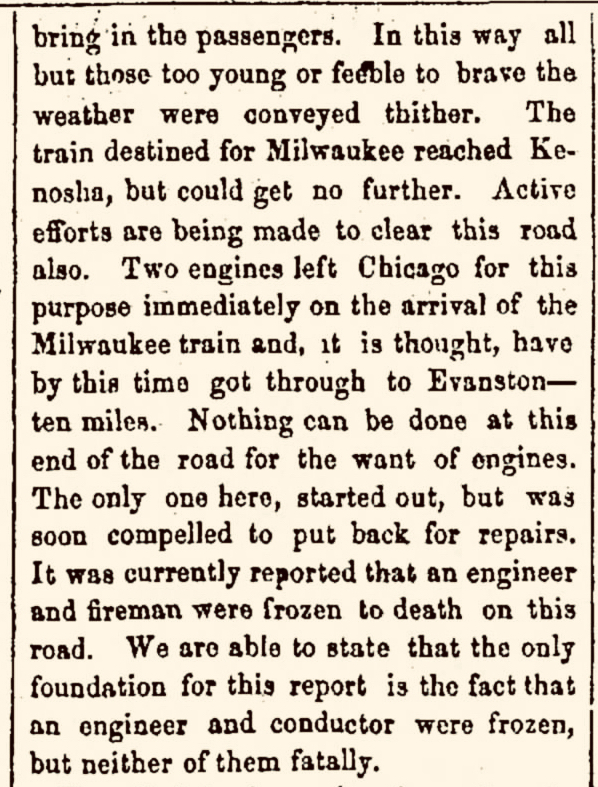
Snow & cold stop the trains
The article continues with details of disruptions to street car operations as well as local and long distance railroad travel:
Closed for business
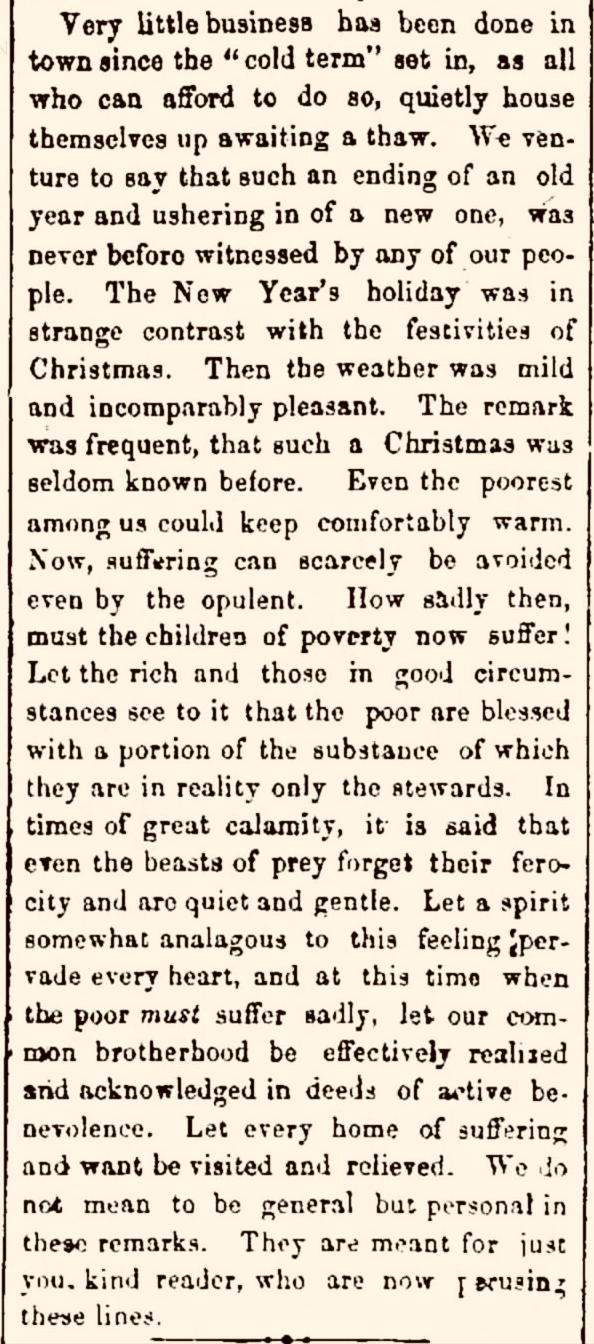
Our 2026 cold spell has prompted the closing of schools and many adults have been told to stay home and work remotely. Our 1864 article details how the unusually mild weather of Christmas, 1863, was followed by the bitter cold of this New Year’s, 1864, storm. Businesses were closed, and “all who can afford to do so” are quietly sheltering at their homes.
The article continues with a passionate plea that the poor and less fortunate should not be abandoned at such a time of “great calamity.”
“Saved from death”
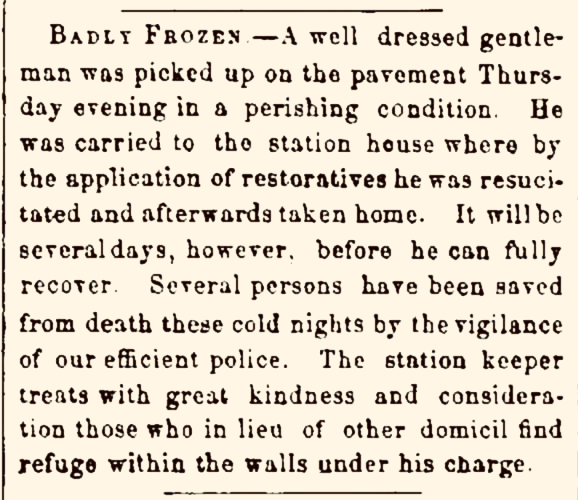
It seems that at least some Milwaukee citizens took these charitable admonitions to heart. In a sort of postscript to the Daily Milwaukee News’ main coverage on page 4, the next page of the Sunday, January 3, 1864, issue contained this short news item that detailed how Milwaukee’s “efficient police” had saved more than one individual, including at least one “well dressed gentleman,” from death by exposure.
Hard frosts
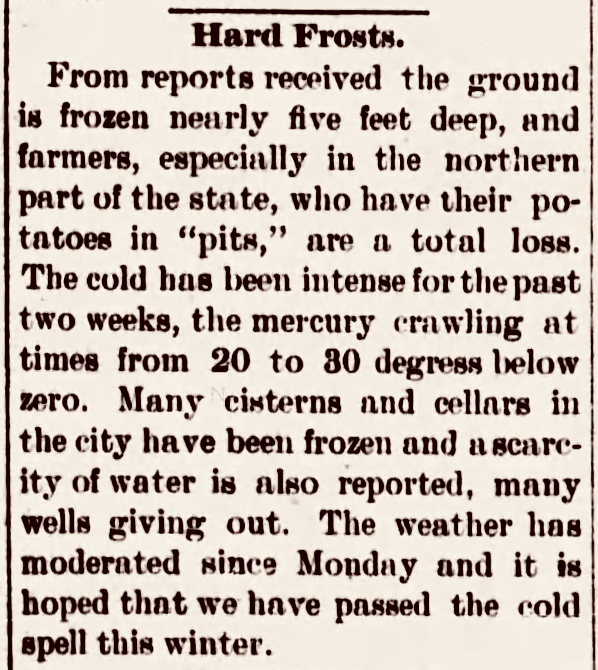
Intense cold was not just a city problem. It affected persons of all sorts, living in cities, towns and on farms. This short article from page three of the Cedarburg News of February 15, 1899, reports that the preceding two weeks of early 1899 have been intensely cold, with “the mercury crawling at times from 20 to 30 degrees below zero.”
In fact, it was so cold, for so long, that the soil was frozen to a depth of almost five feet. Potatoes buried for winter storage were ruined, and many of Cedarburg’s cisterns, cellars, and wells froze, leading to water shortages.
No doubt about it, the Jonathan Clark family and their neighbors lived through some tough winters. In reading these old clippings, I am reminded of how grateful I am to have central heating and the other “modern conveniences.” I also find it encouraging that even in the deepest snows and bitterest cold, many of the Clark family’s fellow citizens, including the press and police, urged—and demonstrated—simple human decency, compassion, and care for those in need.
I hope you are well and staying warm. I’ll be back with more Clark House history in just a bit.
 Clark House Historian
Yikes! Ears snapped off, freezing in a stuck train, five feet of frozen soil- these things remind us of how good we have it now!
LikeLike
Indeed!
LikeLike
Pingback: Bitter cold? Sounds like fun! | Clark House Historian
Pingback: Indexing. Again! | Clark House Historian