Guess what I’ve been doing?
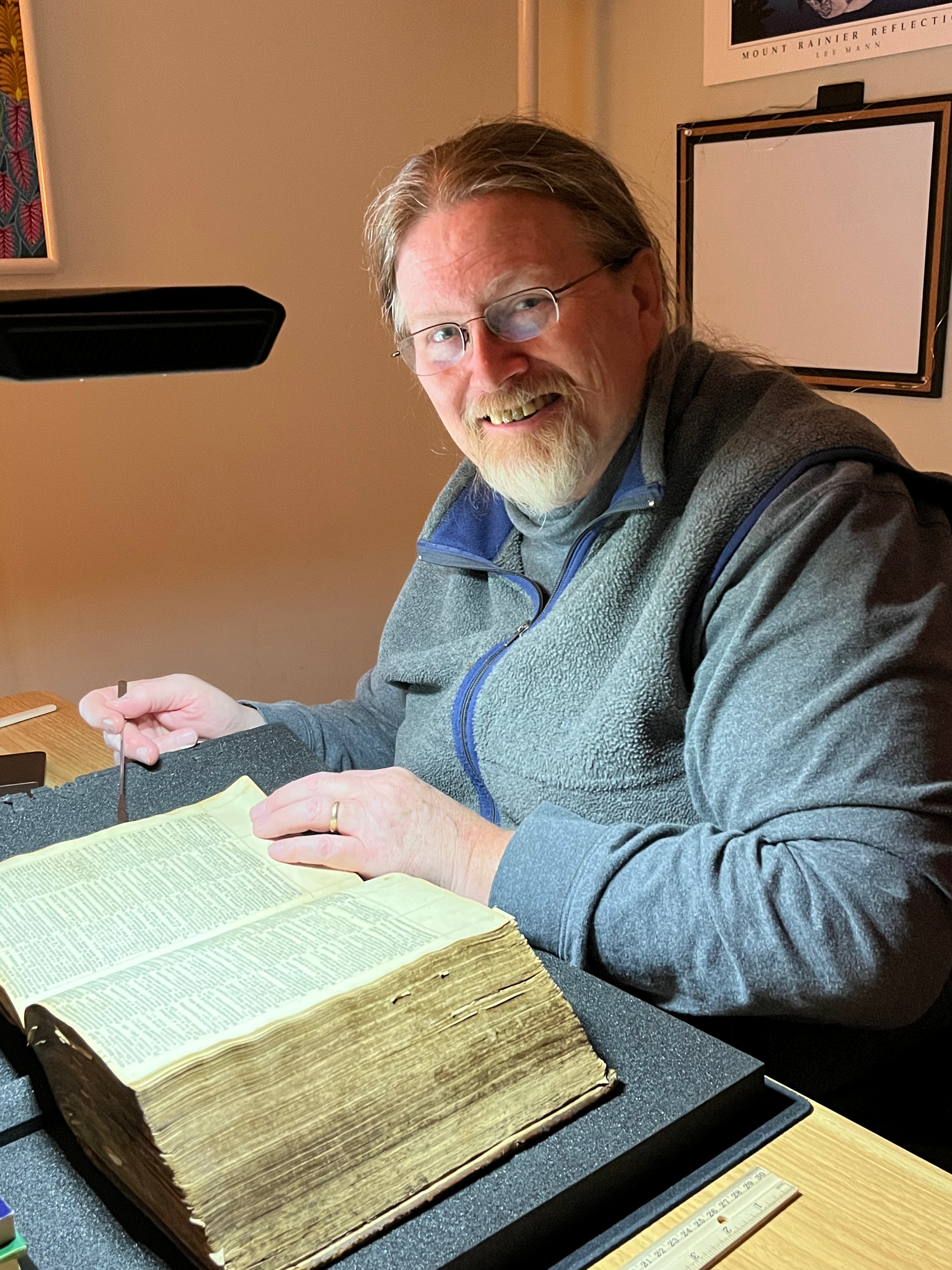
The author, studying and scanning the JCH Bonnniwell family Bible, October, 2025. Photo credit: Laura Rexroth, 2025.
Yes, I’ve been immersed in Bible study, but with an emphasis on the bibliographical and historical—rather than theological—aspects of that many-layered subject.
As I mentioned earlier this year, it’s been my privilege to borrow the Jonathan Clark House Museum’s great treasure, the Bonniwell family Bible, for detailed study, photographing and cataloging. It’s been fascinating and challenging, and I am deeply thankful for the opportunity to work with this unique and irreplaceable source of bibliographic and Bonniwell family history.
Lots of questions…and some preliminary answers
In previous posts, I noted that there was a lot we didn’t know about our historic Bible. It has had a long, hard, life and lacks all of its original front matter, including the dated title page. And there are other missing pages, the details of which would have been very helpful in trying to understand the origins and complete contents of our JCH Bible.
For documentation and preservation purposes, it is also important that we photograph the entire volume and make note of any missing or damaged pages and other condition issues. Ultimately, I plan to put together a comprehensive report on the Bonniwell Bible, including a full bibliographic description of our Bible and its contents.
Tools of the trade
As you can see (below), my work tools include a CZUR ET24 Pro overhead book scanner, a Mac Pro laptop with all the necessary scanning & editing apps and file storage space, plus a larger second monitor to display detailed images while scanning, and a set of museum-quality adjustable book supports to cradle the book during scanning and study. So far, I’ve taken over 800 archival photographs of the Bible and its text, manuscript inscriptions, binding, watermarks, and more.
In front of the laptop keyboard are two important hand tools. The long, narrow, stainless steel tool is a microspatula. Its thin, but not sharp, edges are very helpful in turning fragile pages, unfolding ancient dog-eared page corners, and holding pages in place while scanning. The broader, white tool next to the laptop is a bone folder. It is made of polished bone and designed for smoothing wrinkles and unwanted creases, among other archival paper handling tasks. (The bone folder makes a handy, lightweight, paper hold-down, too.)

The author’s scanning setup. The Bible is open to the end of the New Testament (verso) and the title page of the Two Right Profitable […] Concordances […] or Tables Alphabeticall (recto). Photo credit: Reed Perkins, 2025.
That looks like a big book.
Yes, it is a very big book. In fact, the Bonniwell Bible consists of five sections in quarto (4º) format. The Scriptures—Old Testament, Apocrypha, and New Testament—are published in three consecutively numbered sections. These are followed by the separately-numbered Two Right Profitable […] Concordances […] or Tables Alphabeticall, an early and very extensive set of “helps” or indexes to the many Biblical proper and place names, subjects, and other unusual words found in this Bible. The exact number of pages that should be in our Bible, versus the number of pages that actually are present is still to be determined, but it should be something like 600 leaves, or 1,200 pages.
The texts of the New and Old Testaments and the Apocrypha—along with the copious marginal notes that accompany them— are the “Geneva version,” the English translation completed and first published in full in 1560 in Geneva, Switzerland. (And yes, this is a “Breeches Bible,” although that particular chapter of Genesis is, sadly, missing from our copy.) In any case, all of our Bonniwell Bible was published in London in 1581; all but the Metrical Psalms were printed by Christopher Barker.
As was typical of many of Barker’s 1580s quarto Bibles, the Scriptures and Two…Tables Alphabeticall were sold and bound together with a copy of Sternhold & Hopkins’s Metrical Psalms, published by Barker’s rival, the eminent English printer John Daye. Our copy of the Metrical Psalms is in very rough shape and lacks many pages, but still holds a great deal of interest. We will have more to say about John Daye’s Metrical Psalms in future posts.
Details matter, too
Our Bible has had a long and difficult life and now lacks many of the pages that could help us understand the contents of our Bible, its date of issue, and provide answers to many other related questions. Fortunately, the history and bibliography of the English Bible has been a source of serious study for centuries, and it’s possible to look to the details of our book—including the style and size of the type, the details of the binding, and direction of the chain lines and size and presence of any watermarks in the paper—for clues to the history of our Bible.

Photo credit: Reed Perkins, 2025
Some useful tools in the search for details include (from top): microspatula, bone folder, calipers, sliding pocket rule, wooden rule. All rules have metric and imperial scales. Metric measurements feature in most English Bible bibliographic and historical reference sources, so I recorded almost all my JCH Bible measurements in centimeters and millimeters.
Next steps
Did I mention I’ve already taken about 800 photographs of the JCH Bible? I have, and now I am reviewing those photos to make sure that I have good images for every page of the book. If there is a gap in the photo record, I need to make sure that I know whether a leaf is missing, or just didn’t get photographed, and then make the necessary corrections to the record.
In any event, I’m due to complete the photography of the JCH Bonniwell family Bible and return it to its new JCH Museum display case shortly. And then? Then I’ve got some real work to do, labeling, organizing, and interpreting all that I’ve found in our big, old, Bonniwell family Bible, including all those old family inscriptions.
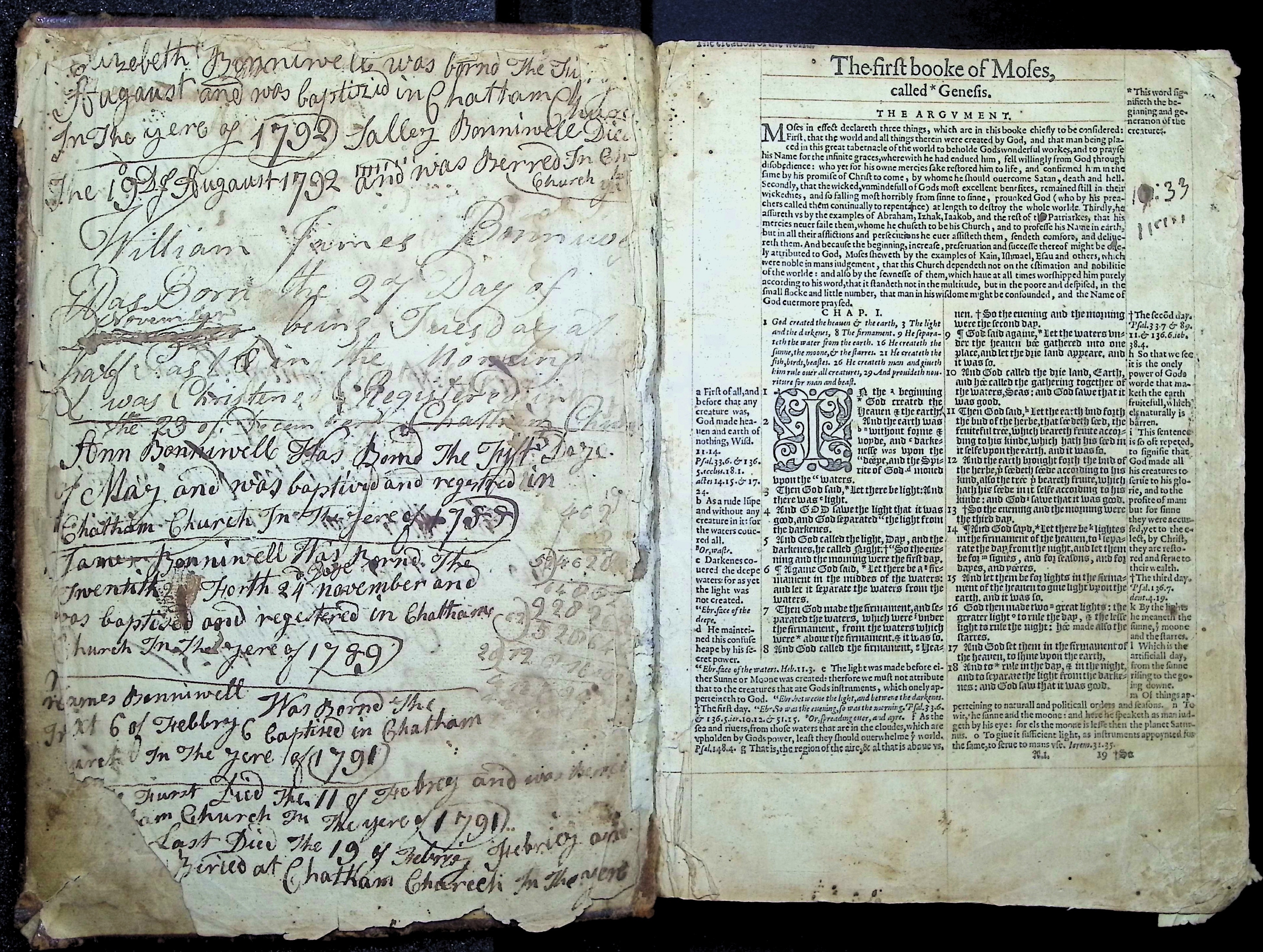
[The Bible], C. Barker, London, 1581. Upper free endpaper, verso, with Bonniwell family inscriptions; Old Testament, Genesis, leaf A1a, f. 1. Photo credit: Reed Perkins, 2025.
More history coming soon. Cheers.
_______________________________
UPDATED, 3 Nov. 2025, to add a few additional, clarifying, words to the description of the book’s contents.
 Clark House Historian
Reed *- What an intriguing adventure. Thank you! Nina *Board members and staff – FYI
LikeLike
You’re welcome! And thanks again to you and all the JCH staff and Board members for allowing me to spend these months in up-close study of this unique and fascinating family Bible.
LikeLike
Pingback: Finding what you want: a few tips for readers | Clark House Historian